The Battle of Orchomenus, fought in 86 BC in Boeotia, was one of the most decisive Roman victories of the late Republic. Coming only months after the bloody struggle at Chaeronea, it confirmed Lucius Cornelius Sulla as the dominant Roman commander in Greece and shattered the hopes of King Mithridates VI of Pontus of holding the region.
Orchomenus has often lived in the shadow of Chaeronea. Ancient writers certainly preferred the drama of the earlier battle, with its echoes of Philip II and Alexander. Yet Orchomenus may have been the more remarkable achievement. Sulla faced a larger army, difficult terrain, and an enemy that still believed sheer numbers could sweep the Romans away. Instead, he turned the marshes of Boeotia into a trap and delivered a lesson in discipline that Roman historians never tired of repeating.
There is also something wonderfully Roman about the whole affair. The Pontic army arrived with glittering cavalry, scythed chariots, exotic contingents from across Asia Minor, and enough confidence to stock a small empire. Sulla turned up with exhausted veterans, a shovel, and a talent for making men dig ditches at sword-point.
Background
The battle formed part of the First Mithridatic War. In 88 BC, Mithridates VI of Pontus had swept through Asia Minor and into Greece, presenting himself as a liberator from Roman rule. His armies occupied much of mainland Greece, while many Greek cities, not for the first time in their history, convinced themselves that Rome might be finished.
Rome was hardly in a stable condition. Civil conflict between the supporters of Sulla and Gaius Marius had already begun. Sulla had marched on Rome itself before leaving for Greece, which is not usually a sign of a healthy republic.
By 86 BC, however, Sulla had already retaken Athens and defeated the Pontic general Archelaus at Chaeronea. Archelaus withdrew north and rebuilt his army with reinforcements sent by Mithridates. Ancient sources claim this new force was enormous, perhaps over 100,000 men. Such numbers are almost certainly exaggerated, as ancient historians tended to become rather carried away whenever an eastern army appeared. Even so, Archelaus almost certainly outnumbered Sulla by a considerable margin.
The Pontic army established itself near Orchomenus in western Boeotia. The location appeared favourable. Broad plains suited cavalry, and nearby marshland limited Roman manoeuvre. Sulla recognised that if he fought in open country, he risked being overwhelmed.
So he did what he often did best. He changed the battlefield.
Foces
| Side | Estimated Strength | Commander | Notes |
|---|---|---|---|
| Roman Republic | 30,000 to 40,000 | Lucius Cornelius Sulla | Experienced veterans from Greece and Italy |
| Pontic Kingdom | 60,000 to 90,000 | Archelaus | Large cavalry force and numerous allied contingents |
Roman Army
- Around five Roman legions, though exact numbers remain uncertain
- Veteran infantry hardened by the siege of Athens and the Battle of Chaeronea
- Small but effective cavalry contingent
- Allied Greek troops and light infantry
- Engineers and camp followers used to constructing fortifications rapidly
Pontic Army
- Pontic infantry drawn from Asia Minor
- Greek mercenaries and hoplites
- Large numbers of cavalry, perhaps 10,000 or more
- Scythed chariots intended to disrupt Roman formations
- Allied troops from Thrace, Cappadocia and elsewhere
Ancient writers repeatedly stress the sheer scale of Archelaus’ cavalry. The plains around Orchomenus gave him room to deploy it properly, which made Sulla’s decision to fortify the field all the more sensible.
Leaders
| Commander | Side | Role at Orchomenus |
| Lucius Cornelius Sulla | Rome | Overall commander, directed fortifications and counterattack |
| Archelaus | Pontic Kingdom | Commanded Mithridates’ field army in Greece |
| Lucius Licinius Murena | Rome | Senior subordinate, commanded part of the Roman line |
| Galba | Rome | Assisted in holding Roman positions during the battle |
Lucius Cornelius Sulla
Sulla was not an easy man to admire, which perhaps makes him interesting. He was brilliant, ruthless, vain, and quite capable of regarding most human beings as inconvenient obstacles. At Orchomenus he displayed the qualities that made him one of Rome’s finest battlefield commanders.
He understood that his army could not survive a straightforward contest on open ground. Rather than accept the terrain, he ordered trenches and embankments to be dug in order to pin the Pontic army against the marshes.
When his own soldiers hesitated under enemy attack, Sulla reportedly seized a standard, ran towards the front, and shouted that if anyone asked where their general died, they could say, ‘At Orchomenus.’ Ancient commanders had a taste for dramatic speeches. Most of them probably improved in the retelling, but in this case one suspects Sulla truly would have said it.
Archelaus
Archelaus was one of Mithridates’ best generals and had already shown considerable ability. After surviving defeat at Chaeronea, he rebuilt his army and attempted to exploit the flat terrain near Orchomenus.
His plan was sound enough. Use cavalry superiority, trap the Romans in the open, and crush them before they could entrench themselves. The difficulty was that Sulla proved faster and more stubborn than expected.
Arms and Armour
Roman Equipment
| Item | Description |
| Helmet | Montefortino and Coolus bronze helmets, with some iron examples |
| Body Armour | Mail shirts, scale armour and some older bronze cuirasses |
| Shield | Large oval scutum |
| Spear | Pilum, thrown before close combat |
| Sword | Gladius Hispaniensis, the standard Roman short sword |
The Roman infantry at Orchomenus would have fought in dense formations, hurling pila before closing with the gladius. By this period, the Gladius Hispaniensis remained the principal Roman sword. Designed for stabbing at close range, it was brutally effective once Roman discipline held the line.
Roman officers may also have carried longer blades or decorated versions of the gladius, though function mattered far more than appearance. Sulla was not especially sentimental about military fashion.
Pontic Equipment
| Item | Description |
| Helmet | Mixed Greek, Thracian and eastern styles |
| Body Armour | Linen cuirasses, scale armour and mail |
| Shield | Round hoplite shields and lighter eastern shields |
| Spear | Long spears and pikes used by infantry and cavalry |
| Sword | Kopis, xiphos and akinakes depending on troop origin |
Specific sword types in the Pontic army included:
- Kopis: A curved chopping sword favoured by many cavalrymen and Greek troops.
- Xiphos: A straight, double-edged Greek sword used by hoplite-style infantry.
- Akinakes: A short eastern sword or dagger common among Persian and Anatolian contingents.
The Pontic cavalry were particularly formidable. Heavily armed horsemen, supported by lighter riders and scythed chariots, could devastate troops caught in open terrain. Sulla’s trenches and earthworks neutralised much of this advantage.
The Battle
Sulla began by ordering his men to dig long trenches across the plain. Their purpose was to cut off the Pontic army from the marshes and restrict the movement of cavalry.
Archelaus recognised the danger and launched repeated attacks while the Romans worked. Pontic cavalry and infantry surged forward, hoping to overwhelm the Roman line before the fortifications were complete.
At one stage the Roman troops on the left faltered badly. Sulla rode to the threatened area, rallied the men, and personally led the counterattack. According to Plutarch, his presence restored the line immediately.
Once the trenches were completed, the Pontic army found itself compressed between the Roman earthworks and the marshy ground behind. The cavalry could no longer manoeuvre freely.
The Romans then advanced.
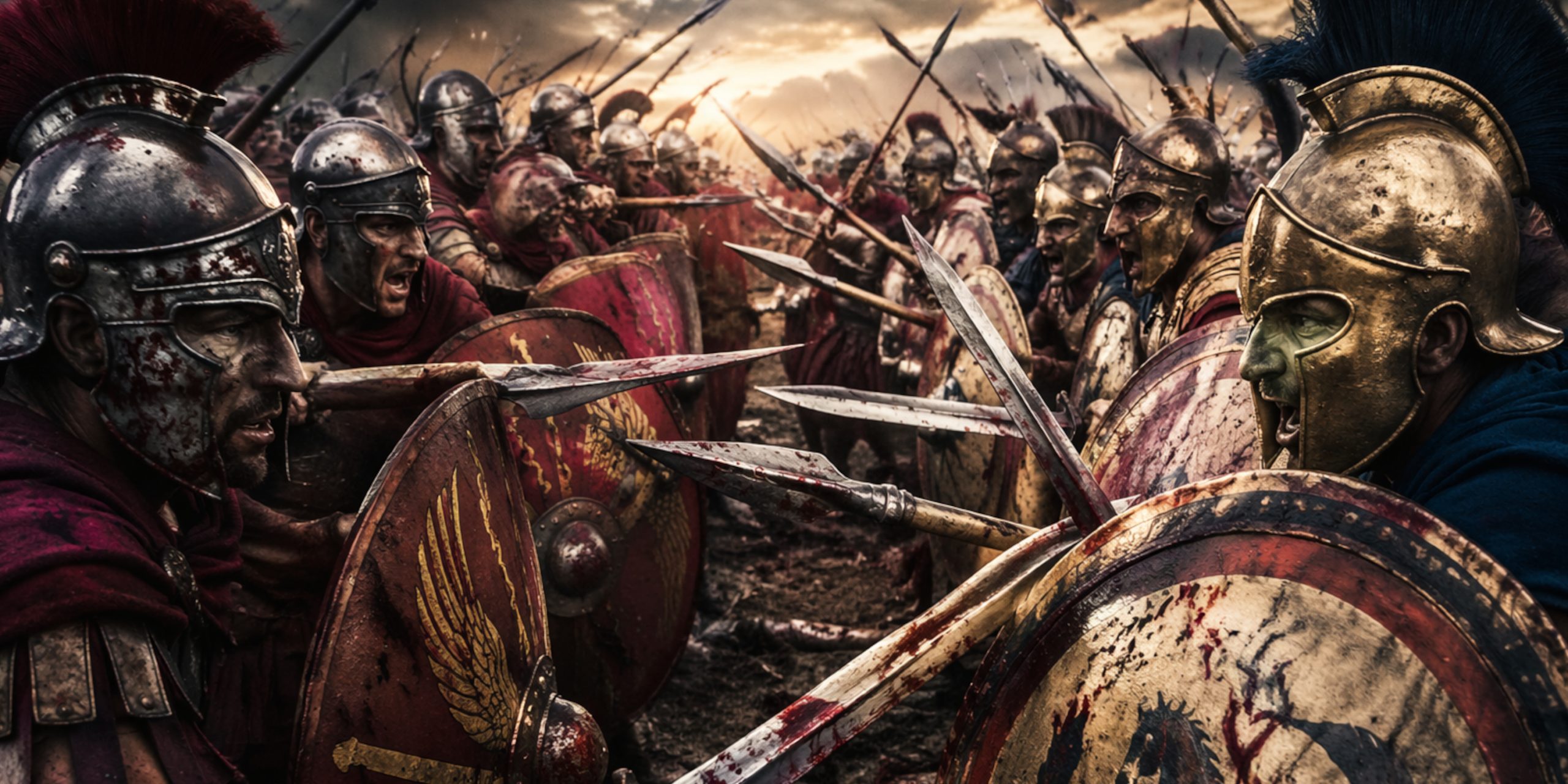
The fighting became chaotic and brutal. Pontic troops were crowded together and unable to deploy properly. Roman legionaries pushed forward in disciplined formation, stabbing with the gladius and driving the enemy back into the marshes.
Many of Archelaus’ soldiers were killed while attempting to flee. Ancient sources describe huge numbers drowning in the marshes or being cut down against the Roman defences. The casualty figures are certainly exaggerated, but the defeat was clearly catastrophic.
Archelaus escaped with a small portion of his army. The rest ceased to be an effective fighting force.
Battle Timeline
| Time | Event |
| Early 86 BC | Archelaus rebuilds his army after Chaeronea |
| Summer 86 BC | Pontic and Roman forces converge near Orchomenus |
| Morning | Sulla orders trenches and earthworks constructed |
| Midday | Archelaus launches attacks to disrupt Roman works |
| Afternoon | Roman left nearly collapses before Sulla rallies it |
| Late Afternoon | Roman trenches completed, Pontic cavalry restricted |
| Evening | Roman counterattack drives Pontic army into marshes |
| Aftermath | Archelaus retreats, Mithridates loses control of Greece |
Contemporary Quotes
Plutarch, writing in his Life of Sulla, records Sulla’s words during the crisis:
“When you are asked where you abandoned your general, say, at Orchomenus.”
Plutarch also described the destruction of the Pontic army:
“The barbarians were hemmed in by the marshes and slaughtered in great numbers.”
Appian, another ancient historian, wrote:
“Sulla enclosed them with trenches and slew them without difficulty.”
Ancient historians admired Sulla’s determination, though one suspects they were also slightly alarmed by how much he seemed to enjoy this sort of thing.
Archaeology
The battlefield has never been excavated on the scale one might hope for, which is frustrating but not unusual. Ancient battlefields often disappear beneath fields, roads and villages, leaving historians to quarrel over topography for generations.
The likely site lies near the drained remains of Lake Copais and the marshy land around Orchomenus. Changes in the landscape have made precise reconstruction difficult. The ancient marshes that played such a central role in the battle were largely drained in the nineteenth century.
Archaeological work in the wider region has uncovered:
- Hellenistic and Roman military remains from Boeotia
- Sections of ancient roads and field boundaries that may relate to troop movements
- Coins and weapons dating to the late second and early first centuries BC
- Evidence for the former extent of the marshland that constrained the Pontic army
Modern studies of the terrain support the ancient accounts. The ground near Orchomenus narrows between higher land and wetlands, creating precisely the sort of bottleneck Sulla exploited.
There is a curious irony here. Sulla won because he trapped the Pontic army against a marsh, yet the marsh itself has mostly vanished. History has a habit of tidying away the evidence just when we would like to inspect it more closely.
Why Orchomenus Mattered
The Battle of Orchomenus ended Mithridates’ hopes of dominating Greece. After losing both Chaeronea and Orchomenus, Mithridates could no longer maintain a serious field army in mainland Greece.
The victory also strengthened Sulla politically. He returned to Italy with the prestige of a conquering general and soon used that prestige to seize power during Rome’s civil wars.
In military terms, Orchomenus demonstrated several important lessons:
- Roman discipline could defeat much larger armies
- Engineering and field fortifications could decide a battle before the fighting began
- Cavalry superiority meant little if terrain removed space to manoeuvre
- Sulla belonged among the finest Roman commanders of the late Republic
Without Orchomenus, Mithridates might have prolonged the war in Greece for years. Without Sulla’s victory, Roman politics might have followed a very different path. Julius Caesar and Augustus inherited a republic already transformed by Sulla’s example, for better or, more often, for worse.
Legacy
Orchomenus became one of the great examples of Roman tactical flexibility. Later commanders studied Sulla’s use of trenches and terrain. Roman historians admired the battle because it fitted their favourite narrative: disciplined Romans defeating a larger and more flamboyant eastern army.
That narrative can be rather smug, and sometimes unfair to the skill of commanders like Archelaus. Even so, Orchomenus was undeniably a masterclass in battlefield control.
Sulla did not simply win because he had better soldiers. He won because he shaped the battlefield, anticipated his enemy, and refused to panic when the situation briefly turned against him.
For all his many faults, and there were enough to fill a senate chamber, Sulla at Orchomenus was a commander operating at the height of his powers.