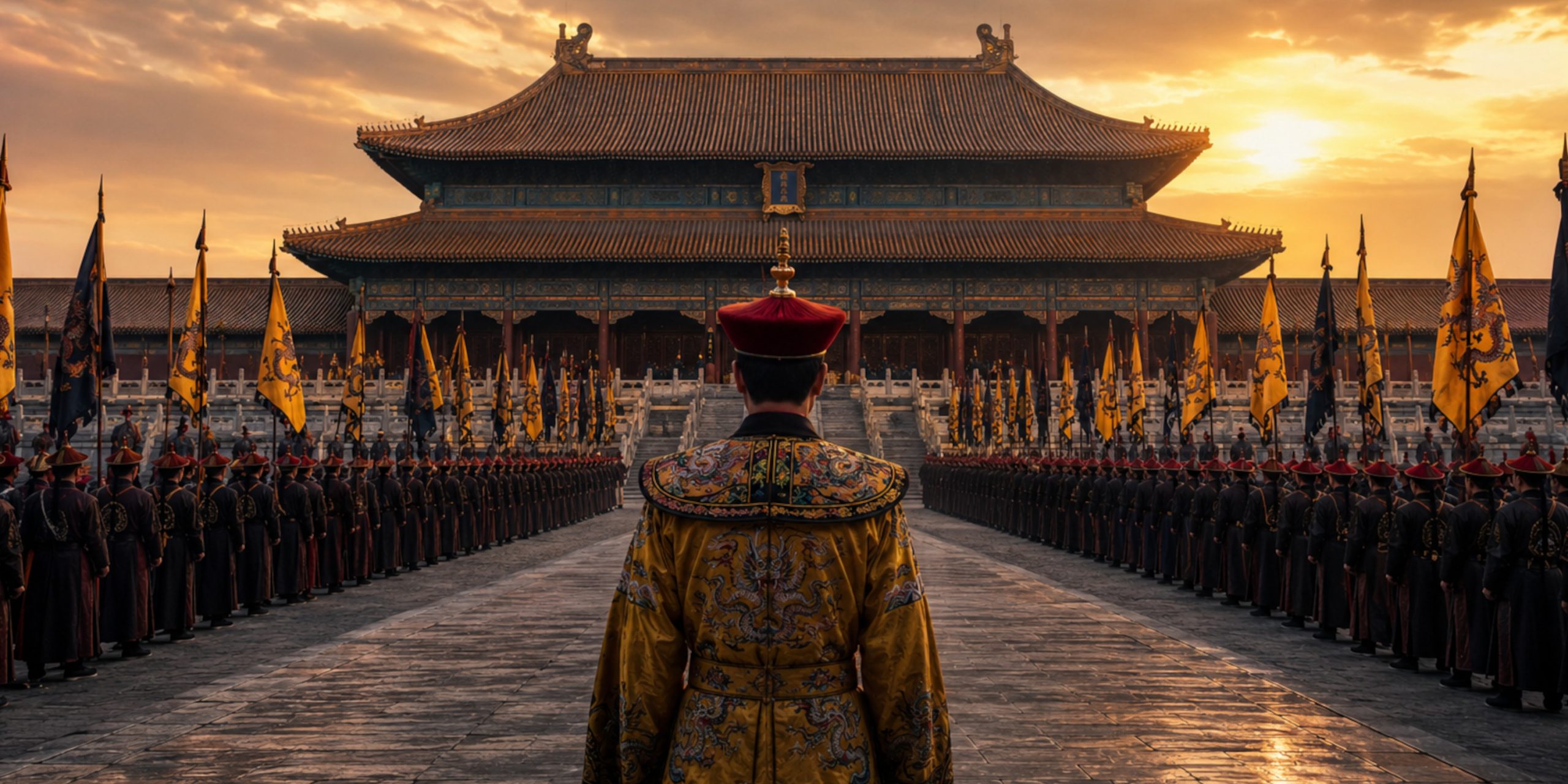
The Empire That Bridged Ancient and Modern China
The Qing Dynasty was the final chapter of imperial China, ruling from 1644 until the fall of the monarchy in 1912. Founded by the Manchu people from northeast Asia, it transformed from a conquering foreign dynasty into one of the largest and most powerful states of the early modern world.
At its height, Qing China controlled a vast territory stretching from Manchuria and Mongolia to Tibet, Xinjiang and Taiwan. Its population exploded, its economy became one of the largest on earth, and its emperors presented themselves as guardians of a civilisation thousands of years old.
Yet the Qing story is also one of pressure, hesitation and painful adaptation. It was a dynasty that mastered the old imperial world but struggled when confronted by industrialised empires, modern warfare and revolutionary politics.
As a historian, I find the Qing fascinating because it refuses to fit into a simple rise and fall narrative. It was not merely an old empire collapsing under its own weight. For much of its existence, it was remarkably successful. The tragedy was that the world changed faster than the imperial system could adjust. History has a habit of moving the furniture around when nobody is ready.
Origins of the Qing Dynasty
The Qing began with the rise of the Jurchen peoples of Manchuria, later reorganised under the identity of the Manchu.
The key architect was Nurhaci (1559 to 1626), a skilled military and political leader who united Manchu tribes and created the famous Eight Banner system. This organisation combined military, social and administrative functions, giving the Manchus a disciplined foundation for conquest.
His son Hong Taiji strengthened the state further and renamed the dynasty Qing in 1636.
The opportunity to conquer China came during the collapse of the Ming Dynasty.
In 1644:
- Rebel leader Li Zicheng captured Beijing
- The last Ming emperor, Chongzhen, committed suicide
- Ming general Wu Sangui opened the Great Wall passes to Manchu forces
- Qing armies entered Beijing and claimed the Mandate of Heaven
A dynasty born beyond the Great Wall now ruled the civilisation that had spent centuries building walls against northern powers. History does enjoy a little irony.
The Manchu Identity and Rule Over China
The Qing rulers faced an enormous challenge. A relatively small Manchu elite had to govern a massive Han Chinese population.
Their solution was a careful balance of integration and separation.
They adopted:
- Confucian government traditions
- Chinese bureaucracy
- Imperial examination systems
- Traditional court rituals
However, they preserved Manchu identity through:
- The Eight Banner military structure
- Manchu language at court
- Restrictions on intermarriage during parts of the dynasty
- Separate Manchu cultural traditions
One of the most visible symbols of Qing authority was the queue hairstyle, where Han Chinese men were required to shave the front of the head and wear a long braid.
The order was deeply controversial because hair held cultural significance in Confucian society. For many, it was not just a haircut. It was a political statement enforced with imperial authority.
The Great Qing Emperors
The strongest period of Qing rule came under three major emperors.
Kangxi Emperor (Reigned 1661 to 1722)
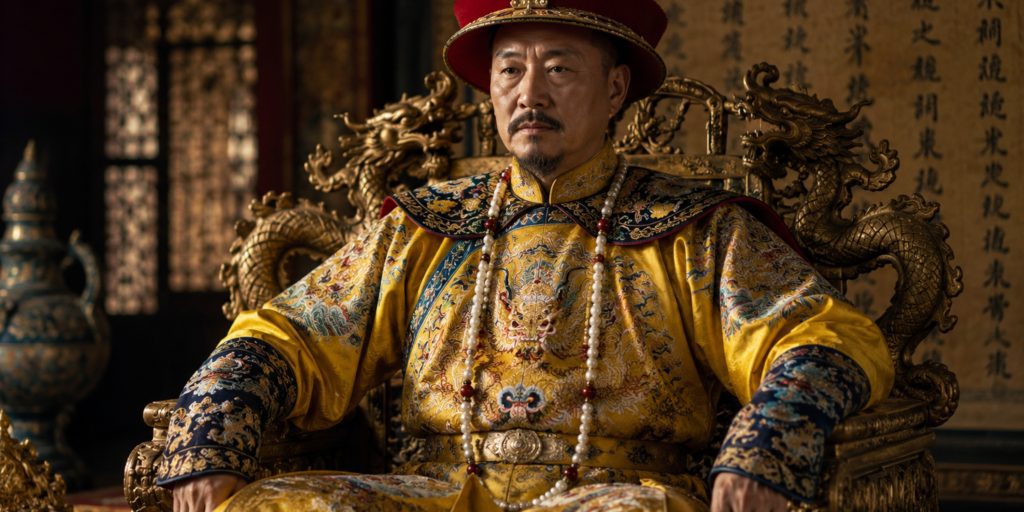
The Kangxi Emperor was one of China’s longest ruling and most successful monarchs.
His achievements included:
- Suppressing the Revolt of the Three Feudatories
- Defeating rival powers in Mongolia
- Strengthening imperial administration
- Encouraging scholarship and cultural projects
- Expanding Qing influence into Inner Asia
He combined military ability with intellectual curiosity, studying subjects from Confucian classics to European science.
Yongzheng Emperor (Reigned 1722 to 1735)
Yongzheng ruled for a shorter period but was one of the dynasty’s most effective administrators.
His reforms included:
- Fighting corruption
- Improving tax collection
- Strengthening central authority
- Making government more efficient
He lacked the glamour of great conquerors, but every empire needs someone willing to fix paperwork. Sadly, history books rarely make tax reform sound exciting, even when it keeps millions of people fed.
Qianlong Emperor (Reigned 1735 to 1796)
The Qianlong Emperor presided over the Qing at its greatest territorial extent.
Under his rule:
- Xinjiang was incorporated into the empire
- Military campaigns expanded Qing power
- Art and literature flourished
- Imperial collections grew enormously
However, the later years of his reign also revealed problems:
- Court corruption increased
- Military effectiveness declined
- Government struggled with population growth
The famous official Heshen became a symbol of late Qing corruption, accumulating extraordinary wealth through his position.
Qing Military Power
Early Qing success came from a powerful combination of steppe warfare traditions and Chinese resources.
The Qing military included:
Eight Banner Forces
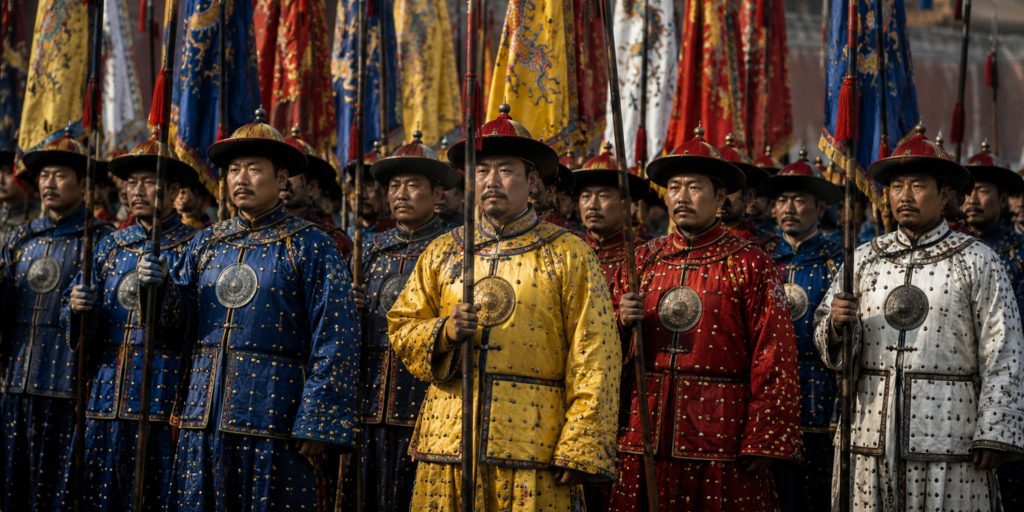
Originally the elite Manchu military system.
Strengths:
- Skilled cavalry traditions
- Strong organisation
- Personal loyalty to the emperor
- Multi-ethnic structure including Manchu, Mongol and Han banners
Weapons included:
- Composite bows
- Sabres
- Spears
- Matchlock firearms
- Later muskets and artillery
Green Standard Army
Mostly composed of Han Chinese soldiers.
Used for:
- Internal security
- Policing
- Regional defence
- Suppressing rebellions
Qing Arms and Armour
Qing warfare mixed traditional Asian military equipment with increasing use of firearms.
Common weapons:
Dao Sabres
The dao became one of the most important Qing military swords.
Types included:
- Liuyedao (Willow Leaf Sabre): Curved military sword used by cavalry and infantry
- Yanmaodao (Goose Quill Sabre): Slightly straighter blade allowing better thrusting
- Niuweidao (Ox-Tail Sabre): Popular in later Qing civilian martial traditions
Jian
The straight double-edged jian remained prestigious, often associated with officers, scholars and martial tradition rather than ordinary battlefield troops.
Firearms
The Qing used:
- Matchlock muskets
- Cannon
- Imported European-style artillery
- Later rifles
One of the great Qing weaknesses was not a refusal to use firearms, which is a common misconception. The problem was that industrialisation elsewhere accelerated dramatically.
Expansion of the Qing Empire
The Qing created one of the largest empires in Chinese history.
Major expansions included:
| Region | Qing Development |
|---|---|
| Taiwan | Conquered from the Zheng family in 1683 |
| Mongolia | Integrated through military campaigns and alliances |
| Tibet | Qing influence established through imperial representatives |
| Xinjiang | Conquered after campaigns against the Dzungar Khanate |
| Manchuria | Maintained as ancestral homeland |
The Qing empire was not simply China expanding outward. It was a multi-ethnic empire ruled by Manchu emperors who governed different peoples through different systems.
Economy and Daily Life
For much of the Qing period, China remained an economic giant.
Key developments:
- Massive agricultural growth
- Introduction of New World crops such as maize and sweet potatoes
- Expanding internal trade
- Growth of cities
- Increased literacy
The population grew from roughly 150 million people in the early Qing period to over 400 million by the nineteenth century.
That success created its own problems. More people meant more pressure on farmland, jobs and government resources. A booming population sounds wonderful until everyone needs dinner.
Culture, Art and Science
The Qing period produced extraordinary cultural achievements.
Important developments included:
- Porcelain production
- Landscape painting
- Literature
- Historical collections
- Imperial architecture
The massive Complete Library of the Four Treasuries project under Qianlong attempted to collect and preserve Chinese knowledge.
Qing art blended:
- Chinese traditions
- Manchu influences
- Tibetan Buddhist imagery
- European artistic techniques introduced by Jesuit missionaries
Contact With Europe and the Opium Wars
By the nineteenth century, Qing China faced increasing pressure from European powers.
The British demand for trade access and the illegal opium trade created a major crisis.
The First Opium War (1839 to 1842) ended with Qing defeat.
Consequences included:
- Treaty of Nanjing
- Opening of treaty ports
- British acquisition of Hong Kong
- Growth of foreign influence
The Second Opium War (1856 to 1860) further weakened Qing authority.
These conflicts exposed the growing technological and organisational gap between Qing forces and industrialised powers.
Major Rebellions and Internal Crisis
The nineteenth century was devastating for Qing stability.
Major uprisings included:
Taiping Rebellion (1850 to 1864)
One of the deadliest conflicts in human history.
Effects:
- Tens of millions killed
- Huge economic damage
- Weakening of central government
- Rise of regional military leaders
Other Conflicts
Including:
- Nian Rebellion
- Muslim rebellions in western China
- Boxer Rebellion
The Qing survived these crises, but survival came at a cost.
Attempts at Reform
The Qing government was not completely resistant to change.
Reform efforts included:
Self-Strengthening Movement
Focused on:
- Modern weapons
- Shipbuilding
- Industry
- Military training
Hundred Days’ Reform
Attempted rapid changes in:
- Education
- Government
- Military organisation
Conservative resistance limited many reforms.
The Qing problem was not that nobody saw danger coming. Plenty did. The difficulty was convincing an ancient political machine to suddenly behave like a modern industrial state.
The Fall of the Qing Dynasty
By the early twentieth century, pressure became overwhelming.
Causes of collapse included:
- Military defeats
- Economic problems
- Foreign intervention
- Revolutionary movements
- Loss of confidence in imperial rule
The 1911 Revolution ended Qing authority.
In 1912, the child emperor Puyi abdicated, bringing more than two thousand years of imperial Chinese rule to an end.
The final emperor leaving the throne was not just the fall of a dynasty. It was the closing of an entire political tradition.
Archaeology and Surviving Qing Artefacts
Important Qing collections can be found around the world.
Major locations include:
Palace Museum, Beijing
Located in the Forbidden City.
Contains:
- Imperial robes
- Weapons
- Documents
- Ceramics
- Court objects
National Palace Museum, Taipei
Contains a vast collection of imperial treasures moved from mainland China.
Highlights:
- Jade objects
- Paintings
- Manuscripts
- Porcelain
British Museum, London
Holds Qing-era:
- Ceramics
- Textiles
- Decorative arts
Recent research focuses on:
- Palace archaeology
- Qing frontier administration
- Environmental history
- Military sites
- Trade networks
Legacy of the Qing Dynasty
The Qing Dynasty remains one of history’s most complicated empires.
Its achievements:
- Created China’s modern territorial foundations
- Expanded imperial borders
- Produced major cultural achievements
- Maintained stability for centuries
Its failures:
- Struggled with industrial transformation
- Failed to contain foreign pressure
- Could not reform quickly enough
- Lost political legitimacy
The Qing story is sometimes told as a tale of decline, but that misses how powerful and adaptable the dynasty was for most of its existence.
Its rulers built an empire that lasted nearly three centuries. The challenge was that they inherited an ancient system and eventually faced a world that had rewritten the rules. Even the strongest dynasty struggles when history changes the game halfway through.