The Battle of Fornovo, fought on 6 July 1495 near the village of Fornovo di Taro in northern Italy, was one of those battles that left both sides loudly claiming victory while the battlefield itself looked unconvinced.
King Charles VIII of France was retreating from Naples with his army and an immense train of loot, baggage, artillery, tapestries, church plate, and no doubt a great many things that had looked far more useful when taken in southern Italy than they did while being dragged through mud in Emilia. Waiting for him was the League of Venice, an alliance hastily assembled by states that had briefly watched the French march across Italy and then collectively realised this had perhaps been a poor idea.
The result was a brutal, confused battle fought in rain, river water, smoke and flying mud. Charles VIII escaped and returned to France. The League held the field. Both sides announced a triumph. Historians have been arguing about which of them was less wrong ever since.
Background
Charles VIII had invaded Italy in 1494 to press his claim to the Kingdom of Naples. The campaign initially seemed absurdly easy. French artillery shattered fortresses that Italian commanders had assumed would hold for months. Cities surrendered. Naples fell with alarming speed.
That success frightened the Italian powers into action. Venice, Milan, the Papacy, Spain and the Holy Roman Empire formed the League of Venice in March 1495. Their aim was straightforward: trap the French army before it could escape north.
By early July, Charles and roughly 10,000 to 11,000 men were marching along the valley of the Taro River. The League army, larger and full of confidence, moved to block his route near Fornovo.
Forces
| Side | Commander | Estimated Strength | Key Troops |
|---|---|---|---|
| France | Charles VIII | 10,000 to 11,000 | French gendarmes, Swiss pikemen, Gascon infantry, artillery |
| League of Venice | Francesco II Gonzaga | 20,000 to 25,000 | Italian men-at-arms, Stradiots, infantry, cavalry |
The battlefield lay beside the swollen Taro River. Heavy rain had turned the ground into a miserable mixture of mud and shallow flooding. It was not ideal country for cavalry, which is rather unfortunate when much of your army consists of heavily armoured horsemen eager to prove themselves.
Leaders and Troop Composition
French Army
| Leader | Role | Troops Commanded |
| Charles VIII | King of France, overall commander | Royal household troops and reserve |
| Louis II de La Trémoille | Senior field commander | French cavalry and infantry |
| Gian Giacomo Trivulzio | Condottiere in French service | Mixed cavalry contingents |
| Yves d’Alègre | Cavalry commander | French men-at-arms |
French Troop Composition
- Around 1,500 heavily armoured French gendarmes
- 3,000 Swiss pikemen, perhaps the most feared infantry in Europe at the time
- Gascon crossbowmen and light infantry
- Roughly 40 artillery pieces
- Camp followers and baggage train numbering in the thousands
League of Venice Army
| Leader | Role | Troops Commanded |
| Francesco II Gonzaga, Marquis of Mantua | Overall commander | Main League army |
| Ridolfo Gonzaga | Cavalry commander | Heavy cavalry |
| Gianfrancesco da Sanseverino | Infantry commander | Italian infantry contingents |
| Bernardino Fortebraccio | Commander of light cavalry | Stradiots and skirmishers |
League Troop Composition
- 2,000 to 3,000 Italian men-at-arms
- 8,000 infantry from Venice, Milan and allied states
- Large numbers of Stradiots, Balkan light cavalry in Venetian service
- Several thousand mounted retainers and militia
- Fewer guns than the French, though still a respectable artillery train
The League had the larger army, but it was less unified. Italian alliances in this period had a habit of being held together by diplomacy, suspicion and the faint hope that somebody else would take the worst of the fighting.
Arms and Armour
The Battle of Fornovo came at a fascinating moment in military history. Medieval styles of warfare still dominated the battlefield, yet the first signs of the early modern age were beginning to appear.
French Arms and Armour
French gendarmes wore full plate armour of late fifteenth-century style, often richly decorated. Their equipment usually included:
- Lance for the initial charge
- Mace or war hammer
- Rondel dagger
- Longsword or early estoc
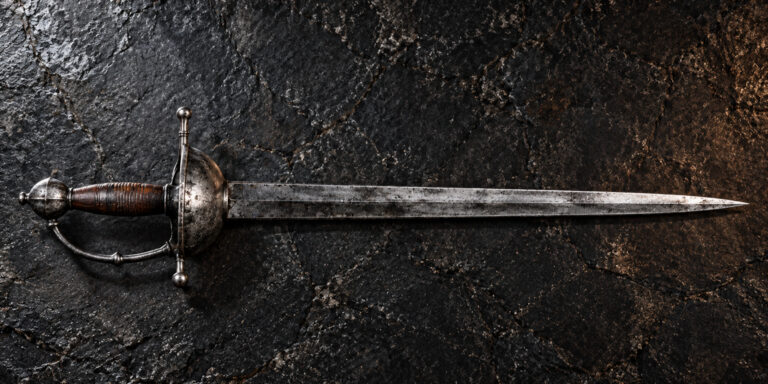
The French longsword remained a versatile weapon for mounted and dismounted combat. Many noblemen also carried an estoc, a stiff thrusting sword designed to punch through gaps in armour.
| Weapon Type | Used By | Purpose |
| Longsword | French men-at-arms | General combat |
| Estoc | Nobles and cavalry | Thrusting against armour |
| Swiss Pike | Swiss infantry | Anti-cavalry and close combat |
| Crossbow | Gascon troops | Missile fire |
Swiss infantry fought in dense pike blocks, supported by halberds and short swords. Their discipline and aggression were legendary. One contemporary observer noted that the Swiss advanced “like an iron wall that had suddenly decided it was in a very bad mood”. It is difficult to improve upon that.
League Arms and Armour
Italian men-at-arms also wore fine plate armour, often of Milanese manufacture, which was widely regarded as the best in Europe.
Common swords in the League army included:
- Arming sword
- Estoc
- Early side sword
- Falchion among lighter infantry
The Stradiots carried a rather different assortment of weapons:
- Sabres of Balkan style
- Spears and javelins
- Small shields
- Curved knives
| Weapon Type | Used By | Purpose |
| Arming Sword | Italian cavalry | Mounted and foot combat |
| Estoc | Men-at-arms | Armour-piercing thrusts |
| Side Sword | Officers and nobles | Versatile personal weapon |
| Sabre | Stradiots | Fast light cavalry attacks |
The Battle
The battle began on the afternoon of 6 July. Charles VIII placed his army in three divisions and attempted to move north along the Taro.
Francesco Gonzaga planned to strike the French column from the flank while also seizing the baggage train. This second objective proved unusually popular. Many League troops became rather more interested in French loot than French soldiers.
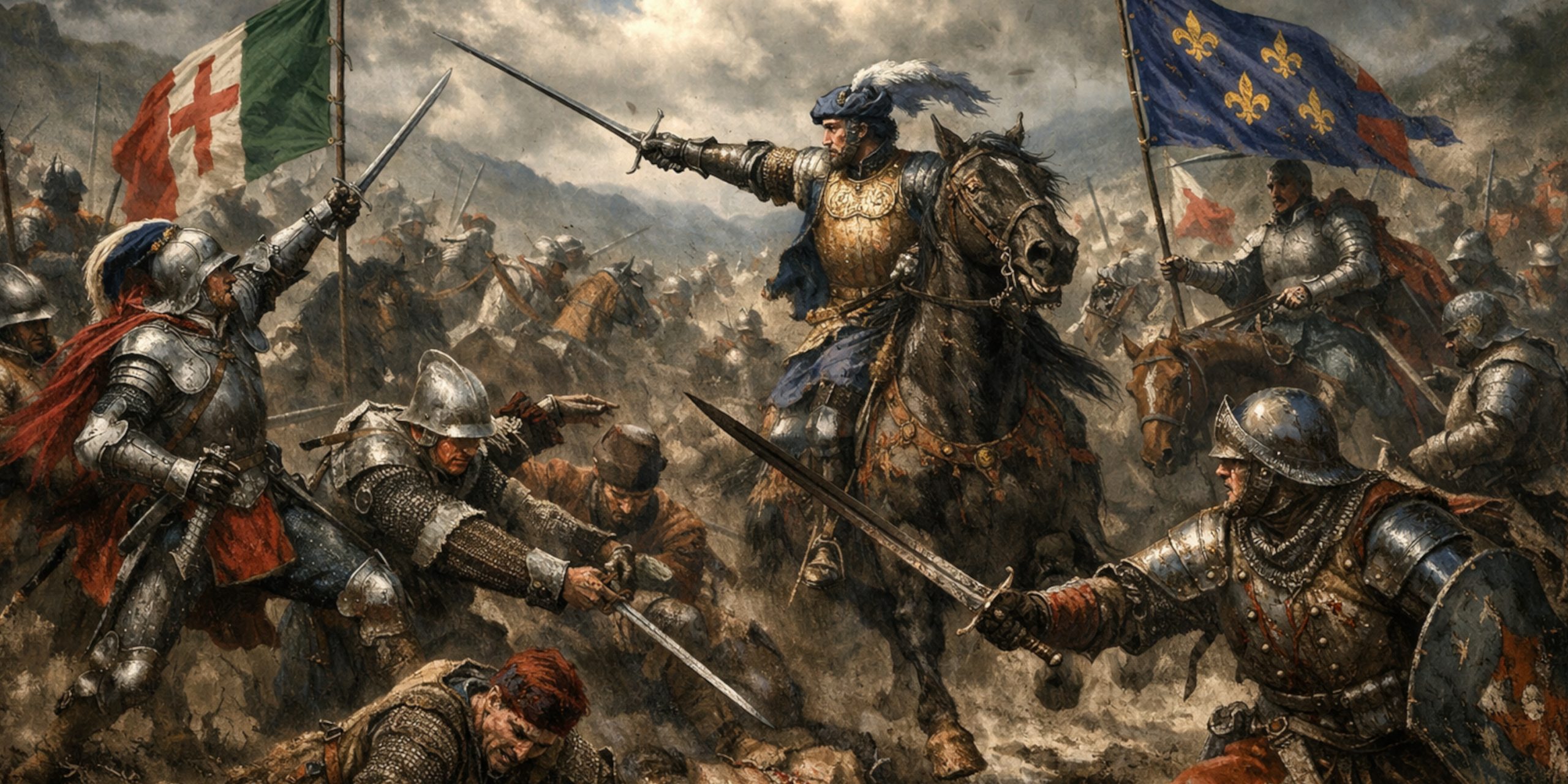
As the armies collided, the fighting quickly dissolved into chaos.
- French cavalry smashed into the League centre
- Swiss pikemen drove back Italian infantry
- Stradiots swept around the French baggage train
- Rain and mud made coordination almost impossible
- Visibility became poor due to smoke and dust
At one point Charles VIII personally led a cavalry charge. This was brave, effective, and perhaps not the sort of thing his advisers would have preferred from a king whose survival was somewhat important.
The French managed to punch through the League lines and continue their retreat north. The League remained on the field and captured much of the French baggage.
Hence the argument.
If victory means escaping the trap, the French won.
If victory means holding the battlefield and taking the enemy baggage, the League won.
If victory means ending the war cleanly and decisively, nobody won at all.
Battle Timeline
| Time | Event |
| Early Morning, 6 July 1495 | French army begins moving north along the Taro River |
| Midday | League forces deploy near Fornovo |
| Early Afternoon | Rain intensifies and river levels rise |
| Around 3:00 PM | League cavalry attacks the French column |
| Shortly After | Swiss pikemen and French cavalry counter-attack |
| Late Afternoon | League troops overrun the French baggage train |
| Evening | Charles VIII escapes north with surviving army |
| Night | League army remains on the battlefield |
Casualties
Precise casualty figures remain uncertain.
| Side | Estimated Losses |
| France | 1,000 to 2,000 |
| League of Venice | 2,000 to 3,000 |
Many of the dead drowned in the flooded river or were trampled in the confusion. Others vanished into the mud, which has a remarkable talent for hiding both bodies and reputations.
Archaeology and the Battlefield Today
Archaeological work around Fornovo has uncovered weapons, armour fragments, horse equipment and cannon shot linked to the battle.
Finds have included:
- Iron cannonballs
- Fragments of plate armour
- Crossbow bolts
- Pieces of sword blades
- Spurs and horse fittings
Several of these finds confirm contemporary descriptions of close-range fighting and the heavy use of artillery. The concentration of material near the river also supports accounts that much of the battle took place in and around the flooded banks of the Taro.
Modern studies of the terrain have shown that the battlefield was even more restrictive than earlier historians believed. The narrow ground between the river and surrounding hills compressed both armies into a chaotic struggle where command and control quickly broke down.
Today, the site near Fornovo di Taro still preserves much of its general landscape. It is surprisingly peaceful. One would never guess that thousands of armoured men once attempted to kill one another there while also trying to steal each other’s luggage.
Contemporary Quotes
“The battle was terrible and confused beyond measure.”
Francesco Guicciardini
“The French king escaped by miracle and by courage.”
Philippe de Commynes
“The river, the rain and the disorder did as much damage as the enemy.”
Contemporary Venetian chronicler
These accounts capture the essential character of Fornovo. It was not a neat, elegant Renaissance battle fought by brightly dressed noblemen posing for paintings. It was wet, violent, exhausting and deeply confused.
Why Fornovo Mattered
The Battle of Fornovo did not end the Italian Wars. In truth, it began them.
Charles VIII escaped to France, but he left behind the knowledge that Italy was vulnerable to large foreign armies. Over the next sixty years France, Spain, the Holy Roman Empire and numerous Italian states would fight repeatedly across the peninsula.
Fornovo also highlighted several important changes in warfare:
- The growing importance of artillery
- The battlefield power of Swiss pike formations
- The decline of purely feudal armies
- The increasing role of organised infantry and gunpowder
The old world of armoured knights still existed in 1495, but it was beginning to share the battlefield with something newer and rather less forgiving.
The Seven Swords Takeaway
The Battle of Fornovo remains one of the strangest battles of the Renaissance. It was muddy, confused and tactically indecisive, yet its consequences were enormous.
The French escaped. The League held the field. Both sides congratulated themselves. Meanwhile, Italy was left facing decades of war.
For historians, that combination of chaos and consequence is exactly what makes Fornovo so fascinating. It is a battle where the arguments after the fighting may have lasted longer than the fighting itself.