Harold I, better known as Harold Harefoot, remains one of the most overlooked kings in English history. Sandwiched between the towering reputations of his father Cnut the Great and his half-brother Harthacnut, Harold’s reign often receives little more than a passing mention. Yet his story reveals a fascinating struggle for power in an England that was still deeply influenced by its Scandinavian rulers.
As a historian, I have always found Harold oddly compelling. He was not a conqueror on the scale of his father, nor a dramatic failure like some medieval kings. Instead, he was a political survivor. In an age where rivals often ended up blinded, exiled, or dead, surviving long enough to wear the crown was an achievement in itself.
Who Was Harold Harefoot?
Harold was born around the beginning of the eleventh century and was one of the sons of King Cnut of England, Denmark, and Norway.
His mother was Ælfgifu of Northampton, Cnut’s first wife or consort. This would later become a major source of controversy. Many influential English churchmen and nobles regarded Cnut’s later marriage to Emma of Normandy as more legitimate, creating uncertainty over Harold’s right to inherit.
The nickname “Harefoot” appears in later sources and likely referred to his speed and skill as a runner or hunter.
Quick Facts
| Detail | Information |
|---|---|
| Full Name | Harold I Harefoot |
| Reign | 1035-1040 |
| Father | Cnut the Great |
| Mother | Ælfgifu of Northampton |
| Dynasty | House of Knýtlinga |
| Successor | Harthacnut |
| Burial | Originally Westminster |
The Succession Crisis After Cnut’s Death
When Cnut died in 1035, his empire stretched across England, Denmark, and Norway.
The succession was immediately complicated.
Several claimants emerged:
- Harold Harefoot
- Harthacnut
- Magnus of Norway
- Various regional magnates pursuing their own interests
Harthacnut, Cnut’s preferred heir in many eyes, was trapped in Denmark dealing with threats from Norway and could not immediately travel to England.
Harold seized the opportunity.
Initially appointed as regent in parts of England, he gradually accumulated support until he was recognised as king by most of the kingdom.
Emma of Normandy fiercely opposed him and attempted to defend the rights of her son Harthacnut.
The political struggle became one of the defining events of Harold’s short reign.
Harold’s Rise to the Throne
Harold’s success rested largely on his ability to win over powerful English nobles.
One of his most important supporters was Leofric, Earl of Mercia, among the wealthiest and most influential men in England.
The kingdom effectively split into rival factions:
- Supporters of Harold
- Supporters of Harthacnut
- Neutral magnates seeking stability
By 1037 Harold had secured enough support to be formally accepted as king throughout England.
Emma was forced into exile in Flanders.
For a man often portrayed as a temporary ruler, Harold demonstrated considerable political skill.
The Fate of Alfred Ætheling
One of the most controversial episodes associated with Harold’s reign involved Alfred Ætheling, son of Emma of Normandy and future brother of Edward the Confessor.
Alfred returned to England in 1036, apparently hoping to gather support.
He was captured by supporters of Harold.
Shortly afterwards he was blinded.
The injuries proved fatal.
Whether Harold personally ordered the blinding remains uncertain.
Medieval chroniclers hostile to Harold certainly believed he was responsible. Modern historians are more cautious. The evidence is frustratingly incomplete, which is historian shorthand for “we wish someone had written things down properly.”
The incident nevertheless damaged Harold’s reputation for centuries.
Harold Harefoot’s Military Ability
Harold inherited a kingdom created through conquest and sustained through military strength.
Unlike Cnut, however, he never had the opportunity to lead major overseas campaigns.
Strengths as a Military Leader
- Maintained stability during a dangerous succession crisis
- Prevented civil war despite rival claimants
- Retained support from key military aristocrats
- Preserved royal authority throughout England
Weaknesses
- No major battlefield victories are recorded
- Lacked opportunities to expand territory
- Never commanded the vast multinational armies assembled by Cnut
His greatest military achievement may have been avoiding large-scale conflict altogether.
That sounds less glamorous than winning a battle, but medieval kings often lost their crowns through reckless warfare. Harold’s caution arguably helped preserve his position.
Battles and Military Activity
No major battle can be firmly attributed to Harold’s reign.
Instead, his rule was marked by political manoeuvring and localised power struggles.
Potential military concerns included:
- Danish succession disputes
- Norwegian threats
- Internal English resistance
- Coastal defence against raids
The fact that England remained largely stable suggests competent military administration.
Medieval kings who failed at defence usually left far more dramatic evidence behind.
Arms and Armour During Harold’s Reign
Harold ruled during the late Viking Age, when Scandinavian and Anglo-Saxon military traditions were increasingly blending together.
Weapons Used by Elite Warriors
| Weapon | Description |
|---|---|
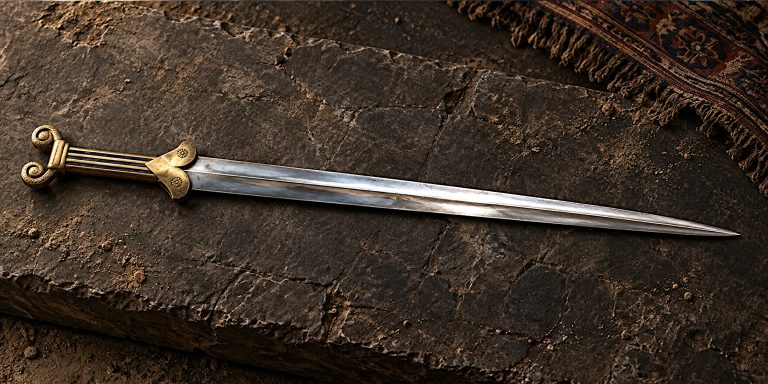
| Viking Sword | High-status double-edged sword |
| Seax | Single-edged utility and fighting blade |
| Spear | Most common battlefield weapon |
| Danish Axe | Powerful two-handed weapon |
| Shield | Round wooden shield with iron boss |
| Javelin | Used by some troops before close combat |
Sword Types of the Period
Likely sword forms included:
- Petersen Type S
- Petersen Type T
- Petersen Type U
- Petersen Type X
- Early medieval Viking swords transitioning toward Norman styles
These swords were highly prized possessions and often passed through generations.
Armour
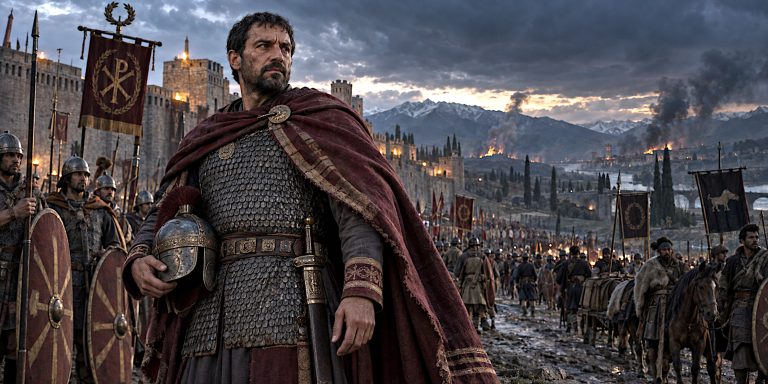
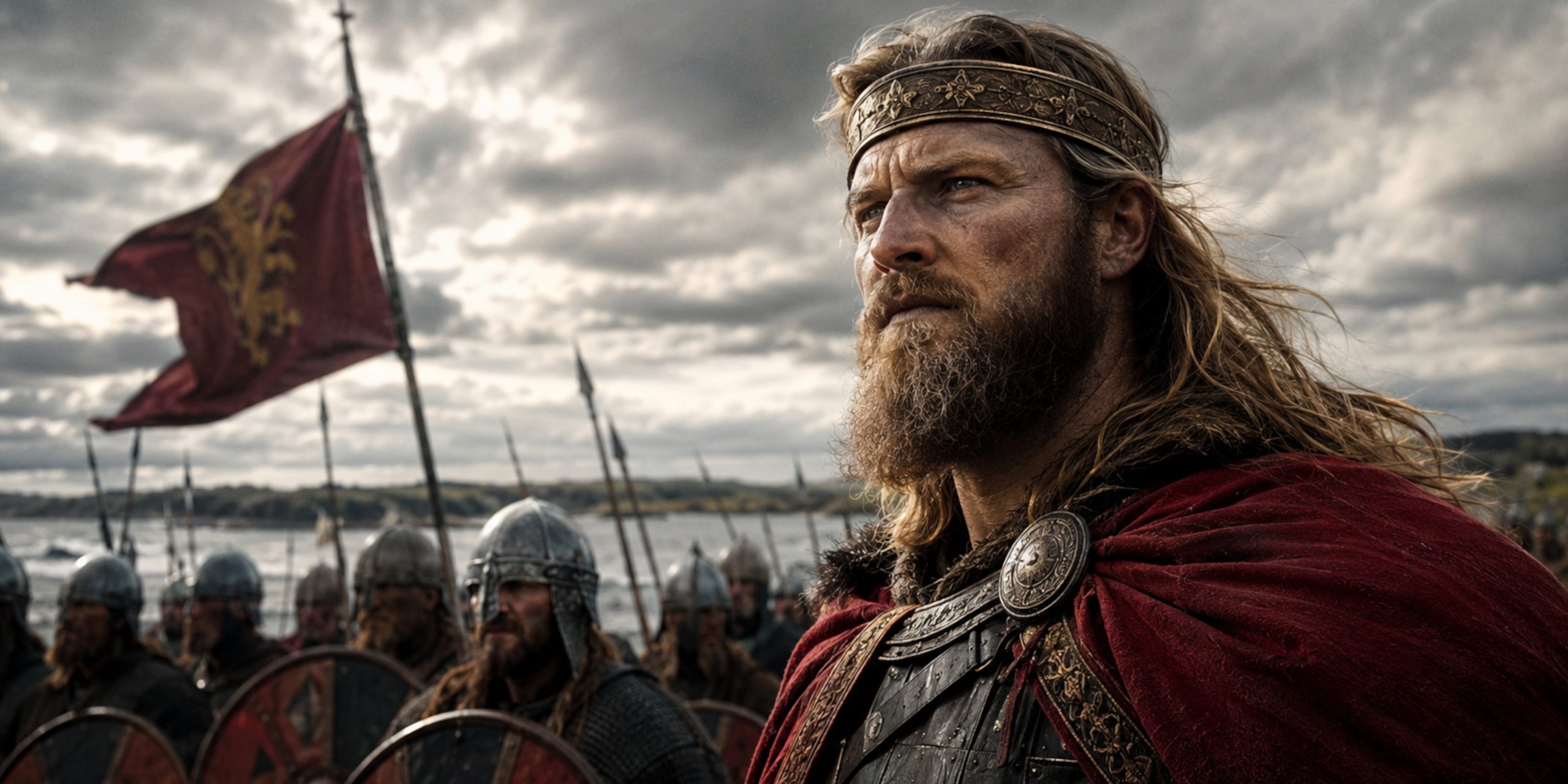
Elite warriors likely wore:
- Mail hauberks
- Iron helmets with nasal guards
- Woollen or padded undergarments
- Leather belts and weapon hangers
- Cloaks secured by decorative brooches
Most ordinary soldiers relied more heavily on shields than expensive armour.
Government and Rule
Harold’s reign is often characterised as a period of consolidation.
His government continued many of the systems established by Cnut:
- Collection of taxation
- Royal administration
- Cooperation with earls
- Church patronage
Coinage continued to be produced in significant quantities, demonstrating that royal authority remained functional.
This may sound mundane compared to conquest, but functioning government was one of the foundations of medieval kingship.
Death and Burial
Harold died unexpectedly in March 1040, probably at Oxford.
He was still relatively young.
His death immediately changed the political landscape.
Harthacnut finally arrived from Denmark and claimed the English throne without serious resistance.
Harold’s treatment after death reflected the bitterness of the succession dispute.
His body was reportedly exhumed, decapitated, and thrown into a fen near the Thames on Harthacnut’s orders.
Supporters later recovered and reburied the remains at St Clement Danes.
Even by medieval standards, it was not a particularly dignified postscript.
Artefacts from Harold Harefoot’s Reign
No artefacts can be definitively linked to Harold personally.
However, several categories of objects survive from his reign.
Coins
The most important surviving artefacts are silver pennies bearing Harold’s name.
Examples can be found in:
- The British Museum
- The Ashmolean Museum
- Regional collections throughout England
- Various documented hoards
These coins provide direct evidence of his authority and government.
Viking Age Weapons
Weapons contemporary with Harold’s reign can be viewed in:
- The British Museum
- York’s Jorvik collections
- National Museum of Denmark
Ecclesiastical Artefacts
Church treasures from the period reveal the wealth and artistic sophistication of the kingdom Harold inherited.
Latest Archaeological Discoveries
Archaeology has not uncovered any site directly associated with Harold himself in recent years, but discoveries continue to illuminate the world he inhabited.
Coin Hoards
New hoards found across England regularly include coins from Cnut, Harold, and Harthacnut.
These finds help historians understand:
- Trade networks
- Political authority
- Economic stability
- Regional loyalties
Viking Age Burials
Recent excavations across England have expanded understanding of Scandinavian settlement patterns during the early eleventh century.
These discoveries reinforce how integrated Viking and Anglo-Saxon societies had become by Harold’s time.
Isotope and DNA Research
Modern scientific analysis of human remains from the period has revealed increasing mobility between Scandinavia and England.
Harold ruled a kingdom that was culturally connected across the North Sea rather than isolated within Britain.
Historical Reputation
Harold’s reputation suffered largely because the surviving sources were written by authors who favoured Emma, Harthacnut, and later Edward the Confessor.
As a result, he is often portrayed as an opportunist who seized power unlawfully.
Modern historians tend to offer a more balanced assessment.
Harold appears less as a usurper and more as a capable political operator who exploited circumstances effectively.
His reign was short, but it was not chaotic.
England remained governed, defended, and largely peaceful.
That alone deserves recognition.
Legacy
Harold Harefoot remains one of England’s forgotten kings.
He lacked the spectacular victories of Cnut, the saintly reputation of Edward the Confessor, and the dramatic downfall of Harold Godwinson.
Yet his brief reign played an important role in preserving stability during one of the most uncertain moments in Anglo-Saxon history.
Without Harold’s ability to hold England together between 1035 and 1040, the transition to Harthacnut and ultimately Edward the Confessor might have been far more violent.
History often remembers the conquerors and the saints.
Harold Harefoot was neither.
He was something rarer: a practical survivor who managed to keep the kingdom functioning when almost everything around him suggested it should have fallen apart.