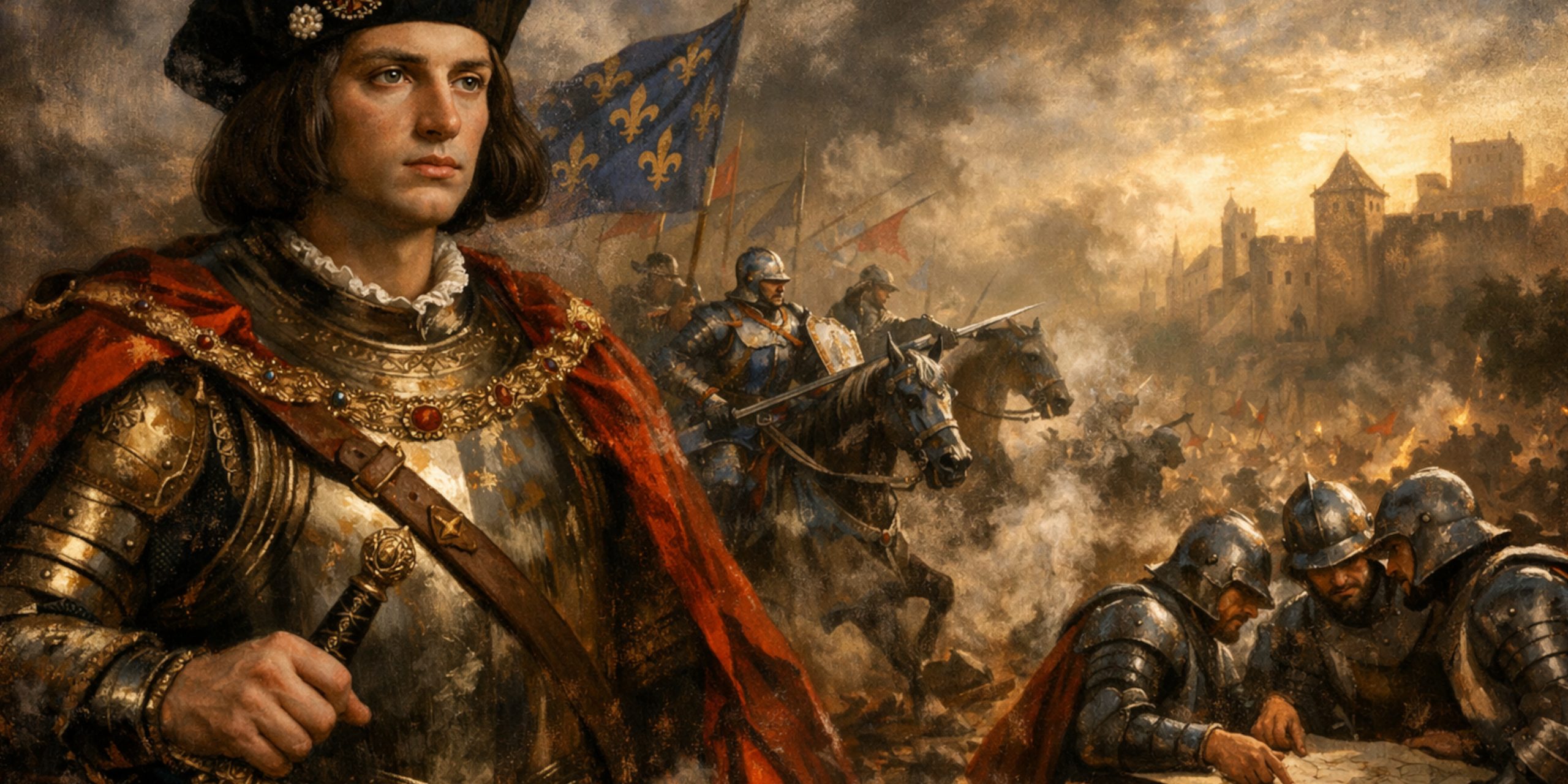
Charles VIII of France remains one of those monarchs who seems to stride into history with immense confidence, only to leave behind a rather complicated trail of glory, chaos and broken promises. He was king from 1483 until 1498, inherited France as a boy, marched into Italy dreaming of crowns and crusades, and accidentally transformed European warfare in the process.
At first glance Charles appears an unlikely conqueror. Contemporary writers described him as short, physically frail and rather awkward in manner. One ambassador, not trying terribly hard to be polite, noted that he had large eyes, a prominent nose and legs that did not quite seem to have agreed upon the same direction. Yet this unimpressive young king launched one of the most important military expeditions in European history.
His invasion of Italy in 1494 did not merely begin the Italian Wars. It also dragged France, Spain, the Holy Roman Empire and the Italian states into a struggle that would last for decades. Charles wanted the throne of Naples. Europe instead got a century of bloodshed.
Early Life and Family
Charles was born at Amboise on 30 June 1470, the only surviving son of Louis XI and Charlotte of Savoy. His father, Louis XI, had spent years strengthening royal authority and reducing the power of rebellious nobles. Charles inherited the fruits of that hard work, though not necessarily his father’s caution.
When Louis XI died in 1483, Charles was only thirteen. The kingdom was effectively governed by his elder sister, Anne of France, and her husband Pierre de Beaujeu. Anne proved remarkably capable. During Charles’s minority she crushed noble revolts, preserved royal authority and ensured that France remained stable.
Without Anne, Charles might have become another unfortunate medieval king remembered chiefly for being manipulated by everyone around him. Instead, he inherited a strong and centralised monarchy, with money, soldiers and ambitious advisers ready to encourage his dreams.
Charles VIII Takes Power
By 1491 Charles had begun to rule in his own right. That same year he married Anne of Brittany, one of the most important political marriages in French history.
The marriage effectively brought Brittany under French control. This mattered enormously. Brittany had long been semi-independent and frequently allied with France’s enemies. By marrying Anne, Charles achieved through diplomacy what earlier kings had failed to secure by war.
There was, however, an awkward detail. Anne of Brittany had already been married by proxy to Maximilian of Habsburg. Charles ignored this entirely. Medieval kings had a charming habit of treating marriage law as highly important until it became inconvenient.
The Character of Charles VIII
Charles is difficult to pin down. He could be generous, impulsive, idealistic and surprisingly brave. He also had an unfortunate tendency to trust flatterers and chase impossible ambitions.
He seems to have genuinely believed he could revive the glories of Charlemagne, conquer Naples and then perhaps march onward to Jerusalem. It sounds absurd now, but to Charles it was a perfectly sensible sequence of events. First Naples, then Constantinople, then perhaps the whole eastern Mediterranean if lunch went well.
Unlike his father, Charles was not naturally suspicious or calculating. He preferred chivalric ideals, courtly display and military adventure. He was more knight than statesman, which made him attractive to contemporaries but often disastrous in practice.
Why Charles Invaded Italy
Charles claimed the Kingdom of Naples through his Angevin ancestors. In theory he had a legitimate dynastic claim. In practice many European rulers had claims to Naples, some more convincing than others.
By the early 1490s Charles became convinced that he should invade Italy and seize the kingdom. Several Italian exiles and advisers encouraged him, especially Ludovico Sforza of Milan, who hoped French intervention would help his own position.
Italy in 1494 was wealthy, divided and dangerously complacent. Its city-states had spent decades fighting limited wars with mercenaries. Their armies were skilled but often cautious. Charles arrived with something rather different: a large French army, modern artillery and a willingness to use both.
The Italian Campaign of 1494 to 1495
Charles crossed the Alps in September 1494 with around 25,000 men. His army included French knights, Swiss mercenaries, Gascon infantry and perhaps most importantly, a formidable artillery train.
The French guns astonished Italy. Heavy bronze cannon could now move rapidly across the countryside and smash through walls that medieval fortifications had once considered impregnable.
Cities that expected to resist for weeks or months sometimes surrendered within hours.
Key Stages of the Campaign
- Charles entered Milan in triumph.
- Florence submitted after Piero de’ Medici disastrously surrendered key fortresses.
- Charles entered Rome in December 1494.
- In February 1495 he occupied Naples with little serious resistance.
For a brief moment Charles seemed unstoppable. Yet his success alarmed the rest of Europe. Venice, Spain, the Papacy, Milan and the Holy Roman Empire formed the League of Venice against him.
Charles had conquered Naples. He now had to fight his way home.
Battles and Military Acumen
Charles VIII was not a great battlefield commander in the mould of Henry V or Gustavus Adolphus. He did not possess extraordinary tactical genius. What he did have was courage, determination and the sense to bring capable soldiers and effective artillery with him.
His greatest military contribution lay in recognising, perhaps instinctively rather than intellectually, the importance of speed, mobility and gunpowder.
Battle of Fornovo, 1495
The most famous battle of Charles’s reign took place at Fornovo on 6 July 1495.
Charles and his army were retreating north from Naples when they encountered the forces of the League of Venice near the River Taro.
The battle was confused, violent and fought in terrible weather. The French army managed to break through and continue its retreat, although both sides claimed victory. Charles escaped, which in practical terms mattered more than the argument afterwards.
French Strengths at Fornovo
- Powerful heavy cavalry, including the famous French gendarmes.
- Experienced Swiss pikemen.
- Effective field artillery.
- High morale and aggressive tactics.
Weaknesses
- Charles struggled to coordinate his forces in battle.
- He often relied heavily on advisers and experienced captains.
- He lacked the patience and logistical skill needed for a long campaign.
As a historian, one is left with the impression that Charles excelled at beginning wars and was far less gifted at deciding how to end them.
Arms and Armour of Charles VIII and His Army
Charles VIII lived at a transitional moment between medieval chivalry and Renaissance warfare. His armies combined armoured knights with gunpowder artillery and disciplined infantry.
Charles VIII’s Personal Armour
Charles would have worn a late fifteenth-century French or Milanese harness of polished steel.
Typical features included:
- A close-fitting sallet or armet helmet.
- A breastplate with rounded contours to deflect blows.
- Plate armour for arms and legs.
- Mail protecting the joints and gaps.
- Rich decoration, often gilded or etched.
His armour was not merely practical. It was also political theatre. A king was expected to look magnificent on campaign. Charles may not have cut an especially imposing figure physically, but armour could do wonders. Medieval monarchs often relied on it rather like modern politicians rely on carefully managed photographs.
Weapons Used by Charles and His Nobles
- Longswords of late medieval French type.
- Arming swords worn at the hip.
- Lances for mounted combat.
- Maces and war hammers against armoured foes.
- Daggers, especially rondel daggers.
French knights during Charles’s reign increasingly used longswords suited to both cutting and thrusting. Many surviving examples resemble Oakeshott Type XVIII and XVIIIb blades, with narrow points designed to exploit weaknesses in plate armour.
Infantry Weapons
- Swiss pikes, often over 4 metres long.
- Halberds.
- Crossbows.
- Early handguns and arquebuses.
- Poleaxes.
The Swiss mercenaries in Charles’s service were especially feared. Their dense pike formations could shatter cavalry and overwhelm infantry. Italian commanders found them deeply alarming, which was entirely understandable if one suddenly discovered several thousand determined Swiss men marching towards you with sixteen-foot poles.
Artillery
The true revolution of Charles VIII’s army was its artillery.
French cannon were:
- Lighter and more mobile than older siege guns.
- Cast in bronze.
- Mounted on wheeled carriages.
- Capable of reducing fortifications rapidly.
Charles’s invasion demonstrated that the old medieval castle was becoming obsolete. Italian engineers soon responded by creating lower, thicker fortifications, eventually producing the trace italienne style of fortress.
Court, Culture and the Renaissance
Although Charles is best remembered for war, his reign also had cultural consequences.
The French invasion of Italy exposed the French court to Renaissance art, architecture and ideas. Charles returned with Italian artists, craftsmen and architects. Under his rule and that of his successors, the French Renaissance began to flourish.
The royal castles at Amboise and Blois began to show increasing Italian influence. Charles helped transform France from a medieval kingdom into an early modern state.
Ironically, the man who invaded Italy to seize a crown may have left a more lasting legacy by importing Italian culture.
Death of Charles VIII
Charles died unexpectedly on 7 April 1498 at the Château d’Amboise.
According to contemporary accounts, he struck his head on a low stone lintel while hurrying to watch a game of jeu de paume, an ancestor of tennis. He initially appeared unharmed but collapsed later and died several hours afterwards.
There is something oddly tragic and faintly ridiculous about it. After surviving war, political intrigue and a hazardous retreat across Italy, Charles was defeated by architecture.
He was only twenty-seven years old.
Charles and Anne of Brittany had several children, but none survived infancy. His death therefore ended the senior Valois line, and the throne passed to his cousin Louis XII.
Where to See Artefacts from the Reign of Charles VIII
Several museums and historic sites preserve artefacts connected to Charles VIII and his reign.
Château d’Amboise
The château where Charles was born and died still contains objects and architectural features linked to his court.
Visitors can see:
- Royal apartments.
- Late fifteenth-century decorative elements.
- The chapel of Saint-Hubert nearby.
Château de Blois
Blois contains important surviving architecture from the late Valois period and reflects the transition from medieval to Renaissance France.
Musée de l’Armée, Paris
The Musée de l’Armée at Les Invalides contains:
- Late fifteenth-century French armour.
- Swords and polearms of Charles VIII’s period.
- Early artillery pieces.
- Armour in the style used by French gendarmes.
Musée National de la Renaissance, Écouen
This museum holds objects from the early French Renaissance, including decorative arts, weaponry and courtly items from the decades immediately following Charles’s reign.
Naples and Italian Museums
Museums in Naples, Milan and Florence preserve artefacts linked to the Italian Wars, including armour, cannon and documents relating to the French invasion.
Latest Archaeology and Research
Archaeology connected with Charles VIII has increasingly focused on battlefields, fortifications and royal residences.
Fornovo Battlefield Research
Recent surveys around the battlefield of Fornovo have uncovered:
- Musket and arquebus balls.
- Fragments of armour.
- Horseshoes and military fittings.
- Evidence for the position of troop formations.
These discoveries have helped historians reconstruct the battle in greater detail. The evidence suggests the fighting was even more chaotic than contemporary accounts imply.
Italian Fortress Excavations
Archaeologists studying fifteenth-century Italian fortifications have found clear evidence of the destructive power of Charles’s artillery.
Damaged walls, shattered masonry and hurried rebuilding efforts reveal how suddenly traditional castles became vulnerable.
Château d’Amboise
Excavations at Amboise have revealed:
- Remains of Charles VIII’s building works.
- Imported Italian decorative styles.
- Fragments of ceramics and courtly objects.
- Evidence for the changing layout of the royal residence.
These finds reinforce the view that Charles’s reign was a turning point. France was still medieval in many ways, yet increasingly drawn toward the Renaissance.
Historical Reputation
Charles VIII has often been judged harshly. Some historians see him as reckless, vain and politically naïve. Others argue that he was an energetic ruler whose ambitions outpaced the age in which he lived.
Personally, I find him strangely compelling. He was not a great king in the conventional sense. He won no lasting empire and left France burdened with expensive wars. Yet he changed Europe.
The Italian Wars began because Charles dreamed too boldly and thought too little about consequences. Yet those same dreams reshaped diplomacy, warfare and culture for generations.
Charles VIII reminds us that history is not always made by the wisest rulers. Sometimes it is made by the young, ambitious and disastrously overconfident.
Takeaway
Charles VIII of France ruled for only fifteen years, but his reign marked the end of one era and the beginning of another. He inherited a strong kingdom, secured Brittany, invaded Italy and transformed warfare through the use of artillery.
He also imported the Renaissance into France, altered the balance of power in Europe and left behind one of the most curious royal deaths in French history.
For a king who died at twenty-seven and failed to keep the kingdom he conquered, Charles VIII casts a surprisingly long shadow.