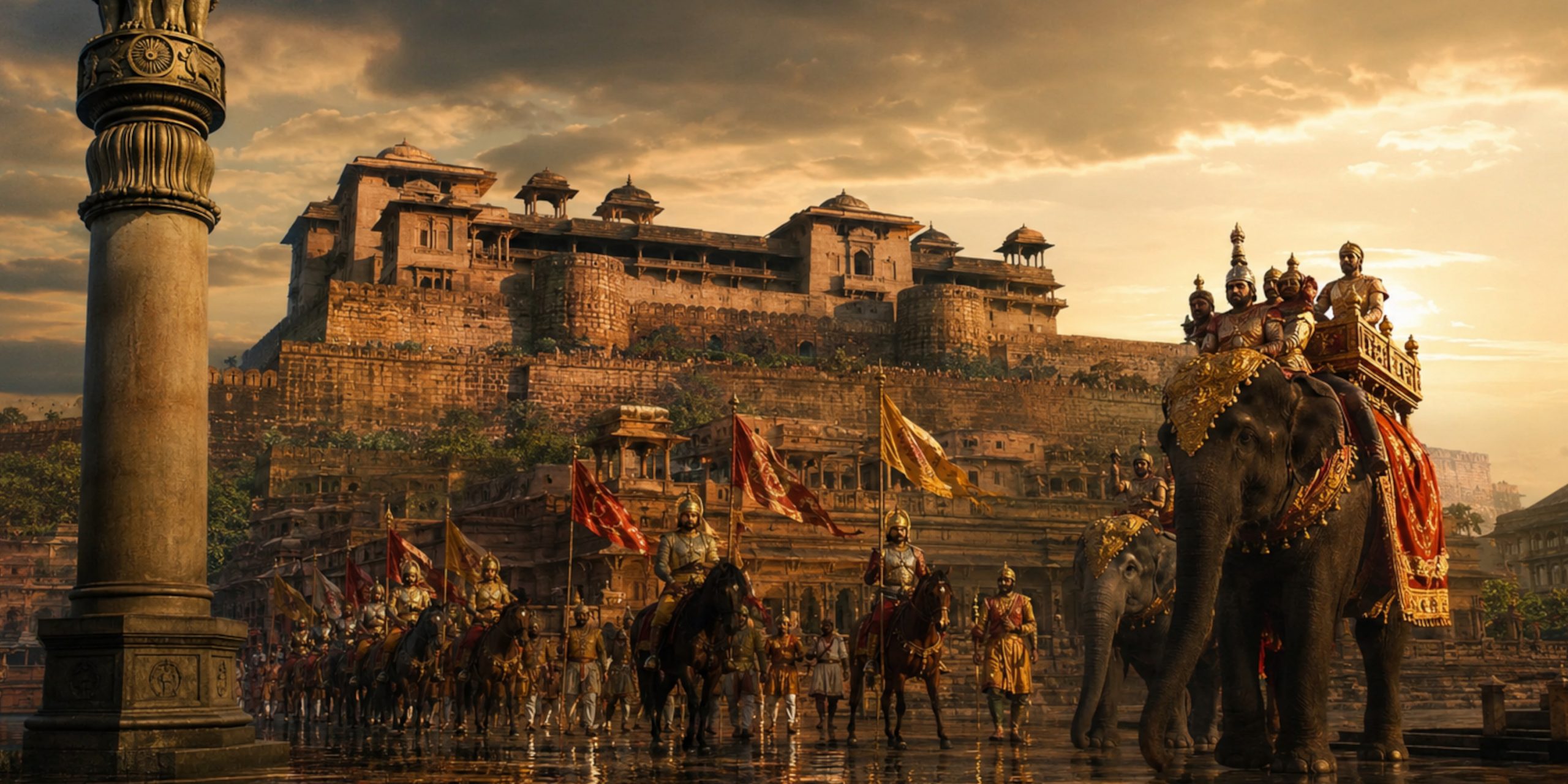
The Maurya Dynasty stands as one of the great turning points in world history. Before its rise, northern India was divided among kingdoms, republics and regional powers. By the time of its collapse, much of the Indian subcontinent had been united under a single imperial administration, governed from a magnificent capital and connected by roads, officials and a surprisingly sophisticated bureaucracy.
As a historian, I often find the Mauryas fascinating because they seem both familiar and distant. Their rulers dealt with taxation, infrastructure, diplomacy and military logistics in ways that would not look entirely out of place today. Yet they also governed a world of war elephants, wandering ascetics and royal courts that could appear almost mythical to modern eyes.
The dynasty lasted little more than a century and a half, yet its influence shaped Indian civilisation for centuries.
Origins of the Maurya Dynasty
The dynasty was founded by Chandragupta Maurya around 322 BCE.
At the time, northern India was experiencing profound change. The powerful Nanda Dynasty controlled the wealthy kingdom of Magadha in eastern India, while the aftershocks of Alexander the Great’s invasion had created instability across the north-west.
According to traditional accounts, Chandragupta was guided by the scholar and strategist Chanakya, also known as Kautilya. Together they overthrew the Nandas and established a new ruling house.
Whether every detail of these stories is accurate remains uncertain. Ancient sources often preferred drama over footnotes. Historians generally agree, however, that Chandragupta was an exceptionally capable leader who exploited political fragmentation and military opportunity to create a new empire.
Within a few decades, the Mauryas controlled territory stretching across much of the Indian subcontinent.
Chandragupta Maurya and the Creation of an Empire
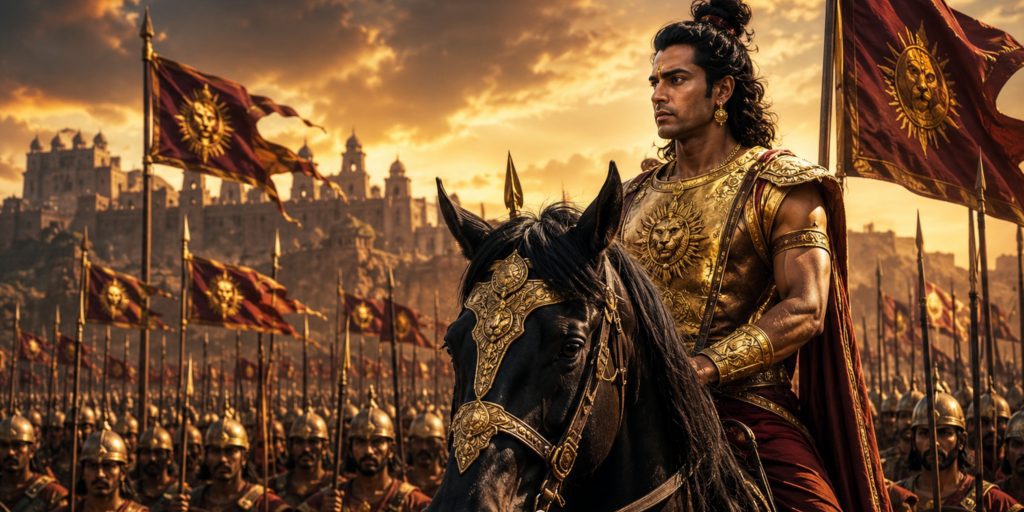
Few rulers have transformed a region so rapidly.
Chandragupta first secured Magadha and its capital at Pataliputra. He then expanded westward into territories previously influenced by Alexander’s successors.
One of his most significant achievements came after conflict with Seleucus I Nicator, ruler of the Seleucid Empire.
Rather than continuing a costly war, the two rulers reached an agreement.
The Settlement with Seleucus
The treaty appears to have included:
- Territorial concessions to Chandragupta
- Diplomatic recognition
- A marriage alliance according to some sources
- The transfer of hundreds of war elephants
Those elephants later played an important role in Seleucus’ own military campaigns. One suspects he may have regretted parting with them, although diplomacy is often cheaper than being trampled by them.
The agreement secured Mauryan control over vast territories and established the dynasty as a major power.
The Mauryan Empire at Its Height
Under Chandragupta and his successors, the empire expanded into one of the largest states in ancient history.
At its greatest extent, Mauryan authority covered:
- Most of modern India
- Pakistan
- Bangladesh
- Parts of Afghanistan
- Areas of Nepal
Only the far south remained largely outside direct Mauryan control.
Pataliputra became one of the largest cities in the world. Ancient visitors described impressive wooden palaces, defensive walls and bustling commercial districts.
The Greek ambassador Megasthenes left one of the most valuable descriptions of Mauryan India in his work Indica.
Although parts of his account contain exaggerations and occasional misunderstandings, much of it remains invaluable to historians.
Bindusara: The Overlooked Emperor
Between the famous reigns of Chandragupta and Ashoka stood Bindusara.
He ruled from approximately 297 to 273 BCE.
Despite receiving far less attention in popular history, Bindusara played a crucial role in maintaining and expanding the empire.
Sources suggest he extended Mauryan influence deeper into the Deccan region and preserved political stability during a period that might otherwise have fractured the young empire.
Many great empires collapse after their founder dies. Bindusara deserves considerable credit for ensuring that the Mauryan state did not.
Ashoka the Great
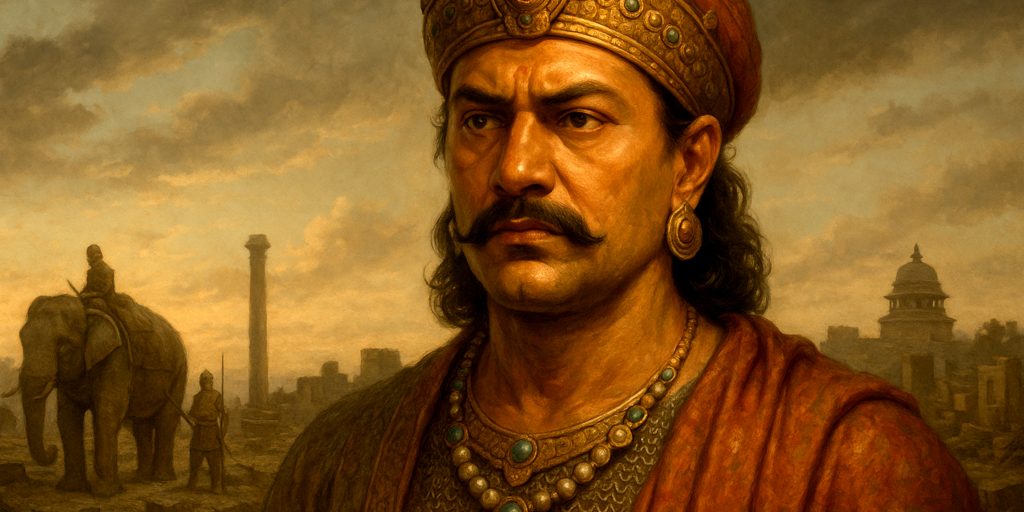
No Mauryan ruler is more famous than Ashoka.
Initially known as a formidable conqueror, he transformed both his own reputation and the character of the empire after the brutal Kalinga War.
The Kalinga War
Around 261 BCE, Ashoka launched a campaign against Kalinga, located on India’s eastern coast.
The conflict was devastating.
According to Ashoka’s own inscriptions:
- Large numbers were killed
- Many more were displaced
- Entire communities suffered immense hardship
What makes this event remarkable is Ashoka’s response.
Rather than celebrating victory, he expressed remorse.
His inscriptions describe sorrow for the suffering caused by war and a determination to pursue a different path.
Such admissions are rare among ancient conquerors. Most rulers preferred monuments praising victories rather than public reflections on regret.
Ashoka and Buddhism
Following Kalinga, Ashoka became a major patron of Buddhism.
He did not abandon government or military power, but he increasingly promoted:
- Religious tolerance
- Moral governance
- Compassion
- Welfare projects
- Non-violence where practical
His famous edicts were carved onto rocks and pillars across the empire.
These inscriptions survive today and provide direct evidence of imperial policy.
Ashoka also supported missionary activity that helped spread Buddhism across:
- Sri Lanka
- Central Asia
- South-East Asia
The long-term consequences were extraordinary.
Buddhism evolved from a regional Indian tradition into one of the world’s major religions.
Government and Administration
The Mauryan administration was remarkably sophisticated.
At its centre stood the emperor, supported by ministers, governors and a large bureaucracy.
Key Features
- Provincial governors
- Tax collection systems
- Agricultural oversight
- Census operations
- Intelligence networks
- Judicial officials
- State regulation of trade
The political treatise known as the Arthashastra, traditionally associated with Chanakya, provides insight into the principles behind Mauryan governance.
Some passages reveal a state that monitored almost everything.
Reading parts of it today occasionally feels like discovering an ancient government handbook written by someone who trusted absolutely nobody.
Economy and Trade
Mauryan prosperity rested upon agriculture.
Farmers cultivated:
- Rice
- Wheat
- Barley
- Pulses
- Cotton
The state invested in:
- Irrigation systems
- Roads
- Administrative infrastructure
Trade flourished both within India and beyond.
Commercial links connected Mauryan territories to:
- Central Asia
- Persia
- The Mediterranean world
- Sri Lanka
Merchants transported goods across extensive networks, generating wealth that supported imperial administration and military forces.
Society and Daily Life
Mauryan society was diverse and complex.
People lived in environments ranging from crowded urban centres to isolated rural villages.
Social life was influenced by:
- Regional traditions
- Religious beliefs
- Occupational roles
- Family structures
Cities featured markets, artisans and government officials.
Rural communities remained the backbone of the economy.
Like many ancient societies, daily life varied enormously depending on wealth, status and location.
Religion Under the Mauryas
The Mauryan Empire was religiously diverse.
Major traditions included:
- Early Hindu traditions
- Buddhism
- Jainism
- Various local beliefs
Chandragupta himself is traditionally associated with Jainism later in life.
Ashoka became closely linked with Buddhism.
Despite these associations, the empire generally displayed significant religious tolerance.
Ashoka’s inscriptions explicitly encouraged respect between different faiths.
The Mauryan Military
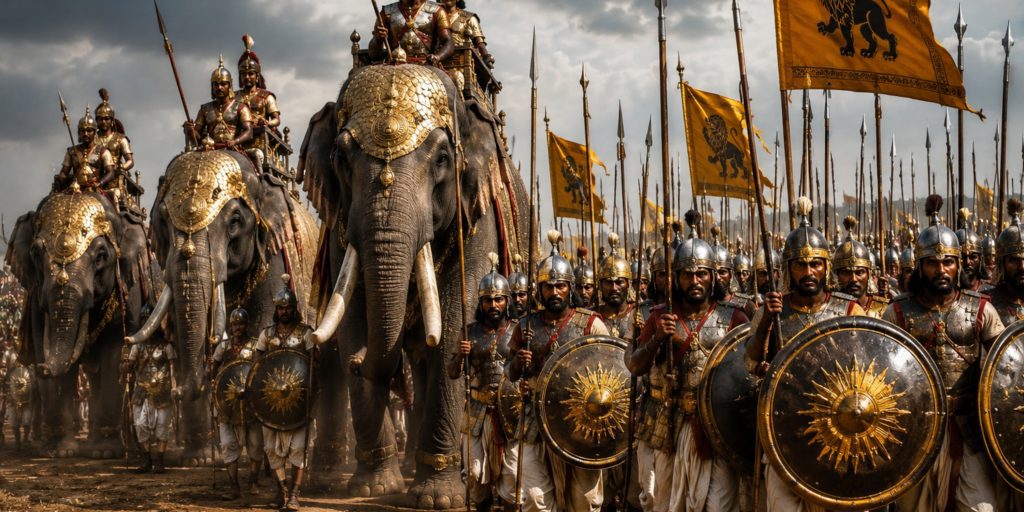
The Mauryas maintained one of the largest military forces of the ancient world.
Greek observers described vast armies composed of:
- Infantry
- Cavalry
- Chariots
- War elephants
War elephants became a symbol of Mauryan military power.
Their psychological impact alone could be devastating.
Ancient cavalry horses were often brave. Asking them to charge directly at an armoured elephant was perhaps testing that bravery rather severely.
Strengths of the Mauryan Army
- Massive manpower reserves
- Strong logistical support
- Effective administration
- Large elephant corps
- Strategic road networks
These advantages allowed the dynasty to control enormous territories.
Art, Architecture and Culture
Mauryan culture flourished under imperial patronage.
Notable achievements included:
- Monumental stone pillars
- Buddhist stupas
- Sculptural innovations
- Urban planning
- Courtly literature
The famous Lion Capital of Ashoka remains one of the most iconic symbols of Indian history.
Today it serves as the national emblem of India.
Mauryan artisans pioneered sophisticated stone-working techniques that influenced later Indian art for centuries.
Archaeological Discoveries
Archaeology continues to expand our understanding of the Mauryan world.
Important discoveries include:
Pataliputra
Excavations have uncovered:
- Wooden palisades
- Defensive structures
- Pillared halls
- Urban infrastructure
Ashokan Pillars
Numerous pillars survive across South Asia.
Their inscriptions remain among the most important primary sources for ancient Indian history.
Sanchi
Although expanded later, the site preserves important links to Mauryan patronage and early Buddhist architecture.
Recent Research
Modern archaeological work continues to investigate:
- Ancient trade routes
- Settlement patterns
- Administrative centres
- Environmental history
Each new discovery adds detail to a civilisation that still holds many mysteries.
Why the Maurya Dynasty Collapsed
Following Ashoka’s death, imperial authority weakened.
Several factors likely contributed:
- Succession disputes
- Administrative overextension
- Regional separatism
- Economic pressures
- Declining central control
The empire gradually fragmented.
In approximately 185 BCE, the last Mauryan ruler, Brihadratha, was overthrown by his general Pushyamitra Shunga.
The Maurya Dynasty came to an end.
Legacy of the Maurya Dynasty
The Mauryas created the first great empire of South Asia.
Their achievements included:
- Political unification on an unprecedented scale
- Administrative innovation
- Expansion of long-distance trade
- Support for religious tolerance
- Promotion of Buddhism across Asia
- Monumental artistic achievements
Ashoka remains one of the most admired rulers in world history.
His transformation from conqueror to advocate of moral governance continues to attract fascination more than two thousand years later.
As a historian, what strikes me most is the dynasty’s ambition. The Mauryas attempted something immense: governing a vast and diverse population through institutions rather than personal charisma alone. They were not always successful, and their empire ultimately fragmented, but the scale of their achievement remains astonishing.
Many ancient kingdoms flickered briefly before disappearing into obscurity. The Mauryas left inscriptions, monuments, political ideas and religious influences that still shape the modern world. That is a rather impressive legacy for a dynasty that lasted barely longer than some modern television franchises.
Key Takeaway
The Maurya Dynasty transformed the history of India.
From Chandragupta’s military conquests to Ashoka’s moral vision, the dynasty established political traditions, cultural achievements and religious connections that extended far beyond its own lifespan.
More than two millennia later, the Mauryas remain central to understanding the development of South Asian civilisation. Their empire was not merely large. It was influential, innovative and remarkably enduring in its impact.
Few ancient dynasties can claim quite so much.