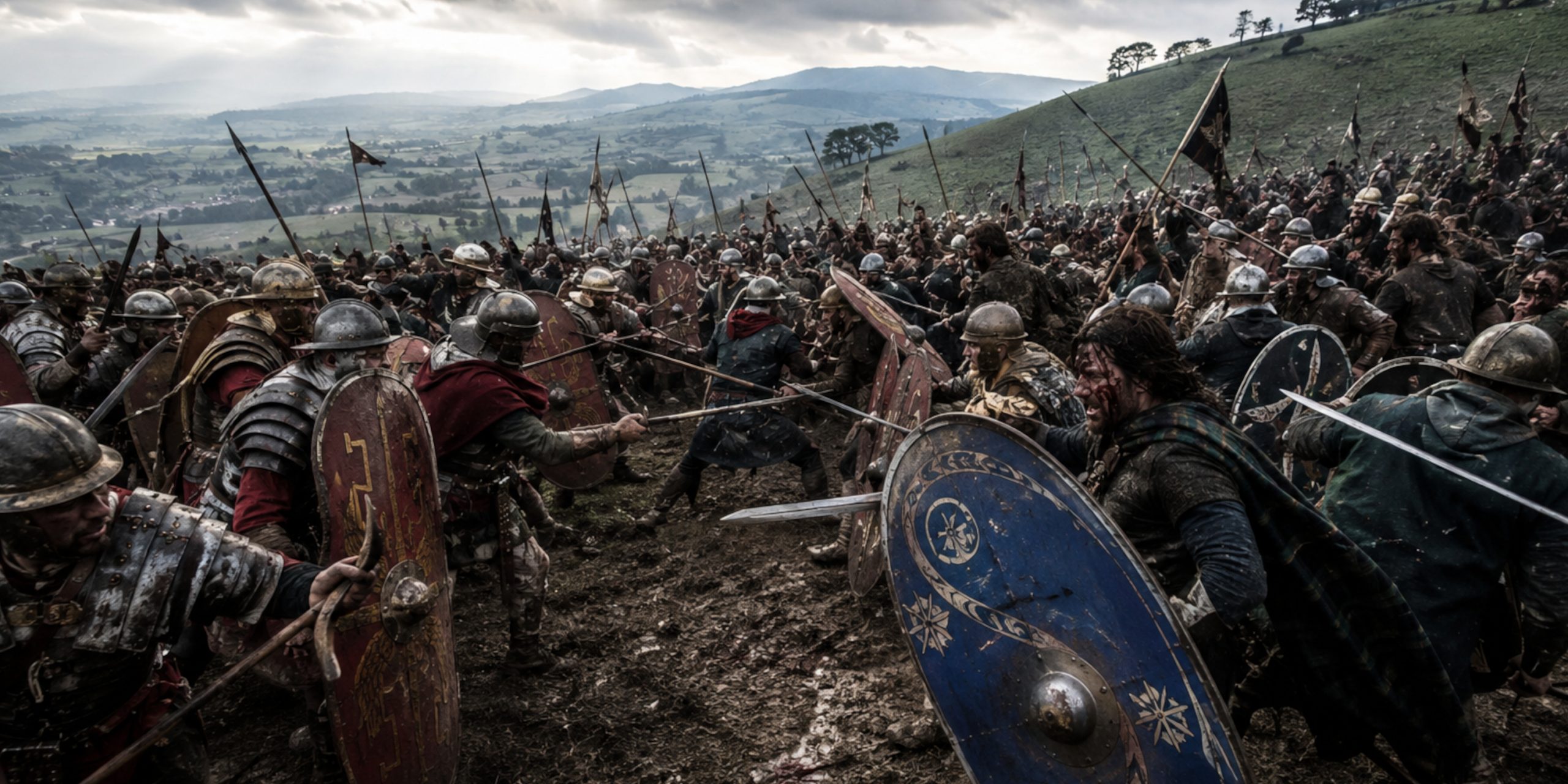
The Battle of Bibracte was one of the defining clashes of the early Gallic Wars, fought in 58 BC between the forces of Julius Caesar and the migrating Helvetii tribes. It was not Rome’s largest battle, nor its neatest, but it mattered enormously. Caesar needed a victory. The Helvetii needed survival. Somewhere in the hills of Gaul, both sides collided in a grinding, exhausting struggle that helped launch Caesar toward immortality and pushed Gaul closer to Roman domination.
It is also one of those battles where the surviving evidence comes almost entirely from one man with a tremendous ego and a very sharp pen. Caesar’s Commentarii de Bello Gallico remains our primary source. Conveniently for Caesar, Caesar is also the hero of the story.
Historians have spent centuries trying to untangle the propaganda from the reality. Even so, the bones of the battle remain visible beneath the self-promotion.
Background to the Battle
In 58 BC, the Helvetii, a confederation of Celtic tribes from what is now Switzerland, decided to migrate westward. The reasons remain debated:
- Population pressure
- Raids from Germanic tribes
- Internal political instability
- Desire for richer lands
Caesar presented the migration as a looming catastrophe for Roman allies and territories. More importantly, it gave him the perfect opportunity to begin a major military campaign in Gaul.
The Helvetii attempted to move through Roman-controlled territory near the Rhône. Caesar blocked them, forcing them to take a longer route through Gaul. He then shadowed the migrating tribes for weeks, looking for the right moment to strike.
That moment came near the oppidum of Bibracte, the fortified capital of the Aedui tribe.
Where Was Bibracte?
Bibracte was a major Gallic hillfort located on Mont Beuvray in modern Burgundy, France. The site dominated trade routes and offered excellent defensive ground.
Today, the archaeological remains at Mont Beuvray provide one of the richest windows into late Iron Age Gaul.
The battle itself probably occurred somewhere near the slopes surrounding the oppidum, though the exact battlefield remains disputed.
Forces
Roman Army
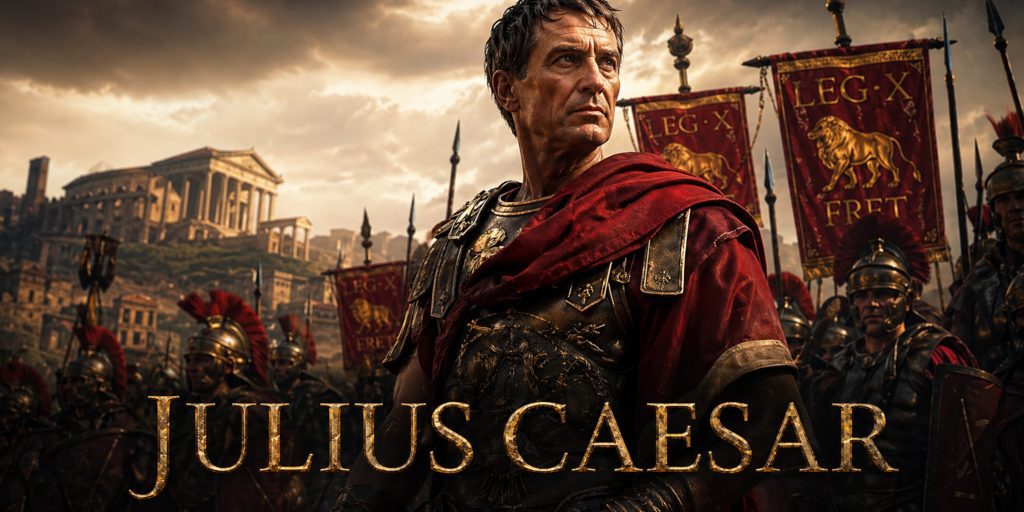
Caesar commanded a hardened Roman force made up primarily of legionaries, supported by cavalry and auxiliary troops.
| Roman Forces | Estimated Numbers |
|---|---|
| Roman legions | 6 legions |
| Legionaries | 25,000 to 35,000 |
| Allied auxiliaries | Several thousand |
| Cavalry | Approximately 4,000 |
The Roman army at Bibracte included experienced veterans, though some legions were newly raised. Caesar’s ability to maintain discipline during prolonged campaigning was already becoming clear.
Helvetii Coalition
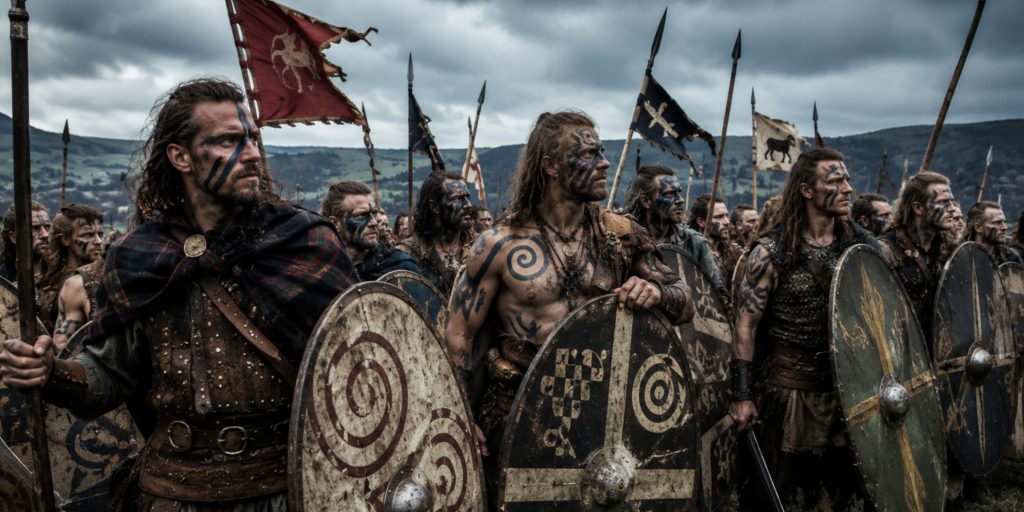
The Helvetii were joined by allied tribes including the Boii and Tulingi.
| Helvetii Coalition | Estimated Numbers |
|---|---|
| Warriors | 50,000 to 70,000 |
| Non-combatants | Possibly over 100,000 |
| Wagons and baggage | Massive migration train |
Ancient sources famously inflate the total numbers into the hundreds of thousands. Caesar claimed over 368,000 migrants. Modern historians tend to cough politely at this figure and quietly lower it by a great deal.
Even conservative estimates still suggest an enormous migrating population.
Commanders
| Side | Commander | Notes |
|---|---|---|
| Roman Republic | Julius Caesar | Governor of Cisalpine and Transalpine Gaul |
| Helvetii Confederation | Divico | Veteran leader who had previously defeated Roman forces decades earlier |
Divico was no amateur tribal chieftain wandering about with a painted shield and vague enthusiasm. He had already faced Rome successfully during the Cimbrian conflicts. Caesar likely understood he was facing an experienced opponent.
Arms and Armour
The battle featured a fascinating contrast between Roman military standardisation and Celtic flexibility.
Roman Arms and Armour
Roman legionaries fought in disciplined formations with highly standardised equipment.
Weapons
- Gladius Hispaniensis, short thrusting sword designed for close combat
- Pilum, heavy throwing spear intended to bend on impact
- Dagger (pugio)
- Cavalry spears
Armour
- Mail armour (lorica hamata)
- Large rectangular shield (scutum)
- Montefortino and Coolus helmets
- Greaves for some officers and elite troops
The Roman gladius was particularly effective in dense infantry fighting. Caesar’s men were trained to stab rather than slash, which was less dramatic but usually more fatal. Roman military practicality rarely cared about theatrical flourish.
Helvetii Arms and Armour
The Helvetii and their allies fought in traditional Celtic style.
Weapons
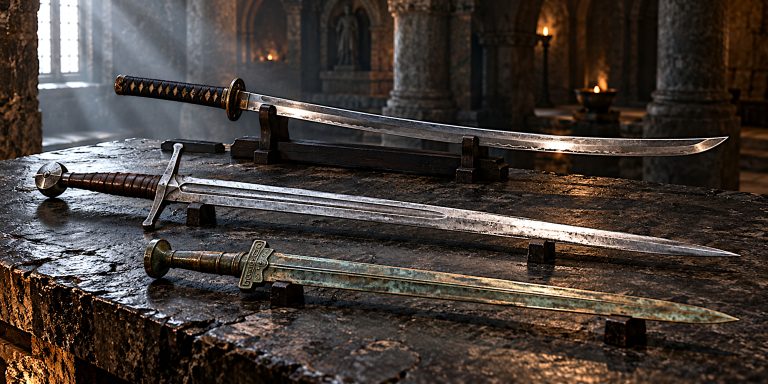
- Long slashing swords, likely La Tène-style Celtic blades
- Spears and javelins
- Large oval shields
- Axes and knives
Armour
- Mail shirts among wealthy warriors
- Bronze and iron helmets
- Heavy cloaks and layered clothing
- Many warriors likely fought with minimal armour
Celtic swords of this period were often longer than Roman gladii and designed for cutting attacks. They could be devastating in open combat but were less efficient in tightly packed formations.
The Battle Timeline
Morning
Caesar’s army moved toward Bibracte seeking supplies from the Aedui. The Helvetii interpreted the movement as retreat and decided to attack.
Roman forces rapidly formed defensive lines on a nearby hill.
Midday
The Helvetii launched uphill assaults against Roman positions.
Roman legionaries threw pila into advancing Celtic ranks before engaging in close combat.
The fighting became intense and prolonged.
Afternoon
The Helvetii began to falter under Roman discipline and repeated counterattacks.
However, allied Boii and Tulingi forces struck the Roman flank, creating a dangerous situation.
Caesar reportedly redeployed his reserves personally.
Late Afternoon
Roman troops eventually drove back the Helvetii coalition after brutal hand-to-hand fighting.
The Helvetii retreated toward their wagon camp.
Evening
The battle continued around the baggage train, where desperate resistance persisted.
Women and children reportedly participated in the defence of the camp.
The fighting finally ended after hours of attritional combat.
Tactics and Combat
Bibracte demonstrated the strengths of the Roman legion system:
- Flexibility
- Reserve deployment
- Unit discipline
- Coordinated missile attacks
The Helvetii fought fiercely and nearly overwhelmed parts of Caesar’s line. This was not a casual Roman stroll through Gaul with dramatic speeches and perfectly polished armour.
Caesar’s position became genuinely dangerous at several moments.
The uphill Roman deployment proved critical. It slowed the Helvetii advance and maximised the effectiveness of Roman pila volleys.
Roman reserves also played a decisive role. Caesar repeatedly emphasised command flexibility in his writings, partly because it genuinely mattered and partly because he enjoyed reminding readers how clever he was.
Casualties
Exact losses remain unknown.
| Side | Estimated Casualties |
|---|---|
| Romans | Several thousand |
| Helvetii coalition | Heavy losses, possibly tens of thousands |
Caesar claimed the Helvetii were nearly annihilated. Modern historians are sceptical. The Romans clearly won decisively, but ancient casualty figures often resemble fishing stories after several cups of wine.
Archaeology
Archaeological work at Mont Beuvray has revealed extensive evidence of late Iron Age settlement and Roman contact.
Finds include:
- Celtic fortifications
- Roman military items
- Coins from both Gallic and Roman contexts
- Weapon fragments
- Imported Mediterranean goods
While the precise battlefield remains uncertain, the archaeology confirms Bibracte’s importance as a major Gallic centre during Caesar’s campaigns.
Excavations have also revealed sophisticated urban planning within the oppidum itself:
- Workshops
- Roads
- Elite residences
- Defensive walls using murus gallicus construction
The discoveries challenge older stereotypes of Gauls as disorganised barbarians. Bibracte was a substantial political and economic centre long before Rome arrived announcing civilisation at sword-point.
Contemporary Quotes
Julius Caesar on the battle
“The battle was long and fiercely contested.”
Caesar describing the Helvetii
“They fought with the greatest bravery.”
Caesar on the aftermath
“Not one enemy turned his back.”
Like many ancient military accounts, Caesar’s writing mixes admiration with political messaging. Praising the enemy also made his own victory appear more impressive. Roman authors understood marketing perfectly well two thousand years before social media inflicted it on the planet.
Aftermath
The defeat shattered the Helvetii migration.
Caesar ordered the survivors to return to their homeland, partly to create a buffer zone against Germanic tribes east of the Rhine. Rome preferred frontier states that were weakened enough to obey but strong enough to absorb someone else’s invasion first.
The victory also transformed Caesar’s reputation:
- It strengthened his authority in Gaul
- It boosted his political standing in Rome
- It marked the true beginning of the Gallic Wars
Over the next years, Caesar would conquer vast parts of Gaul and accumulate the power that eventually helped trigger the collapse of the Roman Republic.
Bibracte was not the largest battle of Caesar’s career, but it was one of the most important stepping stones on his road to dictatorship.
Legacy of the Battle
The Battle of Bibracte remains significant because it represents:
- Rome’s expanding domination of Gaul
- The effectiveness of the Roman legion system
- The opening phase of Caesar’s rise to power
- One of the best documented battles of the late Iron Age
It also captures a recurring pattern in Roman history. Rome often framed offensive expansion as defensive necessity. Caesar did not merely defeat the Helvetii. He crafted a narrative in which Rome had no choice but to intervene. Future empires would learn the same trick remarkably quickly.
Takeaway
The Battle of Bibracte was brutal, chaotic and deeply consequential. Caesar emerged victorious, but the fighting exposed how dangerous the Gallic tribes could be when united and determined.
For historians, the battle sits at the crossroads of myth and evidence. We rely heavily on Caesar’s account, yet archaeology and comparative analysis continue to reshape our understanding of what happened beneath the hills near Bibracte.
One thing remains certain. After 58 BC, Gaul would never be the same again.