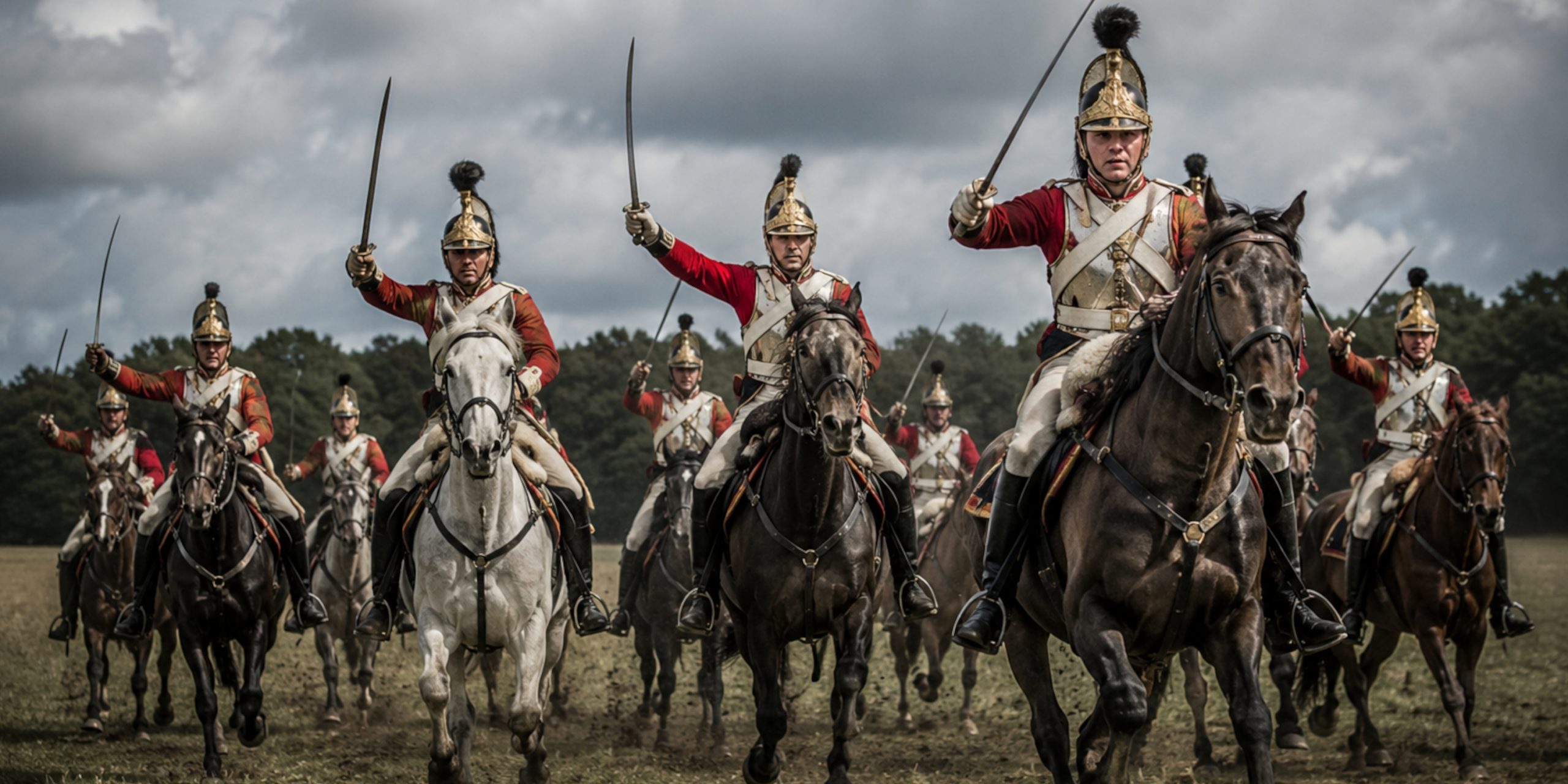
The British Light Dragoons occupy a curious place in military history. They were glamorous enough for paintings, reckless enough for poetry, and practical enough to terrify infantry caught out in open ground. They sat somewhere between scout, raider, mounted skirmisher and battlefield opportunist. Officers often fancied themselves as dashing cavalry heroes. The horses occasionally disagreed.
By the late 18th century and through the Napoleonic Wars, the Light Dragoons became one of Britain’s most recognisable mounted forces. They carried curved sabres, pistols, carbines, and a reputation for speed that was sometimes deserved and sometimes aided greatly by enemy panic.
Unlike the heavier cavalry regiments, which existed to smash through formations with brute force, the Light Dragoons specialised in mobility, reconnaissance, screening manoeuvres, pursuit, and sudden violence delivered at alarming speed. Wellington valued them greatly, though he also spent a fair amount of time complaining about them. That is usually the sign of a useful cavalry arm.
Origins of the British Light Dragoons
The term “dragoon” originally referred to mounted infantry. Early dragoons rode to battle but often fought on foot. Over time, European armies gradually transformed many dragoon units into true cavalry.
Britain followed the same pattern. During the 18th century, the British Army began adapting some dragoon regiments into lighter cavalry better suited to scouting and rapid operations. Continental warfare had demonstrated the value of nimble mounted troops, especially after encounters with Austrian, Prussian, and French light cavalry.
By the Seven Years’ War, British commanders recognised that heavy cavalry alone could not handle the fluid realities of campaigning across Europe and colonial theatres.
The official transition accelerated during the 1750s and 1760s. Several regiments were redesignated as Light Dragoons, adopting lighter equipment and revised tactical roles.
The American War of Independence further reinforced their usefulness. Open terrain, long patrols, ambushes, and rapid communication all suited light cavalry far more than rigid battlefield charges.
The Role of the Light Dragoons
The Light Dragoons rarely fought as simple shock cavalry. Their duties were varied and exhausting.
Main Battlefield Roles
- Reconnaissance
- Screening advancing armies
- Pursuing retreating enemies
- Harassing supply lines
- Escorting officers and artillery
- Raiding camps and depots
- Countering enemy cavalry scouts
- Delivering rapid battlefield messages
In practice, this meant endless riding, poor sleep, muddy boots, and horses that developed opinions about warfare.
A successful Light Dragoon regiment needed discipline more than glamour. Poorly controlled cavalry could easily outrun support and become isolated. The British learned this lesson repeatedly in the Peninsular War.
The Napoleonic Wars and the Rise of the Light Dragoons
The Napoleonic Wars became the defining era of the British Light Dragoons.
Regiments served throughout the Peninsular Campaign, the Low Countries, and eventually at Waterloo. They fought French chasseurs à cheval, hussars, lancers, and cuirassiers across Spain and Belgium.
Some of the most famous regiments included:
| Regiment | Notable Campaigns |
|---|---|
| 10th Royal Hussars | Peninsula, Waterloo |
| 11th Light Dragoons | Peninsula |
| 13th Light Dragoons | Peninsula, Waterloo |
| 15th Light Dragoons | Emsdorf, Peninsula |
| 16th Light Dragoons | India, Peninsula |
The 15th Light Dragoons earned particular fame at the Battle of Emsdorf in 1760, where they captured large numbers of French prisoners and standards. Their success helped legitimise the effectiveness of British light cavalry.
During the Peninsular War, Light Dragoons became indispensable to Wellington’s army. They screened troop movements, scouted French positions, and pursued retreating forces after battles such as Salamanca and Vittoria.
Yet cavalry commanders often struggled with restraint. British cavalry charges had a habit of becoming wildly enthusiastic. A successful attack could quickly turn into a chaotic pursuit stretching miles beyond support.
Wellington himself famously remarked:
“Our officers of cavalry have acquired a trick of galloping at everything.”
That sentence carries the exhausted tone of a man who had watched cavalry disappear over the horizon one too many times.
Arms and Armour
British Light Dragoons balanced mobility with offensive capability. Their equipment evolved throughout the late 18th and early 19th centuries.
Swords Used by the Light Dragoons
The sabre became the defining weapon of the British Light Dragoon.
Common Sword Types
| Sword | Period | Characteristics |
|---|---|---|
| 1788 Pattern Light Cavalry Sabre | Late 18th century | Curved blade designed for slashing attacks |
| 1796 Pattern Light Cavalry Sabre | Napoleonic era | Broad curved blade with strong cutting power |
| 1821 Pattern Light Cavalry Sabre | Post Napoleonic | More refined design balancing cut and thrust |
The famous 1796 Pattern Light Cavalry Sabre remains one of the most iconic British military swords ever produced.
Its curved blade was heavily influenced by Central European cavalry sabres, especially Austrian examples admired by British officers. The weapon excelled in mounted slashing attacks.
French cavalry reportedly feared its cutting ability. Contemporary battlefield injuries certainly suggest it was devastating in close combat.
The weapon’s downside was subtlety. It handled with all the delicacy of an angry farm tool. Elegant thrusting was not really its purpose.
Firearms and Secondary Weapons
Light Dragoons also carried firearms.
Standard Equipment
- Flintlock pistols
- Cavalry carbines
- Occasionally muskets during earlier periods
- Sabretache equipment pouches
- Powder flasks and ammunition boxes
Mounted firearms were often inaccurate during rapid movement, though useful during skirmishing and scouting operations.
The sabre remained the decisive weapon once cavalry closed with the enemy.
Uniforms and Protective Equipment
Light Dragoon uniforms evolved considerably over time.
Common Features
- Tarleton helmets during the late 18th century
- Braided dolman jackets
- Pelisses in hussar influenced units
- High riding boots
- Spurs
- Leather crossbelts
Unlike heavy cavalry, Light Dragoons generally wore minimal armour. Speed mattered more than protection.
Tarleton helmets became especially associated with British light cavalry during the American Revolutionary War. Their dramatic crest and leather construction created a distinctive silhouette, though comfort was another matter entirely.
Many cavalrymen modified uniforms during campaign conditions. Spanish dust, Belgian rain, and horse sweat had little respect for parade regulations.
Tactics and Battlefield Behaviour
British Light Dragoons relied on speed, discipline, and momentum.
Common Tactical Methods
- Flank reconnaissance
- Mounted skirmishing
- Rapid pursuit operations
- Hit and run raids
- Screening infantry advances
- Counter cavalry actions
A well executed cavalry charge depended on cohesion. Horses had to maintain formation while accelerating across uneven ground toward armed infantry or rival cavalry.
Timing mattered enormously.
Infantry squares could repel cavalry effectively if properly formed. Disordered infantry, however, were vulnerable to devastating mounted attacks.
Light Dragoons also excelled after battles. Pursuit often inflicted greater losses on retreating armies than the battle itself.
French forces retreating through Spain learned this repeatedly to their misfortune.
The Light Dragoons at Waterloo
At Waterloo in 1815, British Light Dragoons participated in several major cavalry engagements.
Units such as the 13th Light Dragoons operated alongside heavier cavalry formations and allied mounted troops.
The battlefield conditions were dreadful. Mud slowed horses, exhausted men, and complicated manoeuvres. Cavalry charges became fragmented and difficult to coordinate.
Despite this, British light cavalry contributed to the pressure exerted against French forces throughout the battle.
The campaign also highlighted a constant truth about cavalry warfare. Horses were as important as the men themselves.
An exhausted horse turned even the finest cavalryman into an unusually vulnerable pedestrian.
Archaeology and Material Evidence
Archaeological discoveries continue to illuminate the daily realities of British cavalry service.
Battlefield Finds
Excavations from Peninsular War sites and Waterloo have uncovered:
- Cavalry sabre fragments
- Horse harness fittings
- Pistol shot
- Carbine ammunition
- Uniform buttons
- Spur fragments
- Belt buckles
Waterloo excavations have revealed evidence of cavalry movement patterns through concentrations of horse remains and military debris.
Some sabre damage on skeletal remains demonstrates the brutal effectiveness of mounted edged weapons. Cavalry combat was intimate, violent, and often shockingly fast.
Museum Collections
Important collections relating to the Light Dragoons can be found at:
- The National Army Museum in London
- Regimental museums across Britain
- The Royal Armouries in Leeds
- Waterloo battlefield collections in Belgium
Surviving sabres often show heavy sharpening and field wear. These were working weapons, not ornamental parade pieces.
Though some officers certainly spent more time polishing boots than preparing tactics.
Daily Life of a Light Dragoon
Life in the cavalry revolved around the horse.
Troopers spent enormous amounts of time feeding, grooming, cleaning, inspecting, and managing mounts. Campaign success depended heavily on horse health.
Poor forage could cripple cavalry effectiveness within weeks.
Rations varied wildly depending on theatre and supply conditions. Disease among horses was a constant concern. So too were saddle sores, exhaustion, and poor weather.
Pay was inconsistent, promotion limited, and campaign conditions brutal.
Yet cavalry service also carried prestige. Many young recruits viewed the mounted regiments as more glamorous than infantry service.
Recruitment posters naturally omitted details involving dysentery and sleeping beside anxious horses in freezing rain.
Contemporary Quotes
Several observers left vivid impressions of British cavalry.
Captain Mercer of the Royal Horse Artillery wrote of British cavalry attacks:
“The ground trembled beneath the charge.”
French observers frequently commented on the aggression of British mounted troops.
One French officer described British cavalry as:
“Magnificent in attack, terrible in pursuit, and often impossible to restrain.”
That final point appears repeatedly across nearly every campaign record involving British cavalry.
Legacy of the British Light Dragoons
The Light Dragoons left a lasting mark on British military tradition.
Over time, many regiments transitioned into hussars or lancer formations as military fashion and tactical doctrines evolved.
The decline of cavalry in the late 19th and early 20th centuries eventually reduced the battlefield role of mounted troops. Machine guns, rifled artillery, and industrial warfare transformed cavalry from battlefield dominance into vulnerability.
Yet the image of the British Light Dragoon endured.
Their curved sabres, elaborate uniforms, and reckless battlefield reputation became central to popular memory of the Napoleonic Wars.
Modern regiments within the British Army still preserve many of their traditions, battle honours, and ceremonial customs.
The romance of cavalry warfare survives partly because it balanced discipline with chaos. At its best, a Light Dragoon charge combined precision, speed, courage, and an alarming willingness to ride directly toward danger with very little hesitation.
Historians admire the effectiveness. Horses probably had mixed feelings.
Takeaway
The British Light Dragoons represented one of the most adaptable and feared cavalry forces of their era. They operated across Europe and beyond, carrying out reconnaissance, raiding, pursuit, and combat duties that demanded stamina and nerve in equal measure.
Their weapons, particularly the famous 1796 sabre, became symbols of British cavalry power during the Napoleonic age. Archaeological discoveries continue to reveal the realities behind the romantic image, exposing a world of exhaustion, violence, mud, horse sweat, and extraordinary courage.
For all the mythology surrounding cavalry warfare, the Light Dragoons succeeded because they mastered movement. In an age before engines and radios, speed on horseback could decide campaigns.
And occasionally ruin a French general’s afternoon rather dramatically.