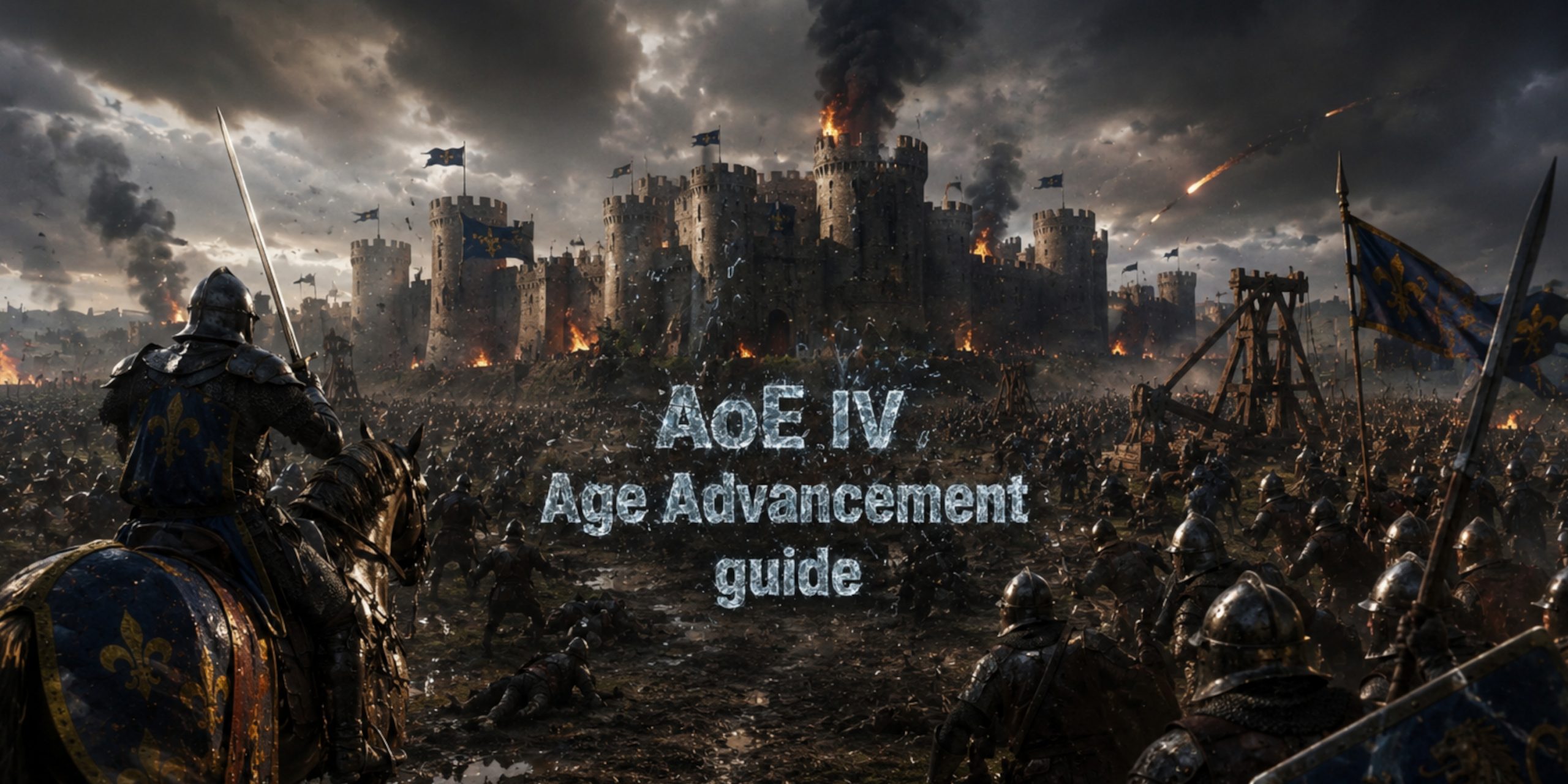
Few decisions in Age of Empires IV shape a match more than when you advance to the next Age. Every player has faced the same dilemma. Do you click up early for stronger units, or squeeze every last resource from your economy before investing? Get it right and you suddenly control the pace of the game. Get it wrong and you’re wondering why your opponent has knights knocking at your Town Center while you’re still arguing with your villagers over enough gold.
Age advancement is much more than unlocking new units. It changes your civilisation’s identity, opens new technologies, expands strategic options, and determines whether you dictate the match or spend the next ten minutes desperately defending.
This guide explains exactly how age advancement works, when you should move up, and how different civilisations approach one of the game’s biggest strategic decisions.
How Age Advancement Works
Every match begins in the Dark Age (Age I).
To progress, you must gather the required resources and construct one of your civilisation’s available Landmarks. Unlike previous Age of Empires games, your Landmark choice is permanent and becomes a defining feature of your strategy.
The four Ages are:
| Age | Focus |
|---|---|
| Dark Age | Economy setup, scouting and opening build |
| Feudal Age | Military expansion and map control |
| Castle Age | Powerful units, relics and advanced economy |
| Imperial Age | Elite armies, siege warfare and late game technologies |
Each advancement unlocks:
- New military units
- Additional technologies
- Economic upgrades
- Stronger buildings
- More strategic flexibility
Your Landmark is not simply a requirement. It is often the centrepiece of your entire game plan.
The Importance of Landmarks
Every civilisation chooses between two unique Landmarks when advancing.
These are effectively free powerful buildings that offer significant bonuses.
Examples include:
- Economic improvements
- Military production
- Defensive advantages
- Technology discounts
- Religious bonuses
- Resource generation
Choosing the correct Landmark is often as important as choosing when to age up.
Some Landmarks create immediate military pressure, while others reward longer economic games.
The Dark Age: Building the Foundations
The Dark Age is surprisingly important despite its simplicity.
Your priorities should include:
- Constant villager production
- Efficient food gathering
- Early scouting
- Identifying enemy civilisation
- Locating sheep, deer and boar
- Planning expansion
Newer players often stay in the Dark Age too long.
Unless your civilisation specifically benefits from it, spending excessive time in Age I usually puts you behind.
The goal is to establish a healthy economy while avoiding idle Town Center time. Every second without producing villagers is effectively giving your opponent free resources.
Advancing to the Feudal Age
For most standard openings, players advance between four and six minutes.
Moving into the Feudal Age unlocks:
- Archers
- Spearmen
- Horsemen
- Blacksmith upgrades
- Additional economic technologies
- Defensive structures
More importantly, it opens aggressive possibilities.
Many matches are decided by who establishes early map control rather than who builds the biggest economy.
An early Feudal timing can:
- Pressure enemy villagers
- Secure sacred sites
- Protect trade routes
- Control relic locations before Castle Age
- Force defensive investments
The trick is arriving with enough economy to actually use these advantages.
A fast Feudal with no army often accomplishes very little.
When Should You Stay in Feudal?
Not every game requires an immediate rush to Castle Age.
Remaining in Feudal can be the correct choice when:
- You have military momentum
- Your opponent is under pressure
- You’re controlling most resources
- Your civilisation excels in Feudal combat
- You need to defend against aggression
Civilisations such as the English can remain incredibly dangerous throughout the entire Feudal Age thanks to powerful longbow pressure.
Sometimes the strongest strategy is simply refusing to let your opponent breathe.
Castle Age Changes Everything
Castle Age is arguably the biggest power spike in the game.
It unlocks:
- Heavy cavalry
- Men-at-Arms improvements
- Crossbowmen
- Springalds
- Monks
- Relic collection
- Veteran unit upgrades
- Strong economic technologies
Many experienced players view Castle Age as the point where the real strategic depth begins.
Relics become available, stronger siege appears, and elite military compositions start to emerge.
If both players reach Castle Age safely, the match usually shifts away from early raids toward larger tactical engagements.
Why Relics Matter
One of the biggest reasons to reach Castle Age quickly is relic control.
Each relic provides a steady stream of gold throughout the game.
Securing multiple relics can generate thousands of extra resources over a long match.
Ignoring relics is one of the easiest ways to fall behind economically without even noticing.
Fast Castle strategies often exist almost entirely to secure relics before the opponent can react.
Imperial Age and the Late Game
Imperial Age transforms armies into their strongest versions.
You gain access to:
- Elite upgrades
- Powerful siege
- Final economic technologies
- Unique civilisation bonuses
- Maximum military potential
Games reaching Imperial usually revolve around:
- Population efficiency
- Gold control
- Siege warfare
- Wonder victories
- Sacred Site pressure
At this stage, every unit lost matters more because armies become increasingly expensive to replace.
Players who arrive in Imperial with a stronger economy often snowball into overwhelming map control.
Fast Age Up vs Greedy Economy
One of the biggest strategic choices is deciding whether to age quickly or build a stronger economy first.
Fast Age Up
Advantages:
- Earlier military technology
- Stronger units sooner
- Initiative
- Earlier relic access
- Faster pressure
Disadvantages:
- Smaller economy
- Fewer villagers
- Vulnerable to counter attacks
- Limited production
Greedy Economy
Advantages:
- More villagers
- Better long-term income
- Easier army production later
- Stronger macro
Disadvantages:
- Risk of early aggression
- Delayed military upgrades
- Slower map control
Neither approach is universally correct.
Good players constantly adjust based on scouting rather than following rigid build orders.
Civilisations That Approach Age Advancement Differently
Every civilisation values age progression in slightly different ways.
English
Often comfortable playing extended Feudal games thanks to longbows and strong defensive bonuses.
French
Frequently prioritise early Feudal to unleash Royal Knights before opponents are ready.
Holy Roman Empire
Often aims for an efficient Castle Age to secure relics and powerful economic bonuses.
Rus
Can comfortably adapt depending on bounty collection and map control.
Mongols
Their mobility allows flexible timing that punishes predictable opponents.
Delhi Sultanate
Often balances military pressure with sacred site control rather than simply rushing through the Ages.
Understanding these differences helps you anticipate what your opponent is likely planning before they even reveal their army.
Reading Your Opponent’s Age Timing
Scouting should never stop after the opening minutes.
Signs your opponent is preparing to advance include:
- Reduced military production
- Large stockpiles of food and gold
- Multiple villagers moving toward Landmark construction
- Fewer new military units
- Defensive positioning
Recognising these clues allows you to choose whether to attack immediately or prepare to match their timing.
Many games are won simply because one player noticed an age up thirty seconds earlier.
Common Age Advancement Mistakes
Even experienced players occasionally fall into these traps.
Advancing Too Early
A shiny new Age means little if you cannot afford the units it unlocks.
Advancing Too Late
Remaining in an earlier Age while your opponent fields stronger armies rarely ends well.
Ignoring Landmarks
Your Landmark should support your strategy, not simply be whichever one you happened to click first.
Forgetting Military Production
Many players invest everything into ageing up and discover they have no production buildings ready.
Not Scouting
Age timing should respond to your opponent’s strategy, not just your own build order.
Adapting Throughout the Match
The best Age of Empires IV players treat age advancement as part of a wider strategic conversation.
Ask yourself throughout every game:
- Am I ahead economically?
- Who controls the map?
- Can I safely invest resources?
- Will advancing now create an advantage?
- What is my opponent trying to achieve?
Those answers matter far more than reaching a certain Age at an exact timestamp.
Takeaway
Age advancement in Age of Empires IV is one of those mechanics that looks simple until you realise almost every major decision branches from it. Your Landmark shapes your strategy, your timing influences every engagement, and one well judged age up can completely swing the momentum of a match.
There is no magical minute where everyone should click the button. Sometimes racing into Castle Age is the winning move. Other times, staying in Feudal and relentlessly applying pressure is exactly what your opponent does not want to see.
That constant tension is part of what makes AoE IV so compelling. Every match asks the same question in a slightly different way: Are you ready to move forward, or are you about to walk into a disaster wearing a very expensive new Age?