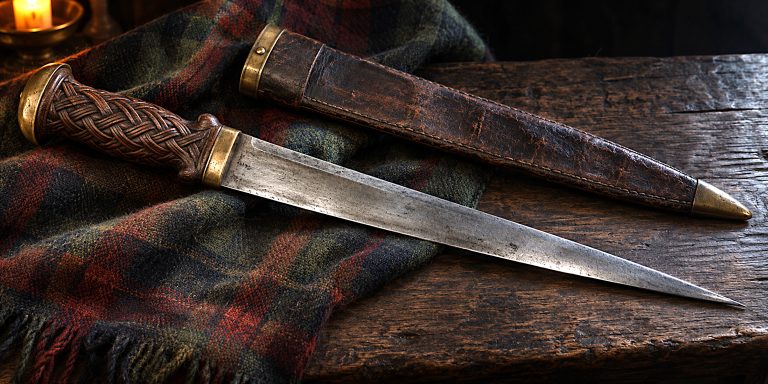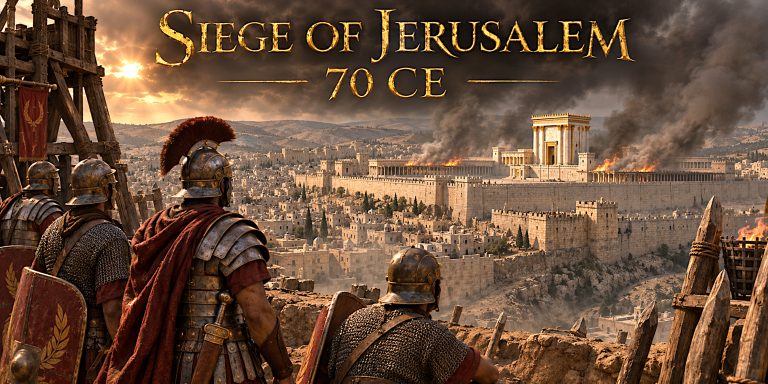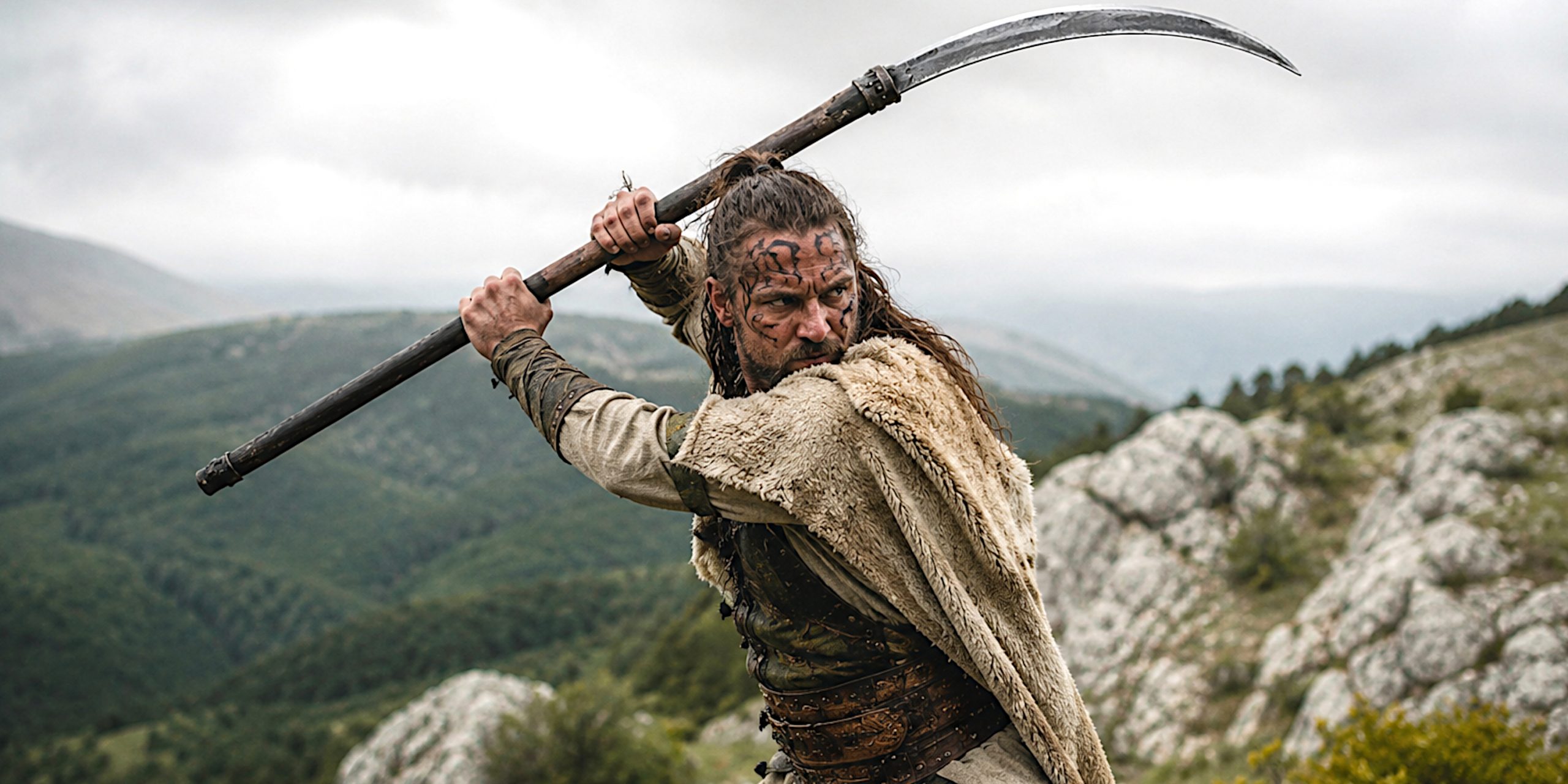
The falx was a curved, single-edged weapon most closely associated with the Dacians of the lower Danube and Carpathian region, particularly during their wars against Rome. Its cutting edge followed the inside of the curve, giving it a distinctive, sickle-like profile. Larger examples were wielded with both hands.
That outline is easy to recognise. Almost everything beyond it requires more care. Ancient names overlap, surviving blades are scarce, and Roman carvings were made to celebrate victory rather than record weapon measurements. The falx deserves its reputation as a dangerous weapon, but the familiar story of a blade that effortlessly defeated every Roman defence runs well ahead of the evidence.
What Is a Falx?
The Latin word falx could describe a sickle, scythe or other curved cutting implement. In discussions of ancient warfare, the Dacian falx usually means an inward-curving sword or longer cutting weapon associated with Dacian warriors.
Three distinctions help keep the terminology useful:
- Falx: a curved weapon with its cutting edge on the concave side, including substantial examples suited to two-handed use.
- Sica: a shorter curved dagger or weapon belonging to the broader Balkan tradition. Treating every sica as a miniature falx obscures differences in size and function.
- Rhomphaia: a long Thracian cutting weapon, related in general appearance and regional context but not automatically interchangeable with the falx.
Nor is the falx the same weapon as the Iberian falcata. Similar names have caused a remarkable amount of trouble for objects that were already sharp enough.
Falx Specifications

There was no single standard model. A useful specification must distinguish observable features from measurements supplied by modern replica makers.
| Feature | Historically supportable description |
|---|---|
| Principal association | Dacia, especially the region of modern Romania |
| Best-known military context | Late Iron Age Dacia and the Roman conquest in the early second century CE |
| Blade form | Curved, with the degree and position of curvature varying |
| Cutting edge | Single edge along the concave, inner side |
| Point | Often drawn into a curved, penetrating tip |
| Material | Ferrous metal; preservation can complicate assessment of original metallurgy |
| Grip | Larger forms required space for two hands; organic components frequently do not survive |
| Hand protection | No basis for assuming a standard medieval-style crossguard |
| Blade and overall length | Must be quoted for an identified artefact or reconstruction, not assigned to the entire type |
| Original weight | No dependable universal figure; corrosion and missing handles make comparisons difficult |
Published studies distinguish several curved weapon forms and acknowledge uncertainty in matching archaeological finds to artistic representations. Precise-looking dimensions can therefore be misleading unless the object behind them is named.
History and Evolution
Regional background. Curved blades belonged to a wider Thracian and Balkan weapon tradition. Their resemblance to agricultural tools is evident, but a simple progression from farm sickle to battlefield falx is harder to demonstrate than it is to illustrate.
Dacian development. Late Iron Age Dacian metalworkers produced weapons whose shapes and fittings varied. The surviving evidence does not support the idea of one mass-produced pattern carried by every warrior. Spears, shields and other weapons remained part of the Dacian military world.
The wars with Rome. The falx is particularly associated with the conflicts culminating in Trajan’s campaigns of 101–102 CE and 105–106 CE. Dacia’s conquest made curved weapons a conspicuous part of Roman representations of the defeated enemy.
After the conquest. The weapon remained recognisable in Roman imagery. Its symbolic life is easier to trace than an uninterrupted sequence of surviving blades. Claims that it directly produced medieval sabres or later European curved swords require evidence that resemblance alone cannot provide.
How the Falx Worked in Combat
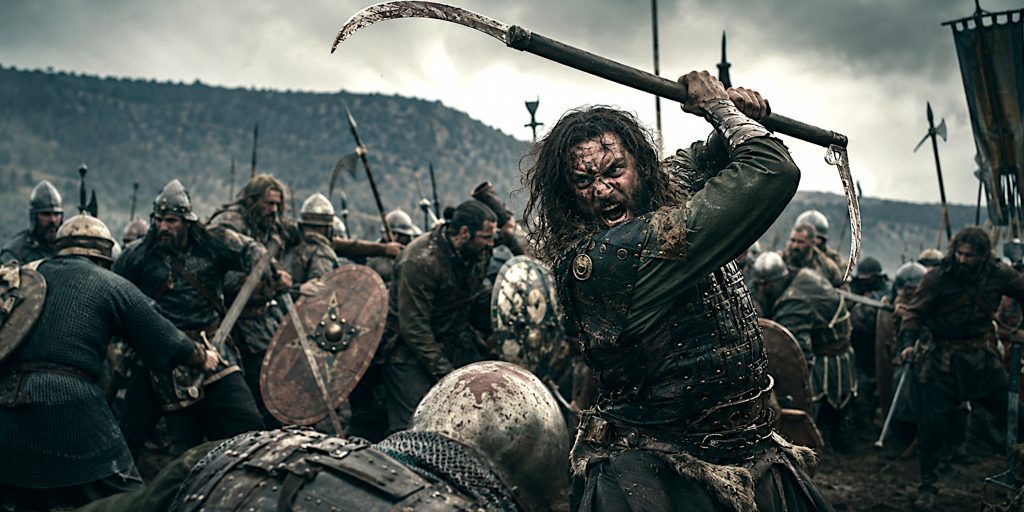
The following points are mechanical interpretations of the weapon’s shape, rather than a recovered Dacian fencing system.
An inward-facing edge lends itself to cutting actions that draw the target into the curve. A hooked point can approach an exposed area from a different angle to a straight blade. With a long grip, the wielder can apply both hands to control a forceful descending or diagonal stroke.
The idea of striking around a shield is plausible in some positions. It should not become a claim that the falx simply cancelled shields. Distance, timing, shield movement and the opponent’s response still mattered. A Roman soldier was unlikely to stand obligingly still while a theory was demonstrated.
No surviving Dacian combat manual tells us how attacks, recovery movements or formations were taught. Modern experiments can explore possibilities, but their results depend on the replica, target and method.
Advantages and Disadvantages
| Potential advantage | Practical qualification |
|---|---|
| Powerful cuts using a substantial blade and two-handed grip | Performance depended on construction, edge condition and technique |
| Curved point could threaten exposed areas beyond a shield edge | Getting the angle required an opening, not merely possession of the weapon |
| Reach offered by a longer weapon | Reach varied between forms and should not be assumed from the name |
| Distinctive attack geometry | An unusual shape also required familiarity and control |
Likely disadvantages
- Reduced personal shield protection: a two-handed grip prevents ordinary simultaneous use of a hand-held shield.
- Recovery after commitment: a missed or deflected forceful stroke could leave the wielder exposed.
- Space requirements: larger weapons need room to move, particularly beside friendly troops.
- Less direct thrusting: the curved point does not behave like the point of a straight sword.
- Risk of catching: hooking into equipment might disrupt an opponent, but could also delay withdrawal of the blade.
These trade-offs are more useful than declaring the falx either a battlefield miracle or an impractical curiosity.
Did the Falx Change Roman Armour?
Roman representations of the Dacian fighting show soldiers with substantial protection, including arm defences. Helmet reinforcement is also frequently discussed as a response to curved cutting weapons. That connection is reasonable to investigate, but it should be presented as interpretation rather than a surviving Roman order explicitly blaming the falx.
The segmented arm guard, or manica, deserves particular care. Roman arm protection was not confined to Dacia. The surviving Newstead example, now displayed in Edinburgh, demonstrates its use in Roman Britain as well.
Accordingly, the strongest cautious conclusion is that the falx presented a serious threat and may have encouraged protective adaptations. It does not follow that Trajan invented arm guards, or that Roman soldiers abandoned them immediately after conquering Dacia.
Comparison with Similar Weapons
| Weapon | General form | Usual handling | Main distinction from the falx |
|---|---|---|---|
| Dacian falx | Inward-curving, single-edged blade | Larger forms used with two hands | Concave cutting edge and distinctive curved point |
| Sica | Shorter curved dagger or blade | One hand | More compact; a related category rather than a universal synonym |
| Thracian rhomphaia | Long blade with a substantial grip; curvature varies | Commonly reconstructed for two hands | Separate regional and typological identity despite overlap |
| Iberian falcata | Broad, recurved sword | One hand | Cutting profile and hilt differ; associated with Iberia |
| Roman gladius | Short, straight, double-edged sword | One hand, commonly with a shield | Direct thrusting and compact handling |
| Roman spatha | Longer, straight, double-edged sword | One hand | Different point geometry and a longer straight blade |
There is no sensible universal winner. A weapon’s usefulness depended on the person holding it, the equipment around it and the conditions of the fight.
Legacy of the Dacian Falx
Roman victory monuments helped preserve the falx as an identifying feature of Dacia. The conquerors turned an enemy weapon into an emblem of conquest, a familiar imperial habit with unusually memorable blade geometry.
Today it appears in historical reconstruction, museum interpretation and popular depictions of Dacian warfare. Its distinctive outline makes it useful for visual storytelling, although modern versions sometimes enlarge it into something closer to fantasy equipment.
Its historical significance lies in the relationship between regional craftsmanship, warfare and Roman representation. It does not need an invented family tree of later swords to remain interesting.
Where to See a Falx and Related Evidence
| Location | What to look for | Visitor guidance |
|---|---|---|
| National Museum of Transylvanian History, Cluj-Napoca, Romania | Published Dacian curved-blade material, including the well-known example discussed in specialist studies | Ask whether the relevant weapon is currently exhibited; collection ownership does not guarantee display |
| Adamclisi Museum Complex, Romania | Original sculptural material from Tropaeum Traiani, important for studying weapons and armour in Roman representations of the fighting | Read the reliefs as artistic evidence, not scale drawings |
| Trajan’s Column, Rome, Italy | Roman depictions of the Dacian campaigns | Detailed photographs are useful because many scenes are difficult to inspect from ground level |
| National Museum of Scotland, Edinburgh | The reconstructed Roman arm guard from Newstead | Related armour evidence, not an original falx |
The Adamclisi museum complex preserves material from the victory monument. National Museums Scotland also provides background on its Roman arm guard display.
Collector’s Guide: Identification and Condition
An ancient curved iron blade needs more than a persuasive label. Agricultural tools, fragmentary weapons, modern alterations and related blade types can all create identification problems.
Before considering an original, request:
- An ownership history: dated records, previous catalogues and photographs are more useful than “from an old collection”.
- An independent identification: ideally from a specialist familiar with Balkan Iron Age weapons.
- A condition report: look for joined fragments, replacement metal, reconstructed tips and modern handles.
- Clear photographs: both faces, the edge, tang, fracture lines and repaired areas.
- Supporting documentation: obtain the relevant records for lawful ownership and movement of the object.
- A conservation assessment: active corrosion can matter more than how complete the blade initially appears.
Avoid polishing archaeological iron to make it look like a newly forged sword. The surface can retain evidence worth far more than a shine.
For replicas, ask the maker to identify the archaeological or sculptural source used. A reconstruction with stated assumptions is more informative than a supposedly exact weapon assembled from several unrelated references.
Auction Prices: What the Records Actually Show
There is insufficient verified public sale evidence here to establish reliable price bands for original Dacian falces. Related sica lots provide context, but they should not be used as direct valuations of a larger falx.
| Auction record | Catalogue attribution | Published outcome | What it tells a collector |
|---|---|---|---|
| A10 by Artmark, The History Auction, 24 June 2025, lot 1 | Dacian sica with a scabbard fragment, catalogued to the first century BCE–first century CE | €3,000 recorded as sold | A documented result for a related weapon, not a falx price benchmark |
| Artmark Historical Art Auction, April 2025, listed Dacian sica | Dacian sword described as a sica | Listed as withdrawn | A withdrawn lot is not a sale and supplies no realised-price evidence |
| Original Dacian falx | Requires individual authentication and provenance | No defensible general range established from the checked records | Assess a specific object rather than rely on generic condition bands |
The June result appears in the published auction catalogue. The public summary does not establish whether the displayed figure includes buyer’s premium, so it should not be presented as a confirmed all-in purchase cost. The auction attribution is also not an independent authentication.
Prices are retained in the original currency to avoid giving a fluctuating sterling conversion the appearance of a permanent valuation. Add buyer’s premium, taxes, transport and conservation when assessing a particular purchase.
Further Reading
Cătălin Borangic’s study of Dacian curved weapon types is useful for understanding the identification problems behind the familiar silhouette. Its discussion makes clear why archaeological objects, ancient terminology and Roman imagery must be examined together.