The Dacian falxman remains one of the most feared warriors of the ancient world. Roman soldiers fought Gauls, Germans, Parthians and Britons, yet it was the curved blade of the Dacian falx that forced one of the greatest military machines in history to redesign its own armour.
That alone says plenty.
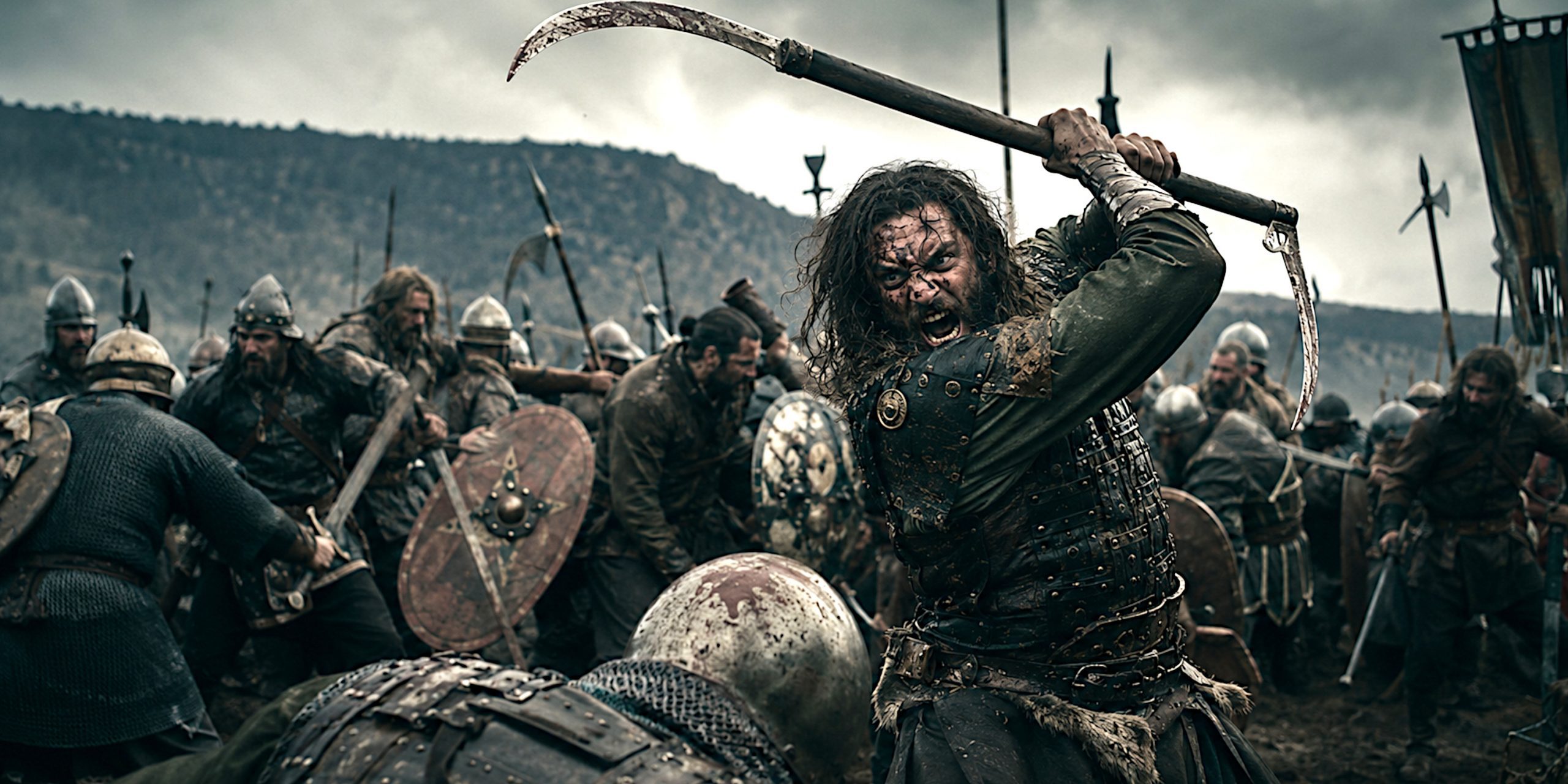
The image of a two-handed warrior swinging a wickedly curved blade from above has become almost legendary. Modern popular culture often exaggerates these warriors into unstoppable berserkers, but the historical reality is arguably more interesting. Dacian falxmen were disciplined specialist infantry who carried one of antiquity’s most unusual and effective battlefield weapons.
Although much about them remains uncertain, Roman writings, Trajan’s Column, archaeological discoveries and surviving weapons allow us to build a remarkably detailed picture.
Who Were the Dacian Falxmen?
The falxmen were elite or specialist infantry serving the Dacian kingdoms during the first and early second centuries AD, particularly under King Decebalus.
They were recruited from the peoples living across modern Romania, Moldova and parts of Serbia, Hungary and Bulgaria. Their mountain homeland produced tough warriors accustomed to difficult terrain, rapid movement and fierce resistance against invaders.
The falxman was not an entirely separate military class. Rather, he represented soldiers equipped with the devastating falx, often deployed where shock action was required.
During the Dacian Wars of AD 101 to 102 and AD 105 to 106, these warriors became the greatest battlefield threat faced by Emperor Trajan’s armies.
Origins of the Falx
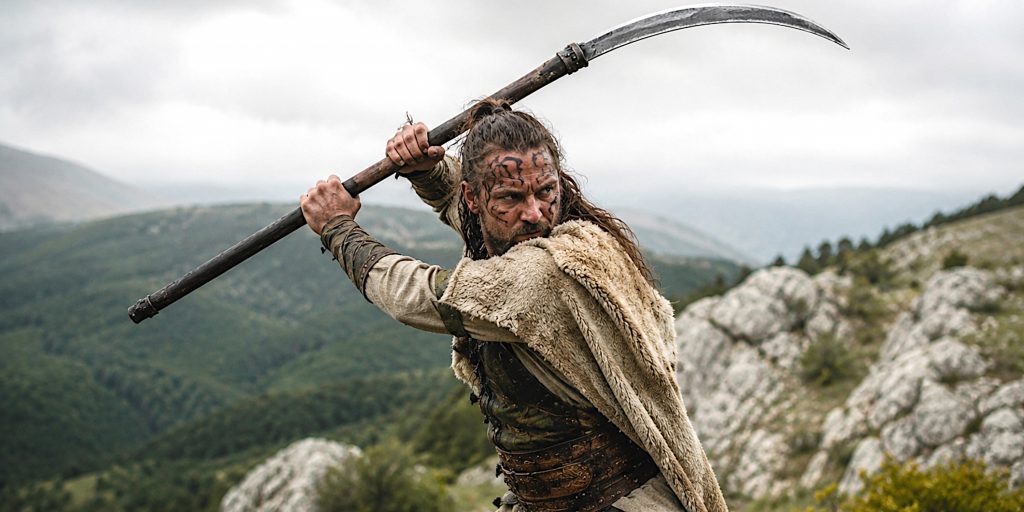
The curved falx evolved from agricultural tools and earlier curved fighting knives used throughout the Balkans.
Unlike the Roman sword, the falx relied upon leverage rather than thrusting precision.
Its inward-curving blade concentrated enormous force into a small point. The weapon could hook around shields, strike over defensive formations and generate terrifying cutting power.
There were several forms.
| Weapon | Description | Typical Length |
|---|---|---|
| Sica | Single-handed curved sword or dagger | 40 to 60 cm |
| One-handed falx | Larger curved weapon | 70 to 100 cm |
| Two-handed falx | Long pole-mounted curved blade | 1.5 to 2 metres |
The great two-handed falx became the defining weapon of the Dacian Wars.
Arms and Armour
The Falx
The famous falx was unlike almost every contemporary sword.
Construction
- Long wooden shaft
- Heavy iron blade
- Sharply curved cutting edge on the inside
- Pointed tip capable of penetrating armour
- Weight concentrated towards the end of the blade
The weapon functioned somewhere between a sword, polearm and axe.
A downward strike could split helmets, crush bones and shear through shields.
Other Weapons
Not every Dacian carried a falx.
Other common weapons included:
- Sica curved swords
- Straight iron swords
- Spears
- Heavy javelins
- Hunting spears
- Axes
- Knives
- Slings
- Bows
Many warriors probably carried both a spear and a sidearm, reserving the falx for specialised fighters.
Armour
Contrary to dramatic artwork, not every falxman charged into battle bare-chested.
Equipment varied according to wealth.
Typical protection included:
- Leather armour
- Quilted jackets
- Scale armour for wealthy nobles
- Iron helmets
- Fur caps
- Oval or round shields for ordinary infantry
Many two-handed falxmen probably abandoned shields entirely in favour of maximum striking power.
That certainly made them more dangerous. It also made them considerably easier to stab once a Roman legionary survived the first swing.
Helmets
Archaeological discoveries reveal several helmet styles:
- Iron conical helmets
- Phrygian-style helmets
- Bronze helmets
- Imported Celtic designs
Some were decorated with silver or bronze fittings belonging to noble warriors.
How the Falx Was Used
The falx excelled against disciplined infantry.
Rather than fencing with an opponent, the wielder delivered powerful chopping attacks aimed at:
- Heads
- Shoulders
- Arms
- Shield rims
- Necks
- Legs
The curved blade could hook behind Roman shields before pulling them aside.
It also attacked from above, exploiting weaknesses in Roman formations.
This proved especially dangerous during close fighting in rough terrain.
Roman Response
Perhaps the greatest testament to the falx comes from Rome itself.
Roman armour evolved specifically because of it.
Legionaries serving in Trajan’s Dacian campaigns began wearing additional reinforcements including:
- Crossbars riveted across helmets
- Extra iron helmet plates
- Reinforced cheek guards
- Improved arm guards (manicae)
- Heavier limb protection
Very few enemy weapons forced Rome to alter standard military equipment.
The falx achieved exactly that.
Battlefield Tactics
Dacian armies fought differently from the highly structured Roman legions.
Their strengths included:
- Fighting from forests
- Mountain warfare
- Ambushes
- Defensive hill fortifications
- Sudden counter-attacks
- Aggressive shock assaults
Falxmen likely formed assault troops during key moments of battle.
Once Roman formations became disrupted, these heavy blades became especially effective.
Organisation
Precise military organisation remains uncertain.
Evidence suggests Dacian armies consisted of:
- Noble cavalry
- Spearmen
- Archers
- Falxmen
- Tribal levies
- Allied Sarmatian cavalry
King Decebalus appears to have maintained a more permanent military structure than many neighbouring tribes.
Roman sources repeatedly acknowledge his organisational ability.
The Dacian Wars
The falx reached its greatest fame during Trajan’s campaigns.
First Dacian War (AD 101 to 102)
Trajan invaded Dacia after repeated frontier conflicts.
Despite Roman victories, Dacian resistance proved unexpectedly fierce.
The falx inflicted significant casualties.
Second Dacian War (AD 105 to 106)
Trajan returned with overwhelming force.
The Romans eventually captured the Dacian capital at Sarmizegetusa.
King Decebalus committed suicide rather than face capture.
Roman annexation followed, ending the independent Dacian kingdom.
Archaeology
Archaeology has transformed our understanding of Dacian warfare.
Important discoveries include:
Falx Blades
Numerous iron falx heads have been recovered across Romania.
These demonstrate variation in:
- Blade length
- Curvature
- Weight
- Manufacturing techniques
Many show evidence of repeated sharpening and battlefield use.
Hill Fortresses
The UNESCO-listed Dacian fortresses in the Orăștie Mountains reveal sophisticated military engineering.
Features include:
- Stone defensive walls
- Watchtowers
- Water systems
- Workshops
- Sacred sanctuaries
- Iron production
These were far more than simple tribal settlements.
Weapons Workshops
Excavations reveal large-scale iron production.
Recovered artefacts include:
- Sword blanks
- Spears
- Arrowheads
- Agricultural tools
- Smithing equipment
The Dacians possessed one of Europe’s most advanced iron-working traditions outside the Roman Empire.
Roman Battle Damage
Roman helmets recovered from Dacian battlefields display horrific damage.
Some exhibit deep cuts almost certainly produced by heavy curved blades.
These finds help explain why Roman armour was strengthened.
Contemporary Accounts
Much of what survives comes from Roman authors.
Cassius Dio
“The Dacians were formidable both in courage and in war.”
Dio describes Decebalus as a capable and intelligent opponent who repeatedly challenged Roman power.
Trajan’s Column
Although not a written source, Trajan’s Column functions as a contemporary visual narrative.
It depicts:
- Curved falx weapons
- Dacian clothing
- Fortifications
- Battle scenes
- Roman engineering
Like all victory monuments, it carries obvious Roman propaganda, yet remains invaluable.
Jordanes
Writing centuries later, Jordanes preserved traditions celebrating Dacian bravery, though his account mixes history with legend.
Strengths and Weaknesses
| Strengths | Weaknesses |
|---|---|
| Exceptional cutting power | Required considerable skill |
| Effective against shields | Two-handed versions lacked shield protection |
| Could damage armour | Less effective in tight formations |
| Excellent psychological impact | Slower recovery after large swings |
| Outstanding reach | Vulnerable to missile fire |
Legacy
The Dacian falx became one of history’s most influential battlefield weapons.
Its greatest legacy was not conquest but adaptation.
Rome changed.
Few enemy weapons can claim responsibility for altering Roman military equipment on an empire-wide campaign.
Modern reconstructions consistently demonstrate the frightening efficiency of the falx. Experimental archaeology has shown that replicas can inflict severe damage on shields, helmets and armour under controlled conditions, supporting the concerns expressed by Roman soldiers nearly two thousand years ago.
For historians, the falx also serves as a reminder that technological superiority is rarely absolute. The Roman army is often portrayed as an unstoppable machine, yet the Dacians found a weakness and exploited it with remarkable success.
That is perhaps the highest compliment any ancient enemy could receive.
Where to See Dacian Weapons Today
Several museums preserve important Dacian military artefacts.
- National Museum of Romanian History, Bucharest
- National Museum of Transylvanian History, Cluj-Napoca
- Museum of Dacian and Roman Civilisation, Deva
- Roman collections in the Capitoline Museums, Rome
- Casts and detailed studies of Trajan’s Column in museums across Europe
Interesting Facts
- The falx was one of the few foreign weapons that prompted widespread Roman armour modifications.
- Some falx blades exceeded a metre in length.
- The Dacians possessed sophisticated iron-working industries.
- Trajan’s Column contains over 2,500 carved human figures, many depicting Dacian warriors.
- King Decebalus was considered one of Rome’s most capable opponents of the early second century.
- Modern experimental archaeologists continue to test replica falxes against reconstructed Roman equipment, with results that remain impressively destructive.