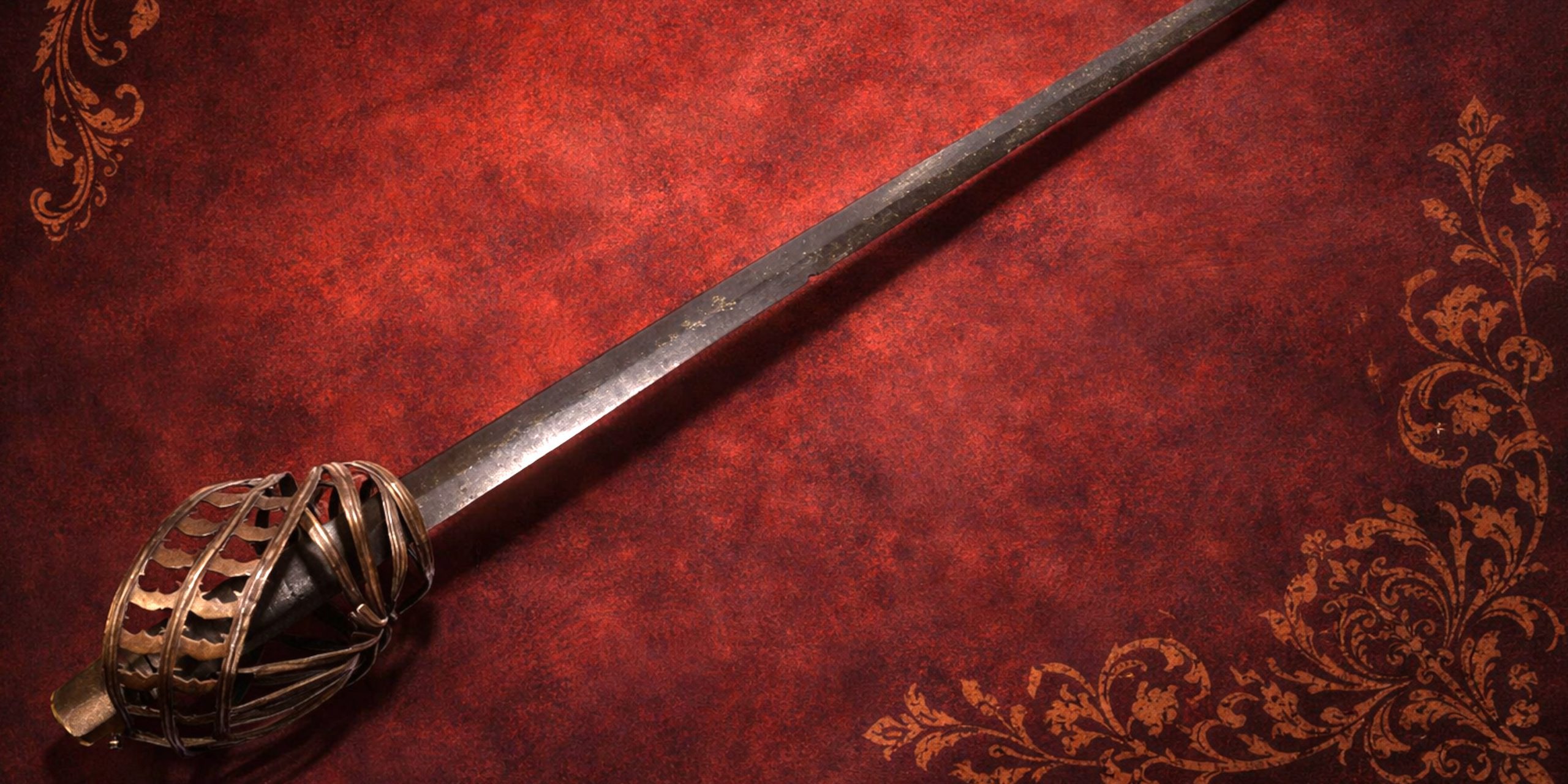
The Schiavona is one of the most distinctive swords of the late Renaissance. With its broad blade, cat’s-head pommel and cage-like basket hilt, it looks as though somebody took a broadsword and decided the wielder’s hand deserved the protection of a small iron conservatory.
Developed in Venice during the late 16th century, the Schiavona became closely associated with the Schiavoni, the Dalmatian and Slavic troops who served the Venetian Republic. It was carried by infantry, cavalry and, most famously, the bodyguards of the Doge.
Unlike the rapier, which dominated fashionable civilian life, the Schiavona remained unapologetically martial. It was built to cut, thrust and survive the sort of brutal close combat that tends to ruin both clothes and illusions of elegance.
By the 17th century the Schiavona had spread beyond Venice and could be found across much of Europe. Today it is one of the most sought-after forms of basket-hilted sword among collectors.
Specifications
| Feature | Typical Measurement |
|---|---|
| Overall length | 95-110 cm |
| Blade length | 80-95 cm |
| Blade type | Double-edged straight blade |
| Blade width | 3-4.5 cm at base |
| Weight | 1.1-1.5 kg |
| Grip length | 8-11 cm |
| Hilt type | Full basket hilt |
| Pommel | Distinctive cat’s-head form |
| Period of use | c. 1570-1750 |
| Primary users | Venetian infantry, cavalry, Doge’s guard |
Typical Features
- Broad, straight, double-edged blade
- Complex basket hilt made from interlaced bars
- Thumb ring or finger ring on many examples
- Heavy pommel shaped like a stylised cat’s head
- Usually designed as a cut-and-thrust weapon
- Often fitted with imported blades from Solingen in Germany
Many surviving Schiavonas use earlier blades that were rehilted during the 17th century. Venetian armourers were practical people. If an old blade was still sound, there was little point in throwing it away simply because the fashion had changed.
History and Evolution
Origins in Venice
The name “Schiavona” comes from the Italian word Schiavoni, meaning “Slavs”. Venetian authorities recruited large numbers of soldiers from Dalmatia, Istria and the eastern Adriatic coast. These men formed an important part of Venice’s infantry and later served as the bodyguard of the Doge.
The earliest forms of the Schiavona appeared in the second half of the 16th century. They developed from earlier side swords and military broadswords, particularly those used in northern Italy and the Balkans.
Early examples have relatively simple guards. By around 1600, the basket hilt became larger and more elaborate. The bars of the hilt formed a lattice around the hand, giving superb protection without making the weapon excessively heavy.
Type 1 and Type 2 Hilts
Collectors usually divide Schiavonas into two main hilt styles.
| Type | Date | Features |
| Type 1 | c. 1600-1650 | Simpler basket with broad, flat bars |
| Type 2 | c. 1630-1750 | More intricate lattice hilt with denser guard |
Type 1 examples are generally earlier and often rarer. Type 2 swords became more common during the later 17th century and remained in use well into the 18th century.
The Type 2 hilt is the version most people picture when they think of a Schiavona. It has an almost architectural appearance, as though a blacksmith had been challenged to build a miniature Venetian window around somebody’s fist.
Military Use
The Schiavona was carried by:
- Venetian infantry
- Heavy cavalry
- Mercenary troops in Italian service
- The Doge’s bodyguard
- Wealthy officers and noblemen
It proved especially useful in the dense, chaotic fighting of the 17th century, where the protection of the hand mattered enormously. In a battle filled with pikes, pistols and slashing cavalry swords, losing fingers was alarmingly easy.
The Schiavona’s broad blade allowed powerful cuts, while its point still gave it a respectable thrust. That made it more versatile than many purely cutting swords.
By the 18th century it gradually disappeared from military service as lighter sabres and smallswords became more fashionable.
Design and Construction
Blade
Most Schiavonas have straight, double-edged blades with one or two fullers running along the upper section.
Common blade styles include:
- Broad cutting blades similar to broadswords
- Narrower cut-and-thrust blades influenced by the rapier
- Earlier recycled blades from the 16th century
The blade was usually stiff enough for thrusting but still heavy enough to deliver deep cuts. Compared with a rapier, it feels broader, weightier and far more interested in solving problems through blunt practicality.
Basket Hilt
The hilt is the defining feature of the Schiavona.
It consists of:
- Multiple interlaced bars
- A knuckle guard
- Side bars protecting the fingers
- Sometimes a thumb ring inside the basket
This offered exceptional protection to the hand. A swordsman could parry aggressively without worrying that an enemy blade might slide down and remove several useful fingers.
Cat’s-Head Pommel
The Schiavona’s pommel is often called a “cat’s-head” pommel because of its rounded, flattened shape.
It served several purposes:
- Balanced the weight of the broad blade
- Secured the hilt firmly to the tang
- Helped identify the weapon instantly
Some examples are plain iron, while high-status swords may have brass, silver, gilt decoration or even carved faces and heraldic symbols.
Advantages and Disadvantages
Advantages
- Excellent hand protection from the basket hilt
- Effective for both cutting and thrusting
- Strong enough for battlefield use
- Good balance despite its substantial appearance
- Impressive reach and stopping power
- Distinctive appearance with strong collector appeal
The Schiavona is often more agile than it first appears. Modern handling tests and surviving examples show that many are surprisingly lively in the hand.
Disadvantages
- Heavier than a rapier or smallsword
- More cumbersome in confined spaces
- Basket hilt can be awkward for users with large hands
- Complex hilt is more difficult and expensive to manufacture
- Less nimble than later cavalry sabres
A Schiavona is a magnificent battlefield weapon, but it is not the sword one chooses for elegant civilian duelling in a candlelit salon. Turning up with one would have suggested either questionable social skills or a very strong desire to win.
Comparison With Similar Weapons
| Weapon | Main Difference From the Schiavona |
| Rapier | Lighter, narrower and designed primarily for thrusting |
| Scottish Basket-Hilted Broadsword | Similar basket hilt but usually less elaborate and with a different pommel |
| Mortuary Sword | English sword with half-basket hilt and more restrained guard |
| Walloon Sword | Lighter military sword with a more open hilt |
| Sabre | Curved blade designed mainly for cutting |
Schiavona vs Rapier
The rapier was fashionable, refined and ideal for civilian duelling. The Schiavona was sturdier, broader and more practical in battle.
If the rapier is the sharply dressed nobleman at court, the Schiavona is the veteran mercenary standing in the corner looking unimpressed.
Schiavona vs Scottish Basket-Hilted Broadsword

The Scottish basket-hilted broadsword shares some features with the Schiavona and may even have been influenced by it. However, Scottish hilts are usually less complex and have a different grip and pommel style.
Legacy
The Schiavona influenced later basket-hilted swords across Europe. Elements of its hilt can be seen in Scottish broadswords, Walloon swords and later cavalry weapons.
Its reputation has endured because of three things:
- Striking appearance
- Association with Venice and the Doge’s guard
- Genuine effectiveness in combat
Today the Schiavona appears regularly in:
- Historical collections
- Renaissance art
- Re-enactment groups
- Historical European Martial Arts
- Films, games and fantasy art
Many fantasy sword designs owe an obvious debt to the Schiavona, even when they pretend otherwise.
Where to See a Schiavona

Several excellent examples survive in museums and collections.
| Museum | Location | Notes |
| Royal Armouries | Leeds, England | Several Venetian basket-hilted swords |
| Wallace Collection | London, England | Fine examples of 17th-century European swords |
| Doge’s Palace Armoury | Venice, Italy | One of the best places to see Venetian Schiavonas |
| Metropolitan Museum of Art | New York, USA | Decorative and military examples |
| Kunsthistorisches Museum | Vienna, Austria | Strong collection of Renaissance arms |
| British Museum | London, England | Holds examples of basket-hilted swords and Venetian arms |
The armoury in the Doge’s Palace is particularly worthwhile. Seeing a Schiavona in Venice itself gives the weapon a sense of place that photographs rarely manage.
Collector’s Guide
What to Look For
Collectors generally value:
- Original hilt and blade together
- Early Type 1 hilts
- Surviving Venetian arsenal marks
- Cat’s-head pommel in good condition
- Solingen maker’s marks on the blade
- Provenance linking the sword to Venice or a notable family
Common maker’s marks include:
- Running wolf marks from Solingen
- Venetian arsenal marks
- Decorative punched symbols and crosses
A Schiavona with its original hilt, blade and untouched surface is much rarer than many auction catalogues would like you to believe.
Reproductions vs Originals
Modern reproductions are common and often quite convincing.
Signs of an original sword include:
- Hand-forged hilt with irregular construction
- Natural wear and age to the blade and grip
- Correct period patina
- Evidence of hand finishing
Warning signs of a reproduction include:
- Perfectly symmetrical basket bars
- Modern machine marks
- Artificial ageing
- Incorrect proportions
Some reproductions also make the basket far too large and theatrical. They look less like a real Schiavona and more like something designed for a villain in an opera.
Auction Prices
| Type of Schiavona | Typical Price Range |
| Modern reproduction | £250-£900 |
| Antique example with replaced parts | £2,000-£4,500 |
| Good original 17th-century Schiavona | £5,000-£12,000 |
| Rare early Type 1 example | £12,000-£20,000+ |
| High-status or decorated example | £20,000-£40,000+ |
Swords with strong provenance, unusual decoration or a direct connection to the Doge’s guard can sell for even more.
Condition matters enormously. A heavily restored Schiavona is still attractive, but serious collectors generally prefer a sword that has survived honestly, even if it has a few scars and a slightly crooked basket.
Seven Swords Takeaway
The Schiavona is one of the great military swords of early modern Europe. It combines the brutal practicality of a battlefield weapon with some of the most distinctive hilt design ever produced.
Its broad blade, elaborate basket and unmistakable pommel gave it a character unlike any other sword of the period. More importantly, it actually worked.
That perhaps explains why the Schiavona remains so admired. It is not merely beautiful, though it certainly is that. It is a weapon shaped by centuries of hard military experience, Venetian craftsmanship and the very human desire to keep one’s fingers attached.