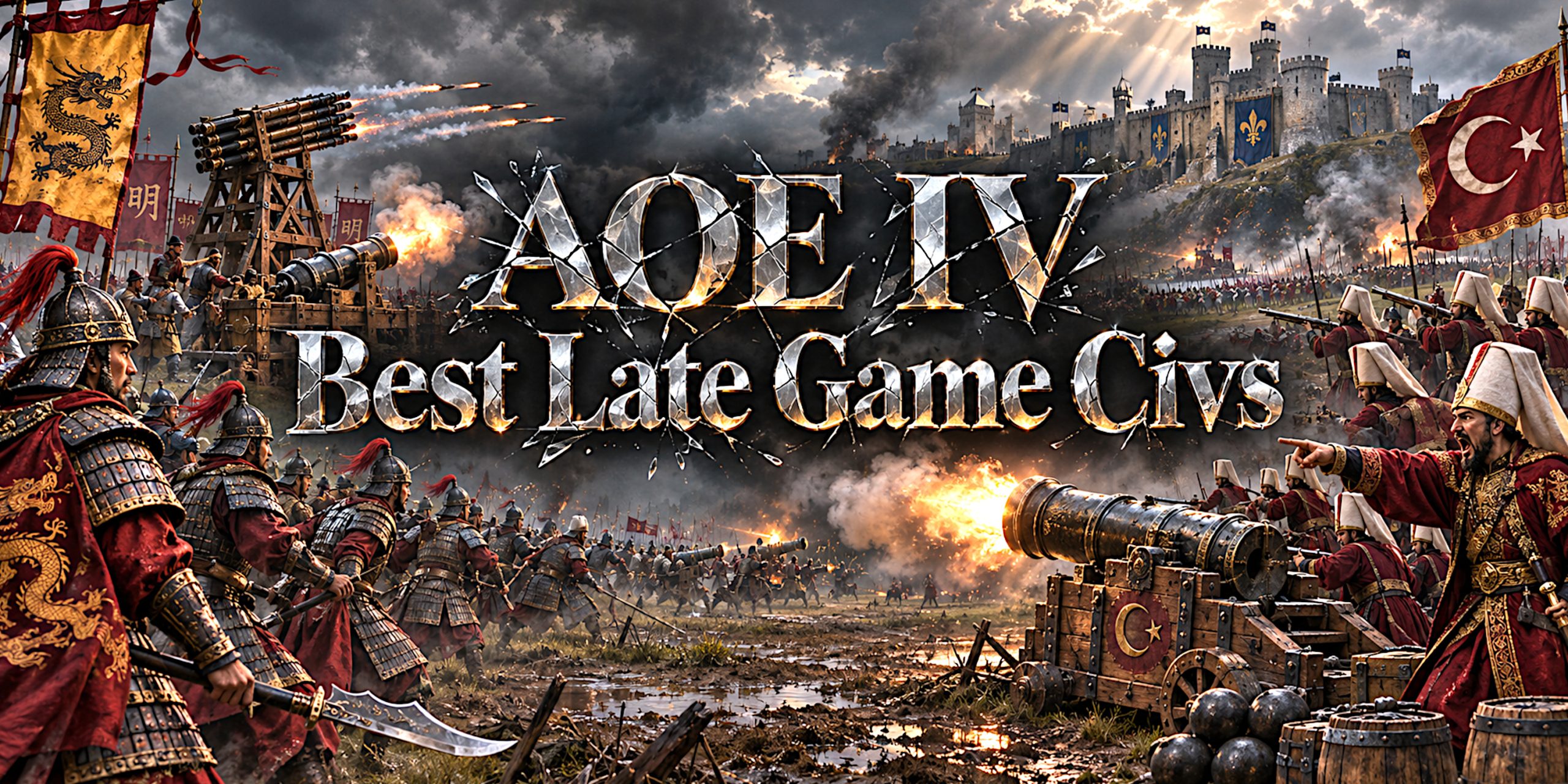
An Age of Empires IV match changes character once the easy gold disappears. Suddenly, that expensive army needs replacing, your farms are under attack, and the opponent has discovered the deeply irritating concept of a second front.
Chinese are my first pick for a fully developed late game, while English are the easiest recommendation for dependable endurance. Ottomans excel at protected siege pushes, Byzantines offer remarkable flexibility, and Abbasids reward players who can turn a large economy into constant pressure.
Those are different strengths. The civilisation with the scariest army does not automatically win the longest game.
The Best Late Game Civilisations at a Glance
This is an editorial ranking of seven established picks, focused on standard-population land games with developed Imperial Age economies. It weighs army quality, sustainable income, reinforcement and practical execution. It is not a statistical ranking of the entire roster or a prediction of every matchup.
| Pick | Civilisation | Main late game strength |
|---|---|---|
| 1 | Chinese | High-ceiling gunpowder armies and economic development |
| 2 | English | Dependable farming and defensive endurance |
| 3 | Ottomans | Siege pressure and ongoing military production |
| 4 | Byzantines | Strong developed economy and mercenary flexibility |
| 5 | Abbasid Dynasty | Economic scale and repeated army replacement |
| 6 | Japanese | Farm-supported infantry and gunpowder options |
| 7 | Holy Roman Empire | Inspired economy, relic income and infantry pressure |
Balance context: Reviewed on 7 November 2026 against the official Update 17.0 notes. The roster now includes Vikings and Scots. Their arrival, alongside the newer variant civilisations, means this established-picks shortlist should not be mistaken for a definitive ranking of every available civilisation.
What Makes a Civilisation Strong in the Late Game?
Reaching Imperial Age is only the entrance fee. A useful late game civilisation must convert its economy into an army, keep that army relevant, and replace losses without conceding the map.
Four things matter especially:
- Population efficiency: How much useful fighting power fits alongside your workers and support units?
- Sustainable income: What happens when the nearby gold mines run dry?
- Army flexibility: Can you answer an enemy composition change?
- Reinforcement: Can replacements reach the battle before your expensive units die?
Game mode changes the answer. Safe trade makes costly armies more sustainable in team games. In a tight 1v1, defending the last accessible gold deposit may matter more than having the most impressive technology tree.
I would also separate an Imperial timing attack from a genuinely mature economy. Clicking the final age while your production buildings sit idle is a surprisingly expensive way to change the architecture.
Chinese: Best for a Fully Developed Late Game
Chinese take my top spot for their combination of economic development, dynasty choices and gunpowder options. Their appeal is the range of tools available once the necessary investment is complete.
A developed Chinese army can combine a durable front line with ranged damage and siege. Nest of Bees punish crowded formations, while Palace Guards offer a mobile infantry option for pressure away from the main engagement. Dynasty investment adds further choices, although paying for extra landmarks needs a reason.
How to use them: Build an army with a clear job. Protect siege, maintain a screen for ranged units, and use a separate raiding force when the opponent commits heavily to one position.
What holds them back: Cost and complexity. Losing the valuable back line can erase several minutes of preparation. Extra technologies are also poor investments if they delay the reinforcements needed immediately.
Chinese suit players who enjoy building towards a powerful, carefully managed army. They are less forgiving when “carefully managed” becomes “briefly unattended”.
English: Best for Reliable Late Game Endurance
English are my most straightforward recommendation for players who want a late game plan they can execute under pressure.
Their farm economy, defensive network and access to Enclosures give them useful tools for prolonged matches. Enclosures provides gold from farming, but that income supports an army rather than funding an unlimited queue of premium units.
How to use them: Establish productive farms, fight around useful defensive positions, and adapt your supporting units to the enemy. Longbowmen remain valuable in the right matchup, but massing them into heavily armoured opposition without an answer is an avoidable donation.
What holds them back: Passivity. Sitting safely at home can allow the opponent to claim trade routes, resources and the positions from which your base becomes much less safe.
English endurance works best when it buys opportunities to expand and counterattack. A castle is helpful. A castle watching you lose the rest of the map is more of a witness.
Ottomans: Best for Protected Siege Pushes
Ottomans earn their place through Military Schools, support units and the threat of the Great Bombard.
Their military production systems help sustain pressure, while a protected siege force can make fortified positions difficult to hold. Great Bombards give an advance real weight, provided the surrounding army can keep them alive.
How to use them: Advance in controlled stages. Keep a protective front line, use Janissaries where their anti-cavalry role matters, and position Mehter support so its chosen bonus helps the engagement.
What holds them back: Their most threatening formation needs protection and coordination. A lumbering siege push can suffer if the opponent forces fights elsewhere or reaches the expensive units from an exposed angle.
Military Schools do not remove population limits or replace an economy. They provide ongoing production without the normal per-unit resource payment, which is valuable for rebuilding and maintaining pressure.
The Ottoman temptation is to buy another enormous cannon. Sometimes the correct purchase is the ordinary unit stopping a horseman from stabbing the first one.
Byzantines: Best for Flexible Late Game Armies
Byzantines are a compelling choice for players who like having answers.
Their connected Cistern economy supports development, while Olive Groves generate Olive Oil for mercenaries. That additional resource gives them ways to complement their native roster and adjust an army’s capabilities.
How to use them: Plan your economic layout early and choose mercenaries that solve a specific problem. Build around a coherent combination of front-line units, damage and support.
What holds them back: Setup and attention. Infrastructure needs space and protection, and flexibility creates more decisions during an already demanding phase of the match.
The recent Update 17.0 notes reduced the top-level Cistern gathering aura and slowed Golden Horn Tower production. Those changes temper the economic argument without removing the civilisation’s underlying appeal.
I particularly like Byzantines for players who scout actively. Access to several possible answers is valuable only if you notice which question the enemy is asking.
Abbasid Dynasty: Best for Economic Scale and Reinforcement
Abbasids are an excellent choice for players who think in replacement armies rather than one decisive fight.
Their Golden Age rewards a developed settlement, supporting gathering, research and production. A strong economy gives them room to maintain pressure and change the supporting units around their core army.
Camel support can also complicate cavalry-heavy opposition, although camels still need a sensible place in the composition.
How to use them: Convert economic strength into enough production buildings, forward reinforcement and repeated attacks. In team games, protected trade can help sustain gold spending.
What holds them back: An economy takes time and territory to develop. An ambitious expansion can become a liability if you cannot defend it, and a large resource bank achieves little while your army loses ground.
Abbasids reward the unglamorous side of late game play: production capacity, routing reinforcements and replacing losses promptly. There is considerable satisfaction in winning because your opponent runs out of army before you run out of administration.
Japanese: Best for Farm-Supported Infantry Pressure
Japanese bring a strong food economy around upgraded Town Centres, supported by Samurai, Bannermen and distinctive ranged options.
Their late game becomes especially interesting when infantry pressure is combined with the right supporting units. Onna-Musha offer a mobile answer to heavy units, while the Tanegashima Gunsmith provides access to Ozutsu, whose handheld cannons threaten buildings and clustered troops.
How to use them: Develop productive farming areas, preserve useful Bannermen, and give the front line support against whatever is stopping its advance.
What holds them back: Expensive infantry can trade poorly into prepared ranged positions. Samurai are durable, but durability does not make every approach a good idea.
Landmark choice matters here. An army plan built around Ozutsu needs the appropriate Imperial landmark; they are not a universal reward for reaching the final age.
Japanese suit players who enjoy sustained infantry pressure, provided they are willing to adjust when the enemy starts winning the exchange.
Holy Roman Empire: Best When Relics Support the Economy
The Holy Roman Empire can turn a strong economic foundation into relentless infantry pressure.
Prelate inspiration improves economic output, while secured relics strengthen the gold situation. That makes the earlier contest for relics relevant long after Castle Age ends.
How to use them: Carry an economic advantage into upgraded armies, keep replacing the front line, and add the units needed to answer ranged damage or armour.
What holds them back: Their late game position depends partly on what they secured earlier. A relic-rich economy and a relic-poor economy offer different spending power.
Infantry also needs support against kiting, concentrated ranged fire and splash damage. Sending more men down the same losing approach rarely improves the argument.
HRE deserve a place among these picks, but I would choose Chinese for a broader developed-army toolkit or English for a simpler endurance plan.
Which Civilisation Should You Choose?
| Your preferred approach | My pick | Main consideration |
|---|---|---|
| Develop a powerful gunpowder army | Chinese | High investment and careful control |
| Sustain a manageable defensive economy | English | Must still contest the map |
| Advance behind heavy siege | Ottomans | Protect expensive siege units |
| Adapt your composition repeatedly | Byzantines | Demands planning and attention |
| Win through economic depth | Abbasid Dynasty | Turn income into timely reinforcements |
| Apply infantry-led pressure | Japanese | Support the front line properly |
| Capitalise on relic control | Holy Roman Empire | Earlier map control shapes later income |
For a first civilisation to practise into long matches, I would start with English. For a demanding project with a rewarding late game ceiling, I would choose Chinese.
Common Mistakes That Waste a Strong Late Game
Buying upgrades without a plan. Research what improves your current army or enables a necessary transition. Unlocking everything is a hobby, not a victory condition.
Keeping production too far from the fight. Reinforcements crossing half the map cannot protect the siege dying right now.
Treating trade as guaranteed income. A profitable route still needs protection. Check its safety before committing heavily.
Overinvesting in siege. Expensive siege without a screen is a target collection.
Ignoring the second front. A modest raid into farms or production can achieve more than another attack into the enemy’s strongest position.
Are Chinese Always the Best Late Game Civilisation?
No. They are my leading pick here for a fully developed army and economy, but matchups, map access and execution can overturn that preference.
A player with a theoretically superior army can still lose through poor positioning, slow replacements or exposed workers.
Which Late Game Civilisation Is Easiest to Learn?
English are the clearest starting point among these choices. Their economy and defensive strengths support a relatively readable plan, leaving more attention for scouting, production and army control.
Does Reaching Imperial Age Guarantee an Advantage?
Only if you can use what it unlocks. The age-up payment and research time can leave a temporary opening for an opponent who spends those resources on an army.
Advance because you have a workable plan for the next few minutes. The scoreboard does not award style points for being the most modern civilisation to surrender.
Sources
Official civilisation guides explain the underlying mechanics; patch notes take precedence where balance values have changed. The ordering and strategic judgements above are editorial assessments, not developer rankings.