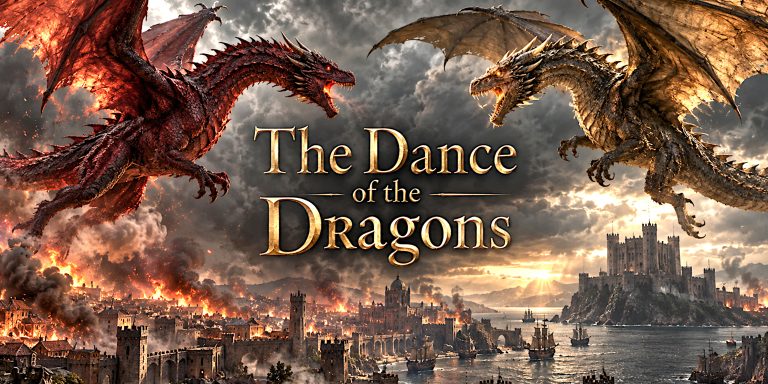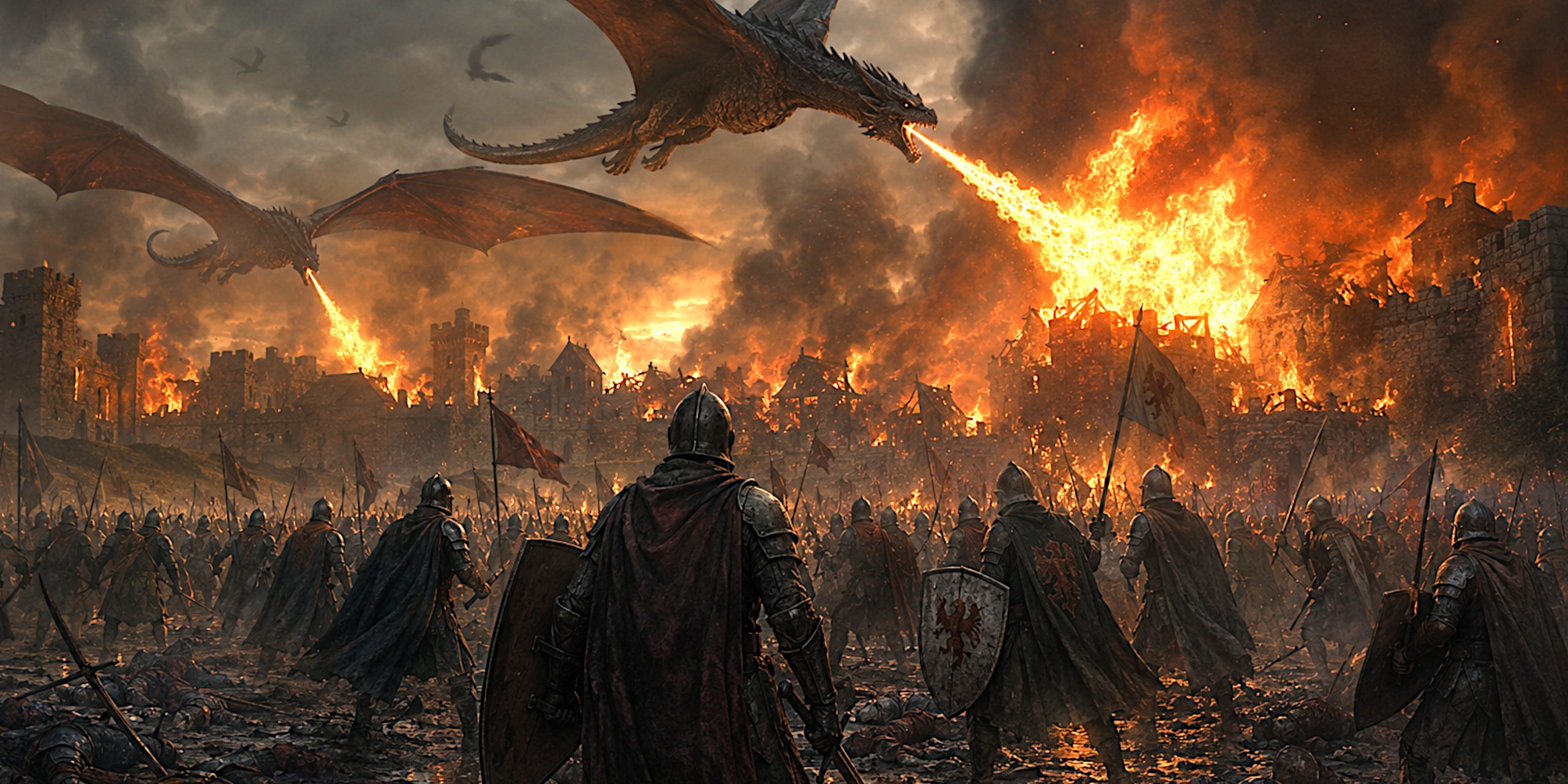
The First Battle of Tumbleton is where the Dance of the Dragons stops feeling like a dynastic argument with unusually large pets and becomes something much uglier.
Fought in 130 AC during the Targaryen civil war, Tumbleton should have been a relatively straightforward attempt by Queen Rhaenyra Targaryen’s forces to block the Green army advancing towards King’s Landing. Instead, it became one of the most infamous episodes in Fire & Blood, combining a desperate infantry battle, the death of a major Green commander, three dragons and one spectacularly badly timed betrayal.
The crucial moment was the Treasons of Tumbleton, when the dragonseeds Hugh Hammer and Ulf White abandoned Rhaenyra and turned Vermithor and Silverwing against the very people they had been sent to defend.
Tumbleton was effectively destroyed.
For House of the Dragon, the battle is especially important because the television adaptation has significantly altered the circumstances leading to it. The broad themes remain familiar, but HBO has rearranged several pieces on the board.
Warning: Major spoilers for Fire & Blood and House of the Dragon follow.
First Battle of Tumbleton at a Glance
| Detail | First Battle of Tumbleton |
|---|---|
| Conflict | Dance of the Dragons |
| Date | 130 AC |
| Location | Tumbleton, the Reach |
| Black allegiance | Queen Rhaenyra Targaryen |
| Green allegiance | King Aegon II Targaryen |
| Main Black commander | Lord Roderick Dustin among the leading field commanders |
| Main Green commander | Lord Ormund Hightower |
| Black dragons | Vermithor and Silverwing before the betrayal |
| Green dragon | Tessarion |
| Result | Green victory |
| Defining event | The Treasons of Tumbleton |
| Major death | Lord Ormund Hightower |
| Consequence | Destruction and sack of Tumbleton |
The numbers in Fire & Blood are deliberately uncertain. Accounts place the Black strength somewhere between roughly 6,000 and 12,000 men, while the Green host was considerably larger.
That uncertainty is worth remembering. Fire & Blood is written as a history assembled from conflicting sources rather than an omniscient account. George R. R. Martin has basically given us medieval chroniclers with dragons, which is a wonderfully convenient way of making everyone argue about what actually happened.
Why Tumbleton Mattered
Tumbleton was a prosperous market town in the Reach and the seat of House Footly. More importantly, it stood in the path of the Green army advancing towards King’s Landing.
Rhaenyra held the capital, but her position was becoming increasingly unstable.
Lord Ormund Hightower had brought a major Green host north from the Reach. Prince Daeron Targaryen accompanied the army with his dragon Tessarion, giving the Greens something most medieval armies would consider a fairly significant tactical advantage.
Rhaenyra therefore needed Tumbleton to hold.
The town became a defensive concentration point for Black forces, including soldiers from the Reach and riverlands, survivors of earlier fighting and the famous Winter Wolves from the North.
And then Rhaenyra added two enormous dragons.
On paper, this should have solved the problem.
It did not.
The Armies at Tumbleton
The Blacks had fewer troops, but their dragon strength initially looked overwhelming.
The Blacks
Among the forces gathered at Tumbleton were:
- Lord Roderick Dustin and his Winter Wolves
- Ser Garibald Grey
- Ser Pate of Longleaf
- Robb Rivers and his archers
- Lord Footly and the Tumbleton garrison
- troops from several houses loyal to Rhaenyra
- Hugh Hammer riding Vermithor
- Ulf White riding Silverwing
The Winter Wolves deserve particular attention. These were older northern warriors who had marched south expecting they were unlikely to return home.
This was not an especially retirement-focused group.
The Greens
The Green army was commanded by Lord Ormund Hightower and included the powerful host raised around Oldtown and the Reach.
Among its most important figures were:
- Lord Ormund Hightower
- Prince Daeron Targaryen
- Ser Hobert Hightower
- Lord Unwin Peake
- Ser Jon Roxton
- Ser Bryndon Hightower
- numerous Reach lords, knights, archers and men-at-arms
Most importantly, Daeron brought Tessarion, known as the Blue Queen.
Tessarion was smaller than Vermithor and Silverwing. As long as Hugh and Ulf remained loyal to Rhaenyra, the dragon maths looked distinctly unpleasant for the Greens.
That last sentence contains the problem.
The Battle Begins
The opening stages went badly for Rhaenyra’s army.
Ser Garibald Grey reportedly led around 6,000 men against Ormund Hightower’s position. Green archers inflicted heavy losses before Hightower’s heavy cavalry struck the Black troops.
The attack collapsed.
Robb Rivers and his archers helped cover the retreat, preventing the setback from immediately becoming a complete rout.
Then Roderick Dustin entered the battle.
And things became considerably more interesting.
Roderick Dustin and the Winter Wolves Attack
Lord Roderick Dustin, better known as Roddy the Ruin, led the Winter Wolves against the Hightower forces.
They were enormously outnumbered.
They attacked anyway.
The Northmen smashed their way deep enough into the Green formation to reach Lord Ormund himself. Dustin killed both Ormund Hightower and Ormund’s cousin, Ser Bryndon Hightower, before finally dying from his own wounds.
It was an extraordinary piece of battlefield violence.
More importantly, it created a genuine command crisis for the Greens.
Their principal commander was dead, the Black forces were still fighting and Rhaenyra apparently possessed the two most powerful dragons present.
For a brief moment, Tumbleton looked as though it might become a major Black victory.
Then Hugh Hammer and Ulf White made their decision.
Daeron and Tessarion Enter the Fight
Prince Daeron and Tessarion appeared above the battlefield.
Under normal circumstances, the arrival of a dragon would be enough to cause an army to reconsider its life choices.
The defenders of Tumbleton had a rather unusual reason not to panic.
They had Vermithor and Silverwing.
Vermithor had once belonged to King Jaehaerys I Targaryen and was one of the largest living dragons. Silverwing had belonged to Queen Alysanne Targaryen and was similarly formidable.
Tessarion was considerably younger and smaller.
A fight involving Tessarion against both older dragons therefore appeared deeply unfavourable for Daeron.
Except Vermithor and Silverwing were about to change sides.
The Treasons of Tumbleton
Hugh Hammer and Ulf White had been recruited as part of Rhaenyra’s attempt to find riders for riderless dragons.
Both were dragonseeds, people of possible Valyrian descent who successfully claimed dragons during the Sowing of the Seeds.
Hugh claimed Vermithor.
Ulf claimed Silverwing.
Their success instantly elevated two relatively obscure men into some of the most militarily powerful individuals in Westeros.
That created an obvious political problem.
How exactly do you reward a man who owns a flying biological siege engine?
At Tumbleton, Hugh and Ulf betrayed Rhaenyra.
The reasons are never established with absolute certainty. Ambition, resentment, fear and expectations of greater rewards from the Greens may all have contributed.
Whatever their motivations, the military consequences were immediate.
Instead of attacking Tessarion and the Green army, Vermithor and Silverwing turned their flames upon Rhaenyra’s forces and Tumbleton itself.
The balance of power flipped almost instantly.
The Blacks had gone from possessing a decisive advantage in dragons to facing three hostile dragons.
There was no realistic recovery from that.
Three Dragons Burn Tumbleton
Vermithor, Silverwing and Tessarion unleashed dragonfire across the battlefield and town.
Ser Garibald Grey was killed by Tessarion’s flames.
Ser Pate of Longleaf was unhorsed and trampled.
Black soldiers were burned, scattered or killed while attempting to escape.
Inside Tumbleton, betrayal continued at ground level. Men sympathetic to Aegon II opened gates and turned upon Rhaenyra’s supporters.
Lord Footly’s forces eventually surrendered.
It did not save them.
The defeated men were bound and executed.
The destruction extended far beyond the soldiers. Buildings burned throughout Tumbleton while civilians attempted to flee. Thousands are said to have died, with some drowning while trying to escape across the Mander.
Grand Maester Munkun later described the destruction as:
“the Field of Fire writ small.”
That is probably the simplest description of what happened.
Tumbleton was no longer really a battle. It had become a catastrophe.
Why Did Hugh Hammer and Ulf White Betray Rhaenyra?
This is one of the more interesting questions because Fire & Blood never gives us a neat answer.
Both men had gained extraordinary power very quickly.
Before becoming dragonriders, neither possessed the status normally associated with Westerosi nobility. After claiming Vermithor and Silverwing, they suddenly controlled weapons capable of destroying castles and armies.
Traditional feudal hierarchy did not really know what to do with them.
Hugh in particular developed enormous ambitions. He would later consider himself worthy of kingship.
Ulf wanted substantial lands and rewards of his own.
Their betrayal can therefore be interpreted as a combination of:
- personal ambition
- dissatisfaction with Rhaenyra’s rewards
- opportunism
- resentment towards established nobles
- belief that the Greens might offer them more
- confidence produced by possessing exceptionally powerful dragons
There is also something fascinating about the social dimension.
The Targaryens had effectively democratised access to their ultimate weapon because they desperately needed riders.
Then they discovered why aristocracies generally dislike democratising access to ultimate weapons.
What Happened to Tumbleton After the Battle?
Winning the battle did not produce an orderly Green occupation.
Quite the opposite.
With Ormund Hightower dead, discipline collapsed.
Green soldiers looted the town and committed extensive atrocities against its inhabitants. Fire & Blood describes the sack as exceptionally brutal even by the fairly miserable standards of Westerosi warfare.
Prince Daeron attempted to restore order and urged Ser Hobert Hightower to control the army.
Hobert failed.
Meanwhile, the victorious Green leadership began arguing among themselves.
Hugh Hammer and Ulf White were now supposedly allies, but there was an obvious issue.
They were also two unpredictable men controlling Vermithor and Silverwing.
The Greens had won Tumbleton partly because of them.
Now they had to work out what to do with them.
Hugh Hammer Becomes a Problem for Everyone
Hugh’s ambitions rapidly became impossible to ignore.
Possessing Vermithor gave him enormous confidence, and he reportedly began entertaining the possibility that he might claim the Iron Throne himself.
From Hugh’s perspective, the logic was not completely ridiculous.
Westerosi politics ultimately rested on military power and claims of legitimacy. Hugh had questionable ancestry but an absolutely unquestionable dragon.
Vermithor was larger and more dangerous than almost every dragon remaining in the war.
The Green nobles understandably became nervous.
A secret group later known as the Caltrops began plotting to eliminate Hugh and Ulf.
So within a remarkably short period, the Two Betrayers had gone from Rhaenyra’s dragonriders, to Green allies, to people the Greens themselves wanted dead.
Career progression in Westeros can be remarkably efficient.
Why the Greens Did Not March Straight to King’s Landing
This is one of the most important strategic consequences of Tumbleton.
The road towards King’s Landing was now open.
Rhaenyra had lost thousands of soldiers, two dragonriders and control of an important defensive position.
A rapid Green advance might have placed enormous pressure on the capital.
Instead, the army remained around Tumbleton.
Looting, internal rivalries, desertion and arguments over Hugh and Ulf paralysed the victorious force. Soldiers slipped away carrying plunder while Green commanders quarrelled about what should happen next.
The victory therefore contained the seeds of another disaster.
The Greens had destroyed the army blocking their advance but had also lost Ormund Hightower, their effective commander.
Tumbleton gave them a tactical triumph and a strategic headache.
How the Battle Changed the Dance of the Dragons

The First Battle of Tumbleton changed the political and military situation dramatically.
Rhaenyra could no longer assume that dragonseeds would remain loyal simply because she had given them dragons.
That suspicion had consequences for other dragonriders, particularly Addam Velaryon, whose loyalty came under scrutiny despite there being no evidence that he intended to betray her.
King’s Landing also panicked.
Stories of what had happened at Tumbleton spread rapidly, and inhabitants feared the Green army and its dragons would eventually reach the capital.
Rhaenyra’s position became increasingly desperate.
Ironically, the Greens were hardly in much better shape.
Their victory had produced an army plagued by desertion, indiscipline and internal conspiracy.
Everybody was winning so successfully that the entire realm was falling apart.
The First Battle of Tumbleton in House of the Dragon
This is where things become particularly interesting for viewers of HBO’s House of the Dragon.
The television series has changed the circumstances surrounding Tumbleton considerably from Fire & Blood.
In the book, Tumbleton is a Black-held defensive position. Hugh Hammer and Ulf White are sent there with Vermithor and Silverwing to help stop Ormund Hightower’s advancing Green army.
The television adaptation has rearranged that situation, with Ormund taking control of Tumbleton before the central confrontation. Hugh’s personal connection to the town through his wife also gives the series a potential emotional motivation that is absent from the historical account in Fire & Blood.
The adaptation has also changed major character movements and participation around the battle.
That matters because the television version cannot simply reproduce the book sequence beat for beat. The writers have created different motivations, relationships and battlefield circumstances.
The fundamental idea of Tumbleton remains recognisable, however.
It is a trap in which loyalties collapse at exactly the moment dragons become decisive.
Book Versus TV Version
| Fire & Blood | House of the Dragon |
| Tumbleton begins as a Black defensive position | The strategic situation around the town has been substantially altered |
| Hugh and Ulf are sent to defend Tumbleton | Hugh has a stronger personal connection to events in the town |
| Both Hugh and Ulf become the Two Betrayers | The adaptation has changed how the betrayal develops |
| Ormund commands the advancing Green host | Ormund has been given a more developed strategic role |
| Daeron and Tessarion participate in the battle | Daeron’s storyline has been substantially reworked |
| Roderick Dustin kills Ormund | The television adaptation changes elements of their confrontation |
| Daemon and Caraxes are absent | The series expands and rearranges character involvement |
The changes are substantial enough that viewers should probably treat Fire & Blood as a guide to the destination rather than a screenplay for how the television version gets there.
That has arguably made Tumbleton more unpredictable, even for readers who know the book.
Why Tumbleton Is So Important to House of the Dragon
Tumbleton works because it attacks one of the assumptions sitting underneath the entire Dance of the Dragons.
Dragons do not automatically make their riders loyal.
Rhaenyra’s faction needs more dragonriders, so it finds people outside the traditional Targaryen elite capable of claiming dragons. Militarily, this makes perfect sense.
Politically, it is terrifying.
Hugh and Ulf suddenly possess more destructive power than almost every lord in Westeros. Titles, castles and inherited prestige become slightly less impressive when the bloke standing opposite you owns Vermithor.
The First Battle of Tumbleton is the moment that contradiction explodes.
It also reinforces one of the nastier themes running through the Dance. The people making decisions are aristocrats fighting over succession, but ordinary townspeople repeatedly pay the highest price.
Tumbleton has virtually nothing to gain from the Dance.
It gets burned anyway.
Who Actually Won the First Battle of Tumbleton?
Technically, the Greens won.
Rhaenyra’s defending army was destroyed, Tumbleton fell and Hugh Hammer and Ulf White joined the Green cause.
Strategically, the answer is less satisfying.
The Greens lost Lord Ormund Hightower and struggled to control their army afterwards. Hugh and Ulf immediately created a new political crisis. Desertion weakened the host, while the surviving commanders failed to exploit their victory quickly.
Meanwhile, the devastation helped push the war towards another confrontation at the same location.
So yes, the Greens won.
They simply managed to win in the most Dance of the Dragons way imaginable.
What Comes After the First Battle?
Tumbleton was not finished.
The Green army remained around the ruined town while Hugh Hammer’s ambitions grew and the Caltrops plotted against the Two Betrayers.
Then Ser Addam Velaryon gathered a new army and marched against them.
That leads directly towards the Second Battle of Tumbleton, an even stranger confrontation involving assassination, a surprise attack and multiple dragons fighting one another amid the ruins.
If First Tumbleton demonstrates how dangerous dragonriders can become, Second Tumbleton shows what happens when virtually nobody can control the dragons at all.
And somehow things get worse.
The Legacy of the First Battle of Tumbleton
The First Battle of Tumbleton deserves its reputation as one of the defining events of the Dance of the Dragons.
It contains almost every element that makes the conflict compelling: ambitious nobles, ordinary soldiers, political miscalculation, divided loyalties, spectacular violence and dragons that make every human mistake dramatically more expensive.
Roderick Dustin’s attack nearly turned the battle into a Black victory. The death of Ormund Hightower should have crippled the Greens.
Instead, two men changed sides.
Hugh Hammer and Ulf White transformed what looked like a Black recovery into annihilation within minutes. Their betrayal gave the Greens victory but simultaneously created another threat that their new allies could barely control.
That is why Tumbleton matters beyond the spectacle.
The Targaryens believed dragons guaranteed power. At Tumbleton they discovered the awkward second half of that equation.
Power belongs to whoever is actually sitting on the dragon.