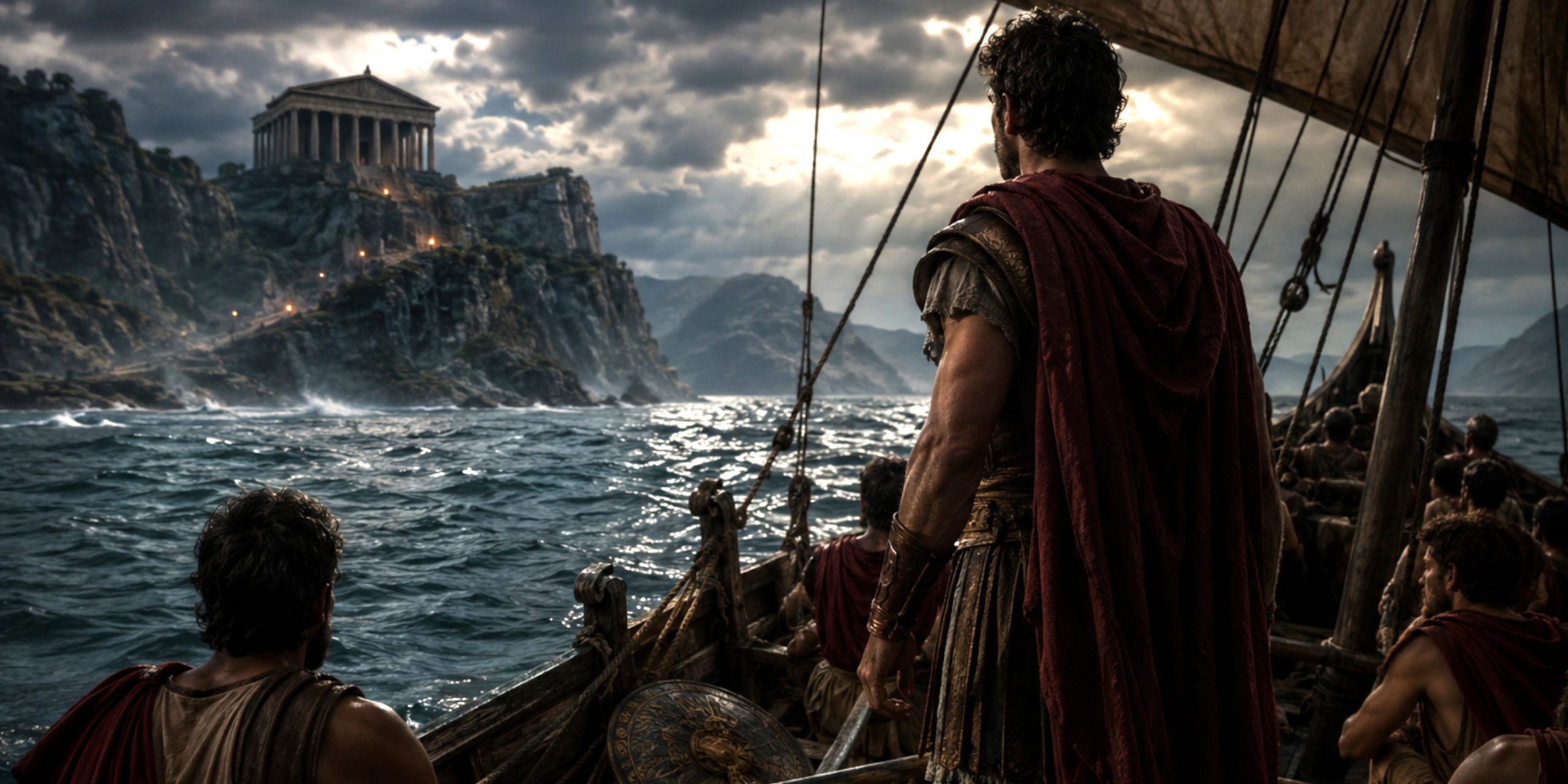
Jason led perhaps the most famous expedition before the Trojan War, commanded a crew containing some of the greatest names in Greek legend, recovered the Golden Fleece and survived encounters with monsters, murderous kings and impossible tasks.
Yet Jason himself is rarely remembered with the uncomplicated admiration attached to Heracles or Perseus.
There is a reason for that.
The story of Jason is partly a heroic adventure, partly a dynastic struggle and, once Medea enters it, increasingly a tragedy about ambition, loyalty and the catastrophic consequences of treating other people as politically convenient.
For historians of mythology, Jason is particularly interesting because his legend developed over centuries. There is no single definitive Jason story. Homer knew of the Argo. Hesiodic tradition knew elements of the wider myth. Pindar reshaped Jason into an impressive heroic figure, while Apollonius of Rhodes produced the fullest surviving account of the Argonautic expedition. Euripides, meanwhile, was rather more interested in what happened after the heroic music stopped.
Jason therefore changed with the Greeks who told his story.
Who Was Jason?
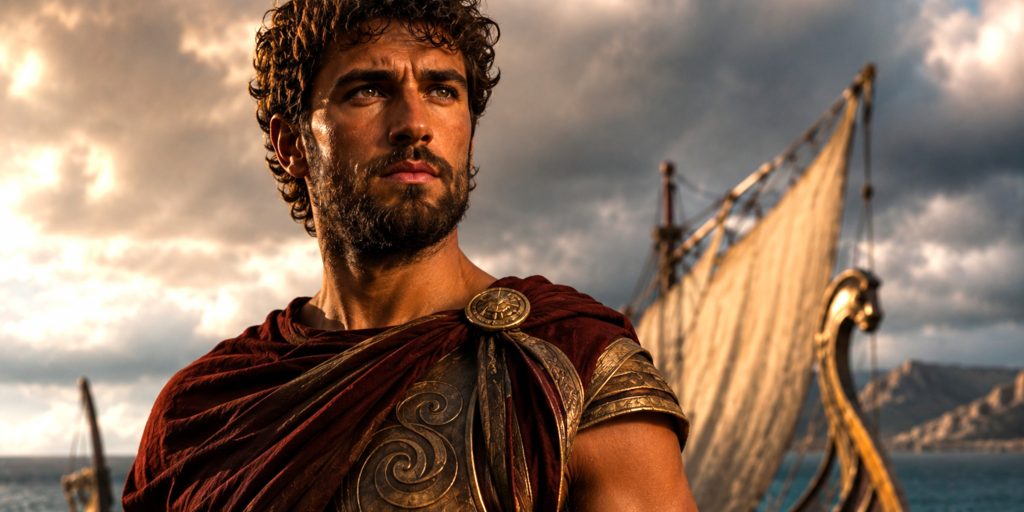
Jason, Greek Iason, was traditionally the son of Aeson, the rightful ruler or heir of Iolcos in Thessaly. His mother varies between traditions, as mothers in Greek heroic genealogies have an unfortunate habit of changing according to whichever poet happens to be holding the stylus.
Jason belonged to the wider Aeolid family of Greek myth.
His principal associations are:
| Detail | Tradition |
|---|---|
| Greek name | Iason |
| Father | Aeson |
| Homeland | Iolcos in Thessaly |
| Guardian or tutor | Chiron in many later traditions |
| Rival | Pelias |
| Famous ship | Argo |
| Expedition | Voyage of the Argonauts |
| Objective | Golden Fleece |
| Principal companion | Medea |
| Major surviving source | Argonautica by Apollonius of Rhodes |
| Heroic generation | Traditionally before the Trojan War |
Jason’s claim to Iolcos provides the political engine behind the Golden Fleece story. The voyage was not originally tourism with unusually high mortality rates. It was connected to kingship.
Jason’s Childhood and the Usurpation of Iolcos
The story begins with a disputed throne.
Pelias seized power at Iolcos, displacing Jason’s father Aeson. Different versions disagree about precisely how this happened and what became of Aeson afterwards.
Jason was removed from immediate danger and, according to a familiar tradition, raised by the centaur Chiron.
Chiron appears repeatedly in Greek mythology as the educator of heroes. Achilles, Asclepius and other major figures were associated with him. Being sent to Chiron was essentially the heroic equivalent of receiving an extremely prestigious education, except the headmaster happened to be half horse.
Jason eventually returned to Iolcos to claim his inheritance.
His arrival produced one of the defining images of his legend.
He was wearing only one sandal.
Why Did Jason Wear One Sandal?
Pelias had reportedly received an oracle warning him to beware a man wearing a single sandal.
Jason fulfilled the prophecy.
According to Pindar, Jason arrived conspicuously dressed, with his distinctive missing sandal helping Pelias recognise the danger almost immediately.
The explanation for the lost sandal varies, but a famous version has Jason losing it while carrying an old woman across a river. The woman was actually the goddess Hera in disguise.
Jason’s act of generosity gained him divine favour.
Hera’s hostility towards Pelias also mattered enormously. Greek mythology frequently presents apparently spontaneous heroic adventures that become rather less spontaneous once the gods begin interfering.
Pelias did not simply hand Jason the throne.
Instead, he sent him after the Golden Fleece.
Why Did Jason Seek the Golden Fleece?
The Golden Fleece belonged to the legendary ram that had carried Phrixus away from danger.
Phrixus eventually reached Colchis on the eastern coast of the Black Sea. There the ram was sacrificed, and its extraordinary fleece was preserved.
By Jason’s time, the fleece was held by King Aeetes of Colchis.
Pelias challenged Jason to retrieve it.
The demand was almost certainly intended to remove a political rival permanently. Sending someone across the known world to steal a sacred treasure guarded by a foreign king was a reasonably elaborate assassination attempt, but Pelias was nothing if not thorough.
Jason accepted.
To undertake the expedition, a remarkable ship was constructed.
The Argo.
The Argo
The Argo was traditionally built by Argus, with divine assistance associated particularly with Athena.
Some traditions describe the ship as containing timber from the sacred oak of Dodona, giving the vessel a supernatural element.
The sailors aboard became known as the Argonauts, literally the sailors of the Argo.
The voyage became one of the foundational adventure narratives of Greek mythology.
The surviving stories combine geography, folklore, colonisation myths, heroic genealogy and supernatural encounters. They also preserve Greek fascination with the Black Sea and the distant lands surrounding it.
Who Were the Argonauts?
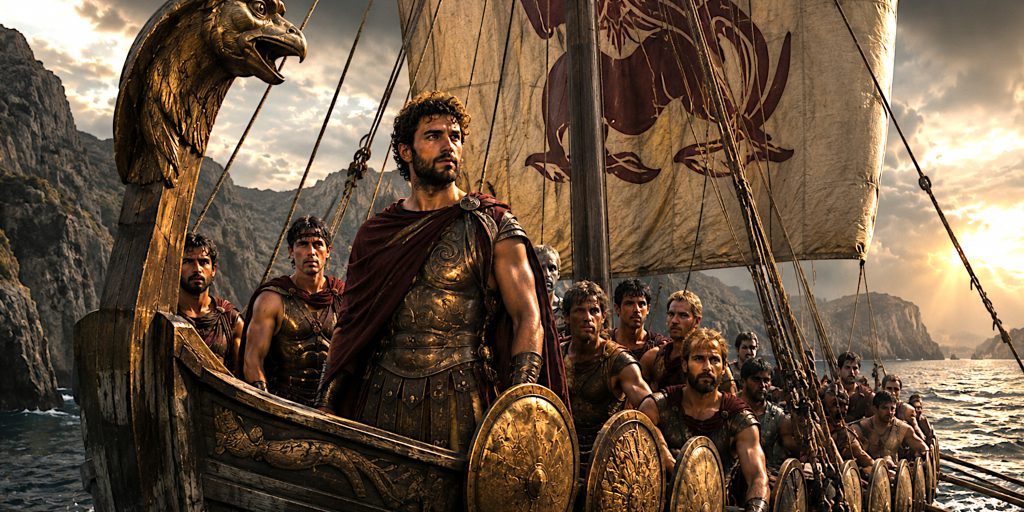
There was never one universally accepted crew list.
Ancient authors supplied different names, partly because attaching a local hero to the Argonautic expedition was an excellent way of inserting him into one of Greece’s grandest legendary traditions.
Frequently named Argonauts include:
- Heracles
- Orpheus
- Castor
- Polydeuces
- Peleus
- Telamon
- Meleager
- Zetes
- Calais
- Idas
- Lynceus
- Admetus
- Argus
- Tiphys
Some traditions also include Atalanta, although Apollonius has Jason refuse to take her on the expedition.
The crew effectively became a heroic all-star cast.
That creates an interesting problem for Jason’s reputation. He was nominally their leader, yet several Argonauts were individually stronger, more famous or possessed spectacular supernatural abilities.
Jason’s heroism was therefore often expressed through leadership, negotiation and endurance rather than simply hitting things harder than everyone else.
Heracles had already cornered that particular market.
Jason as Leader of the Argonauts
Jason’s leadership is more complicated than later popular summaries sometimes suggest.
He is capable of inspiring loyalty and organising powerful individuals, but he also experiences uncertainty. In Apollonius’ Argonautica, Jason can appear anxious, emotionally vulnerable and dependent upon others.
This may seem surprisingly modern, but it reflects Hellenistic literary interests rather than an attempt to turn Jason into an ancient self-help protagonist.
Apollonius wrote centuries after the period in which the myths were supposedly set. His Jason belongs to a sophisticated literary world in which psychological hesitation could be as interesting as physical strength.
Jason leads, but he needs his companions.
More importantly, he eventually needs Medea.
The Voyage of the Argonauts
The journey to Colchis contains numerous episodes, and their precise sequence differs between sources.
Among the most famous are the adventures on Lemnos, the death of Cyzicus, the disappearance of Hylas, the encounter with Amycus, the rescue of Phineus and the passage through the Clashing Rocks.
Each episode helped transform the voyage into something larger than a simple treasure hunt.
The Women of Lemnos
The Argonauts arrived on Lemnos, where the island’s women had killed their male population after being neglected by their husbands.
Queen Hypsipyle received Jason.
Jason formed a relationship with her, and some traditions made him the father of her children.
The episode establishes a pattern that becomes increasingly important in Jason’s mythology.
He forms relationships with women, benefits from them and then moves on.
With Hypsipyle this is uncomfortable.
With Medea it becomes catastrophic.
Heracles and Hylas
Heracles joined the expedition in many versions, but he did not remain aboard for the entire journey.
His companion Hylas disappeared after being taken by water nymphs. Heracles searched for him and was consequently left behind or otherwise separated from the expedition.
Removing Heracles from the story was narratively useful.
If the strongest hero in Greek mythology remained aboard throughout, the obvious solution to many later difficulties would have been to point Heracles towards them and wait for the noise to stop.
Jason had to continue without him.
Phineus and the Harpies
The Argonauts encountered the blind prophet Phineus, who was tormented by Harpies.
The winged brothers Zetes and Calais drove the creatures away.
In return, Phineus advised the Argonauts about the dangers ahead, particularly the Symplegades, the Clashing Rocks guarding the route towards the Black Sea.
The Clashing Rocks
The Symplegades were enormous rocks that crashed together, destroying vessels attempting to pass between them.
The Argonauts first released a bird to test the passage.
After seeing it survive, though narrowly, they rowed through.
The Argo escaped.
The episode probably reflected Greek perceptions of the dangerous maritime passage towards the Black Sea, transformed through myth into a supernatural obstacle.
Ancient sailors did not require monsters to make narrow waters frightening, but monsters certainly improved the story.
Jason Arrives in Colchis
Eventually Jason reached Colchis and demanded the Golden Fleece from King Aeetes.
Aeetes had no intention of surrendering it.
Instead, he imposed a series of impossible tasks.
Jason was required to yoke fire-breathing bulls, plough a field and sow it with dragon’s teeth. From those teeth would grow armed warriors.
This should have ended the expedition.
Instead, Medea intervened.
Medea and Jason
Medea was the daughter of Aeetes and one of the most formidable women in Greek mythology.
She possessed magical knowledge and was associated with the divine lineage of Helios.
Hera and Aphrodite helped cause Medea to fall passionately in love with Jason. Apollonius devotes considerable attention to her emotional conflict.
Medea knew that helping Jason meant betraying her father and homeland.
She helped him anyway.
She provided Jason with magical protection against the bulls’ fire and advised him how to defeat the warriors born from the dragon’s teeth.
Jason’s greatest achievement therefore cannot really be separated from Medea.
Without her, he probably dies in Colchis.
Rather quickly.
The Dragon’s Teeth
Jason successfully yoked the bronze-footed, fire-breathing bulls and ploughed the field.
He then sowed the dragon’s teeth.
Armed men, the Spartoi, sprang from the earth.
Following Medea’s advice, Jason threw a stone among them. Unable to identify who had attacked them, the warriors turned upon one another.
Jason survived the trial.
Aeetes still refused to surrender the fleece.
So Jason and Medea stole it.
How Jason Took the Golden Fleece
The Golden Fleece was guarded by a dragon or enormous serpent that never slept.
Medea used her magical abilities to overcome or lull the creature, allowing Jason to take the fleece.
Ancient artistic representations frequently show Jason beside the serpent, although the precise nature of his role varies considerably.
Some traditions made Jason more physically active in overcoming the guardian. Others emphasised Medea’s magic.
This distinction matters.
Later retellings sometimes make Jason the conventional monster-slaying hero. The ancient tradition is less tidy. Jason succeeds through cooperation, divine assistance and particularly Medea’s intervention.
That makes him more interesting, even if it does slightly complicate the heroic CV.
The Escape from Colchis
Jason, Medea and the Argonauts fled.
Aeetes pursued them.
Here the mythology becomes considerably darker.
Medea’s brother Apsyrtus becomes involved, but ancient traditions differ sharply over what happened.
In one version, Medea takes the young Apsyrtus with her and kills him, scattering pieces of his body so Aeetes must stop to recover them.
In another major tradition, Apsyrtus is an adult who pursues the fugitives and is killed through a plot involving Jason and Medea.
The variations show how unstable Greek myth could be. There was no central authority checking continuity.
What remains consistent is the moral deterioration of the escape.
The romantic adventure has acquired blood.
Jason and Medea Return to Iolcos
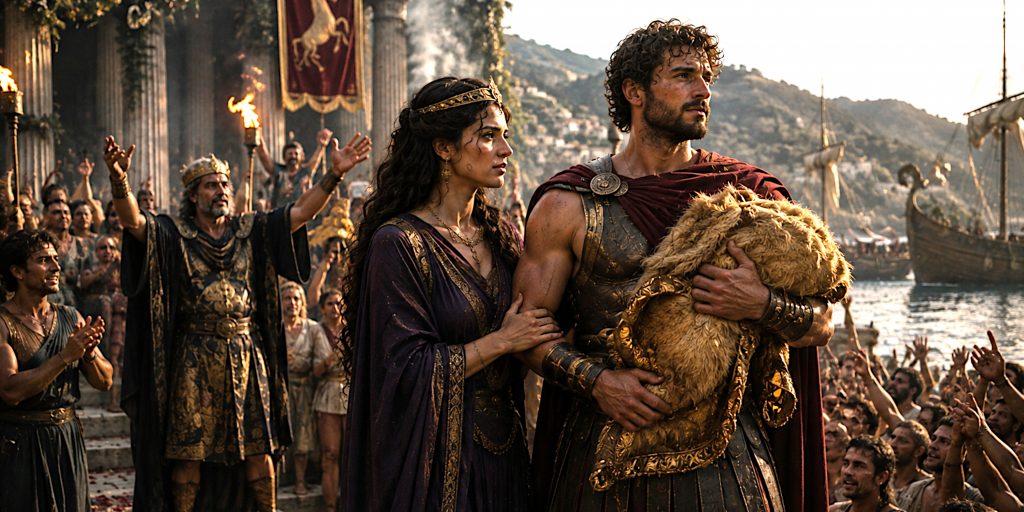
Jason eventually returned to Iolcos with Medea and the Golden Fleece.
One might reasonably expect Pelias to admit defeat at this point.
Greek kings in mythology rarely possess that degree of sporting behaviour.
Medea engineered Pelias’ death.
She convinced his daughters that they could rejuvenate their elderly father by cutting him into pieces and boiling him according to a magical procedure. Medea demonstrated an apparent version of the process using an animal.
Pelias’ daughters followed her instructions.
Their father did not return rejuvenated.
Jason and Medea were consequently forced to leave Iolcos.
So much for the triumphant homecoming.
Jason in Corinth
Jason and Medea eventually settled in Corinth.
It is here that the heroic expedition gives way to one of Greek tragedy’s most disturbing stories.
Jason decided to abandon Medea and marry Glauce, also called Creusa in some traditions, the daughter of King Creon of Corinth.
The marriage would improve Jason’s political position.
From Jason’s perspective, it could be presented as a rational dynastic decision.
From Medea’s perspective, the man for whom she had abandoned her family, homeland and position had decided she was now inconvenient.
Euripides built his Medea around this betrayal.
Was Jason a Hero or a Villain?
This is where modern labels become inadequate.
Jason is certainly a hero in the ancient Greek sense. He belongs to the heroic age, undertakes an extraordinary expedition, interacts with gods and establishes a legendary reputation.
That does not make him morally admirable.
Greek heroes were not superheroes.
Achilles is terrifyingly violent. Heracles commits dreadful acts. Theseus abandons Ariadne. Agamemnon sacrifices his daughter. Odysseus is capable of deception and brutality.
Heroic status concerned lineage, achievement, power and proximity to the divine as much as personal virtue.
Jason fits comfortably within that world.
His treatment of Medea, however, became the central stain upon his reputation.
Jason in Euripides’ Medea
Euripides’ Medea, first performed in 431 BCE, profoundly shaped later perceptions of Jason.
Jason attempts to justify his new marriage as beneficial to his existing family. Medea sees this reasoning for what it is.
His arguments can sound calculating, smug and remarkably incapable of understanding the woman standing in front of him.
The tragedy culminates in Medea’s revenge.
She causes the deaths of Jason’s new bride and Creon.
Most famously, in Euripides’ version she kills her own children to destroy Jason emotionally and extinguish his future.
Medea escapes.
Jason survives.
In heroic literature, survival is normally the desirable outcome.
Here it becomes part of the punishment.
How Did Jason Die?
There are different traditions concerning Jason’s later life.
The most famous later account presents him as an ageing, broken figure sitting beneath the decaying Argo.
A piece of the ship falls and kills him.
It is an extraordinarily effective ending.
The vessel that carried Jason towards his greatest achievement eventually becomes the instrument of his death.
Whether this ending belonged to the earliest forms of the legend is another matter. Greek myths accumulated conclusions, alternatives and local variations over centuries.
Still, as endings go, it has a certain merciless elegance.
Jason’s Weapons and Equipment
Jason is not strongly associated with one distinctive named weapon in the way that Achilles is associated with his armour or Heracles with his club.
Ancient artists generally represented heroes using equipment familiar within Greek martial culture.
| Equipment | Likely mythological or artistic association |
| Spear | Standard heroic weapon in Greek art and epic |
| Sword | Secondary close-combat weapon |
| Shield | Common component of heroic representation |
| Helmet | Often used in artistic depictions |
| Cloak or chlamys | Frequently associated with travelling heroes |
| Single sandal | Jason’s most recognisable personal attribute |
| Golden Fleece | Symbol of his successful expedition |
A historical Bronze Age warrior underlying the imagined heroic world might have carried a thrusting or cutting sword alongside a spear and shield, but attempting to assign Jason a precise archaeological sword type would go beyond the evidence.
Jason belongs to mythology, not a surviving military inventory.
Jason and the Historical Bronze Age
Greek tradition placed Jason among the generations preceding the Trojan War.
This encouraged later attempts to connect the Argonautic expedition with the Late Bronze Age and Mycenaean maritime activity.
There is no archaeological evidence demonstrating that Jason was a historical individual.
There is, however, genuine historical context behind some features of the story.
Mycenaean Greeks were capable sailors and maintained extensive networks of trade and exchange. The Black Sea and Anatolian worlds eventually became deeply significant to Greek communities.
The myth of an expedition to distant Colchis may preserve cultural memories of exploration, trade or encounters with regions considered remote from the Aegean.
That is possible.
It is not the same as proving that a ship called Argo sailed to Georgia carrying Heracles and Orpheus.
History has its limits, even when mythology keeps trying to lure it aboard.
Was the Golden Fleece Based on Something Real?
One intriguing theory connects the Golden Fleece with ancient gold extraction.
Traditional methods in parts of the Caucasus may have involved placing animal fleeces in streams to trap particles of gold. A fleece containing gold could therefore have provided a real-world inspiration for the myth.
The idea is attractive because Colchis corresponds broadly with western Georgia, a region associated with ancient mineral wealth.
However, such connections should be treated cautiously.
Explaining one element of a myth does not explain the entire story, and similarities between traditional practices and legendary objects are not proof of direct origin.
The Golden Fleece also functions symbolically as a royal, sacred and almost unattainable object.
It did not need to begin as mining equipment to make sense to ancient audiences.
Colchis and the Real Geography Behind the Myth
Colchis was not entirely imaginary.
The ancient region lay along the eastern Black Sea, principally within modern Georgia.
To Greek audiences it represented a distant but recognisable edge of the world.
Greek contact with the Black Sea expanded considerably during the archaic period, with settlements and trading networks developing around its coastline.
The Argonaut myth may therefore have become increasingly geographically detailed as Greek knowledge of the region grew.
This is one reason Jason’s story is so useful historically.
Mythical geography can reveal how Greeks imagined foreign spaces even when it cannot tell us whether the events themselves occurred.
Jason in Ancient Greek Art
Jason and the Argonautic cycle appeared in Greek vase painting and other visual traditions.
Artists depicted scenes including:
- Jason and the serpent guarding the Golden Fleece
- Medea assisting Jason
- Pelias and his daughters
- episodes involving individual Argonauts
- the Argo and its crew
Visual traditions do not always agree with surviving literary accounts.
That is important.
Greek mythology existed across poetry, drama, oral storytelling, cult, local tradition and art. Vase painters sometimes preserve versions of myths that are otherwise lost.
The images are therefore evidence for mythology in their own right, rather than illustrations of whichever surviving book happens to be most famous today.
What Did Jason Represent to the Ancient Greeks?
Jason could embody several different ideas depending upon period and storyteller.
He was an adventurer travelling beyond familiar Greek territory.
He was a claimant to kingship.
He was the leader of a collective heroic expedition.
He was a man favoured by Hera.
He was also a husband whose betrayal produced devastating consequences.
The contrast is fundamental to his appeal.
Jason achieves the impossible and still fails to secure a successful life.
Ancient Greek mythology repeatedly returns to this problem. Great achievement does not guarantee happiness, wisdom or moral goodness.
Quite often it seems to guarantee the opposite.
Jason Compared with Other Greek Heroes
| Hero | Defining quality | Major weakness or conflict |
| Jason | Leadership and expedition | Dependence on others and betrayal of Medea |
| Heracles | Extraordinary physical strength | Rage and suffering |
| Achilles | Supreme warrior | Wrath and pride |
| Odysseus | Intelligence and adaptability | Deception and prolonged wandering |
| Theseus | Monster-slayer and Athenian hero | Abandonment and dynastic tragedy |
| Perseus | Divine assistance and monster-slaying | Less morally conflicted in surviving traditions |
Jason stands apart because his greatest adventure is fundamentally collaborative.
He does not succeed alone.
That may actually make him one of the more believable Greek heroes, although his later decisions do their best to squander the goodwill.
The Main Ancient Sources for Jason
Our understanding of Jason comes from sources written across many centuries.
Homer refers to the Argo in the Odyssey, demonstrating that the expedition was already famous in early Greek epic tradition.
Hesiodic poetry preserves connections with the genealogical world surrounding Jason and Medea.
Pindar’s Fourth Pythian Ode, composed in the fifth century BCE, provides an important early extended account of Jason and the expedition.
Euripides’ Medea, first performed in 431 BCE, concentrates on the disastrous aftermath of Jason’s relationship with Medea.
Apollonius of Rhodes’ Argonautica, written in the Hellenistic period, is the fullest surviving ancient narrative of the voyage itself.
Later writers including Diodorus Siculus, Apollodorus, Hyginus and Roman poets preserved further variations.
Anyone looking for one completely consistent biography of Jason will therefore be disappointed.
That inconsistency is part of the evidence.
Jason’s Legacy
Jason’s influence extends far beyond Greek religion and literature.
The voyage of the Argonauts helped establish the narrative pattern of a band of exceptional companions travelling into unknown territory in search of a precious object.
That structure feels immediately familiar because later storytelling has returned to it repeatedly.
Jason himself remains more complicated.
He begins as a dispossessed prince.
He becomes an explorer and commander.
He secures the Golden Fleece.
He returns with one of the most powerful women in Greek mythology beside him.
Then his story collapses.
For me, that collapse is what makes Jason worth studying. Heracles can feel larger than human. Achilles often seems terrifyingly superhuman. Jason is recognisably fallible. He requires help, makes political calculations, underestimates the consequences of betrayal and discovers that completing the great adventure does not mean he has learnt very much from it.
The Golden Fleece was supposed to restore what Jason had lost.
Instead, his pursuit of kingship ultimately costs him almost everything else.
Greek mythology rarely supplies neat moral lessons, but occasionally it produces an ending so precise that one hardly needs explaining.
Jason won the quest.
He simply failed at what came afterwards.