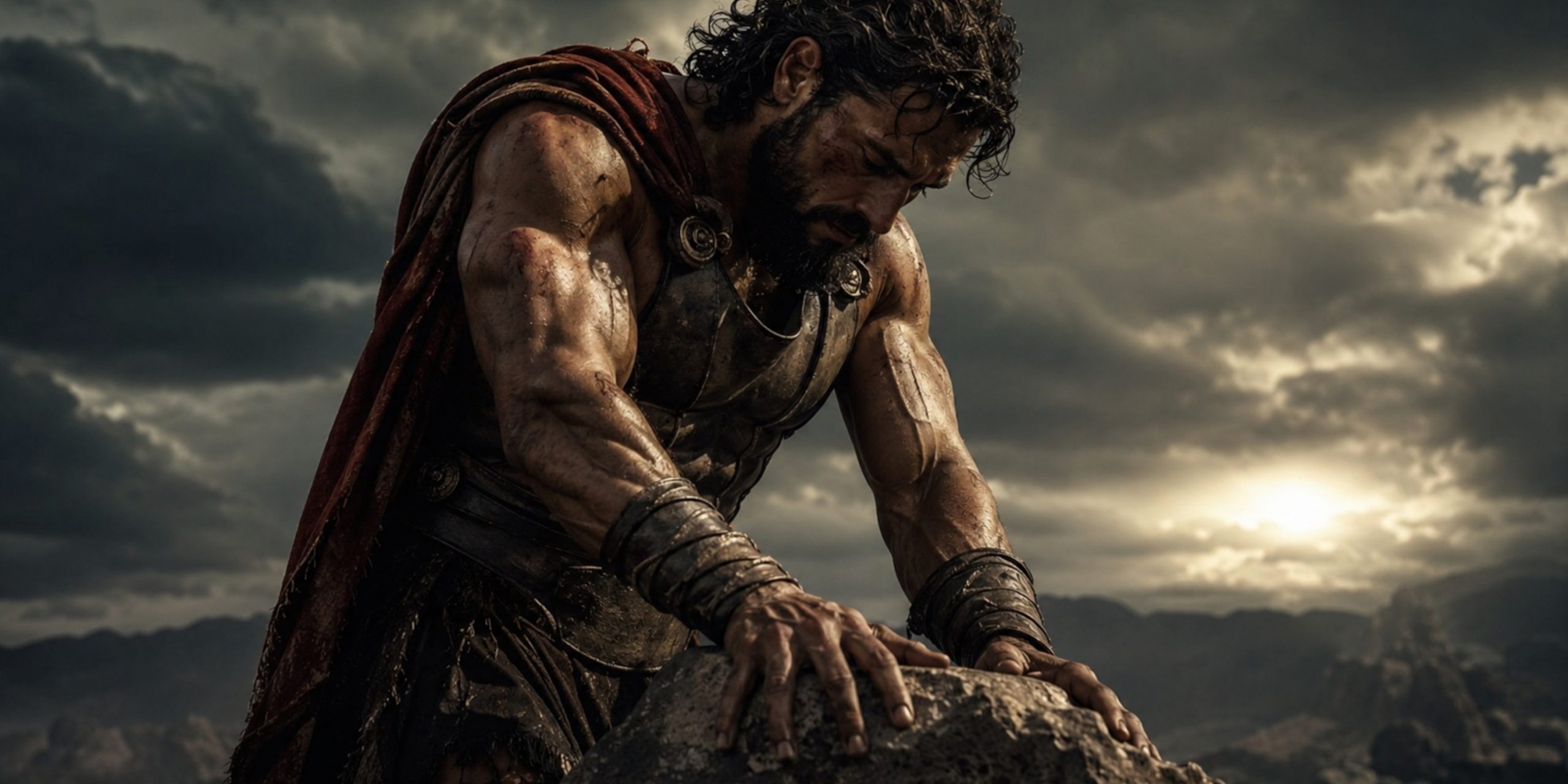
Few figures from Greek mythology feel as human as Heracles. Yes, he wrestled lions, dragged monsters into daylight and carried the heavens upon his shoulders, at least temporarily. Yet beneath the astonishing feats lies a man driven as much by suffering as by strength. His victories came at an immense personal cost, and his greatest battles were often against his own nature.
It is tempting to imagine Heracles as the ancient equivalent of an unstoppable action hero. Ancient writers present something rather more complicated. They describe a warrior capable of extraordinary courage, but also overwhelming rage, profound regret and genuine compassion. His story is one of endurance rather than perfection.
That complexity helps explain why Heracles became one of the most beloved heroes of the ancient world. Kings claimed descent from him, philosophers debated his choices, artists celebrated his exploits and ordinary people prayed to him for protection.
Who Was Heracles?

Heracles, known to the Romans as Hercules, was the son of Zeus and the mortal princess Alcmene. His birth alone guaranteed trouble. Zeus’s wife Hera, furious at another of her husband’s affairs, devoted herself to making Heracles’ life as miserable as divine intervention could reasonably allow.
She began early.
According to myth, Hera sent two enormous serpents into the infant’s cradle. Rather than becoming history’s shortest lived demigod, baby Heracles calmly strangled both snakes. One suspects this made family gatherings rather awkward.
His Greek name, Herakles, ironically means “Glory of Hera”, perhaps reflecting attempts to reconcile the hero with the goddess who pursued him throughout his life.
Heracles at a Glance
| Detail | Information |
|---|---|
| Greek Name | Herakles (Heracles) |
| Roman Name | Hercules |
| Father | Zeus |
| Mother | Alcmene |
| Mortal Father | Amphitryon |
| Divine Enemy | Hera |
| Wife | Megara, later Deianira |
| Children | Numerous, collectively called the Heracleidae |
| Symbols | Lion skin, club, bow and arrows |
| Famous For | The Twelve Labours |
| Fate | Achieved immortality and joined the Olympian gods |
Birth and Early Life
Heracles’ early years established themes that would define his entire life.
Gifted with unmatched physical strength, he received an elite education. He studied wrestling, music, chariot driving and military skills under renowned teachers. Ancient sources also describe him as intelligent and eloquent, qualities often overshadowed by his reputation for brute force.
One tragic incident foreshadowed later events. During a music lesson, Heracles struck his teacher Linus with a lyre after an argument, killing him instantly. Ancient authors vary over whether this was self defence or uncontrolled anger.
Even before adulthood, immense strength proved both blessing and curse.
The Madness That Changed Everything
The defining tragedy of Heracles’ life came not on a battlefield but within his own household.
After marrying Megara and fathering children, Hera inflicted a terrible madness upon him. In his delusion, Heracles murdered his wife and children, believing them to be enemies.
Different ancient writers offer variations, but the outcome remains devastating.
When his sanity returned, he faced unbearable guilt.
Seeking purification, he travelled to the Oracle at Delphi. There he received instructions that would shape mythology forever. He was ordered to serve King Eurystheus of Mycenae and perform whatever tasks the king demanded.
These became the Twelve Labours.
The Twelve Labours
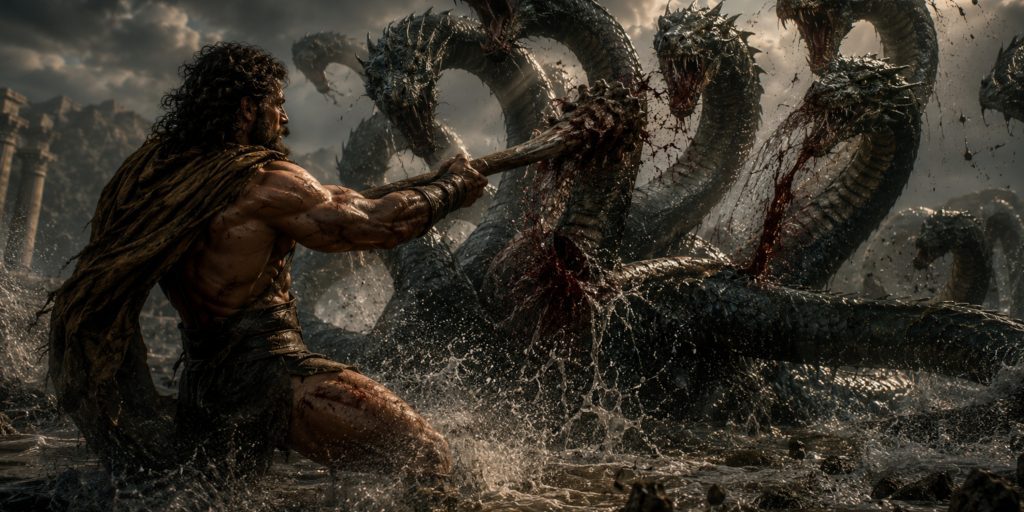
Originally intended as ten tasks, two were later rejected by Eurystheus, extending the total to twelve.
| Labour | Challenge |
|---|---|
| Nemean Lion | Kill the invulnerable lion |
| Lernaean Hydra | Destroy the many headed serpent |
| Ceryneian Hind | Capture Artemis’ sacred deer alive |
| Erymanthian Boar | Capture the giant boar |
| Augean Stables | Clean vast stables in one day |
| Stymphalian Birds | Defeat the deadly birds |
| Cretan Bull | Capture the raging bull |
| Mares of Diomedes | Subdue the man eating horses |
| Belt of Hippolyta | Retrieve the Amazon queen’s belt |
| Cattle of Geryon | Steal the giant’s cattle |
| Apples of the Hesperides | Obtain the golden apples |
| Cerberus | Bring the guardian of the Underworld to the surface |
Each labour demanded different qualities. Strength alone rarely proved enough. Heracles relied upon ingenuity, diplomacy and persistence almost as often as violence.
Weapons and Equipment
Heracles carried some of the most recognisable equipment in Greek mythology.
The Club
Fashioned from an olive tree, the wooden club symbolised raw strength. Unlike elegant bronze swords carried by aristocratic heroes, the club reflected Heracles’ direct and practical approach.
The Lion Skin
After defeating the Nemean Lion, he wore its impenetrable hide as armour. The lion’s head became his helmet, creating one of antiquity’s most famous heroic images.
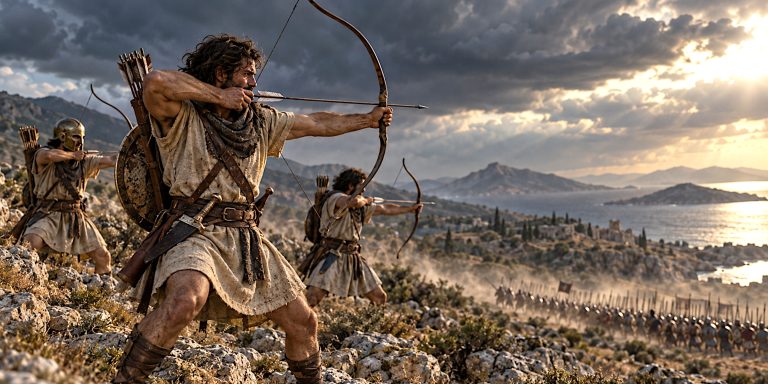
Bow and Poisoned Arrows
Heracles was also a formidable archer. His arrows were dipped in the poisonous blood of the Hydra, making even small wounds lethal.
Ironically, those same arrows would later contribute to his own death.
More Than the Labours
Ancient mythology records dozens of adventures beyond the famous twelve tasks.
These include:
- Joining the Argonauts
- Fighting alongside the Olympian gods against the Giants
- Rescuing Prometheus from eternal punishment
- Defeating the river god Achelous
- Freeing Hesione from a sea monster
- Conquering Troy in an earlier expedition before the Trojan War
- Wrestling Death itself to rescue Queen Alcestis
These stories reveal Heracles as a travelling hero who intervened wherever monsters, tyrants or supernatural threats appeared.
Family and Relationships
Heracles married more than once and fathered many children.
His first marriage to Megara ended in unimaginable tragedy.
Later he married Deianira, whose attempt to preserve their marriage accidentally caused his death. She believed she possessed a love charm, unaware it contained the deadly blood of the centaur Nessus, poisoned by Hydra venom.
The garment soaked in this substance burned Heracles with unbearable agony.
Greek tragedy seldom allows for happy misunderstandings.
Character and Personality
Heracles occupies a fascinating position among Greek heroes.
Unlike Achilles, whose pride dominates his story, or Odysseus, celebrated for cunning, Heracles constantly struggles with his own emotions.
Ancient authors portray him as:
- Courageous
- Compassionate towards the innocent
- Fiercely loyal to friends
- Prone to explosive anger
- Deeply remorseful after wrongdoing
- Willing to endure suffering without complaint
His greatest achievement may not have been defeating monsters but continuing to pursue redemption after catastrophic personal failure.
Ancient Sources
Our understanding of Heracles comes from centuries of literature rather than one definitive account.
Important sources include:
- Hesiod’s Theogony
- Pindar’s victory odes
- Sophocles’ Women of Trachis
- Euripides’ Heracles
- Apollodorus’ Bibliotheca
- Diodorus Siculus
- Pausanias
- Ovid’s Metamorphoses
Each author reshaped the hero according to changing cultural values, creating the richly layered figure recognised today.
Archaeology and Historical Origins
Unlike historical kings, Heracles cannot be confirmed through archaeology.
However, archaeological discoveries demonstrate how deeply his cult spread across the Greek world.
Evidence includes:
- Temple dedications across Greece
- Painted pottery illustrating the Twelve Labours
- Marble statues from the Classical and Roman periods
- Coins bearing his image
- Sanctuaries dedicated to hero worship
Some historians suggest Heracles may preserve distant memories of an exceptionally powerful Bronze Age warrior whose legend expanded over centuries.
Others see him as a symbolic figure representing civilisation overcoming chaos.
Neither interpretation can be conclusively proven.
Heracles in Ancient Art
Artists adored Heracles because his adventures offered endless dramatic possibilities.
Popular scenes include:
- Wrestling the Nemean Lion
- Battling the Hydra
- Carrying Cerberus from the Underworld
- Holding the heavens while Atlas gathered the golden apples
- Resting wearily upon his club after completing impossible tasks
His muscular physique became the artistic model for heroic strength across Greece and later Rome.
Death and Apotheosis
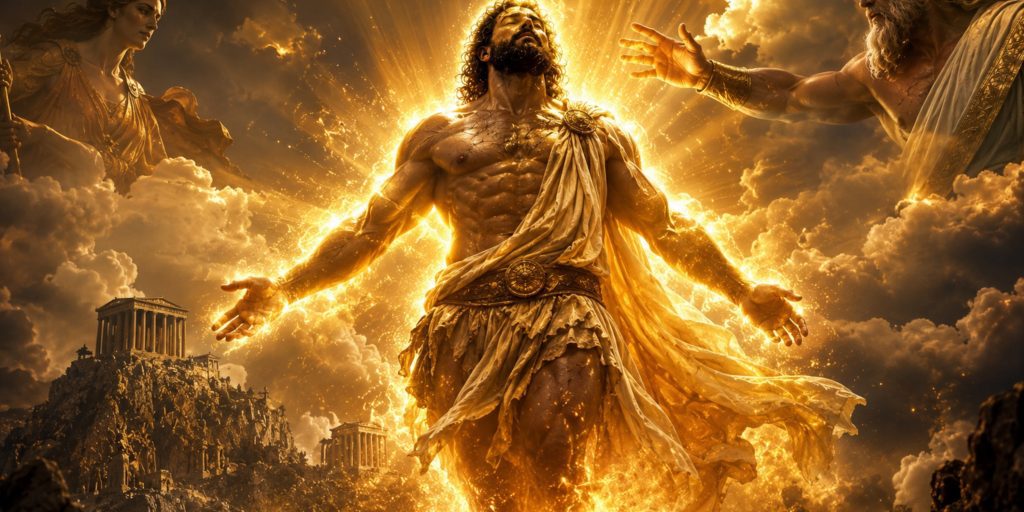
Unable to endure the agony caused by the poisoned robe, Heracles built his own funeral pyre upon Mount Oeta.
As the flames rose, Zeus intervened.
The mortal part of Heracles perished, while his divine nature ascended to Olympus. There he was granted immortality and, according to many traditions, reconciled with Hera at last.
After a lifetime spent battling monsters, kings and his own conscience, peace finally arrived.
Heracles in Later Culture
The Romans enthusiastically embraced Hercules, transforming him into one of their greatest heroic figures.
During the Renaissance he symbolised virtue overcoming adversity.
Modern audiences encounter him in novels, films, television series, comics and video games. These interpretations vary wildly in accuracy, but the essential appeal remains unchanged.
People admire heroes who keep going despite failure.
Heracles is perhaps the oldest example of that idea.
Legacy
Heracles endures because his story speaks to more than impossible strength.
He represents resilience after disaster, the search for redemption and the difficult truth that extraordinary ability does not guarantee wisdom or happiness.
Ancient Greeks did not remember him because he never failed. They remembered him because he failed terribly, accepted responsibility and continued forward.
That makes him feel surprisingly modern.
His monsters may belong to mythology, but his struggles remain recognisably human.
Frequently Asked Questions
Was Heracles a real person?
There is no historical evidence that Heracles existed as an individual. Most historians regard him as a mythological hero whose legends may preserve fragments of older oral traditions.
Why is he called Hercules?
Hercules is the Roman form of the Greek name Heracles. Roman writers adopted many Greek myths while adapting names to Latin.
Why did Heracles perform the Twelve Labours?
He undertook the Labours as penance after killing his wife and children during a divinely induced madness sent by Hera.
Was Heracles stronger than Achilles?
Greek mythology generally portrays Heracles as physically stronger, while Achilles was considered the greater battlefield warrior during the Trojan War.
What happened after his death?
According to Greek mythology, Heracles became immortal and joined the Olympian gods after ascending from his funeral pyre on Mount Oeta.