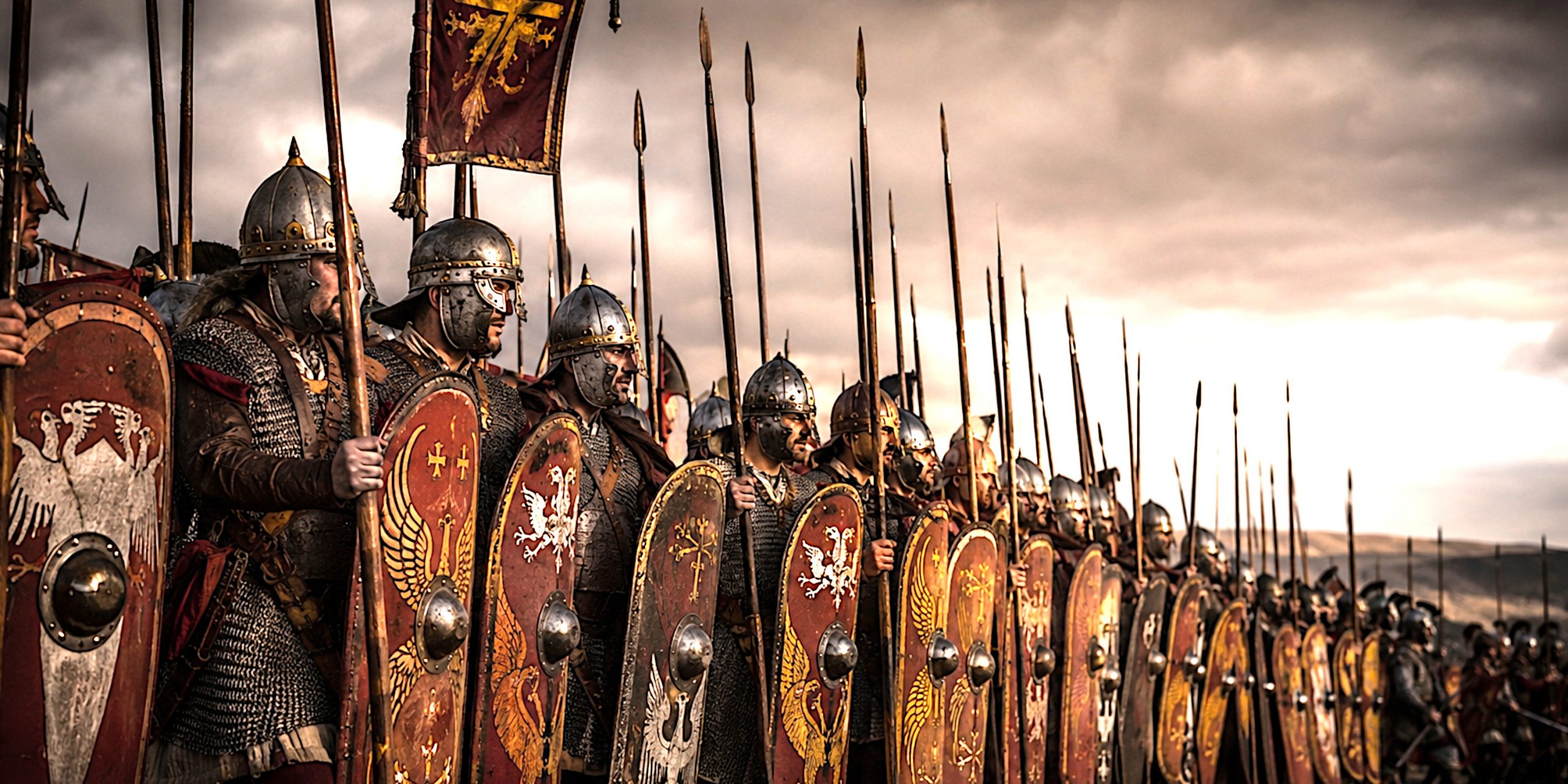
The Skoutatoi were the shield-bearing heavy infantry of the medieval Byzantine, or Eastern Roman, army. For several centuries they provided something every sophisticated cavalry army still desperately needed: men prepared to stand in one place while somebody else charged at them.
Their name came from the skouton, the substantial shield that characterised their equipment and battlefield function. Yet reducing the Skoutatoi to simple spearmen does them a disservice. They belonged to an increasingly sophisticated combined-arms system in which infantry, archers, specialist anti-cavalry troops and heavy cavalry supported one another.
The Skoutatoi are particularly associated with the middle Byzantine military tradition, broadly from the seventh through the eleventh centuries, although the terminology and equipment changed over time. By the tenth century, military manuals describe infantry formations of considerable complexity, designed to survive cavalry attack while creating opportunities for Byzantine mounted troops to deliver the decisive blow.
They were not glamorous. Byzantine writers generally reserved that pleasure for emperors and cavalry commanders. They were, however, essential.
Skoutatoi at a Glance
| Feature | Detail |
|---|---|
| Empire | Byzantine Empire, or Eastern Roman Empire |
| Meaning | Approximately “shield-men”, from skouton |
| Period most associated with them | c. 7th to 11th centuries |
| Troop type | Heavy or line infantry |
| Primary weapon | Kontarion spear or pike |
| Secondary weapons | Spathion, paramerion, axe |
| Principal defence | Skouton or skoutarion shield |
| Armour | Mail, scale or lamellar depending on period, status and availability |
| Typical battlefield role | Hold the battle line, resist cavalry and protect supporting troops |
| Tactical system | Close-order combined-arms infantry formations |
| Best documented period | 10th century |
Who Were the Skoutatoi?
The word skoutatos, plural skoutatoi, derives from the shield carried by the soldier. The linguistic connection reaches back towards the Latin scutum, another small reminder that Byzantium never regarded itself as some entirely new civilisation that had replaced Rome.
Its inhabitants were Romans.
The Skoutatoi represented one stage in the long evolution of Roman infantry rather than a direct continuation of the classical legionary in identical form. By the medieval period, the military circumstances facing Constantinople had changed considerably. Byzantine forces fought Arabs, Bulgars, steppe peoples, Armenians, Rus’, western Europeans and numerous regional powers, often across terrain that made rigid adherence to one tactical system distinctly unwise.
Byzantine military thinking consequently placed great emphasis on flexibility.
Heavy infantry remained valuable because cavalry alone could not reliably occupy ground, protect missile troops, secure camps or provide a stable centre around which more mobile forces could manoeuvre. The Skoutatoi fulfilled much of this less spectacular but essential work.
The Strategikon, traditionally associated with Emperor Maurice, shows how seriously Byzantine commanders treated infantry organisation, equipment, marching, camps and combined operations. It was written as a practical military handbook rather than heroic literature, which makes it especially useful to historians.
Origins and Development
Pinning down an exact moment when the Skoutatoi “appeared” is difficult because Byzantine military terminology evolved gradually.
The armies of the sixth and seventh centuries inherited late Roman infantry traditions in which spears, shields, bows and body armour remained important. During the seventh century, however, the empire underwent enormous military and political disruption following wars with Persia and the rapid Islamic conquests.
The Byzantine army changed with it.
Regional military structures developed, cavalry became increasingly prominent, and infantry equipment and organisation continued to evolve. The heavily equipped shield-bearing infantryman survived because the tactical problem he solved had not disappeared.
By the tenth century the evidence becomes particularly detailed.
Military treatises associated with the great eastern wars describe disciplined infantry formations capable of resisting cavalry while cooperating with archers and specialist troops. The Praecepta Militaria, associated with Emperor Nikephoros II Phokas and composed around 965, is one of the most important sources for this system.
This was not an army blindly imitating ancient Greece or Rome. Byzantine authors certainly enjoyed classical terminology, occasionally with the enthusiasm of men who had spent too much time in libraries, but their tactical recommendations addressed contemporary enemies.
Organisation
The Skoutatoi did not normally fight as isolated bands of shield-bearing swordsmen.
They operated within larger infantry formations containing several different troop types. The precise arrangements varied by period and military manual, but tenth-century tactical literature presents formations in which heavy infantry worked alongside archers and other specialist infantry.
Nikephoros II Phokas’ system placed considerable emphasis on a strong infantry formation capable of acting as the anchor of the army while heavy cavalry manoeuvred around it.
One tenth-century tactical blueprint describes the standard Byzantine infantry formation in considerable detail, while the Praecepta Militaria describes a double square, or four-sided formation, constructed from multiple infantry units.
The basic principle was sensible.
Infantry had to remain sufficiently deep and disciplined to survive attack. Missile troops needed protection. Spears had to be positioned where cavalry might strike. Gaps had to be avoided.
A Byzantine infantry formation therefore functioned less like a collection of individual warriors and more like a defensive machine.
How the Skoutatoi Fought
The primary task of the Skoutatoi was cohesion.
A heavy infantryman who abandoned formation to pursue an opponent might display impressive personal enthusiasm while simultaneously making himself a nuisance to everyone around him.
The Skoutatoi instead fought in organised ranks behind shields and spear points.
Their formation could:
- absorb missile attacks
- resist enemy infantry
- deter or disrupt cavalry charges
- protect archers and lighter infantry
- secure ground
- provide a stable base for Byzantine cavalry manoeuvres
- defend the army if mounted attacks failed
The spear was especially important against cavalry. Long weapons allowed several ranks of infantry to create an intimidating concentration of points in front of the formation.
A horse can be persuaded to do many remarkable things. Voluntarily impaling itself on a forest of spearheads is rarely high on the list.
The Infantry Square
One of the most interesting developments in tenth-century Byzantine warfare was the sophisticated infantry square described in military manuals.
The Praecepta Militaria describes a double infantry square, with troops arranged along four sides.
This formation could provide protection from attacks arriving from several directions and offered a secure position for missile troops and other soldiers.
Its purpose was closely connected to the realities of warfare on Byzantium’s eastern frontiers, where highly mobile enemy cavalry represented a persistent threat.
The formation was not intended simply to sit passively on the battlefield. Byzantine commanders could use their infantry as an anchor while cavalry attacked elsewhere.
This relationship is crucial to understanding the Skoutatoi.
They were rarely intended to win the battle alone.
Arms and Armour
The equipment attributed to Byzantine heavy infantry changed considerably between the seventh and eleventh centuries. Military manuals also describe ideals, not necessarily what every provincial soldier possessed.
A reconstruction should therefore resist the temptation to dress every Skoutatos like an imperial guardsman.
The Skouton
The defining item was the skouton or skoutarion, the shield from which the troops took their name.
Different shield shapes appear across Byzantine art and written evidence, including:
- round shields
- oval shields
- elongated shields
- teardrop forms
- kite-shaped shields during the later period
Large round or oval shields gradually existed alongside elongated forms, with kite-like shields becoming increasingly visible around the tenth and eleventh centuries.
Shields were generally constructed from wood and could incorporate leather coverings, painted decoration and metal fittings.
Their importance extended beyond personal protection. In close formation, shields helped create a coherent defensive frontage.
The Kontarion
The kontarion was the principal spear associated with Byzantine heavy infantry.
Lengths varied according to function and period. Particularly long examples described for forward troops could approach approximately four metres.
Tenth-century evidence describes heavily equipped infantry using very long spears against cavalry. One reconstruction of the textual evidence gives front-rank pikes at around thirteen feet in length.
Other soldiers could carry shorter spears.
The kontarion was therefore not simply an oversized personal weapon. Within formation it formed part of a collective defence.
Against cavalry, that distinction mattered enormously.
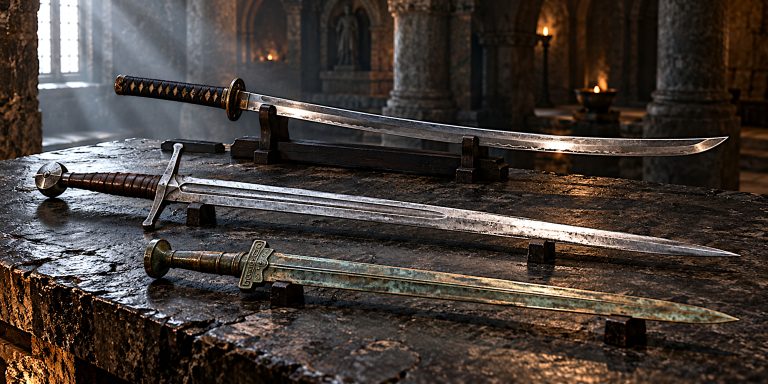
Swords Used by the Skoutatoi
Swords were secondary weapons rather than the Skoutatoi’s principal battlefield arm. Once spear formations became compressed or broken, however, the sword became considerably more useful.
Two sword types are particularly relevant.
Spathion
The spathion was a straight, double-edged sword descended from the late Roman spatha tradition.
It was suited to both cutting and thrusting and represents one of the clearest continuities between late Roman and medieval Byzantine military equipment.
The exact dimensions naturally varied, but blades around 70 to 80 cm are broadly consistent with surviving and comparative examples.
A Skoutatos carrying a spathion therefore possessed a weapon recognisably belonging to the wider European tradition of straight double-edged military swords.
Paramerion
The paramerion was a different proposition.
It was a single-edged weapon with a slightly curved blade, increasingly associated with Byzantine military equipment during the middle period. Its development appears to reflect eastern and steppe influences within Byzantine warfare.
Tenth-century evidence associates both the spathion and paramerion with Byzantine infantry.
The presence of both is revealing. Byzantine military culture was perfectly comfortable preserving Roman traditions while adopting useful ideas from its neighbours.
Practicality generally defeats nostalgia when somebody is trying to kill you.
Axes and Other Weapons
Some Byzantine infantry also used the tzikourion, a military axe.
Axes could be effective in close combat and appear in Byzantine textual and artistic evidence. They should not, however, replace the spear when reconstructing the typical Skoutatos.
The basic hierarchy remained:
spear first, sword or axe when necessary.
Missile weapons were generally the responsibility of supporting infantry rather than the defining weapon of the Skoutatoi.
Body Armour
Byzantine heavy infantry armour could include several forms of protection.
Lorikion
The lorikion was commonly associated with mail armour, although Byzantine terminology was not always as wonderfully tidy as modern equipment catalogues would prefer.
Mail provided excellent flexibility and substantial protection against cuts.
Klivanion
The klivanion is strongly associated with lamellar armour and became one of the most recognisable forms of Byzantine military protection.
Lamellar construction used numerous small plates laced together to form a relatively flexible defensive shell.
Scale Armour
Scale armour also remained part of the broader Byzantine military tradition.
Military technology across Byzantium was never completely uniform. Geography, supply, wealth, rank and date all mattered.
Limb Protection
Military texts also mention additional protection for the arms and lower legs.
Such equipment was particularly useful for men expected to stand in the front ranks.
Helmets
No single “Skoutatoi helmet” existed throughout their history.
Byzantine soldiers used several helmet forms, including relatively simple iron helmets and segmented constructions. Conical forms were widespread, sometimes combined with additional protection for the neck.
The exact appearance varied significantly according to century and region.
This is worth stressing because modern depictions often produce a wonderfully uniform Byzantine army in matching lamellar armour.
Real medieval armies were considerably less cooperative.
What Did a Skoutatos Actually Look Like?
A heavily equipped tenth-century Skoutatos might plausibly carry:
| Equipment | Likely form |
| Helmet | Iron conical or segmented helmet |
| Body armour | Mail, scale or lamellar |
| Shield | Round, oval, elongated or increasingly kite-like skouton |
| Primary weapon | Kontarion |
| Sword | Spathion or paramerion |
| Alternative sidearm | Tzikourion |
| Additional protection | Arm and lower-leg protection where available |
| Clothing | Tunic, trousers, boots and textile layers beneath armour |
Not every soldier would possess the full equipment described in military manuals.
That difference between prescribed equipment and actual equipment is one of the persistent problems in reconstructing Byzantine warfare.
Contemporary Byzantine Military Voices
Byzantine military manuals are unusually valuable because their authors were interested in practical warfare rather than simply celebrating heroic commanders.
The Strategikon attributed to Maurice is explicitly concerned with the realities of campaigning, including formations, equipment, camps, medical arrangements and the characteristics of foreign enemies.
A particularly revealing tenth-century instruction from the military tradition describes the infantry deployment:
“The formation of the aforementioned foot soldiers is to be a double square.”
The passage continues by explaining how units should be distributed around its four sides.
The language is hardly Homer.
That is precisely why it is useful.
Byzantine tactical writers were frequently preoccupied with dimensions, ranks, troop positioning, reconnaissance and contingency planning. Their commanders were expected to understand how an army actually functioned.
The Praecepta Militaria consequently discusses not only infantry and cavalry deployment but camps, spies and operational preparation.
The Skoutatoi and Byzantine Cavalry
Popular images of Byzantine warfare tend to favour cataphracts, and understandably so. Heavily armoured cavalry make rather better paintings.
Yet cavalry needed infantry.
The tactical system described under Nikephoros II Phokas placed a strong infantry formation at the centre of operations while heavy cavalry provided much of the offensive striking power.
The Skoutatoi could hold enemy troops in place, protect archers and provide somewhere relatively secure for the Byzantine army to reorganise.
This created a division of battlefield labour.
Infantry provided stability.
Cavalry provided mobility and shock.
Archers provided missile power.
Commanders attempted to make the three cooperate, which was naturally the difficult part.
Against Cavalry
The Skoutatoi were particularly valuable against mounted opponents.
A disciplined formation equipped with large shields and long spears could make a frontal cavalry assault extremely hazardous.
That did not make infantry invulnerable.
Enemy cavalry could:
- bombard formations with arrows
- threaten the flanks
- feign retreats
- attack isolated units
- disrupt supply lines
- force infantry to march under pressure
The Byzantine answer was combined arms rather than faith in an invincible shield wall.
This is one reason their military manuals repeatedly discuss formations in relation to particular enemies and tactical circumstances.
Against Infantry
When facing infantry, the Skoutatoi could advance behind shields with spears presented forwards.
Once formations met, combat could become much closer.
At that point the long kontarion might become awkward, damaged or lost. Swords such as the spathion and paramerion then became valuable.
The shield remained crucial.
Byzantine infantry combat was therefore potentially a progression from spear fighting at reach towards extremely close combat involving swords and axes.
Precisely how often battlefield encounters followed such a neat sequence is unknowable. Battles have an unfortunate habit of ignoring manuals.
Archaeology and Material Evidence
The archaeology of the Skoutatoi presents a considerable challenge.
There is no single archaeological assemblage conveniently labelled “equipment belonging to a Skoutatos”. Historians instead combine excavated weapons and armour with artistic representations, military manuals and comparative material.
Byzantine military archaeology has produced:
- spearheads
- sword blades and fittings
- axe heads
- arrowheads
- armour fragments
- lamellar plates
- helmet components
- shield fittings
- military belt equipment
The difficulty lies in assigning individual finds to particular troop categories.
A spearhead recovered from a Byzantine military context tells us that somebody carried a spear. It does not politely provide his regimental paperwork.
Archaeological Evidence for Byzantine Swords
Surviving swords and sword fittings are particularly useful when compared with written terminology.
Straight double-edged swords belonging to the broader spatha tradition are well represented across the late antique and early medieval world. Their continuation fits the Byzantine literary references to the spathion.
Single-edged and curved weapons are more complicated.
Byzantium interacted constantly with Avars, Bulgars, Khazars, Magyars, Pechenegs and other peoples whose military cultures included forms of curved sabre. The Byzantine paramerion developed within this broader Eurasian environment.
This does not mean every curved sword excavated around Byzantine territory was a paramerion carried by a Skoutatos.
Archaeological attribution needs rather more caution than that.
Artistic Evidence
Byzantine manuscripts, ivories, wall paintings and religious art provide another important source for military equipment.
Soldiers are shown with:
- spears
- swords
- round shields
- elongated shields
- helmets
- scale or lamellar-style armour
Religious imagery is particularly useful but must be handled carefully.
A painted military saint is not a battlefield photograph.
Artists could employ symbolic equipment, classical conventions and contemporary military fashions simultaneously. Nevertheless, when artistic evidence corresponds with archaeological finds and military texts, it becomes extremely valuable.
The Skoutatoi During the Tenth-Century Military Revival
The tenth century provides perhaps the clearest picture of Byzantine heavy infantry.
Under emperors such as Nikephoros II Phokas, John I Tzimiskes and Basil II, Byzantine armies conducted major campaigns in Syria, Mesopotamia and the Balkans.
The military manuals associated with this period describe infantry as an integral part of armies increasingly capable of sustained offensive operations.
Nikephoros II’s Praecepta Militaria was composed during this environment of military expansion. Its emphasis on carefully organised infantry formations reflects decades of warfare against highly mobile eastern opponents.
The Skoutatoi were therefore participants in one of Byzantium’s most successful periods of military expansion.
Were the Skoutatoi Professional Soldiers?
The answer depends heavily upon period and unit.
The Byzantine military system incorporated different categories of troops, including provincial forces and centrally controlled professional formations.
It would therefore be misleading to imagine every Skoutatos as a permanently employed professional soldier equipped from an identical imperial warehouse.
Training, wealth and equipment could vary.
The tactical manuals describe what commanders wanted from their soldiers. Whether every army achieved those standards is another matter entirely.
Military regulations have been optimistic documents for a very long time.
Were They Byzantine Hoplites?
Sometimes modern descriptions call the Skoutatoi Byzantine “hoplites”.
There are superficial similarities.
Both were shield-bearing spear infantry who relied heavily upon formation cohesion. Byzantine authors themselves also reused classical terminology.
But treating Skoutatoi as simply medieval hoplites obscures more than it explains.
Their equipment, command structure, enemies and tactical environment belonged to the medieval Roman world. Their formations incorporated missile troops and interacted closely with sophisticated cavalry forces.
The resemblance is therefore functional rather than evidence of an uninterrupted classical phalanx tradition.
Skoutatoi Versus Roman Legionaries
The Skoutatoi were descendants of Roman military tradition, but they were not legionaries wearing medieval equipment.
| Feature | Roman Legionary | Skoutatos |
| Period | Principally ancient Roman | Medieval Byzantine |
| Primary weapon emphasis | Varied by period, including javelin and sword | Spear or pike |
| Shield | Scutum and later forms | Skouton |
| Sword | Gladius or spatha | Spathion or paramerion |
| Formation | Cohort-based legionary system | Medieval Byzantine combined-arms formations |
| Cavalry relationship | Generally supporting role in earlier imperial armies | Central component of tactical system |
| Missile support | Auxiliaries and attached troops | Integrated archers and light infantry |
The important connection is institutional rather than visual.
Byzantium inherited Roman military administration, terminology and strategic culture, then altered all three repeatedly.
Skoutatoi Versus Western Spearmen
By the eleventh century a Byzantine Skoutatos might superficially resemble contemporary western infantry.
Both could carry:
- spear
- shield
- helmet
- mail armour
- straight sword
The difference lay partly in tactical organisation.
Byzantine manuals provide evidence for unusually deliberate combined-arms systems involving carefully positioned archers, heavy infantry, specialist troops and cavalry.
Western armies could certainly use sophisticated tactics too, but the Byzantine military literature preserves a particularly detailed intellectual tradition of warfare.
Decline and Disappearance
The Skoutatoi did not suddenly disappear after a single catastrophic battle.
Instead, the military institutions supporting traditional middle Byzantine infantry changed during the eleventh century.
Political instability, financial pressures, changing recruitment systems and military defeats all contributed to the transformation of the Byzantine army.
The defeat at Manzikert in 1071 is often treated as the convenient dividing line, but the process was much more complicated.
Later Byzantine armies increasingly relied upon different mixtures of native soldiers, provincial forces, guardsmen and foreign mercenaries.
The terminology changed accordingly.
The Skoutatoi belonged most clearly to the military world that had reached maturity during the great campaigns of the tenth century.
How Effective Were the Skoutatoi?
Judged by their intended function, they could be extremely useful.
Their strengths included:
- strong defensive cohesion
- effectiveness against cavalry
- substantial shield protection
- ability to protect missile troops
- compatibility with Byzantine combined-arms tactics
- considerable staying power when properly organised
Their weaknesses were equally real:
- limited mobility compared with cavalry
- vulnerability if outflanked
- dependence upon formation discipline
- difficulty pursuing mounted enemies
- considerable equipment requirements
- vulnerability to sustained missile harassment
They were therefore neither invincible heavy infantry nor expendable spear carriers.
Their effectiveness depended upon the rest of the army.
That is perhaps the most Byzantine thing about them.
What We Still Do Not Know
Despite detailed military manuals, many questions remain unresolved.
We cannot confidently reconstruct one universal Skoutatoi uniform.
We cannot determine exactly how faithfully commanders followed theoretical tactical manuals.
We cannot always distinguish archaeologically between equipment belonging to Skoutatoi and weapons carried by other Byzantine troops.
Even the terminology changes between centuries.
Modern reconstruction consequently works best when it concentrates on specific periods. A Skoutatos of the seventh century should not automatically be equipped like one described under Nikephoros II Phokas three centuries later.
Byzantine military history becomes much more interesting once we stop trying to make everybody match.
Historical Legacy
The Skoutatoi represent an important stage in the evolution of European and Mediterranean infantry.
They demonstrate that the medieval Byzantine army was not simply a cavalry force surrounded by poorly equipped foot soldiers. Its commanders developed sophisticated infantry formations specifically intended to cooperate with missile troops and mounted forces.
Their equipment also reveals Byzantium’s position between military worlds.
The spathion preserved a recognisably Roman sword tradition.
The paramerion reflected influences moving through the Eurasian steppe and eastern frontier.
The kontarion answered the perennial problem of mounted attack.
The skouton gave the soldiers their name.
Together these weapons belonged to an army that remained Roman in identity while continually borrowing, modifying and improving whatever proved useful.
For a historian, that is what makes the Skoutatoi particularly compelling. They sit at the point where the Roman infantry tradition becomes unmistakably medieval without ever quite ceasing to be Roman.
The legionary had not survived unchanged.
The idea that disciplined infantry still mattered certainly had.