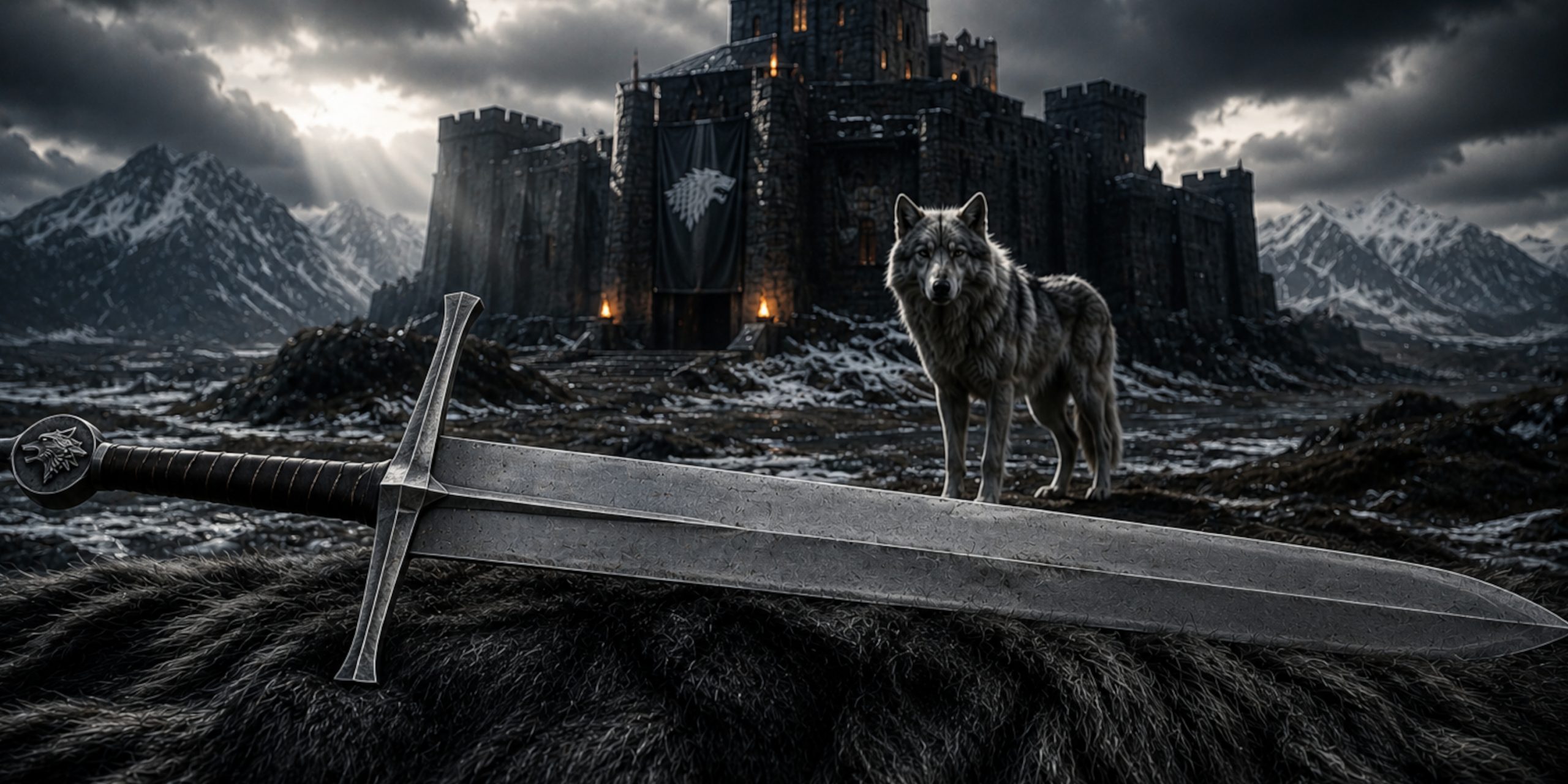
Few weapons in fantasy make an impression quite like Ice. The ancestral blade of House Stark is not covered in magical flames, does not whisper promises of power and is rarely used in glorious heroic duels. In typical A Song of Ice and Fire fashion, its greatest moment is actually devastating.
Ice represents history, duty and the old world of Westeros. It is a weapon carried by men who believe power should come with responsibility. Then, almost cruelly, it becomes a symbol of how quickly those values can be destroyed.
George R. R. Martin has a habit of making objects feel like characters themselves, and Ice might be the best example. For a sword that appears briefly, its shadow hangs over the entire story.
What Is Ice?
Ice is the ancestral greatsword of House Stark of Winterfell. It is forged from Valyrian steel, an incredibly rare metal created using lost techniques from the Valyrian Freehold.
The sword is described as:
| Feature | Details |
|---|---|
| Type | Two-handed greatsword |
| Material | Valyrian steel |
| House | Stark of Winterfell |
| Original Owner | House Stark |
| Known Wielder | Eddard “Ned” Stark |
| Fate | Reforged into two smaller swords |
| New Blades Created | Widow’s Wail and Oathkeeper |
Despite its size, Ice is lighter than a normal steel sword because of the properties of Valyrian steel. It combines terrifying cutting ability with craftsmanship that modern smiths in Westeros struggle to understand.
Basically, it is the medieval fantasy equivalent of inheriting a priceless supercar from your ancestors, except this one removes heads.
The Appearance Of Ice
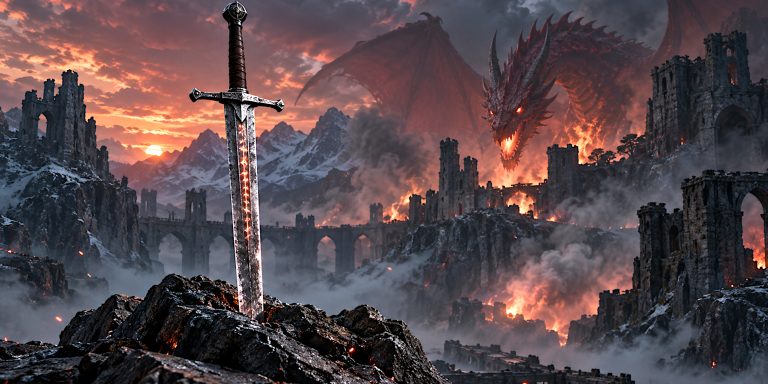
Ice is enormous, even by the standards of Westerosi weapons.
In the books, it is described as being as wide across as a man’s hand and taller than Robb Stark. Its blade has the distinctive rippled appearance associated with Valyrian steel, caused by repeated folding and mysterious forging methods.
Unlike many famous fantasy swords, Ice is not flashy. It perfectly reflects House Stark:
- Simple
- Powerful
- Ancient
- Practical
- Slightly intimidating
The Starks do not need a sword covered in jewels. Their family motto is literally a warning about winter arriving. Subtlety was clearly never the main concern.
Origins And History Of Ice
The exact origin of Ice is mysterious.
The Starks have ruled the North for thousands of years, but this particular sword is not from the earliest days of the family. The current Ice was acquired around 400 years before the events of A Song of Ice and Fire.
The name itself is older. Earlier Stark kings carried weapons also called Ice, suggesting the name was passed from blade to blade as a symbol of authority.
Valyrian steel weapons were usually obtained through enormous wealth, conquest, trade or ancient connections. How House Stark gained such a valuable weapon remains unclear, which only adds to its legend.
Valyrian Steel: Why Ice Is Special
Valyrian steel is among the most valuable materials in Westeros.
Its advantages include:
- Exceptional sharpness
- Lighter weight than ordinary steel
- Superior durability
- Resistance to normal wear
- Possible magical properties
The knowledge required to create new Valyrian steel disappeared after the Doom of Valyria. A few smiths can rework existing blades, but creating new ones is believed impossible.
This makes every surviving Valyrian weapon almost priceless.
Famous examples include:
| Sword | House/User |
| Ice | House Stark |
| Longclaw | House Mormont, later Jon Snow |
| Blackfyre | House Targaryen |
| Dark Sister | House Targaryen |
| Heartsbane | House Tarly |
| Lady Forlorn | House Corbray |
Owning one is not just a military advantage. It is a statement that your family has mattered for centuries.
Ned Stark And Ice
Ice is most closely associated with Lord Eddard Stark.
Interestingly, Ned rarely carries it into battle. The weapon is huge and ceremonial, mainly used for executions. That detail tells us almost everything about Ned’s character.
His famous belief:
“The man who passes the sentence should swing the sword.”
For Ned, Ice is not about showing strength. It represents accountability. If a lord orders death, he should understand exactly what that decision means.
It is a brutal philosophy, but compared with many rulers in Westeros, it is almost refreshing. The bar for decent leadership in Westeros is not exactly sitting high.
The Fall Of Ice
The destruction of Ice is one of the most symbolic moments in the series.
After Ned Stark’s execution, House Lannister gains possession of the sword. Tywin Lannister orders it melted down and reforged into two smaller Valyrian steel blades:
- Widow’s Wail
- Oathkeeper
On a practical level, it makes sense. House Lannister desperately wants its own Valyrian steel legacy weapon.
Symbolically, it is brutal.
The ancient sword of the North is broken apart by a rival house and transformed into trophies. It is not simply the loss of a weapon, it is the attempted destruction of Stark identity.
Oathkeeper And Widow’s Wail
Ice survives through the two swords created from it.
Oathkeeper
Given to Jaime Lannister, who later gives it to Brienne of Tarth.
Despite coming from an act of betrayal, Oathkeeper becomes a blade associated with loyalty, honour and protection. There is a strange poetic justice in that. A Stark sword finds its way back into the hands of someone actually trying to keep promises.
Widow’s Wail
Given to King Joffrey Baratheon.
The name alone tells you everything about Joffrey’s personality. Most people inherit legendary weapons and try to honour them. Joffrey immediately chooses something that sounds like it was named by an angry teenager.
The sword later passes beyond him, continuing the complicated legacy of Ice.
Ice In Game Of Thrones
The television adaptation keeps Ice largely faithful to the novels.
Its design emphasises:
- Immense size
- Plain but elegant craftsmanship
- Dark, practical Northern styling
- A serious ceremonial presence
The show makes the destruction of Ice especially memorable by visually showing the Stark blade being reforged. Watching such an iconic weapon vanish feels almost like watching a character die.
Considering how dangerous Westeros is, even swords are not safe.
Could Ice Return?
A major fan theory suggests the two halves of Ice could eventually be reforged.
The idea fits thematically:
- The Stark family is scattered but could reunite
- The North may need its ancient symbol restored
- Valyrian steel is important against the White Walkers
However, there is no confirmation that this will happen.
Martin often avoids simple restoration stories. Ice returning would feel satisfying, but A Song of Ice and Fire rarely gives characters exactly what they want.
Usually it gives them trauma, difficult choices and occasionally a very large wolf.
Symbolism Of Ice
Ice represents several major themes:
Duty
Ned uses the sword as a reminder that leadership carries responsibility.
Legacy
The blade connects modern Starks to centuries of Northern history.
Loss
Its destruction mirrors the collapse of House Stark after Ned’s death.
Survival
Through Oathkeeper and Widow’s Wail, Ice continues in a changed form.
That final point feels very Stark. Broken, altered, but somehow still surviving.
Why Ice Remains Iconic
Ice is fascinating because it is not famous for winning battles. Many fantasy swords become legendary because their owners defeat monsters or conquer kingdoms.
Ice is different.
It matters because of what it represents: family, honour, memory and the heavy burden of leadership. Its destruction hurts because readers understand that something ancient has been lost.
Yet the story of Ice is not completely finished. Whether it returns physically or only through the actions of those carrying its fragments, the greatsword of House Stark remains one of the most powerful symbols in A Song of Ice and Fire.
Winter came for Ice. The interesting question is whether spring ever will.