Terminus Est: More Than Just a Sword
Some fictional swords exist to win battles. Others exist to look cool on book covers. Terminus Est belongs to a much stranger category.
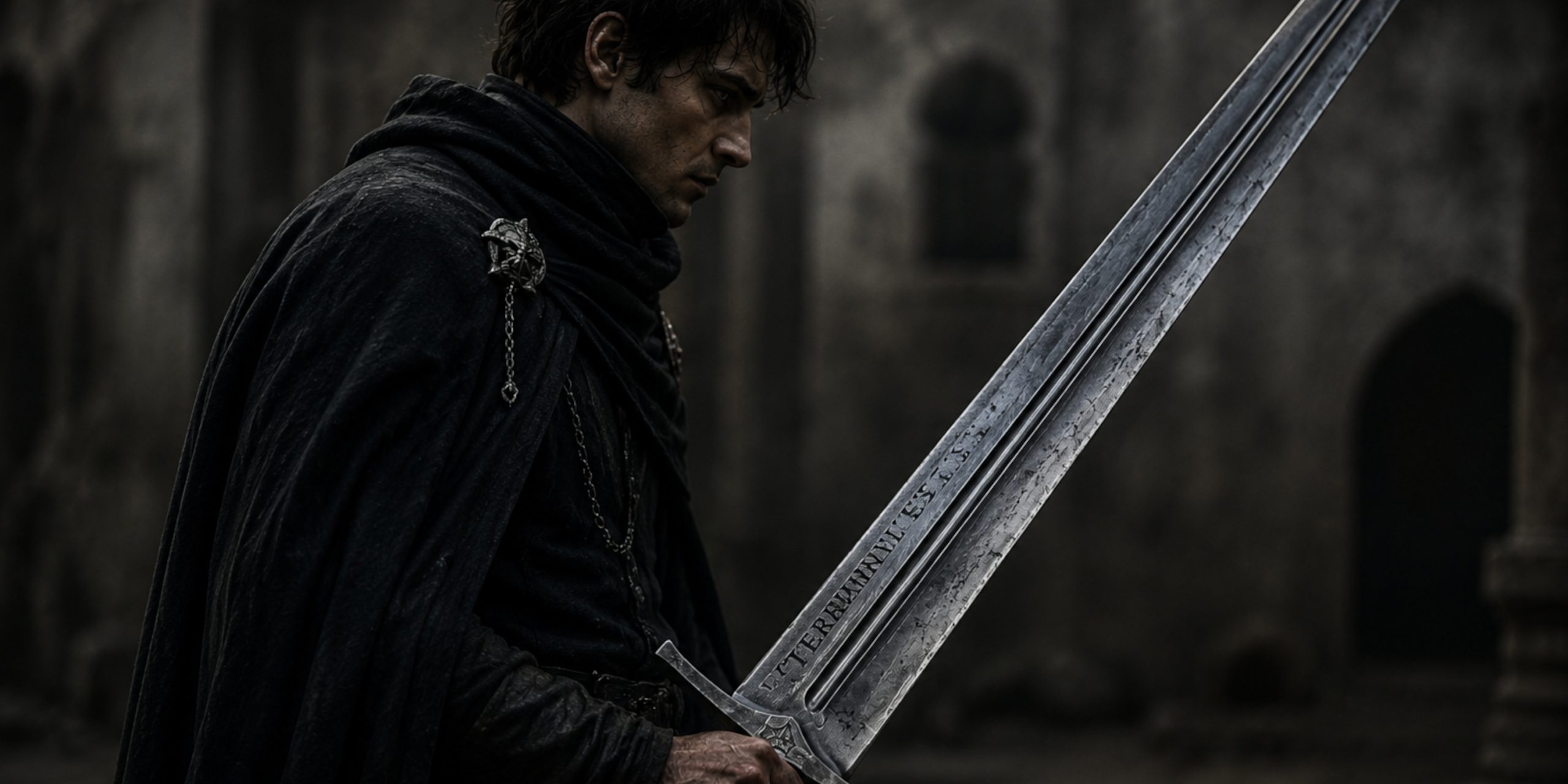
This massive executioner’s sword, carried by Severian throughout The Book of the New Sun, is one of the most memorable weapons in science fiction and fantasy. It is not merely a tool of violence. It is a symbol of duty, guilt, authority, and identity.
The first time many readers encounter Terminus Est, the weapon feels impossibly large, almost theatrical. Then again, so does the world of Urth. Gene Wolfe never gives readers easy answers, and the sword is no exception.
By the end of the series, Terminus Est becomes inseparable from Severian himself. It is a weapon, a burden, and a constant reminder of the life he is trying to leave behind.
What Does Terminus Est Mean?
The name Terminus Est comes from Latin and translates roughly as:
“This is the end.”
For an executioner’s sword, that is about as subtle as a brick through a cathedral window.
The phrase has a grim elegance. Every execution carried out with the blade marks the end of a life. Yet in Wolfe’s story, endings often become beginnings. Death leads to transformation, memory, and rebirth.
The sword’s name therefore operates on multiple levels. It is a statement about execution, but it also reflects many of the deeper themes running throughout the series.
Description of Terminus Est
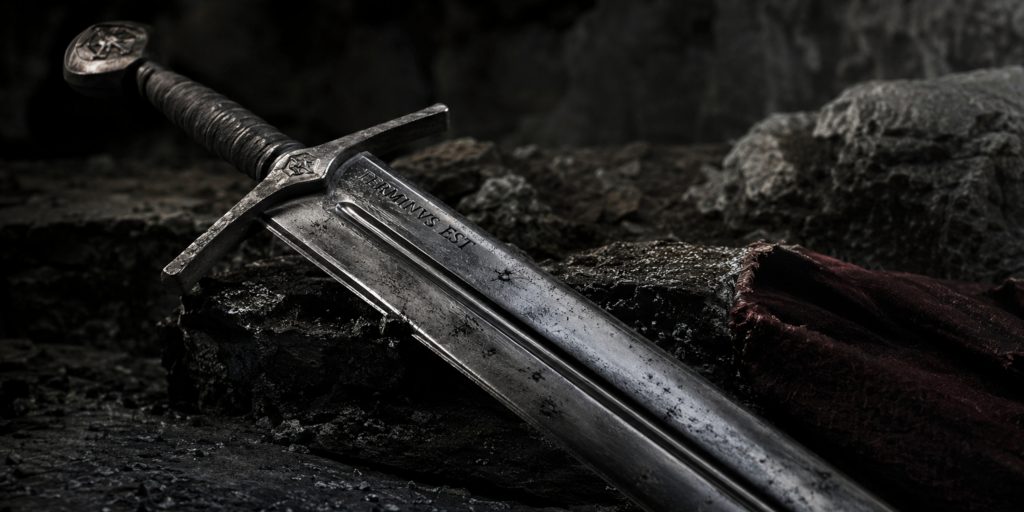
Wolfe provides enough details to make the sword distinctive without turning it into a technical manual.
Key Characteristics
| Feature | Description |
|---|---|
| Type | Executioner’s sword |
| Owner | Severian |
| Material | Steel with a hollow blade filled with mercury |
| Purpose | Judicial execution |
| Edge | Primarily designed for powerful cutting blows |
| Size | Enormous, far larger than an ordinary sword |
| Distinction | One of the most recognisable weapons in speculative fiction |
The most unusual feature is the mercury contained inside the blade.
As the sword swings, the liquid metal shifts toward the tip, increasing momentum and delivering devastating force. It is a fascinating idea that sounds simultaneously ingenious and wildly impractical.
Which, if we’re being honest, describes a surprising amount of advanced technology in The Book of the New Sun.
Why the Mercury Blade Matters
The mercury-filled blade is not simply a clever piece of worldbuilding.
It reinforces the sword’s intended purpose.
An executioner’s weapon does not need to be versatile. It does not need to excel in duels or battlefield combat. It only needs to perform one terrible task with absolute certainty.
The shifting weight helps create immense cutting power. Every swing feels final.
This emphasis on inevitability reflects Severian’s role within the Guild of Torturers. The sword is designed for judgement, not heroics.
That distinction becomes increasingly important as Severian’s journey unfolds.
The Relationship Between Severian and Terminus Est
One of the most fascinating aspects of the sword is how closely it mirrors its owner.
At the beginning of the story, Severian is an apprentice torturer. His identity is defined by the guild that raised him. Carrying Terminus Est marks him as an executioner wherever he travels.
People react to the weapon immediately.
Some fear it.
Some respect it.
Others see it as evidence of the darkness attached to its bearer.
The sword constantly forces Severian to confront his past. Even when he wishes to become something different, Terminus Est remains hanging at his side like a very large and extremely sharp reminder.
Few fantasy protagonists carry a weapon that actively works against the image they wish to project.
Symbolism of Terminus Est
Gene Wolfe’s novels are famous for layers of symbolism, and Terminus Est is among the richest examples.
Justice and Punishment
The sword represents institutional authority.
It exists because society demands punishment and believes certain people should carry it out.
Whether that authority is justified remains one of the questions the series continually explores.
Burden
Severian does not simply wield the sword.
He carries its meaning.
Every execution associated with the weapon becomes part of his history.
Transformation
As Severian changes, the significance of Terminus Est changes as well.
What begins as a symbol of death gradually becomes a marker of his journey through suffering, redemption, and renewal.
Memory
Throughout the series, Severian’s extraordinary memory shapes his understanding of the world.
The sword functions almost like a physical memory. It connects him to his origins even when he travels far beyond them.
Is Terminus Est Based on Real Historical Swords?
Partly.
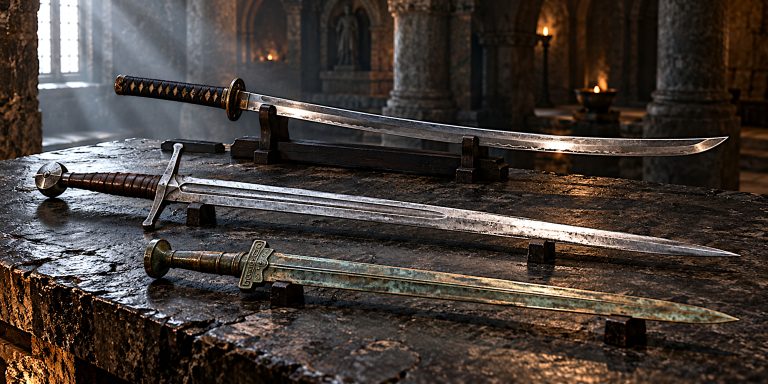
Executioner’s swords existed throughout European history, particularly during the late medieval and early modern periods.
Unlike battlefield weapons, they were designed specifically for carrying out judicial executions.
Many featured broad blades and often lacked sharp points because thrusting was unnecessary.
Real execution swords were symbols of state authority, much like Terminus Est.
The mercury-filled blade, however, appears to be Wolfe’s own invention.
No known historical execution sword used such a design. Practical blacksmiths probably would have had several strong opinions about the idea, most of them unprintable.
Terminus Est in Combat
Although designed for executions, Severian uses Terminus Est in numerous dangerous encounters.
The sword’s immense size gives it tremendous cutting power.
Its disadvantages are equally obvious:
- Considerable weight
- Reduced manoeuvrability
- Difficulty in confined spaces
- Slower recovery between swings
This creates an interesting contrast with many fantasy weapons.
Rather than being a flawless magical artefact, Terminus Est feels specialised and awkward. Its limitations make it more believable and often more interesting.
Why Readers Still Remember Terminus Est
Many fantasy novels feature legendary blades.
Very few achieve the same lasting impact.
Part of the reason is Gene Wolfe’s writing. He rarely explains everything directly, allowing readers to uncover meanings over multiple readings.
Part of it is the sword’s striking appearance.
Most importantly, Terminus Est matters because it is woven into the story’s themes. Remove the sword and Severian remains Severian, but something essential would be missing.
The weapon is not an accessory.
It is part of the character.
Terminus Est’s Legacy in Fantasy and Science Fiction
Since the publication of The Book of the New Sun, Terminus Est has become one of the most celebrated fictional swords ever created.
It frequently appears in discussions alongside legendary weapons such as Excalibur, Andúril, and Stormbringer.
What makes Terminus Est unique is that it was never intended to be a hero’s sword.
It begins as an instrument of execution.
That contradiction sits at the heart of Wolfe’s masterpiece.
The sword represents death, yet accompanies a story obsessed with rebirth.
It symbolises judgement, yet travels with a man seeking mercy.
It is called “This is the End,” yet remains one of literature’s most enduring beginnings.
Key Takeaway
Terminus Est remains one of the great weapons of speculative fiction because it refuses to fit neatly into familiar categories.
It is intimidating without being glamorous.
Symbolic without becoming pretentious.
Powerful without feeling invincible.
Most importantly, it tells us something about Severian every time it appears.
For a sword, that is quite an achievement.
For a sword named “This is the End,” it has enjoyed a remarkably long afterlife.