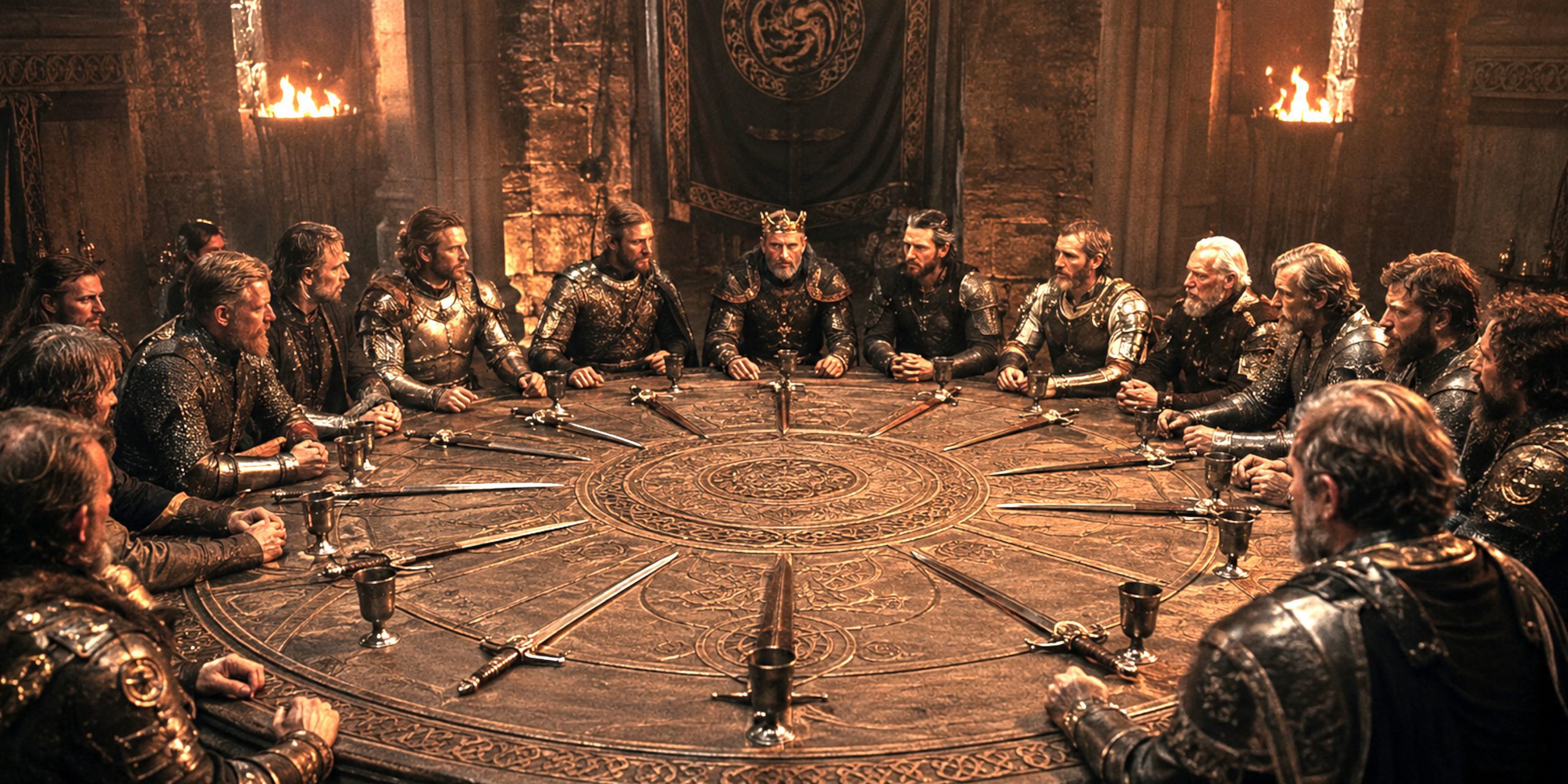
Arthur’s Round Table has become one of the most recognisable symbols in medieval literature, yet there was never a definitive list of its members. Every generation of medieval writers added, removed, promoted, or quietly forgot knights according to the story they wished to tell. Camelot was less a fixed institution than a living literary tradition.
Early Welsh and Norman texts mention only a select circle of Arthur’s companions. By the time the great French romances and Sir Thomas Malory’s Le Morte d’Arthur appeared, the fellowship had grown into a vast company of heroes. Some achieved lasting fame. Others seem to have wandered into a manuscript, fought one impressive duel, and then disappeared into literary obscurity.
What follows is a guide to the principal Knights of the Round Table across the major medieval traditions, placing each within their historical literary context while separating enduring figures from those who briefly enjoyed the spotlight.
Who Were the Knights of the Round Table?
The Round Table represented an ideal as much as a royal household. Unlike the rectangular tables of medieval courts, where rank determined position, the circular table symbolised equality among Arthur’s greatest warriors. Whether such a table ever existed outside literature remains doubtful, but its symbolism proved irresistible.
Wace first introduced the Round Table in his Roman de Brut during the twelfth century, explaining that no knight could claim precedence over another. Later writers transformed that simple idea into the greatest fellowship in medieval romance.
As Sir Thomas Malory observed:
“For the most noble fellowship of the world was broken.”
Few sentences better capture the melancholy that hangs over the entire Arthurian tradition.
The Core Knights of the Round Table
These figures appear consistently throughout the principal Arthurian traditions and form the heart of Camelot.
King Arthur
Strictly speaking, Arthur is not simply another member of the Round Table. He is its founder, king, judge and military commander. His greatest strength is not always personal combat, although medieval writers happily credit him with extraordinary prowess, but his ability to unite rival kingdoms beneath a shared ideal.
Ironically, Arthur spends much of the later romances attempting to resolve crises created by his own knights.
Sir Lancelot du Lac
Lancelot became the model for the perfect medieval knight. No warrior surpassed him in battle, yet no knight contributed more to Camelot’s destruction.
His affair with Queen Guinevere shattered the unity Arthur spent decades building. Medieval audiences admired his courage while recognising that greatness without restraint carries a very high price.
Sir Gawain
Arthur’s nephew combines immense courage with very human flaws. In many traditions his strength increases until midday before gradually fading with the setting sun, an imaginative touch that gives him one of medieval literature’s more unusual tactical advantages.
The anonymous author of Sir Gawain and the Green Knight presents perhaps the most nuanced portrait of Arthurian chivalry ever written.
“Honi soit qui mal y pense.”
Although adopted later as the motto of the Order of the Garter, the sentiment reflects the knightly ideals that shaped Gawain’s world.
Sir Percival
Percival begins life as an innocent raised far from courtly society before gradually becoming one of Arthur’s greatest knights.
In the earliest Grail romances he is the central hero. Only later did Galahad inherit much of that spiritual importance.
Sir Galahad
If medieval authors were creating a knight by committee, Galahad would probably be the result.
He is flawless in battle, morally impeccable and spiritually perfect. Unsurprisingly, he alone completes the Holy Grail Quest in its fullest sense.
His perfection inspires admiration, although readers often find the more imperfect heroes easier to relate to.
Sir Bors the Younger
Practical where others become consumed by mystical visions, Bors survives the Grail Quest and returns to Camelot. His loyalty, discipline and resilience make him one of the court’s most dependable figures.
Sir Tristan
Tristan rivals Lancelot in martial ability and perhaps exceeds him in romantic catastrophe.
His doomed love affair with Iseult became one of Europe’s greatest medieval romances, although Arthur could reasonably have wished that everyone involved had made rather better decisions.
Sir Kay
Arthur’s foster brother remains one of the court’s sharpest tongues.
Boastful, argumentative and frequently insulting, Kay nevertheless proves courageous whenever genuine danger appears. Modern readers often overlook how entertaining he is.
Sir Bedivere
Bedivere stands beside Arthur until the final moments after the Battle of Camlann.
His reluctant decision to return Excalibur to the Lady of the Lake provides one of the defining moments of Arthurian literature.
“Draw me Excalibur.”
The king’s final request carries remarkable emotional weight because Bedivere hesitates before obeying.
Sir Gareth
Introduced memorably in Malory, Gareth arrives at court disguised as a kitchen servant before revealing himself as one of Arthur’s finest young knights.
His patience, humility and determination make him one of Camelot’s most likeable characters.
Sir Gaheris
Often overshadowed by his brothers, Gaheris remains deeply loyal to Arthur while becoming caught in the increasingly bitter divisions within the royal family.
Sir Agravain
Where others attempt diplomacy, Agravain generally chooses confrontation.
His exposure of Lancelot and Guinevere’s relationship accelerates the collapse of Camelot. Whether he acts from loyalty or resentment depends largely on which medieval author you happen to be reading.
The Extended Fellowship
As Arthurian literature expanded across Europe, many additional knights entered the Round Table.
Sir Palamedes
One of the most fascinating later additions, Palamedes is a Saracen knight whose courage earns universal respect.
His pursuit of the mysterious Questing Beast becomes almost legendary in its persistence.
Sir Safir
Palamedes’ brother provides a calmer presence within the romances and frequently demonstrates quiet competence.
Sir Segwarides
Best remembered for becoming another casualty of Tristan’s complicated love life, proving once again that friendship with Tristan could be hazardous.
Sir Aglovale
Percival’s elder brother serves as an experienced warrior who helps guide his younger sibling towards knighthood.
Sir Ector
Lancelot’s foster father remains loyal throughout Camelot’s darkest days and mourns deeply after the kingdom’s fall.
Sir Lionel
Brother to Bors, Lionel possesses extraordinary courage alongside an alarming temper.
The Grail Quest tests his family loyalties as severely as his martial skill.
Sir Lamorak
Perhaps the finest warrior after Lancelot and Tristan, Lamorak becomes entangled in the deadly rivalries of Gawain’s family.
His death marks another step towards Camelot’s destruction.
Sir Tor
Traditionally identified as the son of King Pellinore, Tor earns his reputation through determination rather than noble birth.
Sir Pelleas
A gifted knight whose unhappy devotion to Lady Ettard became one of Arthurian literature’s most poignant romances.
Sir Elyan
A younger member of Arthur’s household whose steadfast loyalty survives the kingdom’s growing divisions.
Sir Uwaine (Owain)
Drawn largely from Welsh tradition, Owain enjoys an impressive independent literary career beyond Arthur’s court.
Sir Yvain the Bastard
Distinct from Owain despite the similarity in names, Yvain appears in several later French romances.
Sir Percard, Sir Brandiles and Sir Melyon
These lesser known figures appear across various romances, tournaments and campaigns. While they rarely become central heroes, their presence illustrates just how expansive the Arthurian tradition became.
Sir Mordred: The Knight Who Destroyed Camelot
Mordred occupies an unusual place within the fellowship.
In some traditions he begins as one of Arthur’s trusted knights before ambition and resentment consume him. In others he is Arthur’s illegitimate son, making the tragedy even more personal.
His rebellion culminates in the Battle of Camlann, where both king and traitor receive mortal wounds.
Without Mordred, Camelot might have endured. With him, its end became inevitable.
Complete List of Major Knights of the Round Table
| Principal Knights |
|---|
| Arthur |
| Lancelot |
| Gawain |
| Percival |
| Galahad |
| Bors |
| Tristan |
| Kay |
| Bedivere |
| Gareth |
| Gaheris |
| Agravain |
| Mordred |
| Palamedes |
| Safir |
| Segwarides |
| Aglovale |
| Ector |
| Lionel |
| Lamorak |
| Tor |
| Pelleas |
| Elyan |
| Uwaine (Owain) |
| Yvain the Bastard |
| Percard |
| Brandiles |
| Melyon |
Many additional names appear in regional manuscripts, particularly within the French Vulgate Cycle and Post-Vulgate romances. Some traditions claim the Round Table eventually seated as many as 150 knights.
Why Does the Number of Knights Change?
There was never an official membership roll.
Arthurian legend evolved over several centuries, across Britain, France and continental Europe. Each writer reshaped Camelot for a new audience, introducing fresh heroes, villains and supporting characters.
The Round Table therefore functions less like a historical institution and more like a shared literary universe. Medieval authors were remarkably comfortable expanding the cast whenever a new adventure demanded another exceptionally brave knight.
Historians sometimes wish medieval scribes had been slightly more consistent. On the other hand, we would have far fewer wonderful stories if they had.
The Legacy of the Round Table
The Knights of the Round Table became Europe’s enduring image of chivalry.
Their influence can be traced through Renaissance literature, Victorian medieval revival, Alfred Lord Tennyson’s Idylls of the King, modern fantasy novels, cinema, television and role-playing games. The idea that honour, courage and fellowship should matter more than birth or status remains one of Arthurian legend’s most powerful themes.
The knights continue to resonate because they are rarely perfect. They succeed magnificently, fail spectacularly, love unwisely, quarrel endlessly and occasionally bring down an entire kingdom through remarkably poor judgement.
As history, Arthurian legend remains elusive. As literature, it remains one of medieval Europe’s greatest achievements. That may ultimately be the Round Table’s greatest victory.als. The knights endure because they are not perfect. Their flaws are half the reason readers keep returning to Camelot. It feels human, even when the plot is wildly impractical.