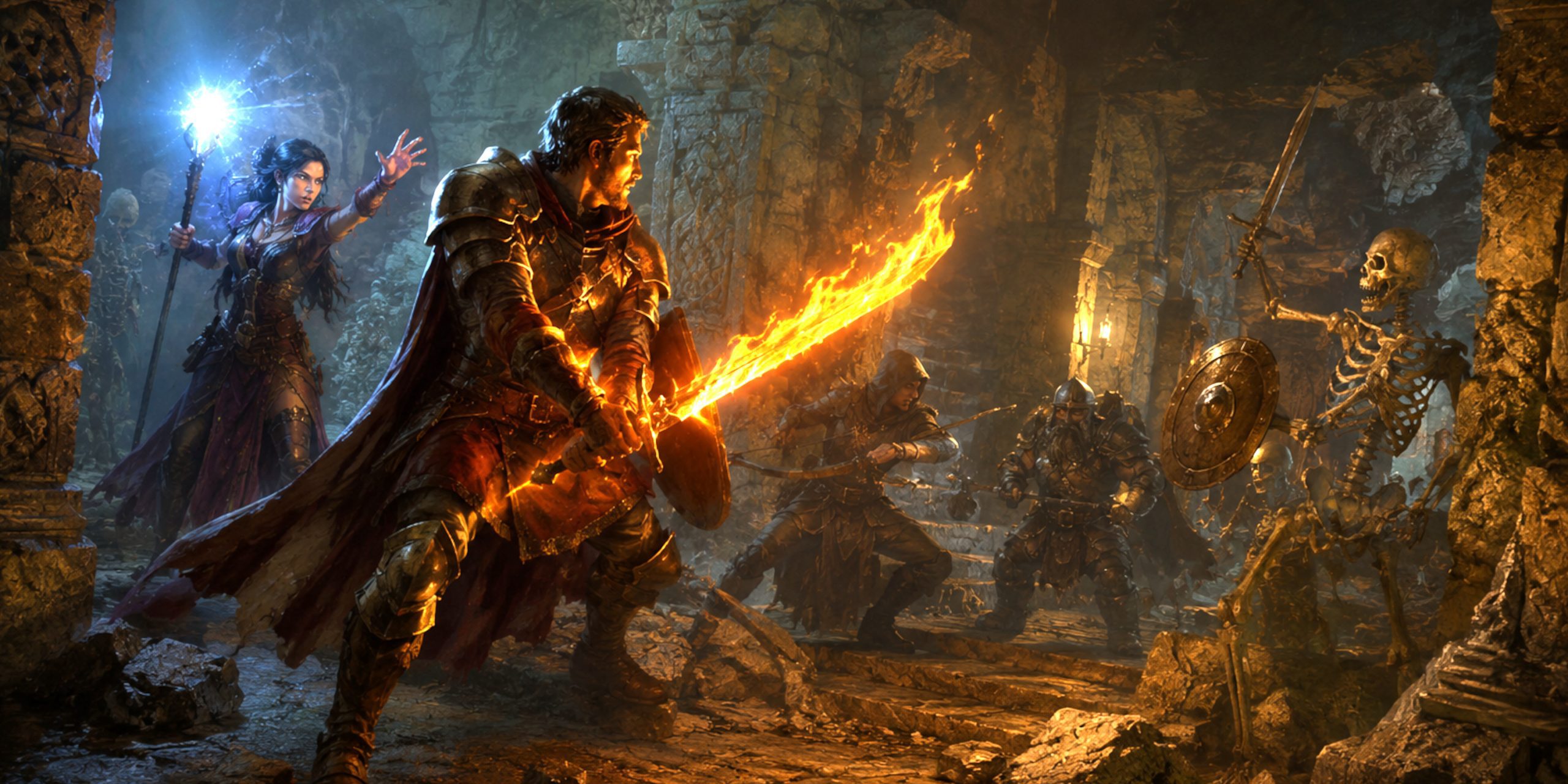
Some magical weapons in Dungeons & Dragons become famous because they are impossibly powerful. Others earn their place because they simply feel cool. The Flame Tongue belongs firmly in the second category, although it is hardly weak.
A sword that bursts into magical fire on command is one of fantasy’s most enduring images. Whether you’re a veteran player who has seen dozens of campaigns or someone rolling their first character sheet, there’s something satisfying about speaking a command word and watching your blade erupt into brilliant flames.
It is straightforward, memorable and wonderfully dramatic. Sometimes the classics really are classics for a reason.
What Is the Flame Tongue?
The Flame Tongue is a magical weapon found throughout the history of Dungeons & Dragons. It first appeared in the earliest editions of the game and has remained a favourite ever since.
Unlike many legendary weapons tied to famous heroes or forgotten kingdoms, the Flame Tongue is less about its history and more about its signature ability.
Its defining feature is simple.
The wielder speaks a command word and the blade ignites with magical flames that do not burn the owner but scorch anything unfortunate enough to stand on the wrong end of the sword.
In Fifth Edition, Flame Tongue is classified as a rare magic weapon requiring attunement.
How the Flame Tongue Works
Once activated, the weapon is surrounded by magical fire that sheds bright light and dramatically increases its damage output.
Core Properties
| Feature | Details |
|---|---|
| Item Type | Rare Magic Weapon |
| Requires Attunement | Yes |
| Activation | Spoken command word |
| Damage Bonus | Extra fire damage on every successful hit |
| Light | Bright light with additional dim light beyond |
The extra fire damage applies every time the weapon lands a successful melee attack, making it particularly effective for martial characters who make multiple attacks each round.
It is refreshingly uncomplicated.
No complicated recharge mechanics.
No spell slots.
No tracking limited uses.
Just point at monster, ignite sword and get to work.
Available Weapon Types
One of the strengths of the Flame Tongue is that it is not restricted to a single sword.
Dungeon Masters can introduce Flame Tongue enchantments on several melee weapons.
Common examples include:
| Weapon | Typical User |
|---|---|
| Longsword | Fighters, Paladins |
| Greatsword | Two-handed warriors |
| Shortsword | Rogues |
| Scimitar | Rangers, Dexterity builds |
| Rapier | Swashbucklers and Bards |
| Sabre or Homebrew Variants | Campaign specific |
This flexibility means the weapon can suit many different character concepts without forcing players into a particular fighting style.
Why Players Love the Flame Tongue
The Flame Tongue occupies a sweet spot in game design.
It feels powerful without completely overshadowing other magical equipment.
Several factors explain its enduring popularity.
Immediate visual impact
Few magical weapons announce themselves quite like a sword suddenly bursting into magical flames.
Every activation creates an unforgettable moment.
Consistent extra damage
Unlike abilities that rely on limited resources, Flame Tongue improves every successful attack while active.
Characters with Extra Attack benefit particularly well from the weapon.
Simplicity
Many legendary weapons come with pages of special rules.
The Flame Tongue can be explained in one sentence.
That makes it ideal for experienced players and newcomers alike.
Iconic fantasy aesthetic
Let’s be honest.
Walking into battle carrying a flaming sword immediately raises your confidence by approximately 73 percent.
The actual statistics behind that figure remain under intense academic review.
Best Classes for a Flame Tongue
Although nearly any martial character can use one effectively, certain classes benefit more than others.
| Class | Why It Works |
|---|---|
| Fighter | Multiple attacks maximise bonus damage |
| Paladin | Combines well with Divine Smite |
| Ranger | Excellent sustained damage |
| Rogue | Adds reliable damage alongside Sneak Attack |
| Barbarian | Extra damage stacks with Rage bonuses |
| Bard | Strong option for College of Swords builds |
The weapon rewards characters who spend most of their time in melee combat.
The Flame Tongue Through the Editions
One reason the weapon remains iconic is its remarkable consistency.
Advanced Dungeons & Dragons
The original versions introduced the now famous flaming blade concept, often offering bonuses against cold-based creatures while producing magical fire.
Third Edition
The enchantment became one of the most recognisable magical weapon properties. Players could apply it to many different weapons through magical crafting.
Fourth Edition
The Flame Tongue appeared with revised mechanics suited to the edition’s combat system while retaining its identity as a fire-infused blade.
Fifth Edition
The current version simplifies the rules while preserving the weapon’s core identity.
Its balance, ease of use and cinematic appeal make it one of the game’s most sought-after rare weapons.
Roleplaying a Flame Tongue
The sword offers plenty of storytelling opportunities beyond combat.
Perhaps the command word is spoken in an ancient forgotten language.
Maybe the flames change colour depending on the wielder’s emotions.
Some Dungeon Masters even give each Flame Tongue a unique personality or elemental origin.
The weapon could have been forged:
- Inside a volcano
- By fire giants
- Within an efreeti’s forge
- By ancient dwarven smiths
- Through elemental magic
- During a dragon’s reign
None of these origins are required by official lore, but each adds flavour to a campaign.
Weaknesses
Despite its popularity, the Flame Tongue is not perfect.
Fire resistance
Many monsters resist or ignore fire damage, reducing much of the weapon’s effectiveness.
Devils, red dragons and numerous fiends are unlikely to be impressed.
Requires attunement
Characters can only attune to a limited number of magical items.
Choosing a Flame Tongue means passing over other potentially useful equipment.
Constant visibility
An activated Flame Tongue glows brightly.
Fantastic for heroic entrances.
Less fantastic when attempting stealth.
Flame Tongue in Popular D&D Culture
The Flame Tongue has appeared in countless published adventures, novels, livestream campaigns and home games.
It has become one of those magical items that almost defines fantasy roleplaying.
Ask a long-time D&D player to picture an enchanted sword and there’s a good chance the mental image involves a blade wreathed in magical fire.
That visual has influenced fantasy art, video games and tabletop illustrations for decades.
Tips for Dungeon Masters
The Flame Tongue makes an excellent treasure reward because it immediately feels meaningful without breaking campaign balance.
To make it even more memorable, consider giving your version unique details:
- A distinctive command word
- Blue, green or white magical flames
- Ancient runes revealed only while burning
- A legendary former owner
- Connections to elemental planes
- A custom scabbard forged to contain its heat
Small narrative touches often become the details players remember years later.
Is the Flame Tongue Worth It?
Absolutely.
It may not reshape reality like an artefact weapon or alter the course of a campaign through divine magic, but that has never been its purpose.
The Flame Tongue succeeds because it delivers exactly what players expect. Reliable extra damage, striking visuals and a fantasy experience that never really gets old.
Sometimes the simplest magical weapon is also the one everyone secretly hopes appears in the treasure chest.
After all, who hasn’t imagined drawing a sword that immediately bursts into flames?
Some ideas simply never lose their spark.