
Agnes of Courtenay is one of those medieval women who seems to make chroniclers deeply uncomfortable simply by existing. She was intelligent, politically connected, ambitious, and entirely unwilling to fade quietly into the decorative background that many male writers preferred for noblewomen. Naturally, generations of chroniclers responded by blaming her for almost everything short of bad weather.
And yet, the closer one looks at Agnes, the more complicated she becomes.
She was not merely a scheming queen mother from crusader gossip. She was born into one of the most powerful families in the Latin East, survived political collapse, navigated multiple marriages, endured public hostility, and remained influential at the royal court of Jerusalem during one of the kingdom’s most fragile periods. That alone deserves a certain grim admiration.
The Kingdom of Jerusalem in the twelfth century was not a romantic kingdom of shining knights. It was a tense, brittle frontier state surrounded by ambitious Muslim powers, fractured noble factions, and enough family feuds to fuel several modern television dramas.
Agnes stood right at the centre of it.
Origins and Family Background
Agnes of Courtenay was born around 1136 into the powerful Courtenay family of the Kingdom of Jerusalem. Her father was Joscelin II, Count of Edessa, ruler of the first crusader state established during the First Crusade.
Edessa mattered enormously during Agnes’s childhood. It was the eastern shield of the crusader states, exposed and vulnerable, but strategically vital. Unfortunately for the Franks, it was also extremely difficult to defend.
In 1144, the city of Edessa fell to the forces of Zengi. The shock echoed across Christendom and directly inspired the disastrous Second Crusade. Agnes was still a child when her family’s fortunes collapsed.
There is something almost symbolic about this beginning. Agnes grew up in a world where security vanished overnight, alliances shifted constantly, and survival depended on political instinct. It is difficult not to suspect that these experiences shaped the hard-edged woman she later became.
Her family retained prestige, but much of their real power had evaporated. That loss lingered over Agnes’s entire life.
Marriage to Amalric

Agnes eventually married Amalric, Count of Jaffa and Ascalon, who later became King Amalric I of Jerusalem.
At the time, the marriage seemed entirely suitable. Both belonged to important noble families within the crusader aristocracy. Together they had two children:
- Sibylla of Jerusalem
- Baldwin IV, later known as Baldwin the Leper
The marriage, however, became politically inconvenient once Amalric was selected to become king in 1163.
The High Court of Jerusalem objected to Agnes remaining queen because the couple were considered too closely related under canon law. Medieval noble families were so interconnected that one suspects the Church occasionally needed a diagram the size of a cathedral wall to keep track of prohibited degrees of kinship.
Amalric was effectively forced to separate from Agnes if he wanted the crown.
He accepted.
The marriage was annulled, though importantly, their children remained legitimate. That detail would later become critically important for the succession crisis that consumed Jerusalem.
Agnes was pushed aside publicly, but she did not disappear.
That was the first major mistake her rivals made.
Agnes and the Court of Jerusalem
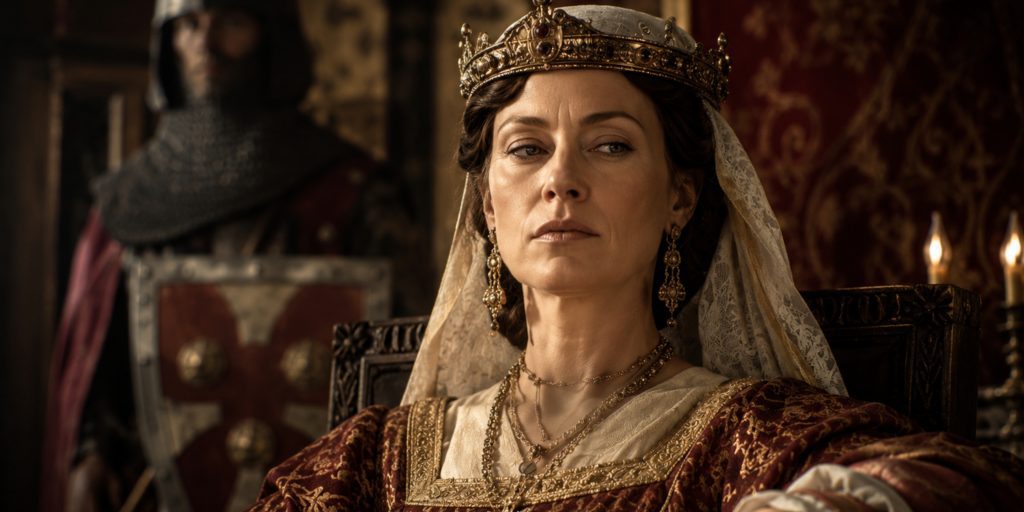
After the annulment, Agnes retained influence through her children and family networks. She later married several more times, including Hugh of Ibelin and Reginald of Sidon, tying herself into some of the kingdom’s strongest noble factions.
Chroniclers hostile to Agnes often portrayed her as manipulative and morally questionable. William of Tyre, one of the main contemporary historians of the kingdom, clearly disliked her intensely. Unfortunately for Agnes, historians have relied heavily upon William for centuries.
One quickly notices a recurring medieval pattern: politically active men become “strong leaders,” while politically active women become “dangerous influences.”
Agnes was accused of:
- Corruption
- Nepotism
- Immorality
- Manipulating royal appointments
- Dominating her son Baldwin IV
Some accusations probably contain elements of truth. Others feel suspiciously theatrical.
The crusader court was notoriously factional. Nearly everyone was attempting to influence royal policy through family alliances, marriages, church appointments, and patronage. Agnes was hardly unique in this regard. She was simply more visible than many women of her era.
And visibility in medieval politics could be fatal to one’s reputation.
Mother of Baldwin IV
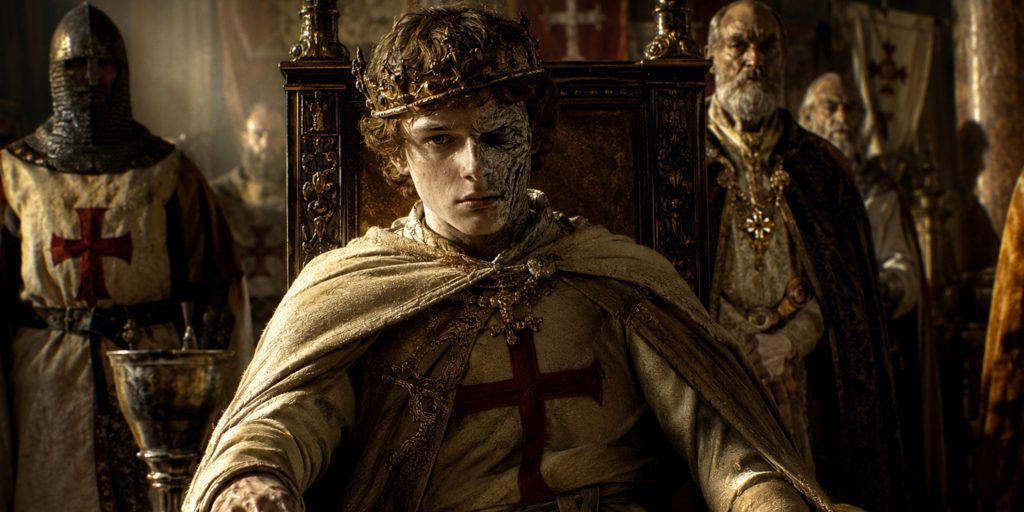
Agnes’s greatest political importance came through her son, Baldwin IV.
Baldwin became king in 1174 while still a minor and already suffering from leprosy. His illness created immense uncertainty within the kingdom. Everyone understood the same grim reality: Baldwin was unlikely to produce heirs or enjoy a long reign.
That made succession politics vicious.
Agnes became one of the central figures around the young king. She influenced appointments and supported allies at court, including the controversial patriarch Heraclius.
Her enemies accused her of surrounding Baldwin with favourites and excluding rival noble factions.
Yet Baldwin himself was highly intelligent and politically capable. The idea that Agnes entirely controlled him probably oversimplifies matters considerably. Baldwin was perfectly capable of independent action, especially as he matured.
Still, Agnes undeniably remained close to the centre of power.
One suspects many nobles found this deeply irritating.
Sibylla and the Succession Crisis

Agnes also played a major role in arranging the marriage of her daughter Sibylla.
This became one of the defining political struggles of the late Kingdom of Jerusalem.
Sibylla first married William of Montferrat, who died young. She later married Guy of Lusignan, a decision that remains fiercely debated by historians.
Guy proved unpopular among much of the nobility. Critics blamed Agnes for supporting the match and elevating an unsuitable candidate. Some chroniclers practically write about Guy as though he personally invented disappointment.
The reality is more complicated.
At the time, Jerusalem desperately needed politically useful alliances and military support. The kingdom faced the growing power of Saladin, who was steadily unifying Muslim territories around the crusader states.
Finding a perfect husband for Sibylla was not exactly easy.
Agnes likely believed Guy could strengthen her family’s position while reinforcing royal authority against competing noble factions.
Whether she misjudged him is another matter entirely.
Rivalries and Reputation
Agnes’s enemies at court included powerful nobles and churchmen, especially those aligned with Raymond III of Tripoli and William of Tyre.
The political divisions inside Jerusalem became deeply personal.
Medieval chroniclers often described Agnes in terms that feel less like objective history and more like carefully sharpened character assassination. Her morality was questioned repeatedly. Her relationships were scrutinised obsessively. Her ambitions were treated almost as a form of criminal behaviour.
Meanwhile, ambitious men around her conducted equally ruthless politics with remarkably less outrage directed toward them.
Curious, that.
Modern historians increasingly treat these hostile accounts with caution. Agnes certainly operated within the brutal realities of crusader politics, but many older portrayals now appear exaggerated or openly biased.
She was not a saint. Few rulers in Jerusalem could afford to be.
But neither was she the monstrous corrupter imagined by some earlier historians.
The Kingdom Around Her
Understanding Agnes requires understanding how unstable the Kingdom of Jerusalem had become during her lifetime.
By the 1170s and 1180s:
- Saladin was consolidating Egypt and Syria
- Crusader nobles were divided into hostile factions
- The royal succession remained uncertain
- Military resources were stretched dangerously thin
- Internal rivalries weakened decision-making
Every court appointment and marriage became politically explosive because the survival of the kingdom itself was in question.
Agnes operated inside this atmosphere of permanent anxiety.
It was a court where charm, alliances, calculation, and survival instinct mattered enormously. Frankly, anyone who remained politically relevant for long probably possessed at least a little ruthlessness.
Death and Final Years
Agnes likely died around 1184, only a few years before the catastrophic defeat at Hattin in 1187 and the fall of Jerusalem to Saladin.
She did not live to witness the kingdom’s greatest disaster.
Her children, however, remained central to the crisis:
- Baldwin IV struggled to preserve the kingdom despite illness
- Sibylla became queen
- Guy of Lusignan led the kingdom during the disastrous Hattin campaign
Because later events ended so badly, historians often searched backward for figures to blame. Agnes became one of the convenient targets.
History enjoys this habit rather too much.
Agnes of Courtenay in Modern History
Modern scholarship has become far more balanced toward Agnes.
Rather than seeing her simply as a corrupt schemer, historians increasingly view her as:
- A politically skilled noblewoman
- A survivor of dynastic collapse
- A mother protecting her children’s inheritance
- A participant in elite crusader politics
- A victim of hostile male chroniclers
She now appears less as a caricature and more as a recognisably human political actor navigating a dangerous world.
That does not make her innocent of ambition or manipulation. Medieval courts practically ran on those qualities. It simply places her behaviour within the realities of her environment.
And honestly, compared with some crusader nobles, Agnes barely registers on the medieval chaos scale.
Legacy
Agnes of Courtenay remains one of the most controversial women of the crusader era because she stood at the intersection of gender, dynastic politics, and the collapse of the Kingdom of Jerusalem.
Her story exposes the fragility of crusader rule in the Holy Land far better than romantic tales of shining knights ever could.
She was ambitious, resilient, divisive, and politically active in a world that often distrusted powerful women. The sources describing her are tangled with bias, rivalry, and hindsight, which makes separating fact from propaganda frustratingly difficult.
Still, her influence is undeniable.
Without Agnes:
- Baldwin IV’s reign looks different
- Sibylla’s marriage politics change
- The factional struggles of Jerusalem evolve differently
- The final years before Hattin take another shape entirely
For historians, that alone makes her fascinating.
Even now, Agnes of Courtenay feels strangely modern. Not because she was progressive or heroic in any simplistic sense, but because one can still see the familiar pattern of a politically active woman being blamed for the failures of an entire political system.
Twelfth-century Jerusalem, it turns out, was not entirely free from that habit.