The armies of Alexander the Great are usually remembered for one thing. The mighty Macedonian phalanx, bristling with impossibly long sarissas, advancing like a moving forest of spear points. Yet anyone who has spent time studying ancient warfare quickly realises that phalanxes alone did not win battles. They were immensely powerful, but also rather inflexible. Someone had to protect their vulnerable flanks, storm difficult terrain, and react when battle plans inevitably unravelled.
That role belonged to the Hypaspists.
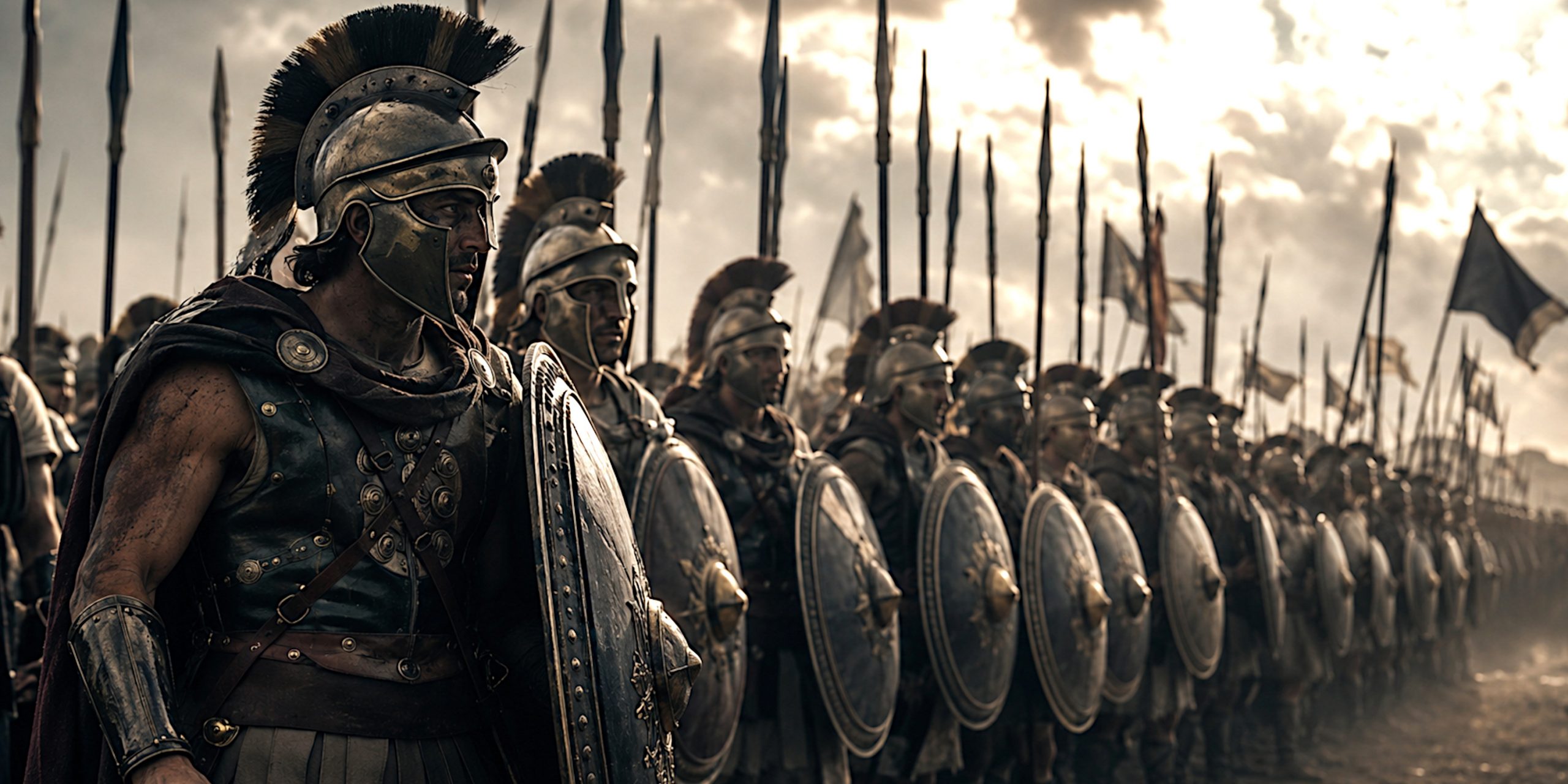
These elite soldiers occupied an unusual place within the Macedonian army. They were neither conventional hoplites nor ordinary phalangites. They fought where Alexander needed reliable professionals capable of adapting to rapidly changing circumstances. Whether scaling fortress walls, crossing rivers under enemy fire, or charging into gaps that appeared for only moments, the Hypaspists repeatedly proved themselves among the finest infantry of the ancient world.
They rarely receive the same attention as the Companion Cavalry or the towering sarissa formations. That seems rather unfair, because Alexander repeatedly trusted them with the most dangerous jobs available.
Who Were the Hypaspists?
The name Hypaspistai literally means “shield bearers.”
Originally, they may have served as royal attendants or bodyguards within the Macedonian court. During the reign of Philip II, however, they evolved into an elite professional infantry corps that formed an essential part of the reformed Macedonian army.
By the time Alexander invaded Persia in 334 BC, the Hypaspists had become highly trained assault troops who operated between the Companion Cavalry and the Macedonian phalanx.
Their flexibility made them indispensable.
Unlike the rigid phalanx, they could:
- Fight across broken ground
- Storm fortifications
- Conduct rapid assaults
- Defend vulnerable flanks
- Support cavalry operations
- React independently during chaotic fighting
Ancient historians consistently place them wherever the battle became most difficult.
Organisation
Although precise figures remain debated, most historians believe the corps consisted of approximately 3,000 men.
The unit was likely divided into three battalions, or chiliarchies, each numbering around 1,000 soldiers.
One battalion enjoyed particularly prestigious status.
The Agema
The Agema served as Alexander’s elite royal guard.
This formation often marched beside the king himself and undertook the most dangerous missions.
Membership was probably restricted to the finest soldiers within the corps.
When ancient sources describe Alexander personally leading assaults, the Agema frequently appears alongside him.
That was both an honour and a rather unhealthy career choice.
Recruitment and Training
The Hypaspists were not ordinary conscripts.
Most appear to have been recruited from experienced Macedonian soldiers with proven records of discipline and courage.
Training likely included:
- Close formation fighting
- Individual swordsmanship
- Rapid manoeuvre
- Siege warfare
- River crossings
- Mountain operations
- Combined arms tactics alongside cavalry
Unlike many ancient armies, Philip II and Alexander expected professional standards year round.
Experience mattered as much as physical strength.
The Role of the Hypaspists
Their greatest strength was versatility.
The phalanx excelled on level ground but struggled on hills, forests, riverbanks and rough terrain.
The Hypaspists filled every gap.
Their duties included:
- Protecting the exposed right flank of the phalanx
- Linking infantry with the Companion Cavalry
- Leading assaults against fortified cities
- Escorting Alexander during critical attacks
- Guarding camps and bridges
- Pursuing defeated enemies
- Acting as shock infantry during decisive moments
Modern military historians sometimes compare them to elite guards or assault infantry rather than conventional line troops.
Arms and Armour
Primary Weapons
Unlike phalangites carrying enormous sarissas reaching around five to six metres, the Hypaspists probably fought with more practical weapons suited to close combat.
Dory Spear
Most scholars believe they carried the traditional Greek dory.
This spear measured approximately 2.5 to 3 metres, making it far easier to handle during mobile fighting than the cumbersome sarissa.
Xiphos Sword
The xiphos was probably the standard secondary weapon.
This straight, double edged sword measured around 60 centimetres.
It excelled in thrusting while remaining effective for cutting.
Kopis
Some soldiers may have preferred the kopis.
This forward curved sword generated tremendous chopping power.
Its weight distribution made it particularly effective against lightly armoured opponents and horses.
Both sword types appear throughout Macedonian military art during the fourth century BC.
Shields
The shield remains one of the most debated aspects of Hypaspist equipment.
Most historians believe they carried:
- Medium sized hoplite style shields
- Possibly lighter pelte style shields for increased mobility
Whatever the exact design, they were significantly more manoeuvrable than phalangites while retaining strong defensive capability.
Armour
Equipment probably included:
- Bronze or iron helmets
- Linen cuirasses (linothorax)
- Bronze muscle cuirasses for wealthier officers
- Greaves
- Cloaks suitable for long campaigns
Helmet styles likely included:
- Phrygian helmets
- Attic helmets
- Thracian helmets
Alexander’s campaigns exposed the army to many cultures, and equipment undoubtedly evolved throughout the expedition.
Leadership
Several notable officers commanded the Hypaspists.
Nicanor
The best known commander was Nicanor, son of Parmenion.
He led the corps through many of Alexander’s greatest victories before dying from illness around 330 BC.
His death represented a significant loss of experience.
Seleucus
Some historians suggest Seleucus later commanded elite infantry formations related to the Hypaspists before becoming one of Alexander’s Successors.
The exact sequence remains debated.
Battles of the Hypaspists
Battle of the Granicus (334 BCE)

The Hypaspists crossed the river alongside Alexander during one of history’s boldest opening attacks.
The riverbank fighting demanded flexible infantry capable of maintaining formation while climbing difficult slopes.
Battle of Issus (333 BCE)
At Issus they protected the critical junction between cavalry and phalanx.
Without that connection, Darius might have exploited dangerous gaps within the Macedonian line.
Siege of Tyre (332 BCE)
The assault on Tyre showcased everything that made the Hypaspists exceptional.
They fought across siege towers, breached walls and engaged in brutal street fighting once the city was entered.
This was warfare requiring discipline rather than simply standing behind a very long spear.
Battle of Gaugamela (331 BCE)
Perhaps their finest battlefield performance.
The enormous Persian army attempted to outflank Alexander.
The Hypaspists repeatedly shifted position, supporting both cavalry and infantry while maintaining cohesion under immense pressure.
Their adaptability contributed significantly to Alexander’s decisive victory.
The Indian Campaign
During the campaigns against King Porus and various hill tribes, the Hypaspists fought across some of the most challenging terrain encountered during Alexander’s career.
Steep hills, forests and rivers suited mobile infantry far better than traditional phalanxes.
Relationship with the Companion Cavalry
One of Alexander’s greatest tactical innovations involved close cooperation between infantry and cavalry.
The Hypaspists acted as the vital connection.
When the Companion Cavalry launched its decisive charge, the Hypaspists ensured enemy infantry could not isolate or surround the cavalry.
This coordination allowed Alexander to create local superiority exactly where he wanted it.
It sounds straightforward.
Achieving it while thousands of armed men attempted to kill one another was considerably more complicated.
Archaeology
Unlike Roman legions, the Hypaspists leave relatively limited archaeological evidence because organic equipment has rarely survived.
Nevertheless, archaeology continues to illuminate their world.
Important discoveries include:
Vergina
Royal Macedonian tombs at Vergina have revealed magnificent armour, weapons and ceremonial equipment associated with the Macedonian elite.
Although not directly identified as Hypaspist equipment, these finds provide valuable insight into elite military culture.
Derveni
Rich burials have uncovered helmets, weapons and armour reflecting fourth century Macedonian craftsmanship.
Amphipolis
Excavations continue to expand understanding of Macedonian military organisation during Philip II and Alexander’s era.
Asian Campaign Sites
Arrowheads, spearheads, siege remains and military camps across modern Türkiye, Syria, Iraq and Pakistan help reconstruct Alexander’s campaigns.
While individual artefacts cannot usually be assigned specifically to the Hypaspists, they reveal the logistical scale of these extraordinary expeditions.
Contemporary Ancient Sources
Our understanding depends largely upon later Greek and Roman historians drawing upon earlier eyewitness accounts that no longer survive.
Arrian
Arrian remains our most reliable source.
He wrote:
“Alexander ordered the Hypaspists to advance.”
This deceptively brief statement appears repeatedly throughout his Anabasis. The elite infantry consistently appear wherever the fighting becomes decisive.
Curtius Rufus
Curtius praises Alexander’s trusted infantry during several major engagements, describing their courage and discipline under extreme pressure.
Diodorus Siculus
Diodorus highlights their role during sieges and difficult assaults, emphasising their reliability.
Plutarch
Plutarch frequently associates Alexander’s personal leadership with the presence of his elite troops.
Although writing centuries later, these authors preserve traditions derived from contemporary accounts by Callisthenes, Ptolemy and Aristobulus.
Did the Hypaspists Become the Silver Shields?
Many historians believe the Hypaspists eventually evolved into the famous Argyraspides, or Silver Shields.
These veterans became legendary during the Wars of the Successors after Alexander’s death.
Even in old age, they remained among the finest professional soldiers of the Hellenistic world.
Whether every Silver Shield had previously served as a Hypaspist remains uncertain, but the connection appears strong.
Legacy
The Hypaspists demonstrated that battlefield success depended upon flexibility as much as raw strength.
Philip II created an army capable of adapting.
Alexander perfected its use.
While the phalanx fixed the enemy in place and the Companion Cavalry delivered decisive blows, the Hypaspists quietly solved every tactical problem in between.
They crossed rivers that others could not.
They climbed walls others avoided.
They held the line when formations began to fracture.
History often celebrates spectacular cavalry charges or forests of spear points. Yet armies usually win because dependable professionals perform the difficult tasks no one else can. The Hypaspists were exactly those professionals, and Alexander’s remarkable string of victories would have been considerably harder without them.
Frequently Asked Questions
Were the Hypaspists part of the phalanx?
No. Although they fought alongside the Macedonian phalanx, they formed a separate elite infantry corps with greater mobility and tactical flexibility.
What weapons did the Hypaspists use?
They probably carried the dory spear, along with either a xiphos or kopis sword. They also used medium sized shields and wore helmets with linen or bronze armour.
How many Hypaspists served under Alexander?
Most historians estimate around 3,000 men organised into three battalions.
Were they Alexander’s bodyguards?
Partly. The Agema battalion acted as the king’s elite guard, but the entire corps served as highly trained assault infantry throughout Alexander’s campaigns.
Did they become the Silver Shields?
Many historians believe the later Argyraspides evolved directly from the Hypaspists, although some details remain debated.