The Knights Hospitaller are often treated as the quieter cousins of the Knights Templar. Less myth, fewer conspiracy documentaries, fewer people insisting they hid the Holy Grail beneath a Scottish sheep farm. Yet in terms of longevity, military achievement, and political survival, the Hospitallers arguably outlasted and outperformed almost every military order of the medieval world.
They began as caregivers tending to sick pilgrims in Jerusalem. They ended as heavily armed naval rulers of Malta, fighting Ottoman fleets with cannon fire and grim determination. Somewhere in between they became one of the most disciplined military and religious organisations in Europe.
The strange thing about the Hospitallers is how adaptable they were. Crusader kingdoms collapsed, dynasties vanished, and rival orders were destroyed, but the Hospitallers simply packed their relics, sharpened their swords, and moved elsewhere. Jerusalem fell. They shifted to Acre. Acre fell. They moved to Rhodes. Rhodes fell. They moved again to Malta. Medieval stubbornness turned into an art form.
Origins of the Knights Hospitaller
The order emerged in Jerusalem during the eleventh century, before the First Crusade fully transformed the eastern Mediterranean. Merchants from Amalfi had established a hospital near the Church of the Holy Sepulchre to care for Christian pilgrims travelling to the city.
After the capture of Jerusalem in 1099, the institution expanded rapidly. Its leader, a figure known as Blessed Gerard, organised the brotherhood into a formal religious community dedicated to charity and medical care.
At first, the Hospitallers were not warriors. They were monks and carers. Their role involved feeding pilgrims, treating illness, and sheltering travellers exhausted by the journey to the Holy Land. Medieval pilgrimage was not the serene spiritual stroll imagined in paintings. It was dangerous, filthy, expensive, and often lethal.
As the Crusader states became increasingly vulnerable, the Hospitallers gradually militarised. By the early twelfth century they had evolved into a military order, combining monastic vows with battlefield service.
Pope Paschal II formally recognised the order in 1113, granting it independence from local authorities and placing it directly under papal protection. That exemption became one of the foundations of their growing wealth and influence.
The Hospitallers and the Crusades
The order expanded alongside the Crusader states. They acquired castles, estates, ports, and agricultural lands across the Levant and Europe. Donations flooded in from nobles seeking spiritual favour or military prestige.
Unlike ordinary knights, Hospitallers took vows of poverty, chastity, and obedience. The irony, of course, was that collectively the order became enormously wealthy.
Hospitaller knights fought in many of the defining conflicts of the Crusades, including:
- The defence of the Kingdom of Jerusalem
- The Battle of Hattin in 1187
- The Third Crusade
- The defence of Acre
- Campaigns against Muslim naval forces in the Mediterranean
Their reputation for discipline became legendary. Muslim chroniclers frequently described them as exceptionally dangerous opponents who refused to retreat easily.
The order’s military hierarchy was highly organised. Members included:
- Knight brothers
- Sergeants
- Chaplains
- Turcopoles, locally recruited cavalry
- Naval personnel
- Medical staff
This combination of military and logistical capability made them unusually resilient compared to feudal armies dependent on short-term service.
Saladin and the Hospitallers
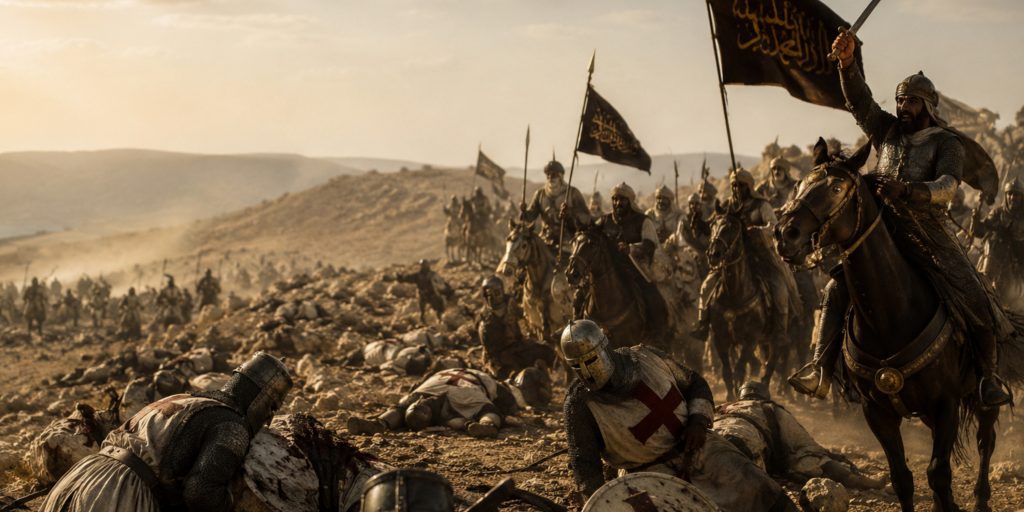
The Hospitallers fought repeatedly against Saladin and his forces during the late twelfth century.
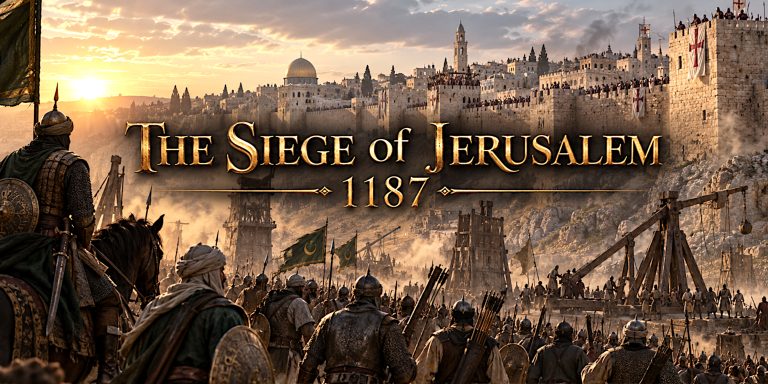
At the Battle of Hattin in 1187, the Crusader army suffered catastrophic defeat. Many Hospitallers and Templars captured after the battle were executed. Contemporary Muslim sources viewed the military orders as particularly fanatical and dangerous enemies.
The chronicler Imad ad-Din wrote of the captured warrior monks:
“He purged the land of these two unclean races.”
That line captures the mutual hostility of the era with uncomfortable clarity. Medieval holy wars were not famous for moderation or polite diplomatic nuance.
Despite disasters such as Hattin, the Hospitallers survived when much of the Crusader world collapsed around them.
Rhodes and the Transformation into a Naval Power
After the fall of Acre in 1291, the Crusader presence in the Holy Land effectively ended. The Hospitallers relocated first to Cyprus and later captured Rhodes in the early fourteenth century.
This changed the order permanently.
On Rhodes, the Hospitallers evolved into a major naval and maritime power. Their fleets raided hostile shipping, defended Christian trade routes, and fought expanding Turkish states across the eastern Mediterranean.
The order became increasingly international. Different linguistic groups, known as “langues,” administered various regions of the organisation.
These divisions included:
- Provence
- England
- France
- Aragon
- Italy
- Germany
Rhodes became one of the strongest fortified islands in the Mediterranean.
The Hospitallers resisted multiple sieges, including the famous Ottoman siege of 1480. Their fortifications impressed even hostile observers.
The Great Siege of Malta
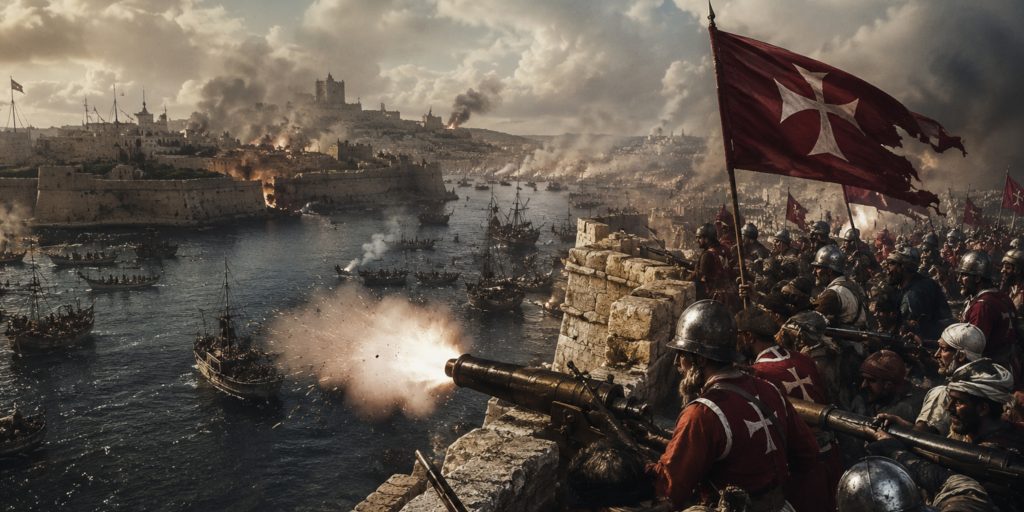
In 1522, the Ottoman Sultan Suleiman the Magnificent finally forced the Hospitallers from Rhodes after a brutal siege.
For a time, the order wandered without a permanent home. In 1530, Emperor Charles V granted them Malta.
Malta became the setting for the most famous chapter in Hospitaller history.
In 1565, the Ottoman Empire launched a massive invasion force against the island. The resulting Great Siege of Malta became one of the defining military events of the sixteenth century.
Under Grand Master Jean Parisot de Valette, the Hospitallers resisted overwhelming odds for months.
The fighting was savage. Forts were pulverised by artillery. Assaults collapsed into hand-to-hand combat. Casualties were horrific on both sides.
The historian Giacomo Bosio later described the defenders as fighting:
“Like lions driven to fury.”
That may sound dramatic, but the siege genuinely shocked Europe. Had Malta fallen, Ottoman naval dominance in the western Mediterranean might have expanded significantly.
Instead, the Hospitallers survived once again.
They had developed a remarkable institutional habit of refusing to disappear.
Arms and Armour of the Knights Hospitaller
The Hospitallers used equipment broadly similar to other western European knights, though regional influences and changing technology altered their appearance over time.
Clothing and Symbols
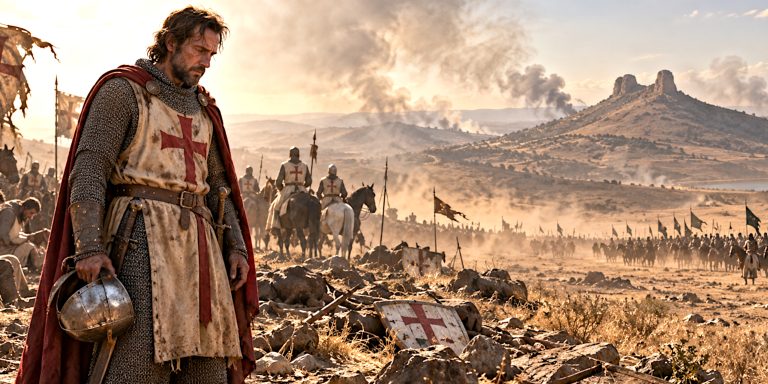
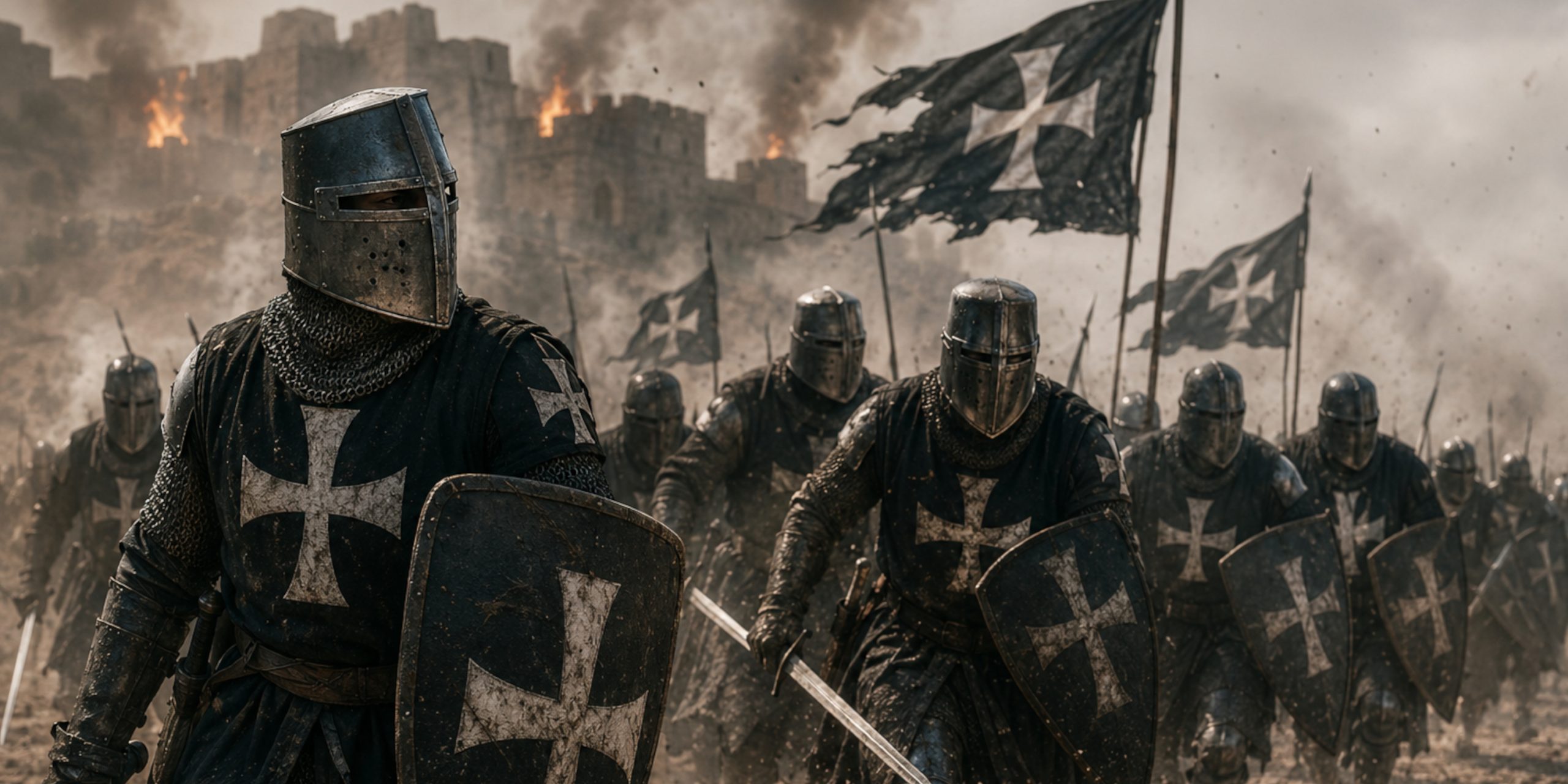
Their most recognisable symbol was the white cross on a black background.
Early Hospitallers commonly wore:
- Black robes marked with white crosses
- Surcoats over armour
- Cloaks bearing the order’s insignia
The later eight-pointed Maltese Cross became especially associated with the order after their settlement on Malta.
Armour
Hospitaller armour evolved significantly between the twelfth and sixteenth centuries.
Twelfth and Thirteenth Centuries
Typical equipment included:
- Mail hauberks
- Coifs
- Kite shields
- Nasal helmets
- Gambesons
By the late thirteenth century, plate reinforcement became increasingly common.
Fourteenth and Fifteenth Centuries
Knights increasingly wore:
- Transitional plate armour
- Bascinet helmets
- Brigandines
- Full plate harnesses
Rhodes-era Hospitallers often incorporated Mediterranean influences into equipment and fortifications.
Sixteenth Century Malta
By the Great Siege, Hospitallers fought with:
- Full plate armour
- Close helmets
- Arquebuses
- Pistols
- Heavy artillery
The order had become thoroughly adapted to gunpowder warfare.
Sword Types Used by the Hospitallers
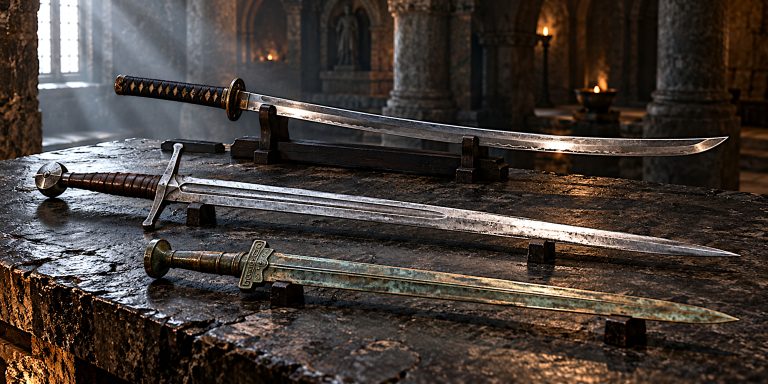
Several sword forms were associated with Hospitaller knights across different eras.
Arming Sword
The classic one-handed cruciform knightly sword remained common throughout the Crusades.
Features included:
- Straight double-edged blade
- Simple crossguard
- Wheel pommel
- Optimised for cutting and thrusting
These swords were effective sidearms for mounted combat.
Knightly Longsword
By the fourteenth and fifteenth centuries, longer hand-and-a-half swords became increasingly common.
Advantages included:
- Greater reach
- Improved leverage
- Strong thrusting capability against armour gaps
These weapons suited evolving armoured warfare.
Falchion
Some Hospitallers likely carried falchions, especially in naval or close-quarter combat.
The falchion’s heavy cutting blade was devastating against lightly armoured opponents.
Medieval art occasionally depicts Crusader warriors carrying broad single-edged swords resembling falchions.
Messer and Sabre Influences
By the Rhodes and Malta periods, contact with Ottoman and Mediterranean warfare introduced curved sabres and eastern influences into regional arsenals.
Hospitaller forces sometimes used captured Ottoman weapons alongside western arms.
Practicality tended to matter more than romantic purity once cannonballs started removing sections of walls.
Hospitaller Castles and Fortifications
The order controlled some of the strongest castles in the Crusader world.
Important sites included:
- Krak des Chevaliers
- Margat
- Rhodes
- Fort St Elmo
- Fort St Angelo
Krak des Chevaliers remains one of the greatest surviving Crusader fortresses ever built.
Hospitaller engineers excelled at defensive architecture. Their fortresses featured:
- Concentric walls
- Massive towers
- Murder holes
- Reinforced gatehouses
- Artillery bastions
The later Maltese fortifications reflected Renaissance military engineering adapted to gunpowder siege warfare.
Archaeology and Modern Discoveries
Archaeology has transformed understanding of the Hospitallers over the past century.
Excavations at Crusader castles have uncovered:
- Weapon fragments
- Armour pieces
- Coins
- Ceramics
- Medical tools
- Religious artefacts
At Krak des Chevaliers, archaeologists identified extensive storage systems, kitchens, chapels, and defensive modifications that reveal how sophisticated Hospitaller logistics had become.
On Malta, excavations around Fort St Elmo and Birgu uncovered siege damage from 1565, including cannon shot embedded within walls.
Rhodes has also yielded important discoveries, particularly relating to Hospitaller urban planning and defensive systems.
Perhaps most interesting are the hospital remains associated with the order. These reveal surprisingly advanced approaches to sanitation and patient care for the medieval period.
Some accounts describe individual beds for patients, clean linens, and dietary management. In twelfth-century Europe, this bordered on medical luxury.
Contemporary Views of the Hospitallers
Contemporary chroniclers admired the order’s discipline and religious devotion, though critics existed as well.
The chronicler William of Tyre praised their charitable role and military value.
Meanwhile, some rulers complained about the order’s wealth and political independence.
That tension became increasingly common across Europe. Military orders accumulated enormous landholdings and operated beyond many local controls.
Yet unlike the Templars, the Hospitallers avoided total destruction.
Part of that survival came from usefulness. Kings might distrust them, but they still needed experienced soldiers and naval defenders.
Decline and Survival
The Hospitallers gradually declined as a major military force after the seventeenth century.
Changes in warfare, politics, and religion weakened the old crusading model. Napoleon captured Malta in 1798, effectively ending the order’s territorial sovereignty.
Yet the order survived in altered form.
Today, the Sovereign Military Order of Malta continues as a Catholic charitable organisation involved in humanitarian and medical work across the world.
In a strange historical circle, the Hospitallers eventually returned to their original purpose, caring for the sick.
After centuries of sieges, cavalry charges, naval warfare, and cannon smoke, they ended much where they began.
Legacy of the Knights Hospitaller
The Hospitallers left an enormous historical legacy.
They shaped:
- Crusader warfare
- Mediterranean naval history
- Fortress architecture
- Medieval medicine
- Chivalric traditions
Their symbols remain globally recognisable.
Modern depictions often romanticise them as flawless holy warriors. Reality was far more complicated. They could be ruthless, politically calculating, and deeply entangled in the violent religious conflicts of their age.
Still, few medieval organisations demonstrated such endurance.
The Hospitallers survived the fall of Jerusalem, the collapse of the Crusader states, Ottoman expansion, shifting European politics, and even the age of Napoleon.
That alone makes them remarkable.
And unlike many medieval powers, they left behind something more enduring than ruins and chronicles. They left institutions, traditions, and an identity that somehow persisted long after the age that created them had disappeared into history.