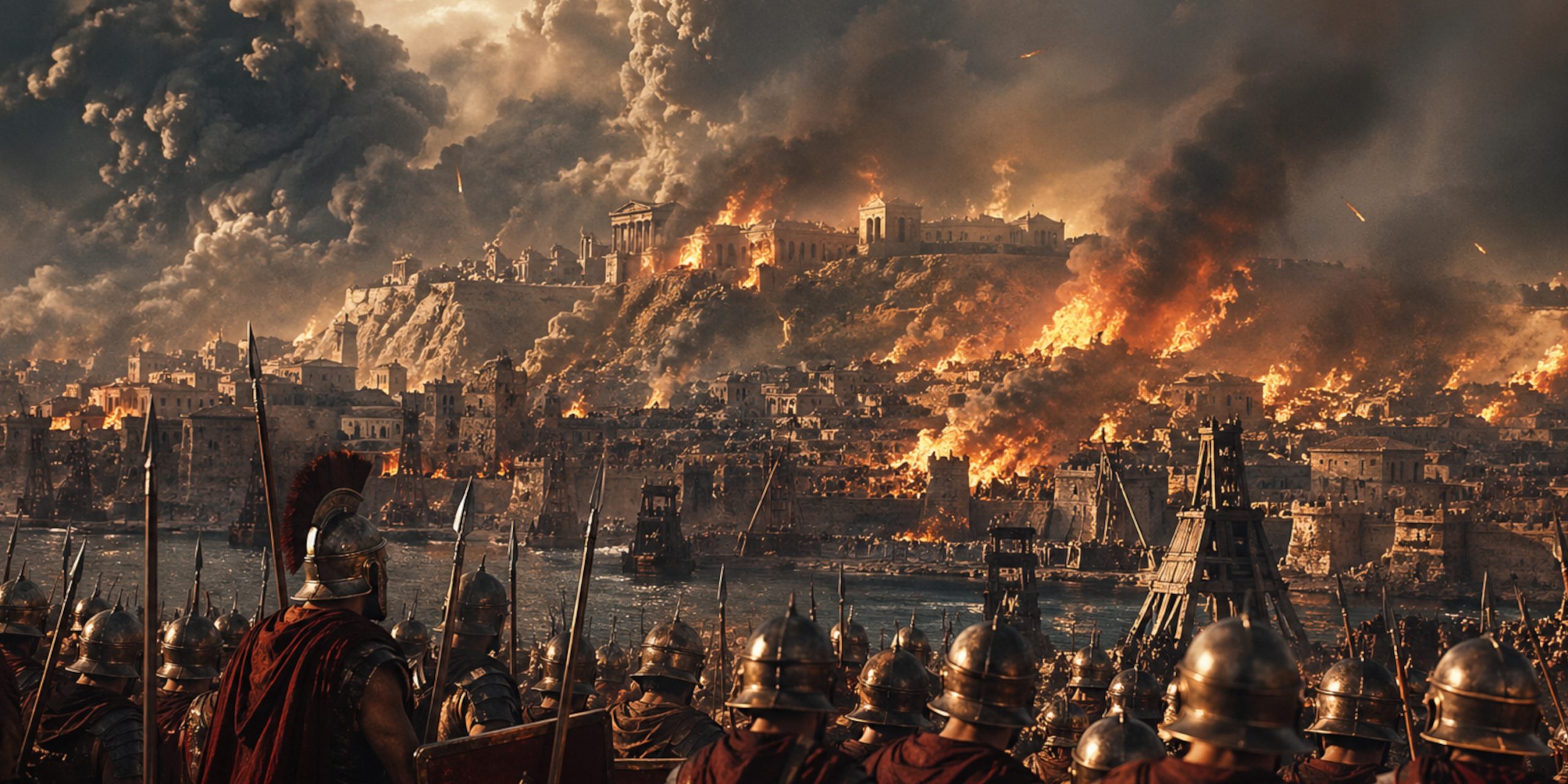
There are few endings in ancient history as final as Carthage’s. By 146 BC, a city that had rivalled Rome for generations was reduced to ash, its population scattered or enslaved, its name turned into a warning rather than a memory. The siege that brought about this destruction lasted three long years, marked by stubborn resistance, Roman frustration, and a grim determination on both sides.
From a historian’s perspective, the Siege of Carthage feels less like a battle and more like a slow tightening of a noose. The outcome was rarely in doubt. The manner of it, however, remains deeply revealing.
Background
The Third Punic War began not with a dramatic clash but with a political decision. Rome, increasingly wary of Carthage’s recovery after earlier defeats, demanded the city disarm and relocate inland. Carthage refused, which is about the most predictable response in recorded history.
War followed in 149 BC. The Romans expected a swift conclusion. Instead, they encountered a desperate and highly organised defence.
Carthage mobilised its population with surprising efficiency. Weapons were produced at speed, even as Roman forces attempted to encircle and isolate the city. What began as a punitive expedition became a prolonged and costly siege.
Foces
Roman Forces
| Category | Details |
|---|---|
| Commanders | Scipio Aemilianus (from 147 BC), initially consular commanders including Manius Manilius |
| Strength | Estimated 50,000 to 80,000 troops over the course of the siege |
| Composition | Roman legions, allied infantry, siege engineers, naval support |
| Strengths | Discipline, engineering, persistence |
| Weaknesses | Early poor leadership, supply strain |
Carthaginian Forces
| Category | Details |
|---|---|
| Commanders | Hasdrubal the Boetharch |
| Strength | Estimated 30,000 to 70,000 defenders including civilians |
| Composition | Citizen militia, remaining mercenaries, naval crews, urban defenders |
| Strengths | Defensive position, high morale, urban warfare familiarity |
| Weaknesses | Limited supplies, isolation, no external support |
Arms and Armour
Roman Equipment
- Gladius Hispaniensis
The standard Roman short sword, ideal for close quarters combat during assaults on walls and streets - Pilum
Heavy javelin designed to disrupt enemy formations before engagement - Scutum
Large rectangular shield, crucial for siege assaults and defensive formations - Lorica Hamata
Mail armour offering solid protection with reasonable flexibility
Carthaginian Equipment
- Straight double-edged swords
Likely influenced by Iberian and earlier Punic designs, suited for infantry fighting - Spears and javelins
Widely used by militia and remaining trained soldiers - Round shields
More varied in size and construction compared to Roman standards - Improvised weapons
As the siege progressed, Carthaginians reportedly produced arms from melted metal and repurposed materials
Observations
Urban combat during the final phase reduced the importance of formation fighting. The gladius proved especially effective in confined spaces, which suited Roman assault tactics. Carthaginian defenders, meanwhile, relied on terrain familiarity and sheer determination rather than uniform equipment.
The Siege Unfolds
The early Roman campaign was marked by hesitation and failure. Assaults faltered, discipline slipped, and Carthage held firm. It was only after Scipio Aemilianus took command in 147 BC that the siege tightened in a meaningful way.
He reorganised the army, enforced discipline, and pursued a strategy of complete encirclement. A massive siege wall cut Carthage off from the hinterland, while a harbour blockade attempted to sever maritime supply.
Carthage responded with ingenuity, even constructing a new fleet in secret and launching a surprise attack. It failed, but it remains one of the more impressive acts of desperation in ancient warfare.
Battle Timeline
- 149 BC
Roman forces land in North Africa, initial operations begin, Carthage prepares for siege - 148 BC
Stalemate, Roman assaults fail, Carthage continues resistance and weapons production - 147 BC
Scipio Aemilianus assumes command, imposes discipline, begins full encirclement - Late 147 BC
Harbour blockade strengthened, Carthaginian fleet sortie fails - 146 BC
Final Roman assault breaches the city, brutal street fighting begins - Spring 146 BC
Byrsa citadel falls after intense resistance, city systematically destroyed
The Fall of the City
The final assault was not swift. Roman troops advanced street by street, house by house. Fighting often took place from rooftops and within buildings. Fires spread, whether by accident or design, adding chaos to the already desperate situation.
Carthaginian resistance centred on the Byrsa, the city’s citadel. Even then, surrender was partial and reluctant. Hasdrubal eventually capitulated, though not without personal disgrace, as accounts suggest his wife chose death over capture.
Scipio, observing the destruction, is said to have reflected on the fate of cities. It is one of those moments where even the victor appears unsettled by the scale of what has been done.
Archaeology
Archaeological work at Carthage has provided a layered picture of the siege and its aftermath.
- Burn layers across sections of the city confirm widespread destruction
- Collapsed structures indicate prolonged urban combat
- Evidence of hurried fortification repairs aligns with written accounts
- Mass graves suggest significant civilian casualties
Roman rebuilding in later centuries complicates the archaeological record. Still, enough remains to confirm that this was not a symbolic destruction. It was thorough.
Contemporary Quotes
Polybius, who witnessed the aftermath, offers one of the most cited reflections:
“Scipio, gazing upon the city as it burned, is said to have shed tears and declared that a day would come when Rome would suffer the same fate.”
Appian provides a more direct account of the brutality:
“They fought not only with men but with fire itself, and the city became a battlefield in every street.”
These accounts, while shaped by their authors, capture the tone of the event rather well. This was not a clean victory.
Legacy
The destruction of Carthage ended a century of rivalry and confirmed Rome as the dominant power in the western Mediterranean. It also set a precedent for how Rome dealt with perceived existential threats.
In practical terms, the territory became the Roman province of Africa, later one of the empire’s most productive regions. In symbolic terms, Carthage became shorthand for total defeat.
There is also a quieter legacy. The siege demonstrated both the limits of resistance and the consequences of refusing submission to Rome. Future enemies took note, though not always in time.
Takeaway
The Siege of Carthage is often remembered for its ending, which is understandable. Yet the three years that led to that ending deserve equal attention. They reveal a city that refused to accept its fate and a republic that decided, quite deliberately, to erase a rival.
It is tempting to see this as inevitable. It was not. It was chosen.
And like many choices in history, it tells us as much about the victors as it does about the defeated.