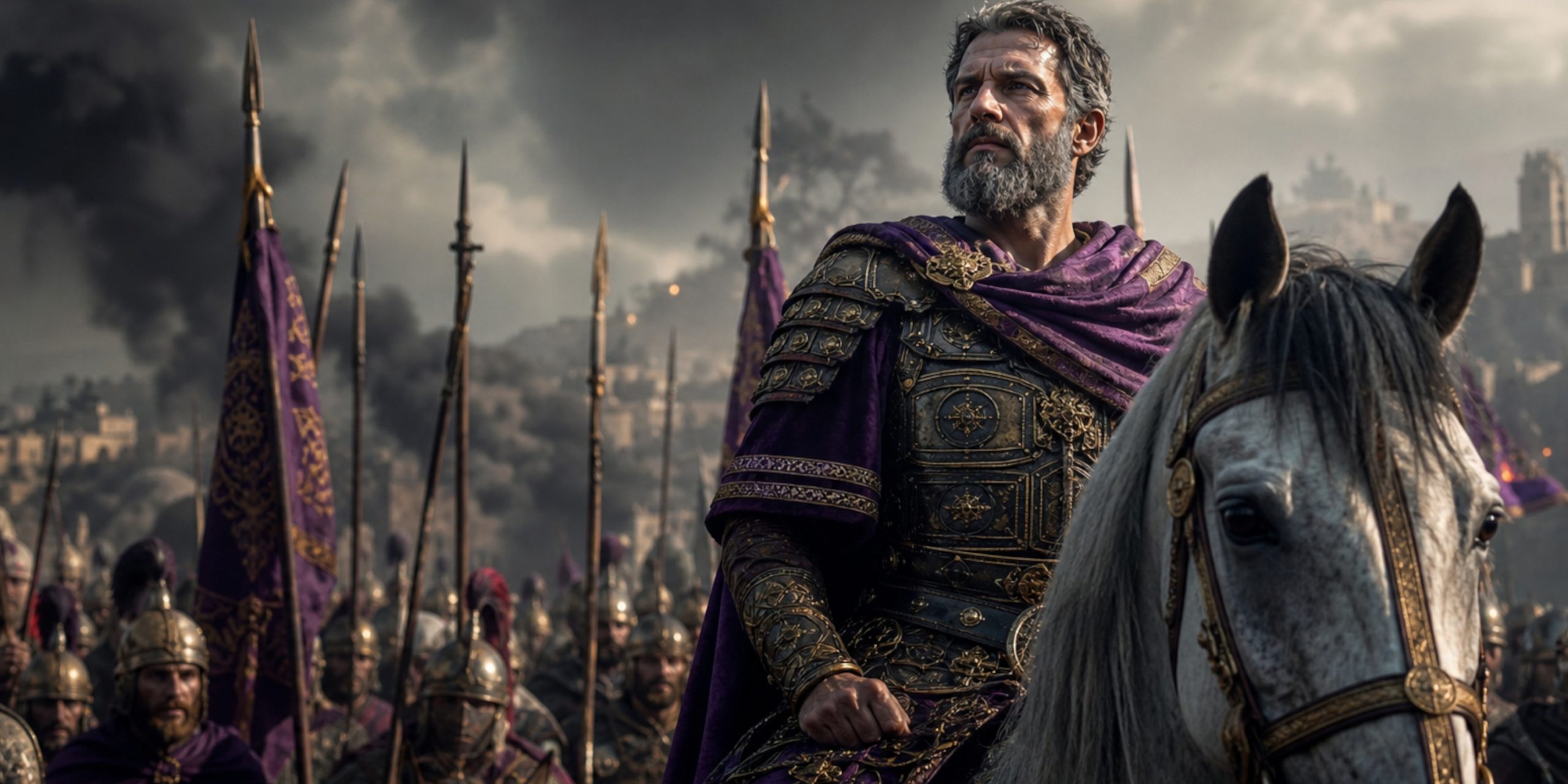
There are figures in history who slip through the cracks because they do not fit the expected mould. Narses is one of them. A court eunuch who rose to command imperial armies, he was not meant to be a conqueror, yet he became one of the most effective generals of the Byzantine age. His story is oddly quiet in tone, almost administrative at first glance, but the consequences of his campaigns reshaped Italy and helped define the late ambitions of the Eastern Roman Empire.
He worked under Emperor Justinian, alongside the more famous Belisarius. Yet when the empire needed a decisive hand in Italy, it was Narses who delivered something close to finality.
Early Life and Rise at Court
Little survives about Narses’ early years. He was likely born in Armenia or eastern regions of the empire around the late fifth century. As a eunuch, he entered imperial service and rose through the palace hierarchy, eventually becoming a senior chamberlain.
This was not a decorative role. Court eunuchs often handled finance, logistics, and imperial communications. Narses developed a reputation for precision and patience. He understood supply, pay, and discipline long before he handled a battlefield.
There is a tendency to imagine him as an unlikely soldier. That misses the point. He was shaped by the machinery of empire itself. By the time he was sent to Italy, he knew how armies functioned because he had been quietly running parts of them.
The Italian Campaign and Command
Narses first entered military affairs during earlier phases of the Gothic War, but his decisive role came later. By the 550s, the conflict in Italy had dragged on for years. The Ostrogothic kingdom still resisted, and imperial authority looked fragile.
Justinian gave Narses command with considerable resources. This alone tells you something. Emperors do not gamble on amateurs in drawn out wars.
Narses advanced into Italy with a mixed force of Byzantine troops, Lombards, Heruls, and other allied contingents. His approach was careful, almost methodical. He avoided rash engagements and kept his army well supplied, which in that war was half the victory.
Battles and Military Acumen
Battle of Taginae, 552
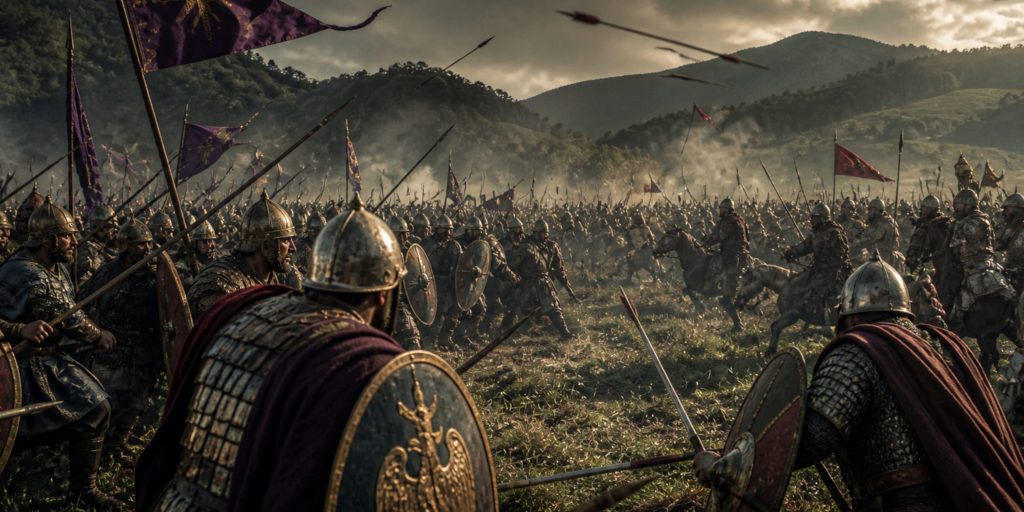
This was Narses’ defining moment. Facing the Ostrogothic king Totila, he deployed his forces in a deliberate defensive formation. Infantry held the centre, with archers positioned to create overlapping fields of fire, and cavalry anchored the flanks.
When the Ostrogoths charged, they met a disciplined wall of missiles and infantry resistance. Totila was killed in the fighting, and with him much of the Gothic momentum collapsed.
What stands out is not just the victory, but the structure of it. Narses did not rely on shock. He engineered the battle so that the enemy destroyed itself against a prepared position.
Battle of Mons Lactarius, 553
The remnants of Gothic resistance regrouped under Teia. Narses pursued and forced another engagement near Mount Vesuvius. The fighting was fierce and prolonged, but the result was decisive. Teia was killed, and organised Gothic resistance effectively ended.
Military Character
Narses was not a flamboyant commander. He preferred control over drama. His strengths were:
- Strong logistical planning
- Careful use of terrain and positioning
- Integration of different troop types into a coherent system
- Patience under pressure
There is a quiet ruthlessness to his method. He did not chase glory. He removed opposition piece by piece.
Arms and Armour
The armies under Narses reflected the transitional nature of late Roman warfare. Equipment was varied, often depending on origin and role.
Infantry
- Helmets, often spangenhelm designs with nasal guards
- Mail or lamellar armour for better equipped troops
- Large oval or round shields
- Spears as primary weapons
- The spatha, a long straight sword, used as a secondary weapon
Archers played a crucial role. They were not just skirmishers but integrated into the battle line, delivering sustained volleys.
Cavalry
- Heavily armoured cavalry, sometimes described as cataphracts
- Composite bows for mounted archers
- Lances for shock combat
- Swords similar to the spatha
Allied Troops
Narses relied on federate forces such as Lombards and Heruls. Their equipment varied widely, often lighter and more aggressive in style. This diversity gave flexibility, though it required careful control.
Governance of Italy
After his victories, Narses became the imperial administrator in Italy. His role shifted from conquest to maintenance.
This was perhaps the harder task. Italy had been devastated by years of war. Cities were damaged, populations reduced, and local power structures unstable.
Narses focused on restoring order and ensuring tax flow back to Constantinople. He maintained a firm grip, though later sources suggest he was not universally loved. That is rarely a surprise. Governors who enforce stability tend to be remembered with mixed feelings.
Where to See Artefacts from His Era
Physical objects tied directly to Narses himself are scarce, but the material culture of his world survives in several important locations.
- Ravenna, especially San Vitale, preserves mosaics from the reign of Justinian that capture the visual language of the court and military elite
- The National Archaeological Museum of Naples holds finds from late antique Italy, including arms and everyday items from the period of the Gothic War
- The Metropolitan Museum of Art in New York and the British Museum both display Byzantine arms, armour fragments, and decorative objects that reflect the equipment used by troops under commanders like Narses
- Istanbul Archaeological Museums contain artefacts from the broader Byzantine world, offering context for the imperial system he served
These collections do not give you Narses as an individual, but they give you his world in texture and detail.
Latest Archaeology and Research
Recent decades have brought more attention to late antique battlefields and settlement patterns in Italy.
Archaeological work in central and southern Italy has revealed:
- Evidence of destruction layers linked to prolonged warfare during the Gothic War
- Changes in settlement patterns, with fortified hilltop sites becoming more common
- Military artefacts such as arrowheads and weapon fragments that align with known campaign zones
There has also been renewed academic interest in logistics and supply systems. This is where Narses’ reputation grows stronger with each study. His campaigns appear increasingly sophisticated when viewed through the lens of movement, provisioning, and coordination rather than simple battlefield heroics.
It is a subtle shift in perspective, but an important one.
Legacy
Narses secured Italy for the Byzantine Empire, at least for a time. His victories closed a long and exhausting chapter of war.
Yet the stability he created did not last. Within decades, the Lombards invaded, and much of Italy slipped from imperial control again.
That does not diminish his achievement. If anything, it highlights how difficult his task was. He did not just win battles. He imposed order on a fractured landscape.
There is something quietly compelling about him. He does not fit the romantic image of a general, and perhaps that is why he endures. He represents competence in its purest form.