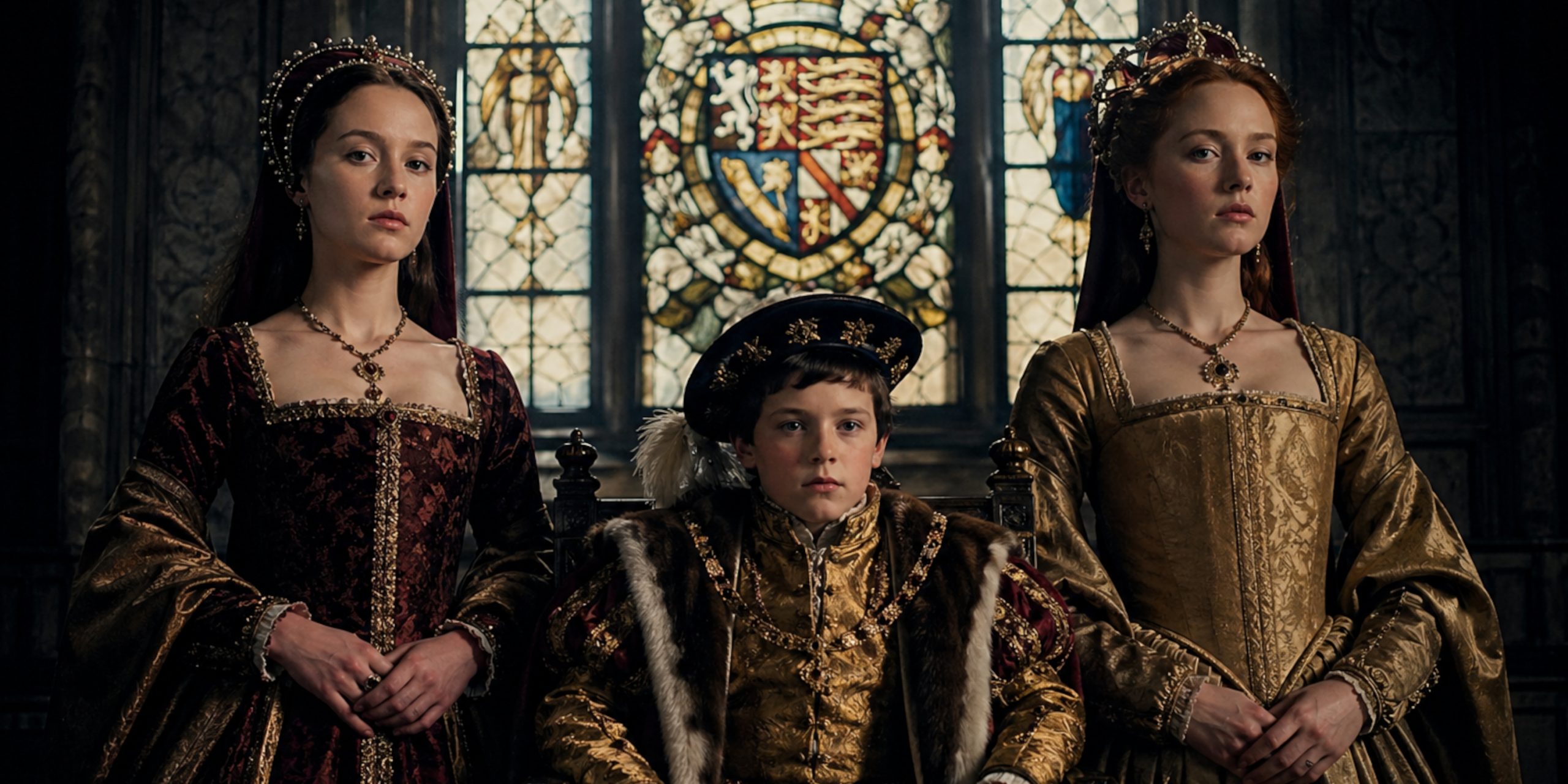
Henry VIII spent much of his reign worrying about succession, yet the fates of his children feel almost like a grim historical joke. He achieved what he wanted in the narrowest sense, three surviving heirs, but each life unfolded with strain, suspicion, and a rather Tudor talent for drama.
As a historian, I often find myself less interested in Henry himself and more in the quieter aftermath, the lives of those who had to carry his legacy. His children did not simply inherit a throne. They inherited a problem.
The Tudor Family at a Glance
Henry VIII had three legitimate children who survived infancy:
- Mary, daughter of Catherine of Aragon
- Elizabeth, daughter of Anne Boleyn
- Edward, son of Jane Seymour
Each was declared illegitimate at some point. Each was later restored. That alone tells you everything about the stability of Tudor politics.
Mary I, The Catholic Queen Who Refused to Bend
Mary’s childhood was a long lesson in humiliation. Once the cherished princess of England, she was demoted to “Lady Mary” after Henry’s break with Rome and the annulment of his marriage to Catherine of Aragon.
She never accepted it. Not privately, not politically, not even when it might have made her life easier.
When she finally became queen in 1553, she moved with purpose. England was to return to Catholicism. Her reign saw the restoration of papal authority and, notoriously, the burning of Protestant dissenters. The label “Bloody Mary” is not subtle, though it is often applied without much nuance.
Her marriage to Philip II of Spain was deeply unpopular. It brought fears of foreign control and, quite understandably, resentment among her subjects. Worse still, she suffered at least one false pregnancy, a cruel episode that left her physically and politically diminished.
Mary died in 1558 without an heir. Her reign had been brief, intense, and in many ways tragic. She had fought her entire life to be recognised, only to be remembered for the harshness of her rule.
Elizabeth I, The Survivor Who Became a Legend
Elizabeth’s early life reads like a study in careful survival. Her mother, Anne Boleyn, was executed before Elizabeth turned three. That fact alone could have ended her prospects entirely.
Instead, she endured.
She navigated suspicion during her brother Edward’s reign, then outright danger under Mary, including imprisonment in the Tower of London. One gets the sense she learned quickly that saying less was often safer than saying more.
When Elizabeth became queen in 1558, she ruled for 45 years. Her approach to religion was pragmatic. The Elizabethan Religious Settlement aimed for a workable middle ground, neither fully Catholic nor aggressively Protestant. It kept the peace, mostly.
Her reign saw the defeat of the Spanish Armada, the flourishing of English theatre, and the careful cultivation of her image as the “Virgin Queen”. Whether that image was a political necessity or a personal choice is still debated, usually with raised eyebrows.
Elizabeth never married and left no direct heir. It is difficult not to admire her control. She turned uncertainty into authority, and danger into distance.
Edward VI, The Boy King Who Never Had Time
Edward VI became king at just nine years old. In truth, he ruled very little. Power rested with his regents, first Edward Seymour, his uncle, and later John Dudley.
His reign pushed England firmly toward Protestant reform. Changes to doctrine and worship were introduced at a pace that would have unsettled even the most committed reformer. Edward himself was devout and serious, perhaps unusually so for a child.
He died in 1553 at the age of fifteen, likely from tuberculosis. His brief life had enormous consequences. Before his death, he attempted to alter the succession to exclude Mary, placing Lady Jane Grey in line for the throne.
It did not last. Jane’s reign collapsed within days, and Mary took power.
Edward’s story always feels unfinished. He was shaped by others, guided by ideology, and gone before he could define himself.
The Unofficial Child, Henry FitzRoy
Henry VIII also had an acknowledged illegitimate son, Henry FitzRoy, born to Bessie Blount.
FitzRoy was treated with surprising favour. He was granted titles, wealth, and a position that looked suspiciously close to legitimacy. At times, it seemed Henry might consider him as a fallback heir.
He died in 1536 at seventeen, possibly of tuberculosis. His death removed a potential alternative to the complicated succession that followed.
One cannot help but wonder how different things might have been had he lived. Though with the Tudors, different rarely meant calmer.
A Dynasty Secured, But Not Simplified
Henry VIII achieved his aim in the most literal sense. The Tudor line continued through his children. Yet none of them produced a lasting dynasty of their own.
- Edward died young without heirs
- Mary died childless
- Elizabeth chose not to marry or produce an heir
The throne ultimately passed to James VI and I, ending the direct Tudor line.
There is a certain irony in that. Henry reshaped England, broke with Rome, and married six times in pursuit of a stable succession. What followed was anything but stable.
Seven Swords Takeaway
When people speak about Henry VIII’s children, they often reduce them to neat labels, Bloody Mary, the Virgin Queen, the boy king. It is convenient, but it flattens them.
Mary was stubborn, yes, but also deeply wronged.
Elizabeth was brilliant, but rarely at ease.
Edward was devout, but never truly in control of his own reign.
They were not just heirs to a throne. They were survivors of a court where favour could vanish overnight and family loyalty had limits.
If there is one thread that binds them, it is endurance. Not the romantic kind, but the practical sort. The kind that keeps you alive in a Tudor palace.
And, as history tends to remind us, sometimes that is the greater achievement.