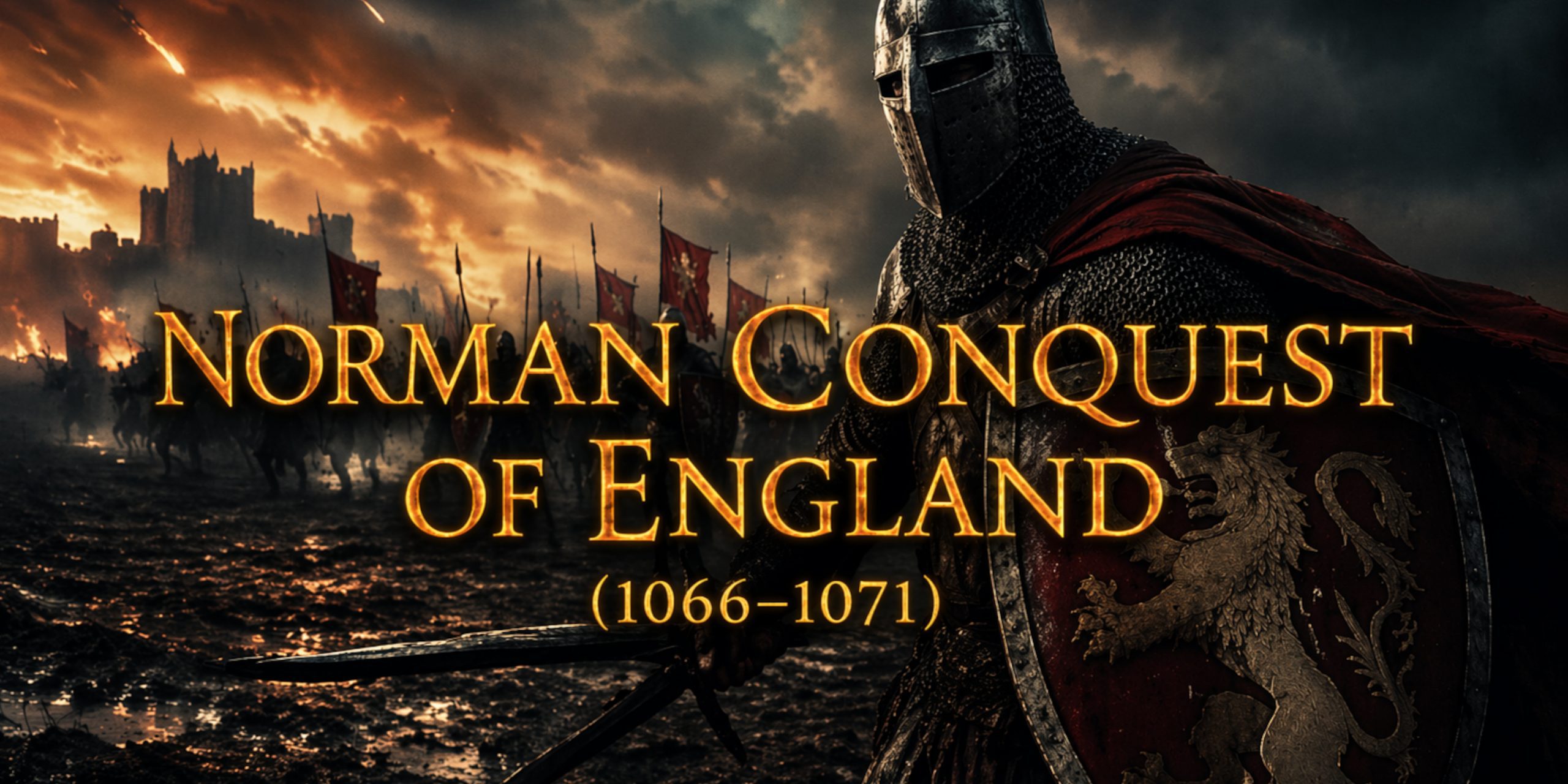
The Norman Conquest is one of those rare moments in English history where almost everything changed at once. A king died, three men claimed his throne, armies marched the length of the country, and within five years England had a new ruling class, a new language of government, and rather more castles than anyone had expected.
School lessons often reduce the story to one dramatic afternoon at Hastings. In truth, Hastings was only the beginning. The conquest dragged on until 1071, with rebellions, sieges and a grim campaign in the north before William of Normandy could truly claim England as his own.
Why 1066 Happened
King Edward the Confessor died on 5 January 1066 without a clear heir. That was awkward enough in any medieval kingdom. In England, where ambitious nobles and foreign rulers all thought they had an excellent case for wearing the crown, it was a recipe for chaos.
Three main claimants emerged:
- Harold Godwinson, the powerful Earl of Wessex, chosen by the Witan and crowned Harold II.
- William, Duke of Normandy, who claimed Edward had promised him the throne.
- Harald Hardrada, King of Norway, who believed he had inherited a right to England through an earlier Scandinavian agreement.
Harold probably thought he had secured the kingdom when he was crowned in Westminster. Unfortunately for him, two invasion fleets were already being prepared.
The Rivals for the Throne
Harold Godwinson
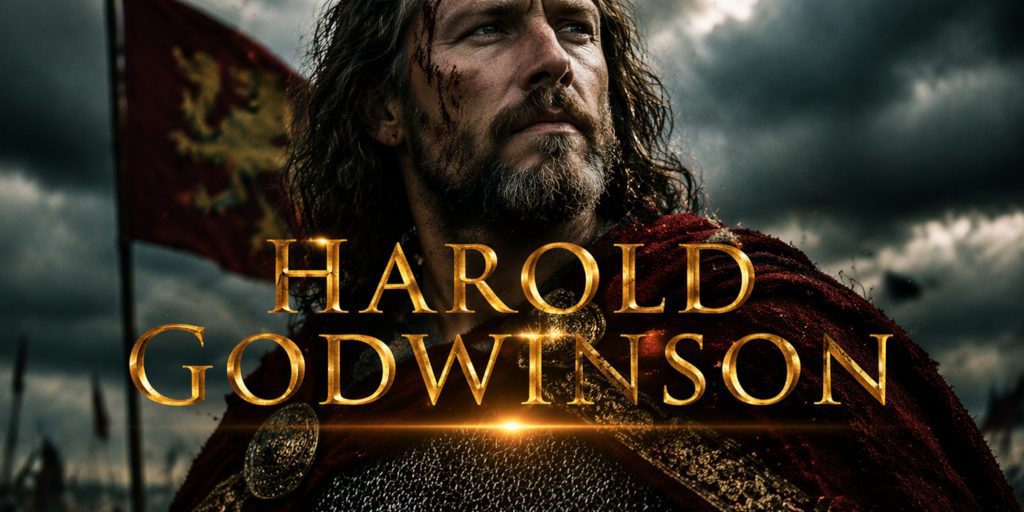
Harold was the richest and most powerful nobleman in England. He had years of military experience and had effectively run much of the kingdom under Edward. He was also, awkwardly, standing in the way of two men with armies.
William of Normandy
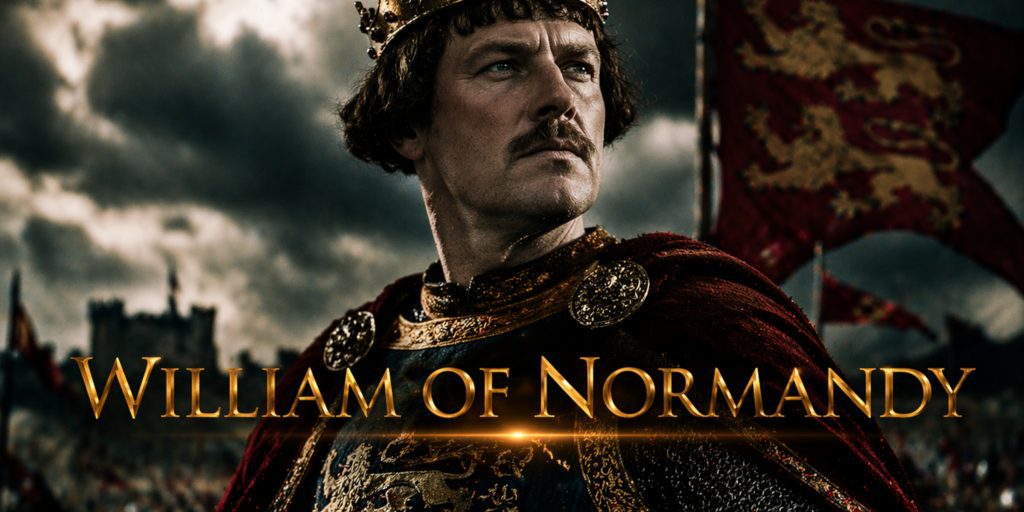
William was a formidable ruler, already hardened by years of war in Normandy. He argued that Edward had promised him the English throne and that Harold had sworn an oath to support him. Medieval politics often depended on who could shout “rightful claim” the loudest while standing next to a mounted knight.
Harald Hardrada
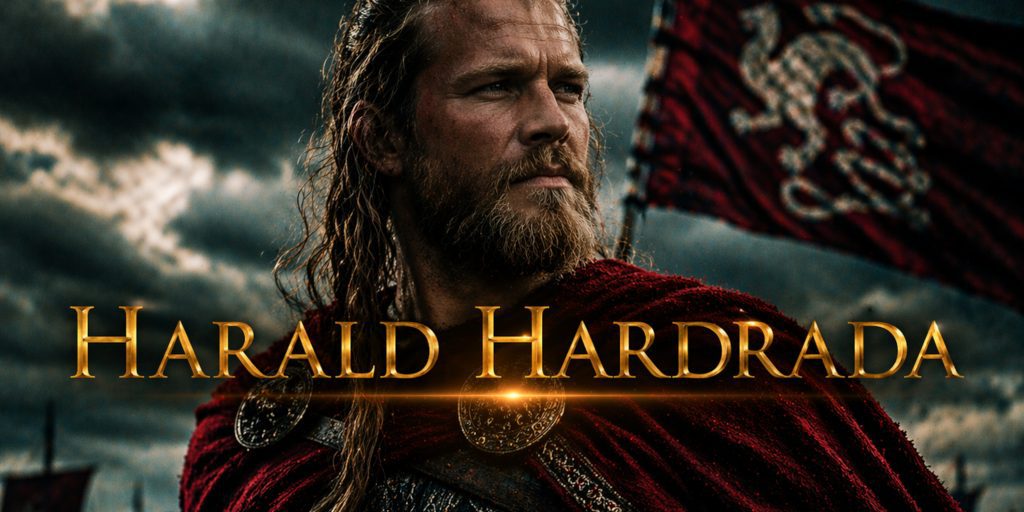
The Norwegian king represented the last great Viking challenge to England. He was backed by Harold’s exiled brother Tostig, who had an unfortunate habit of returning with hostile Scandinavians.
The First Campaign: Stamford Bridge
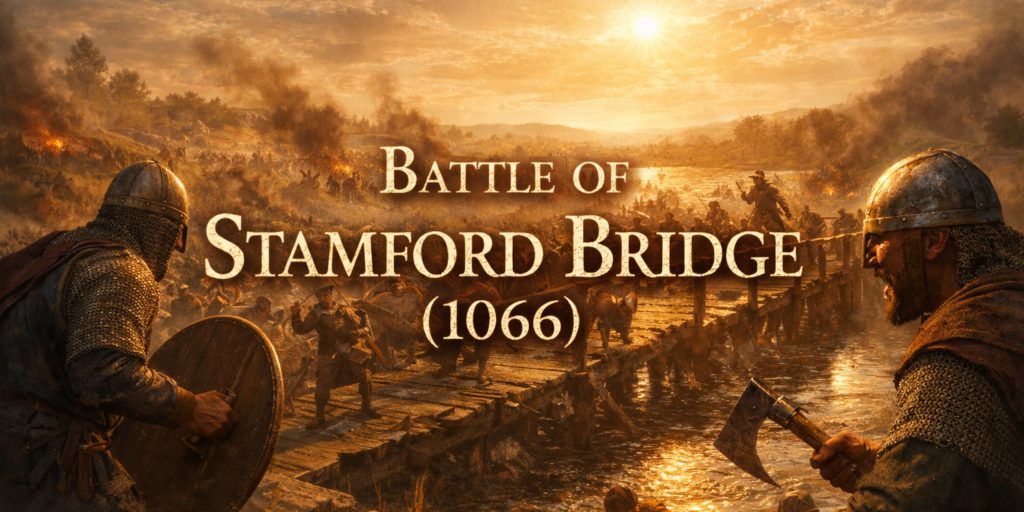
In September 1066, Harald Hardrada and Tostig landed in northern England. Harold Godwinson reacted with remarkable speed, marching north and catching them by surprise at Stamford Bridge on 25 September.
The battle was a crushing English victory. Hardrada was killed, Tostig was killed, and the Norwegian invasion collapsed.
For a brief moment Harold looked unstoppable. Then, three days later, William landed in Sussex.
There is a certain tragic quality to Harold’s position. He had just won one of the most impressive victories in English history and was rewarded with another invasion immediately afterwards, which feels rather unfair even by medieval standards.
William Lands in England
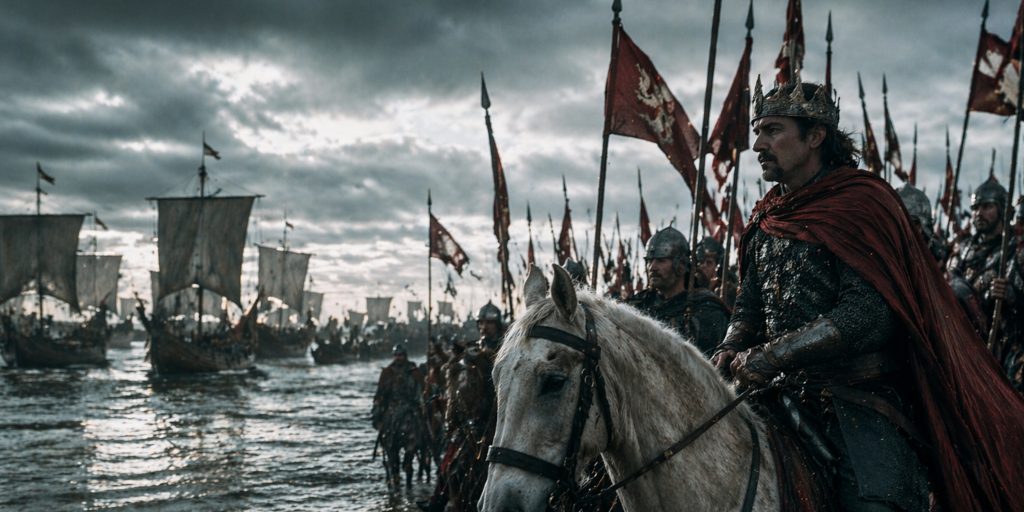
William crossed the Channel and landed at Pevensey on 28 September 1066. He quickly established positions at Pevensey and Hastings and began ravaging the surrounding countryside.
This was not random destruction. William wanted to force Harold into battle before more English forces could gather.
Harold marched south with his housecarls and the remains of his army. Whether his men were exhausted from the journey has long been debated. Recent scholarship suggests Harold may have used ships for part of the journey south, which would make his response rather more organised and considerably less suicidal than older histories often suggest.
The Battle of Hastings
14 October 1066
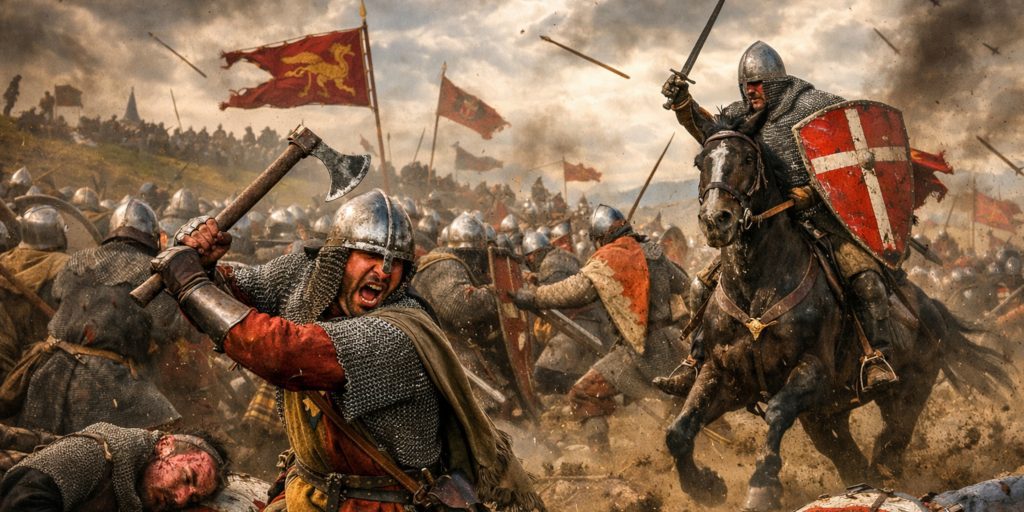
The Battle of Hastings was fought on Senlac Hill near Hastings on 14 October 1066.
Harold’s army took a strong defensive position on high ground. The English formed a shield wall, with heavily armed housecarls and fyrd infantry standing shoulder to shoulder.
William’s force was more varied. It included:
- Norman infantry
- Breton and Flemish allies
- Archers
- Heavy cavalry
The battle lasted for most of the day, unusually long for a medieval battle. Several times the Norman army nearly broke. At one point rumours spread that William had been killed. He famously rode forward, lifted his helmet and shouted that he was still alive. Medieval commanders were expected to lead from the front. They were also expected not to die inconveniently halfway through the battle.
The English shield wall held for hours. Eventually, however, repeated Norman attacks and a series of feigned retreats drew parts of the English line downhill. Once gaps appeared, the Norman cavalry exploited them.
By late afternoon Harold was dead and the English army collapsed.
Exactly how Harold died remains uncertain. The famous image of an arrow in the eye comes from the Bayeux Tapestry, though even that may not be as straightforward as it appears. He may instead, or perhaps additionally, have been cut down by Norman knights. Medieval chroniclers were not always as interested in precision as they were in telling a good story.
Major Battles of the Norman Conquest
| Battle | Date | Result | Significance |
|---|---|---|---|
| Fulford | 20 September 1066 | Viking victory | Opened York to Hardrada and Tostig |
| Stamford Bridge | 25 September 1066 | English victory | Destroyed the Norwegian invasion |
| Hastings | 14 October 1066 | Norman victory | Decisive turning point of the conquest |
| Southwark | October 1066 | Norman success | Helped force London into submission |
| Exeter | 1068 | Norman victory | Crushed resistance in the south-west |
| York and the North | 1069–1070 | Norman victory | Led to the Harrying of the North |
| Ely | 1071 | Norman victory | Ended major organised resistance |
William Takes the Crown
After Hastings, William did not immediately become king. London still held out, and the English elite briefly supported Edgar Ætheling, the last surviving member of the old royal family.
William advanced carefully around London rather than attacking it directly. He crossed the Thames at Wallingford and gradually cut off the capital.
Eventually the English nobles submitted. William was crowned King of England in Westminster Abbey on Christmas Day 1066.
The ceremony did not go entirely smoothly. Norman soldiers outside heard the shouting inside the abbey and assumed, with admirable if misguided enthusiasm, that a rebellion had begun. They responded by setting fire to nearby houses. England’s new regime had arrived with all the calm and grace of a tavern brawl.
Resistance and Rebellion, 1067–1071
The conquest was far from complete after William’s coronation.
England erupted into repeated revolts:
- Rebellion in Exeter in 1068
- Revolts in Mercia and Northumbria
- Danish intervention in 1069
- Resistance led by Hereward the Wake in the Fens
The most serious challenge came in the north. York rebelled twice, aided by a Danish fleet.
William responded with brutal force.
The Harrying of the North
Between 1069 and 1070 William devastated large parts of northern England.
Villages were burned, crops destroyed, livestock slaughtered and food stores ruined. The aim was simple: make further resistance impossible.
The campaign became known as the Harrying of the North. Contemporary chroniclers describe famine and depopulation on a terrible scale.
Even by the standards of medieval warfare, it shocked observers.
The chronicler Orderic Vitalis wrote:
“The king stopped at nothing to hunt down his enemies. He cut down many in his vengeance and destroyed the homes and lairs of others.”
The north eventually submitted, though at dreadful cost.
The Last Resistance at Ely
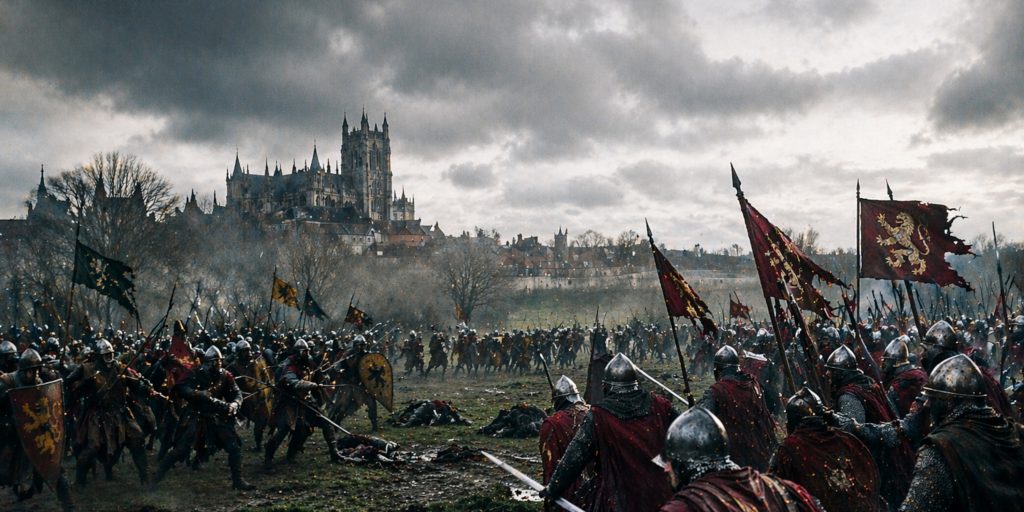
The final phase of the conquest centred on the Isle of Ely in 1071.
Hereward the Wake and other surviving rebels used the marshes of East Anglia as a natural fortress. For a time they embarrassed the Normans thoroughly, which must have been deeply irritating for William.
Eventually the Normans built causeways through the marshes and captured Ely. Hereward escaped into legend, which is often what happens when historical records become inconveniently vague.
With Ely subdued in 1071, the Norman Conquest was effectively complete.
How England Changed
The conquest transformed England more thoroughly than any invasion before or since.
Government and Law
William replaced almost the entire English aristocracy with Norman lords. By 1086, very little land remained in English hands.
The Norman kings introduced:
- A more centralised government
- Greater use of written records
- Feudal landholding
- Stronger royal authority
The Domesday Book of 1086 was perhaps the clearest symbol of this new system, a vast survey of England’s land, wealth and population.
Castles
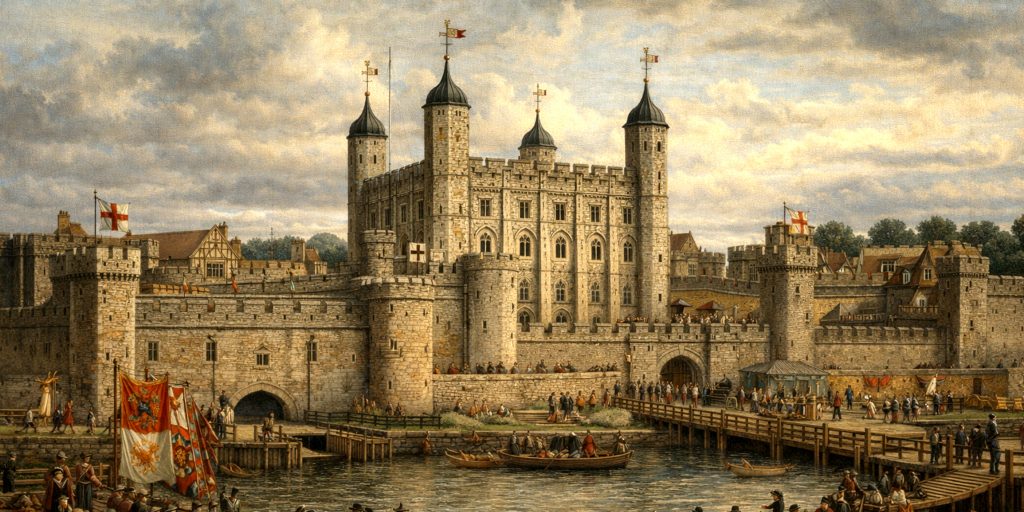
The Normans covered England with castles.
At first these were mostly motte-and-bailey fortifications built from timber and earth. They appeared at places such as:
- York
- Nottingham
- Lincoln
- Warwick
- The Tower of London
Castles allowed a small Norman elite to control a much larger population. They were not subtle. A castle planted beside a conquered town sent a very direct message.
Language
French became the language of the ruling class, law and government, while Latin remained the language of the Church.
English survived among ordinary people, but it changed dramatically. Thousands of French words entered the language. The result was modern English, which has never entirely recovered from its habit of borrowing other people’s vocabulary.
Archaeology of the Norman Conquest
The Bayeux Tapestry
The Bayeux Tapestry is the most famous surviving source for the conquest. It was probably created within a few years of 1066.
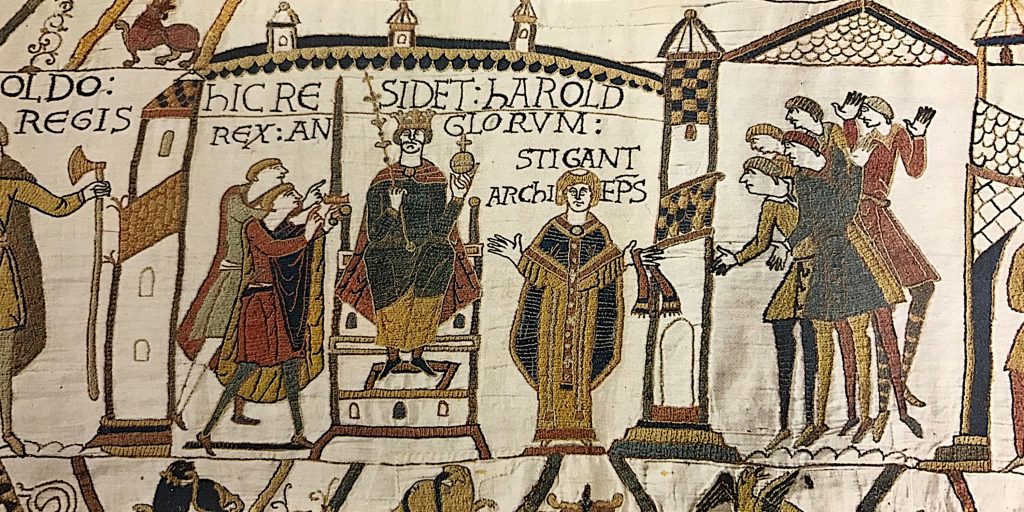
It shows:
- Harold’s oath to William
- The Norman invasion fleet
- The Battle of Hastings
- Harold’s death
Although not entirely neutral, it is invaluable. It also gives us a rare view of eleventh-century weapons, armour, ships and clothing.
Battle Abbey and the Hastings Battlefield
William founded Battle Abbey on the site of Hastings as both a memorial and an act of penance.
Archaeological work at the battlefield has uncovered:
- Norman and English weapon fragments
- Arrowheads
- Burials
- Evidence for the location of the fighting
The battlefield itself remains one of the least altered medieval battlefields in Europe.
Norman Castles
Excavations at early Norman castles show how quickly the conquest changed England.
Archaeologists have found the remains of early timber defences beneath later stone castles at places such as York, Norwich and Windsor.
Coin Hoards
Coin hoards buried during the years after 1066 reveal how unsettled England remained.
Recent discoveries, including the Chew Valley Hoard, contain coins of Edward the Confessor, Harold II and William I in the same deposit. They are a small but rather vivid reminder that people in conquered England had good reason to hide their valuables.
Contemporary Quotes
The Norman Conquest produced some of the most memorable comments in medieval history.
The Anglo-Saxon Chronicle, written by English monks, lamented William’s rule:
“God’s justice was very deep. The men who had no guilt suffered with the guilty.”
William of Poitiers, writing in support of the conqueror, declared:
“No duke in the world had ever shown such courage.”
Orderic Vitalis, writing later, gave a darker assessment of the Harrying of the North:
“I have often praised William, but for this act I can say nothing except that God will punish him.”
Few medieval kings inspire such wildly different opinions. To some, William was a brilliant conqueror. To others, he was an efficient catastrophe.
Legacy
The Norman Conquest reshaped England permanently.
It changed:
- The monarchy
- The aristocracy
- The language
- The Church
- Warfare
- Architecture
- England’s relationship with continental Europe
Without 1066 there would be no Tower of London, no great Norman cathedrals, no Domesday Book and probably a very different English language.
There is a temptation to think of the conquest as inevitable. It was not. A few hours at Hastings, a stronger shield wall, a different decision by Harold, and English history might have taken a completely different path.
Instead, by 1071, England had been conquered by a Norman duke who arrived with a fleet, a claim, and a remarkable confidence in his own destiny. Medieval history rarely does subtlety.