Medieval Europe liked to imagine the Church as a place of prayer, incense and solemn men quietly copying books by candlelight. Medieval Europe itself, unfortunately, had other ideas.
Across the Middle Ages there were bishops who led armies, abbots who defended castles, monks who rode into battle, and entire military orders built around the rather awkward idea that one could save souls while also cutting people in half. The Church officially frowned upon clergy shedding blood. Medieval clergy, being medieval clergy, often discovered that this rule had a remarkable number of loopholes.
The result was the medieval warrior priest. Some fought because they believed it was their sacred duty. Others fought because they were powerful landowners and expected to defend their lands. A few, if we are being honest, simply enjoyed it rather more than they ought to have.
What Was a Medieval Warrior Priest?
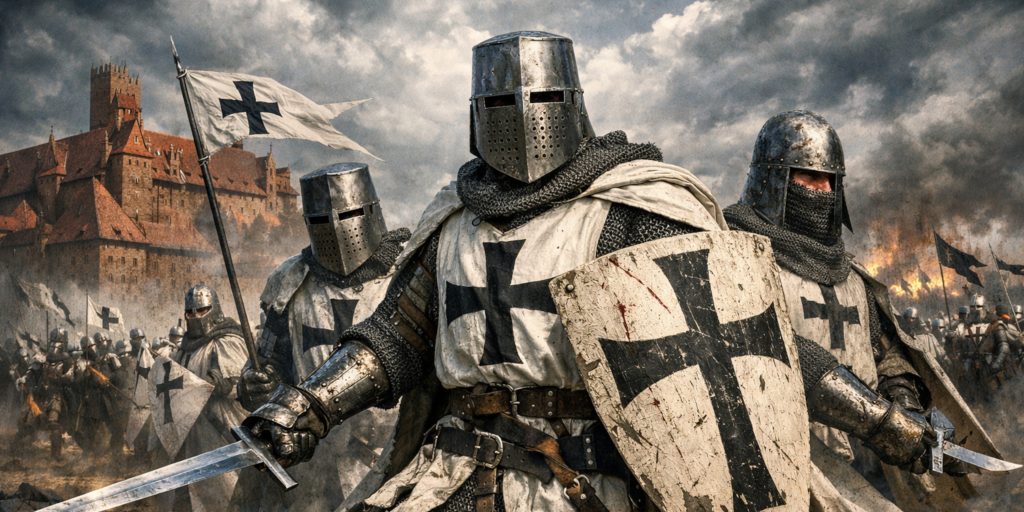
A warrior priest was a member of the clergy who took an active role in warfare. That could mean:
- Leading troops in battle
- Carrying weapons personally
- Serving as a military commander
- Belonging to a religious military order
- Defending church lands, castles or monasteries
In theory, church law forbade priests from shedding blood. Canon law repeatedly insisted that clergy should not fight, hunt, or carry weapons. Yet medieval society blurred the line between church and state. Bishops controlled land, castles and wealth. Abbots governed large estates. Senior clergy were often powerful nobles first and churchmen second.
By the eleventh century, the contradiction had become impossible to ignore. Europe was full of churchmen with armies.
Why Did Priests Fight?
There were several reasons why warrior priests appeared.
Feudal Obligations
Many bishops and abbots held land directly from kings. Like any other lord, they were expected to provide soldiers and defend their territory.
A bishop in medieval France or England might control:
- Castles
- Towns
- Large estates
- Hundreds of knights
When war came, refusing to fight was often less practical than it sounded. A bishop who ignored an invading army risked losing everything. Medieval kings were also not especially patient with bishops who preferred theological discussion to military service.
The Crusading Ideal
The Crusades transformed attitudes to holy war. Fighting for the faith became not merely acceptable but virtuous. Warrior monks and priestly commanders suddenly looked less like an embarrassing contradiction and more like heroes.
Pope Urban II’s call for the First Crusade in 1095 encouraged clergy to support warfare against enemies of Christianity. Some priests accompanied armies as chaplains. Others ended up in armour.
Defence of the Church
Monasteries and churches were often attacked during periods of unrest. Viking raids, border wars and local feuds could leave religious houses badly exposed.
Monks who wanted to survive sometimes found themselves with a sword in one hand and a prayer book in the other. One suspects they preferred the sword at such moments.
The Most Famous Warrior Priests
Peter the Rosh
Peter the Rosh was a Russian Orthodox monk and military leader active during the fifteenth century. He became closely associated with the defence of the Russian principalities against Mongol and Tatar raids, particularly during the troubled decades when religious authority and military leadership often overlapped.
Unlike western warrior bishops such as Odo of Bayeux, Peter the Rosh belonged to the Orthodox monastic tradition. Yet he still gained a reputation as a fighting holy man, rallying soldiers and local militias during campaigns in the Russian borderlands.
Contemporary Russian chronicles describe him as both a spiritual adviser and a battlefield commander. In times of invasion, monasteries in Russia frequently acted as fortified centres, and monks were sometimes expected to fight. Peter the Rosh seems to have embraced this role with rather more enthusiasm than most.
Battles
- Defence of Moscow’s frontier monasteries
- Campaigns against Tatar raiders in the Upper Volga region
- Local conflicts during the rise of the Grand Principality of Moscow
Russian accounts claim that Peter rode into battle carrying both a cross and a sword, a combination which rather neatly captures the entire problem of the warrior priest.
“He stood before the host with the Cross in one hand and the sword in the other.”
Although the details of his life are difficult to separate from later legend, Peter the Rosh became an enduring symbol of the Orthodox warrior monk in medieval Russia.
Bishop Odo of Bayeux
Few warrior priests are more famous than Odo of Bayeux, the half-brother of William the Conqueror.
Odo fought at the Battle of Hastings in 1066 and appears prominently on the Bayeux Tapestry. He is shown riding among the Norman troops, rallying them at a critical moment.
Contemporary chroniclers claimed that Odo avoided breaking church law by carrying a mace rather than a sword. Since a mace crushed rather than cut, this apparently counted as not shedding blood. Medieval lawyers could be alarmingly inventive when necessary.
Battles
- Battle of Hastings, 1066
- Norman campaigns in England
- Rebellions during William’s reign
The Bayeux Tapestry shows Odo in armour, holding a club or mace and encouraging Norman soldiers. He looks less like a bishop and more like a particularly militant uncle at a family dispute.
“Here Bishop Odo, holding a club, gives strength to the boys.”
That inscription from the Bayeux Tapestry remains one of the most famous contemporary references to a warrior priest.
Bishop Adhemar of Le Puy
Adhemar of Le Puy was the papal legate during the First Crusade and one of its most influential leaders.
Unlike some warrior bishops, Adhemar was not merely a ceremonial figure. He marched with the crusading armies, advised commanders and took part in the great struggles of the expedition.
At the Siege of Antioch in 1098 he helped maintain morale during famine, disease and internal quarrels. This was no small achievement. Crusaders were often almost as dangerous to each other as they were to their enemies.
Battles
- Siege of Nicaea, 1097
- Battle of Dorylaeum, 1097
- Siege of Antioch, 1097 to 1098
Contemporary writers described Adhemar as both pious and practical. He was one of the few men on the First Crusade who could command respect from rival princes.
“He was beloved by all for his wisdom and holiness.”
The chronicler Raymond of Aguilers wrote this after Adhemar’s death during the crusade.
Turpin, Archbishop of Reims
The historical Archbishop Turpin of Reims existed in the eighth century, though later medieval writers transformed him into a legendary warrior bishop.
In the medieval epic The Song of Roland, Turpin rides into battle beside Charlemagne’s knights, killing enemies with alarming enthusiasm for a man technically employed by the Church.
The fictional Turpin became an idealised image of the warrior priest, brave, loyal and utterly unconcerned about the paperwork that probably followed.
“The Archbishop is very good and brave. There is no better vassal under heaven.”
Although legendary, Turpin reflects how medieval society admired the idea of a fighting churchman.
The Warrior Monks of the Military Orders
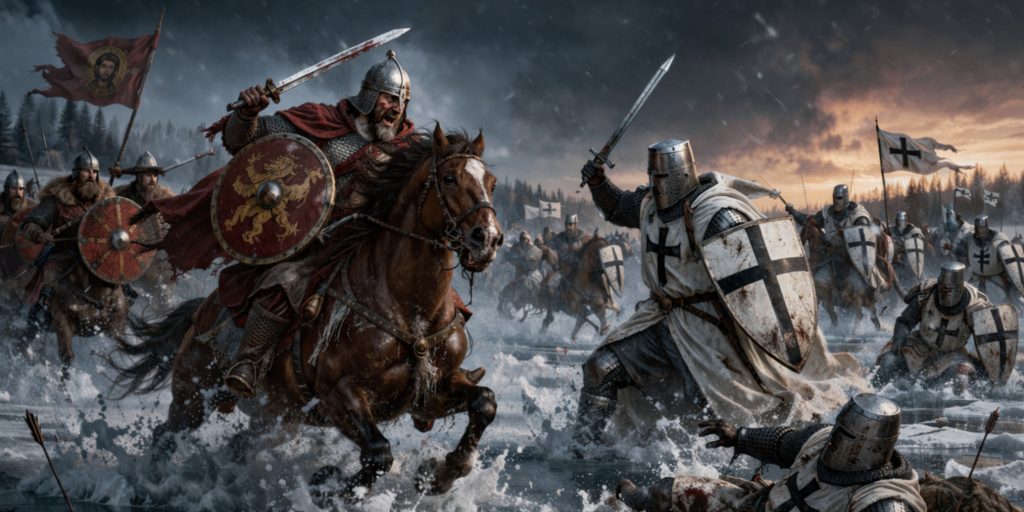
The most organised form of warrior priesthood appeared in the military orders.
These were religious communities whose members took monastic vows but also fought in battle. They combined prayer, discipline and warfare in a way that seems extraordinary today and apparently entirely sensible to the twelfth century.
The most famous orders were:
- Knights Templar
- Knights Hospitaller
- Teutonic Order
Knights Templar
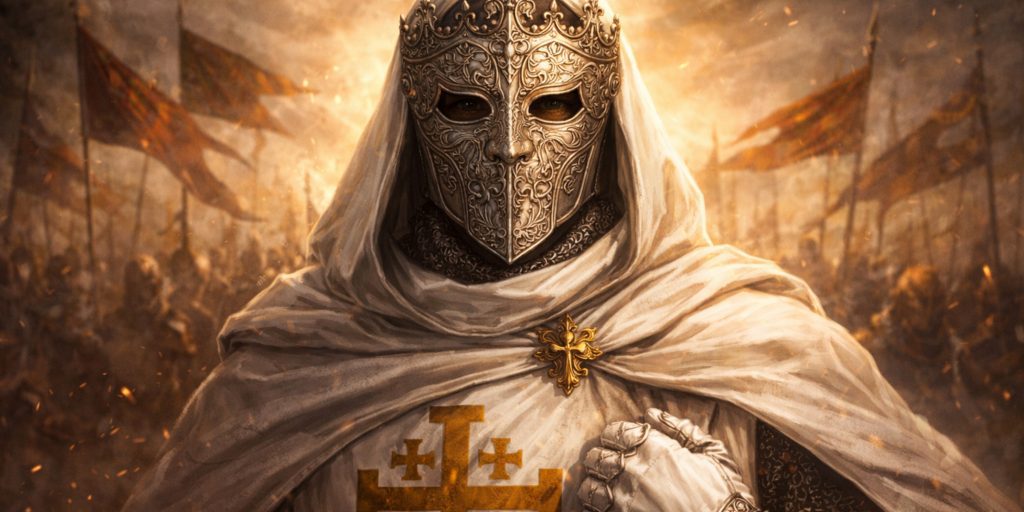
The Knights Templar were founded around 1119 to protect Christian pilgrims in the Holy Land.
Members took vows of poverty, chastity and obedience. They also became some of the finest heavy cavalry in Europe.
Templars were not all priests. Most were knight-brothers, while a smaller number served as ordained chaplains. Yet the order itself was religious, and many of its senior members combined spiritual and military authority.
Battles
- Battle of Montgisard, 1177
- Battle of Hattin, 1187
- Siege of Acre, 1291
At Hattin, the Templars fought almost to the last man against the army of Saladin. Their stubbornness was admired even by their enemies, although it also had a tendency to get them killed in large numbers.
Knights Hospitaller
Originally founded as a charitable order caring for pilgrims, the Hospitallers gradually became a major military force.
Their warrior monks fought in the Crusades, defended castles across the eastern Mediterranean and later resisted the Ottoman Empire.
The Hospitallers had a reputation for discipline and endurance. Unlike some crusading armies, they were capable of remaining organised even when everyone else had decided that panic was a more sensible option.
Battles
- Siege of Jerusalem, 1187
- Siege of Rhodes, 1522
- Great Siege of Malta, 1565
By the later Middle Ages they were among the most experienced military organisations in Europe.
Teutonic Order
The Teutonic Knights began as a German military order in the Holy Land before moving their campaigns to eastern Europe.
There they fought against pagan peoples in Prussia and the Baltic. Their combination of crusading zeal and military efficiency allowed them to build a powerful state.
Battles
- Battle on the Ice, 1242
- Battle of Grunwald, 1410
The Teutonic Knights were feared opponents, though by 1410 their power suffered a devastating blow at Grunwald. Few institutions recover gracefully from being thoroughly flattened by a coalition army.
Weapons and Armour of Warrior Priests
Warrior priests often dressed and fought much like noblemen and knights.
Common Weapons
- Maces, favoured because they were thought less likely to violate church law
- Swords, especially arming swords and knightly longswords
- Spears and lances
- Axes
- Crossbows
Bishops in battle often preferred the mace. It became almost a symbol of the warrior bishop.
The military orders, meanwhile, used the standard knightly weapons of their age.
| Period | Common Weapon | Notes |
|---|---|---|
| 11th century | Arming sword and mace | Used by bishops such as Odo |
| 12th-13th centuries | Lance, sword, kite shield | Typical crusading equipment |
| 14th-15th centuries | Longsword, poleaxe, plate armour | Used by military orders and late medieval clergy |
Armour
Warrior priests could wear:
- Mail hauberks
- Conical helmets or great helms
- Surcoats bearing crosses or church symbols
- Later plate armour
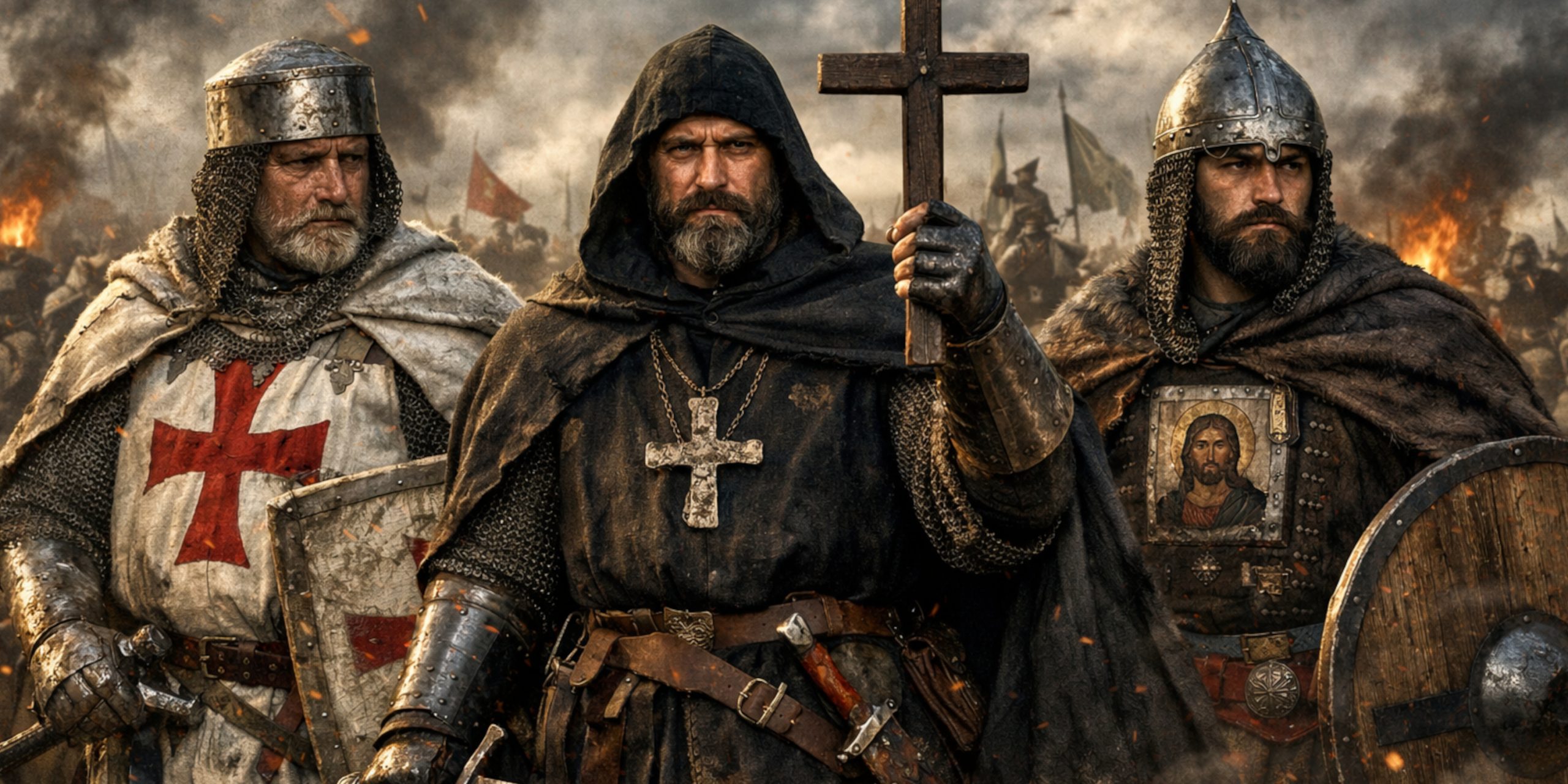
The Templars wore white mantles with a red cross. Hospitallers often wore black with a white cross. Teutonic Knights preferred white with a black cross. Medieval battlefields could occasionally resemble an argument between particularly aggressive heraldic laundry baskets.
Battles Involving Warrior Priests
Warrior priests appeared in many important conflicts.
| Battle | Date | Warrior Priest Involved | Result |
| Battle of Hastings | 1066 | Bishop Odo of Bayeux | Norman victory |
| Siege of Antioch | 1098 | Bishop Adhemar of Le Puy | Crusader victory |
| Battle of Hattin | 1187 | Knights Templar and Hospitaller clergy | Muslim victory |
| Battle on the Ice | 1242 | Teutonic Knights | Russian victory |
| Battle of Grunwald | 1410 | Teutonic Order | Polish-Lithuanian victory |
The presence of clergy in battle could inspire troops. Medieval soldiers often believed that God favoured armies led by holy men. Whether God shared this opinion is harder to establish.
Archaeology and Evidence
Archaeology has revealed much about the lives of warrior priests and military orders.
Templar Sites
Excavations at Templar castles such as Safed and Atlit in the Holy Land have uncovered:
- Armour fragments
- Sword blades
- Arrowheads
- Horse equipment
- Chapel remains inside military fortresses
These sites show how closely religious life and warfare were intertwined. A Templar fortress usually contained both a chapel and an armoury, which rather sums up the order’s priorities.
Hospitaller and Teutonic Castles
The great Hospitaller castle of Krak des Chevaliers and Teutonic fortresses such as Malbork preserve extensive evidence of warrior-monastic life.
Archaeologists have found:
- Fortified chapels
- Barracks for armed monks
- Workshops producing weapons and armour
- Graves containing military equipment
At Malbork, excavations have revealed arrowheads, crossbow bolts and fragments of plate armour from the order’s wars in the Baltic.
The Bayeux Tapestry
Although not archaeology in the strictest sense, the Bayeux Tapestry remains one of the most important visual sources for warrior priests.
It provides a near-contemporary image of Bishop Odo in battle and offers valuable detail on:
- Weapons
- Armour
- Horses
- The role of bishops in warfare
Very few medieval people were fortunate enough to have themselves immortalised in embroidery while committing violence. Odo managed it.
Contemporary Attitudes to Warrior Priests
Not everyone approved of warrior priests.
Church reformers repeatedly condemned clergy who fought. Some writers argued that priests should save souls, not lead cavalry charges.
The reformer Peter Damian criticised bishops who behaved more like soldiers than churchmen.
“They delight in war, they brandish swords, they ride with armed men.”
Others saw warrior priests as necessary in a violent age. Medieval Europe was not especially kind to those who remained unarmed.
The tension never disappeared. Even at the height of the Crusades, many church leaders remained uneasy about priests fighting. Yet the popularity of the military orders and crusading bishops shows that medieval society often accepted, and even celebrated, the contradiction.
Were Warrior Priests Common?
Warrior priests were unusual, but not rare.
Most ordinary parish priests never fought. They were far too busy collecting tithes, settling local disputes and wondering why the church roof was leaking again.
However, among senior clergy and military orders, warrior priests were relatively common. In frontier regions, during crusades or in periods of civil war, churchmen often found themselves involved in conflict.
The medieval world simply did not separate religion and warfare as neatly as we do today.
Legacy
The image of the warrior priest survived long after the Middle Ages.
It appears in:
- Medieval literature such as The Song of Roland
- Later crusading legends
- Modern fantasy novels and games
- Popular depictions of crusading knights and militant bishops
Many fictional warrior priests owe more to Bishop Odo and the Templars than to pure invention.
The real medieval warrior priest was a figure full of contradictions. He was expected to preach mercy while preparing for battle. He blessed armies, carried relics and sometimes rode into combat with a mace in hand.
It is tempting to see this as hypocrisy. In truth, it reflects the strange, complicated world of medieval Europe, where faith and violence were often uncomfortably close companions.
For the medieval warrior priest, prayer before battle was essential. So, apparently, was a very sturdy helmet.