The Vikings arrived in England as raiders. They stayed as settlers, merchants, rulers and, in more than one awkward case, in-laws. By the time their age had passed, England had been altered so deeply that it is difficult to imagine the country without them.
They changed the map, the language, the law and even the monarchy itself. The England that emerged from the Viking Age was more united, more centralised and, rather ironically, more English than the patchwork of kingdoms the Norsemen first encountered.
England Before the Vikings
Before the first Viking ships appeared on the horizon, England was not one country. It was a collection of rival Anglo-Saxon kingdoms, usually referred to as the Heptarchy. Northumbria, Mercia, Wessex, East Anglia, Kent, Sussex and Essex jostled for power, formed alliances and betrayed one another with admirable consistency.
Northumbria was rich but unstable. Mercia had dominated much of England in the eighth century. Wessex, in the south-west, was beginning to rise. There was no single English king and no shared political centre.
This mattered because the divided kingdoms were easy prey. When Viking raiders arrived, the English could rarely agree on anything except that the disaster was someone else’s problem.
The First Viking Raids
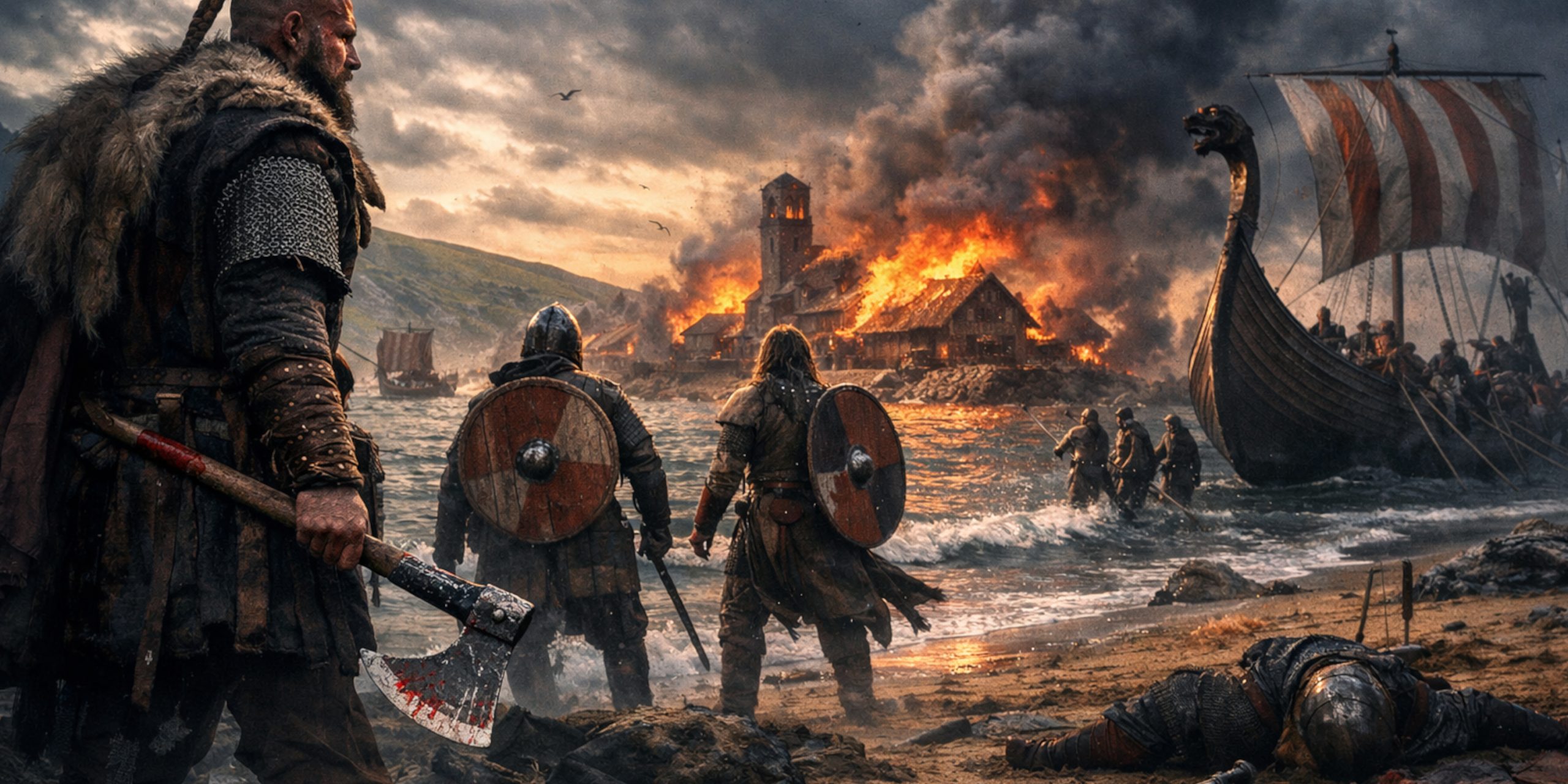
The Viking Age in England traditionally begins in 793 with the attack on Lindisfarne. The monastery on the holy island off the coast of Northumbria was wealthy, poorly defended and full of monks, which from a Viking perspective was very nearly an invitation.
A contemporary Anglo-Saxon chronicler wrote:
“Never before has such terror appeared in Britain as we have now suffered from a pagan race.”
The shock was immense. Monasteries had been seen as sacred places, protected by God. The Vikings arrived and behaved as though they had not read the rules.
Further raids followed at Jarrow, Iona and monasteries across the English coast. At first these attacks were seasonal. Viking ships would appear in summer, plunder what they could and leave. By the mid-ninth century, however, the situation changed.
The Great Heathen Army
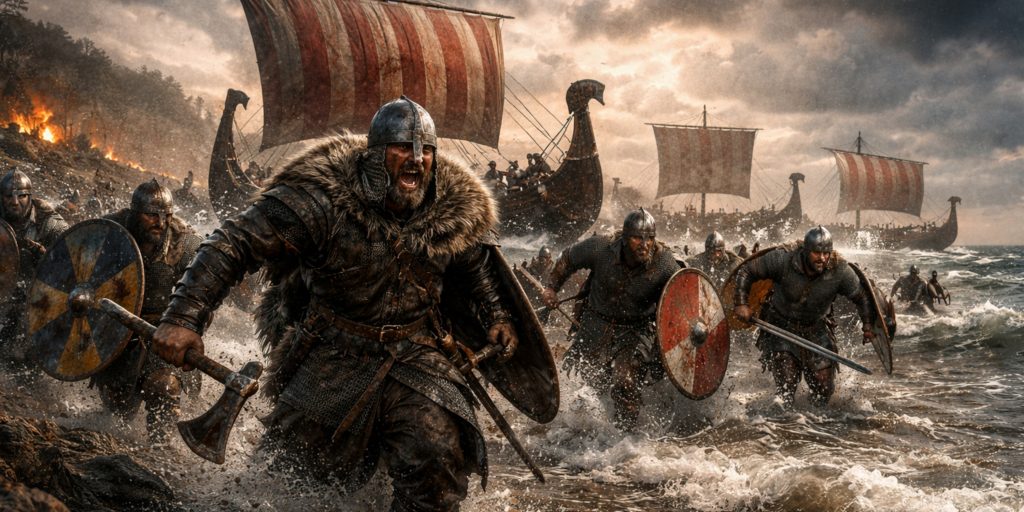
In 865 a large Viking force landed in East Anglia. Later chroniclers called it the Great Heathen Army. This was not a mere raiding party. It was an invasion.
Led by figures such as Ivar the Boneless, Halfdan and Ubba, the army moved from kingdom to kingdom, conquering and extorting. Northumbria fell in 867. East Anglia followed in 869. Mercia was broken and reduced. Only Wessex remained unconquered.
The chronicler of Wessex described the invaders with admirable understatement:
“The army came into Reading and there wrought much evil.”
One suspects that “much evil” included burning towns, killing nobles and ruining the day of nearly everyone involved.
The Viking invasions shattered the old balance of power in England. Ancient kingdoms disappeared. Others survived only by paying tribute. The political map of England would never look the same again.
Alfred the Great and the Survival of Wessex
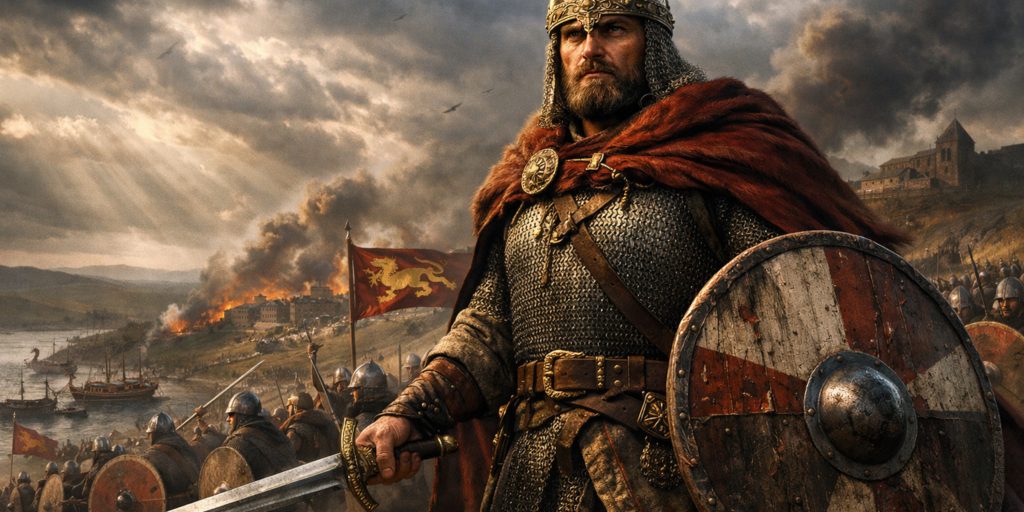
The greatest English response to the Vikings came from Alfred, king of Wessex. When he came to the throne in 871, his kingdom was close to collapse. In 878 the Viking leader Guthrum forced Alfred into hiding in the marshes of Somerset.
Later legend turned this period into the story of Alfred burning the cakes. Historians cannot be certain it happened, although given the circumstances it is entirely possible he had more pressing concerns than bakery standards.
Alfred emerged from hiding, gathered his forces and defeated Guthrum at the Battle of Edington in 878. The victory saved Wessex and laid the foundations for a future English kingdom.
Alfred also recognised that defeating the Vikings once was not enough. He reorganised Wessex permanently. He built fortified towns, known as burhs, strengthened the army and created a small fleet. In effect, he turned Wessex into a state built for survival.
A contemporary praised him in glowing terms:
“He was king over all the English people except that part which was under Danish rule.”
That line mattered. For the first time, people were beginning to imagine an England that might be politically united.
The Danelaw and a Divided England
After Alfred’s victory, England was divided between Anglo-Saxon and Viking rule. The north and east became known as the Danelaw, because Danish law and custom dominated there.
The Danelaw included much of modern Yorkshire, East Anglia, Lincolnshire and the East Midlands. Viking settlers founded towns, farmed the land and intermarried with the local population. They did not simply occupy England. They became part of it.
The names of many places still reveal this settlement. Towns ending in “-by” such as Derby, Grimsby and Whitby come from Old Norse. So do names ending in “-thorpe” and “-thwaite”.
The landscape itself still carries Viking fingerprints.
How the Vikings Changed the English Language
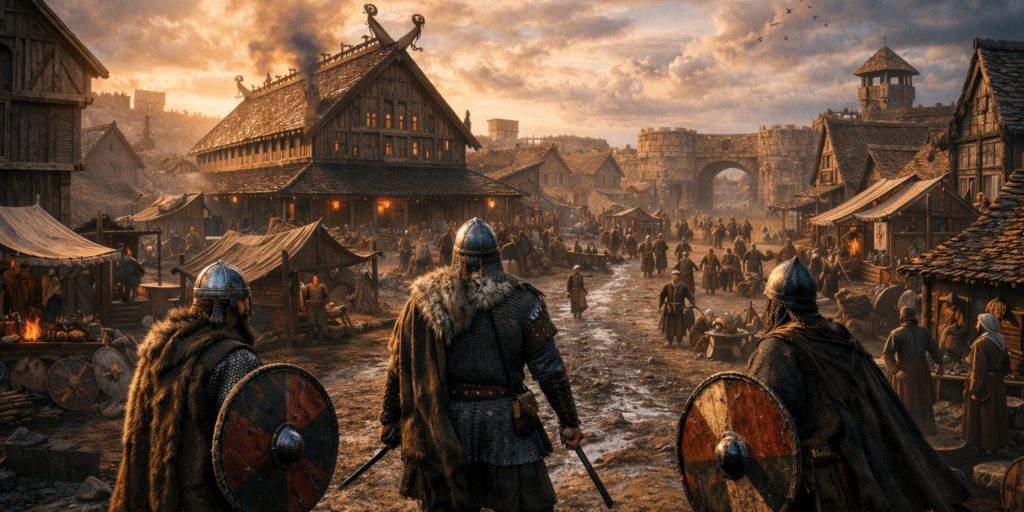
The Viking impact on the English language was extraordinary. Old English and Old Norse were different languages, but they were close enough that people could understand one another after a fashion. Rather like listening to a cousin from the other end of the country after several ales.
Thousands of Norse words entered English. Many are still in daily use:
- Sky
- Window
- Husband
- Knife
- Egg
- Law
- Wrong
- Anger
- Take
- They
- Them
- Their
The last three are especially remarkable. English replaced its original Anglo-Saxon pronouns with Norse ones. Few invasions manage to alter the language quite so completely.
Without the Vikings, modern English would sound very different. It might also be rather more complicated, which is a distressing thought.
Viking Law, Government and Society
The Vikings influenced how England was governed. In the Danelaw, Norse customs mixed with Anglo-Saxon traditions. Local assemblies, known as things, helped settle disputes and make decisions. Their influence can still be seen in later English ideas about local government and juries.
The very word “law” comes from Old Norse.
Viking England also encouraged stronger kingship. Faced with the threat of invasion, the rulers of Wessex centralised power. Taxes became more organised. Armies became more permanent. Records became more detailed.
In trying to resist the Vikings, the English created a stronger state. The irony is delicious. England became more united because it was under attack.
The Viking Kings of England
The story did not end with Alfred. In the early eleventh century, Viking rulers conquered all of England.
Sweyn Forkbeard invaded in 1013 and briefly became king. After his death, his son Cnut secured the throne in 1016. Cnut ruled England, Denmark and Norway, creating a North Sea empire.
Far from being a brutal conqueror alone, Cnut proved an able and pragmatic king. He kept many Anglo-Saxon laws, worked with the English church and ruled through existing institutions.
A later writer recorded:
“King Cnut loved justice and right dealing.”
Cnut’s reign showed that Viking and English traditions had become deeply entwined. By the eleventh century, the distinction between conqueror and conquered was beginning to blur.
Trade, Towns and the Wider World
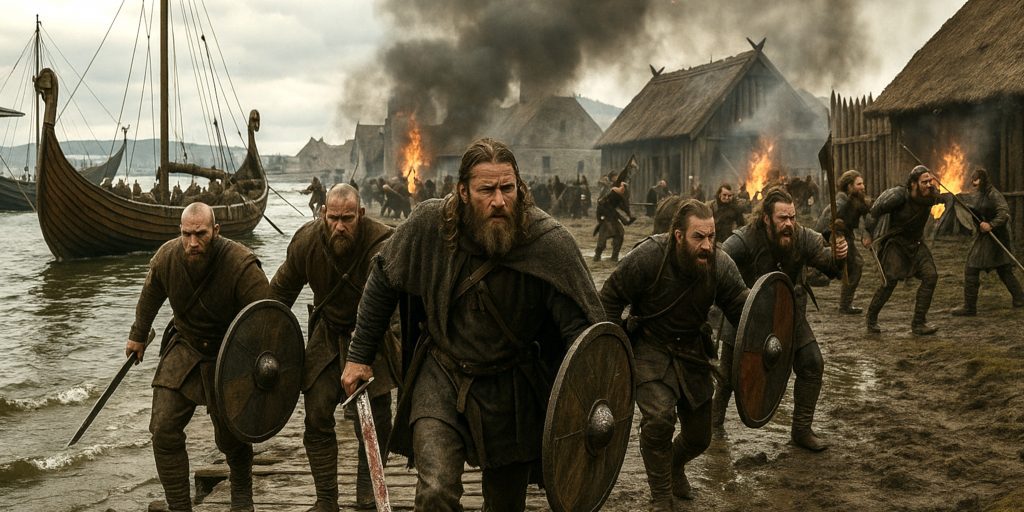
The Vikings connected England more closely to the wider world. Viking traders travelled from Ireland to Constantinople and from the Baltic to the Middle East. England became part of this network.
York, known to the Vikings as Jorvik, became one of the great trading cities of northern Europe. Archaeological discoveries there have revealed imported silk, amber, coins and even exotic spices.
The Viking Age brought new wealth and new towns. It also brought an inconvenient amount of silver buried in fields by anxious people who never returned to collect it. Modern metal detectorists have done rather well from this.
Archaeology and What We Have Found
Modern archaeology has transformed our understanding of the Vikings in England. Excavations at York, Repton and Torksey have revealed large Viking settlements and winter camps.
At Repton in Derbyshire, archaeologists discovered a mass grave linked to the Great Heathen Army. The remains included men killed in battle, along with Viking weapons and artefacts.
At York, archaeologists uncovered houses, workshops and streets from the Viking city. They found combs, jewellery, leather shoes and even fossilised human waste. One particularly famous Viking latrine produced what was described, with admirable scholarly restraint, as “the largest preserved human stool ever found”.
History is glorious. History is also occasionally disgusting.
These discoveries remind us that the Vikings were not simply warriors. They were farmers, traders, craftsmen and families.
The End of the Viking Age in England
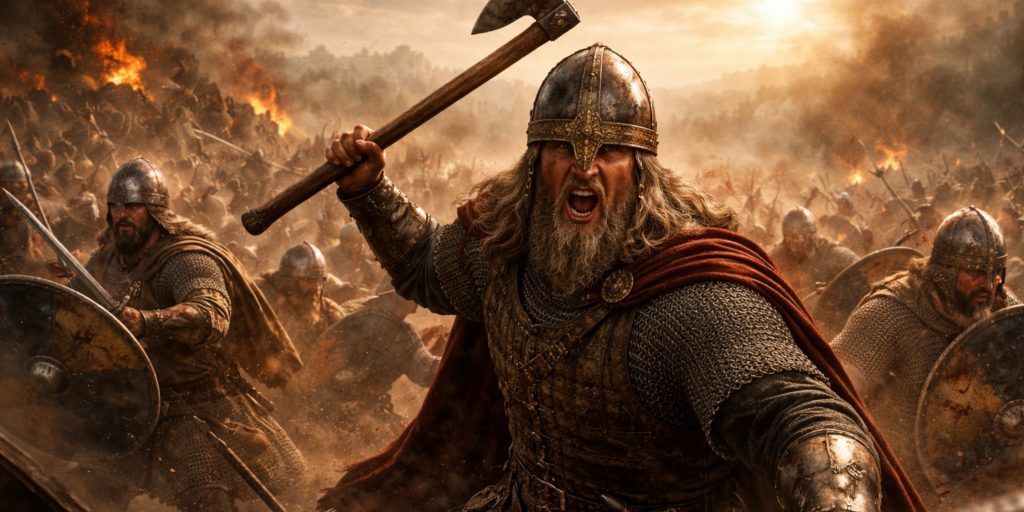
The Viking Age in England effectively ended in 1066. Harald Hardrada of Norway invaded and was defeated at Stamford Bridge by King Harold Godwinson.
Only weeks later, Harold himself was defeated by William of Normandy at Hastings. The Norman Conquest followed, and England entered a new age.
Yet even the Normans carried Viking blood. The dukes of Normandy descended from Norse settlers in France. In a sense, the Viking story never truly ended. It simply changed costume.
The Viking Legacy in Modern England
The Vikings left their mark everywhere.
They shaped the English language. They influenced the law. They helped create towns and trade routes. They forced the kingdoms of England to unite. They left place names, family names and countless buried treasures.
Most importantly, they helped create the England we know today.
When people imagine the Vikings, they often think only of longships and axes. Those things mattered, certainly. They also tended to arrive with alarming speed and ruin the local monastery.
But the deeper Viking legacy was political and cultural. The Vikings did not merely attack England. They helped remake it.
And England, characteristically, spent the next thousand years arguing about exactly how much of that was a good idea.