Before the Last Viking King, There Was a Mercenary Legend
Before Harald Hardrada became King of Norway and launched the famous invasion of England in 1066, he lived through a chapter that feels almost too dramatic for history.
A teenage exile from Scandinavia travelled thousands of miles, fought across the Mediterranean, became an elite warrior of the Byzantine Empire, gained enormous wealth and somehow annoyed enough powerful people along the way to end up imprisoned.
Very Harald.
The version of Harald Sigurdsson shown in Vikings: Valhalla captures the ambition, confidence and warrior image that made him such a fascinating historical figure. The series takes creative liberties with timing and events, but the idea of Harald as a charismatic fighter chasing greatness is rooted in reality. His Varangian Guard years were a major reason he became known as Hardrada, meaning “hard ruler” or “stern counsel”.
Who Was Harald Hardrada?
Harald Sigurdsson was born around 1015 into the Norwegian royal family. His early life was shaped by violence and political collapse.
At only around 15 years old, he fought beside his half-brother King Olaf II of Norway at the Battle of Stiklestad in 1030. Olaf was killed, his forces were defeated and Harald was forced into exile.
Instead of disappearing into history like many defeated young nobles, Harald did something much more Viking. He left Scandinavia, gathered experience abroad and rebuilt himself into one of the most formidable warriors of the medieval world.
His journey took him through:
- Kievan Rus
- The Byzantine Empire
- The Mediterranean
- Sicily
- The Balkans
- The Holy Land
By the time he returned north, Harald was no longer just a prince. He was a battle-tested commander with international experience few European rulers could match.
What Was the Varangian Guard?
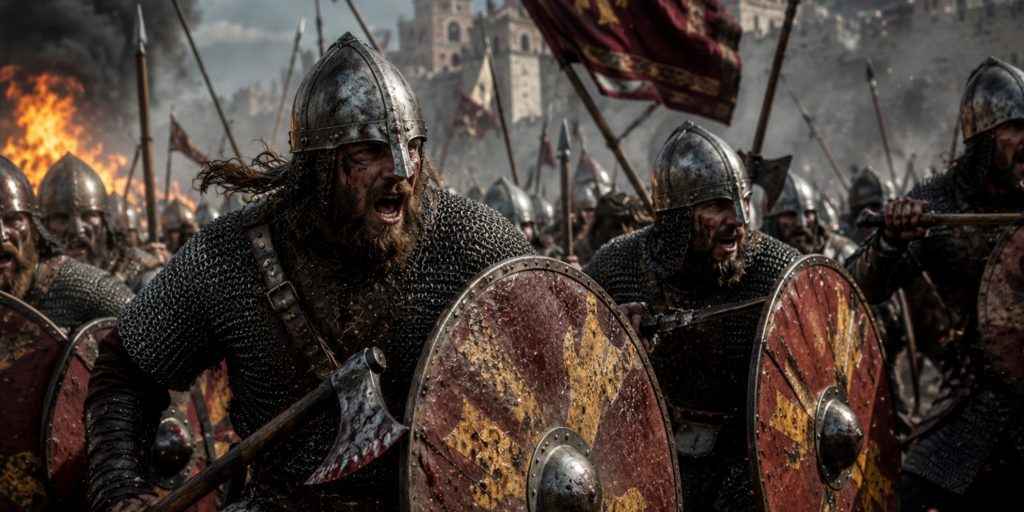
The Varangian Guard was an elite military unit serving the Byzantine emperors in Constantinople. Formed in the late 10th century, it became famous for recruiting warriors from Scandinavia, Rus territories and later Anglo-Saxon England.
Think of them as the emperor’s personal shock troops and bodyguards. Subtle? Absolutely not.
They were known for:
- Extreme loyalty to the emperor
- Heavy armour and aggressive battlefield tactics
- Fearsome use of large axes
- Fighting in some of the empire’s most dangerous campaigns
The Byzantines valued foreign warriors because they were less involved in local politics and palace rivalries. In a city where emperors sometimes had surprisingly short career spans, having a group of heavily armed outsiders watching your back was quite useful.
Harald Joins the Varangian Guard
Harald arrived in Byzantine service around 1034 after spending time with the forces of Yaroslav the Wise in Kievan Rus.
The Byzantine Empire was still one of the richest and most sophisticated powers in the world. Constantinople must have been a staggering sight for a young Scandinavian warrior.
Compared with northern Europe, the city offered:
- Enormous wealth
- Advanced military organisation
- Complex politics
- Access to campaigns across several continents
Harald joined the Varangian Guard and quickly gained a reputation for bravery and leadership. Later Norse sagas describe him rising to a commanding position, although medieval sources sometimes exaggerate ranks and achievements.
The safe conclusion is that Harald became an important and respected figure within Byzantine military service.
Harald’s Campaigns for Byzantium
During his years with the Varangian Guard, Harald fought in several major theatres.
Sicily Campaigns
One of Harald’s most famous campaigns was in Sicily, where Byzantine forces attempted to regain territory from Muslim rulers.
Fighting alongside the general George Maniakes, Harald experienced a completely different style of warfare from Scandinavia.
The campaign involved:
- Siege warfare
- Naval operations
- Fortified cities
- Professional armies from multiple cultures
This was not the smaller-scale raiding warfare associated with Viking expeditions. It was imperial warfare, and Harald absorbed those lessons.
Battles in Bulgaria and the Balkans
Harald also fought in campaigns in the Balkans, where Byzantine forces faced internal revolts and regional threats.
Later traditions gave him the nickname “the burner of Bulgarians”, although details around this title are debated.
What matters historically is that Harald spent years learning how a massive empire managed armies, logistics and strategy.
That experience shaped the king he later became.
Did Harald Visit Jerusalem?
Some accounts claim Harald travelled to the Holy Land while serving Byzantium.
The exact details are uncertain, but Byzantine forces were active in protecting Christian interests and routes in the region during this period.
The image of Harald travelling from Norway to Constantinople and possibly Jerusalem shows just how connected the medieval world actually was. Vikings were not only raiders arriving on longships. Some became merchants, diplomats and professional soldiers operating thousands of miles from home.
Weapons and Armour of Harald’s Varangian Guard
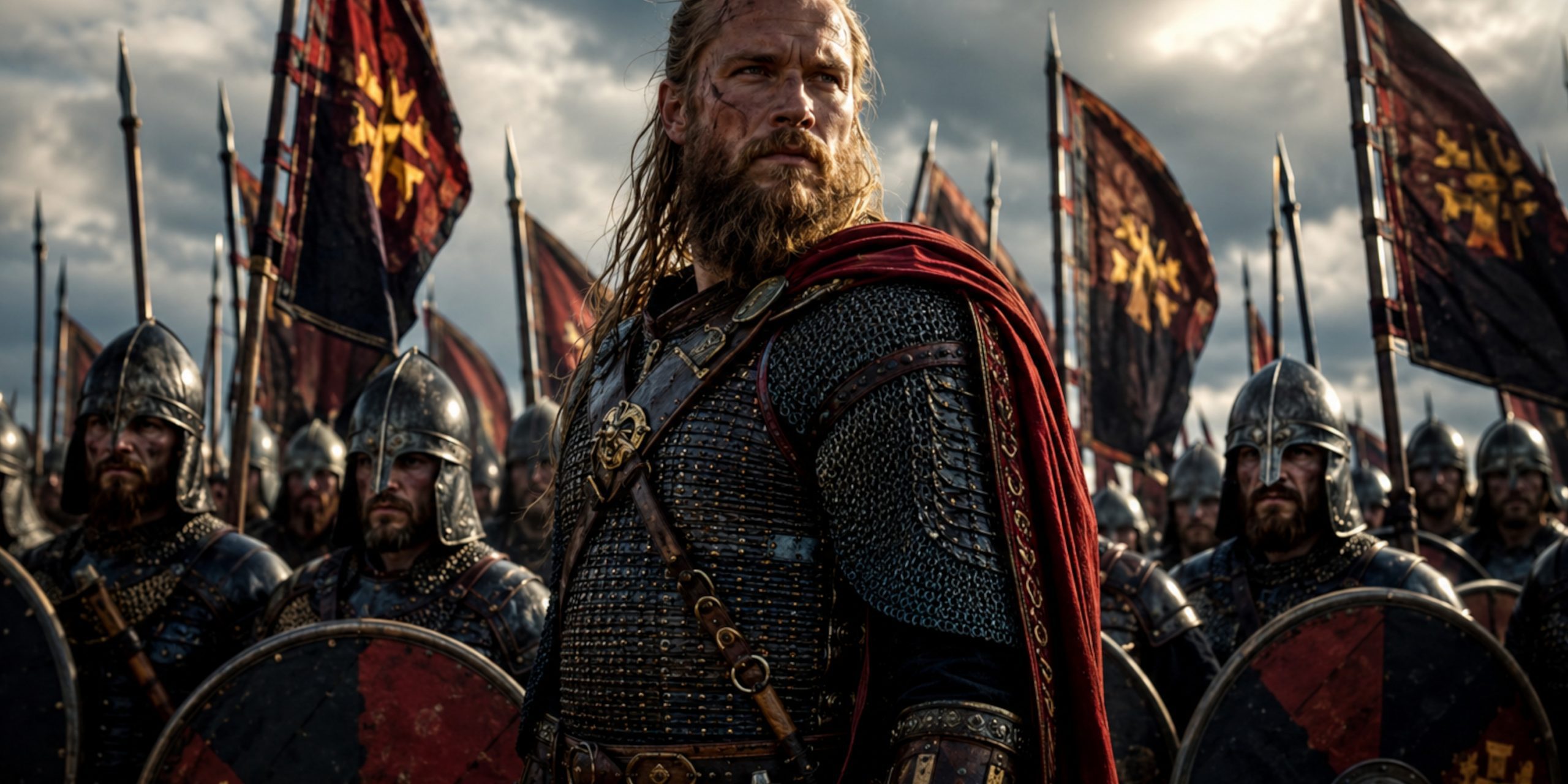
The Varangian Guard looked very different from the stereotypical lightly equipped Viking raider.
A warrior like Harald may have used:
Weapons
- Dane axe: The famous two-handed weapon strongly associated with Varangian troops
- Viking sword: Double-edged blades remained symbols of elite status
- Spear: A practical battlefield weapon across medieval Europe
- Seax: A shorter blade used throughout Germanic regions
Armour
- Mail hauberk protecting the body
- Conical helmet, sometimes with nasal protection
- Round shields influenced by Scandinavian traditions
- Byzantine equipment adopted through service
The Varangians combined northern aggression with Byzantine military discipline. A terrifying combination really. Nobody wants a Viking who has discovered organisation.
How Accurate Is Harald in Vikings: Valhalla?
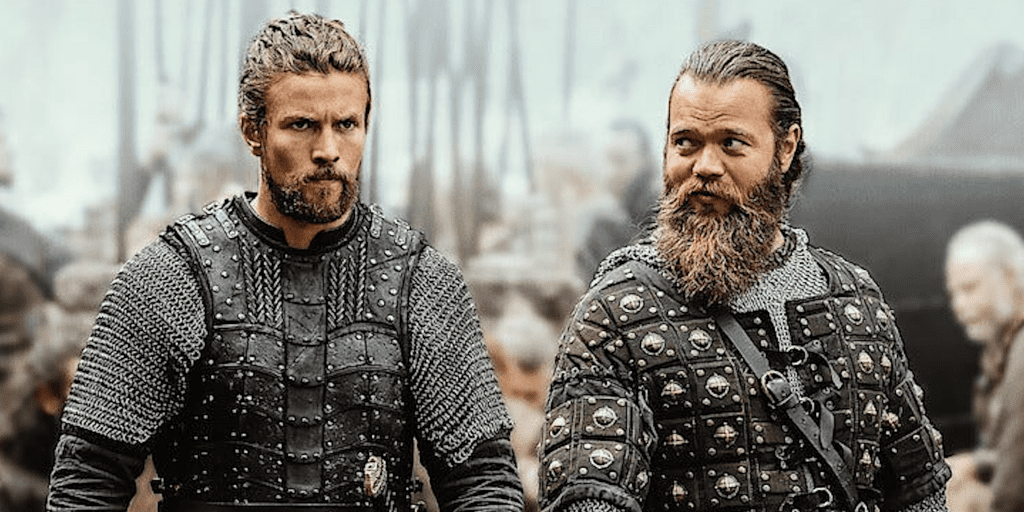
The Harald Sigurdsson portrayed in Vikings: Valhalla is inspired by the historical figure but adapted heavily for drama.
The show captures several real elements:
- His royal ambitions
- His skill as a warrior
- His confidence and personal charisma
- His connection with wider European politics
However, the timeline is compressed and many relationships and events are fictionalised.
The real Harald’s life arguably needed less exaggeration. A Norwegian exile becoming a commander in the emperor’s guard, fighting from Sicily to the Middle East, becoming incredibly rich and returning to claim a throne already sounds like someone pitched a historical drama after drinking too much coffee.
Leaving Byzantium: Wealth, Trouble and Escape
Harald’s departure from Byzantine service was complicated.
According to later sources, he accumulated huge wealth during his campaigns but became involved in political conflict at court. Some traditions claim he was imprisoned before escaping Constantinople.
The details are debated, but Harald eventually returned north with enormous resources.
That wealth helped him pursue power in Scandinavia.
From Varangian Warrior to King of Norway
In 1046, Harald returned and became co-ruler of Norway with Magnus the Good. After Magnus died in 1047, Harald became sole king.
His reign reflected his earlier experiences:
- Strong central authority
- Military organisation
- Ambitious foreign policy
- Ruthless political instincts
The young exile who had served emperors was now ruling his own kingdom.
The Final Campaign: England 1066
Harald’s life ended during one of history’s most famous years.
In 1066, he invaded England, claiming the throne after the death of Edward the Confessor.
After early success, Harald was defeated and killed by Harold Godwinson at the Battle of Stamford Bridge.
His death is often described as the symbolic end of the Viking Age.
A warrior who began as a teenage survivor, fought for Byzantium and became king died exactly as his reputation suggested: leading from the front.
Legacy of Harald’s Varangian Years
Harald Hardrada’s time in the Varangian Guard was not just an interesting side adventure before he became king. It was the foundation of everything that followed.
He learned from one of the world’s greatest empires, fought across different continents and returned with the wealth and reputation needed to challenge for power.
Vikings: Valhalla introduces modern audiences to Harald the ambitious warrior, but the historical figure behind the character was arguably even more remarkable.
Few medieval rulers could claim a career path that went from teenage exile, to Byzantine elite guard, to king, to one of the last great Viking invaders.
Harald Hardrada did.
And somehow, that still sounds like the shortened version.