There is something deeply chaotic about the world of Outlander. One minute Claire is applying sensible twentieth-century medical logic, the next she is being accused of witchcraft because she cleaned a wound too efficiently. Frankly, eighteenth-century Scotland was not a relaxing place.
What makes Outlander stand out from a lot of historical dramas is how seriously it treats belief. Religion is not just background decoration for a moody castle scene. Folklore is not tossed in purely for atmosphere. Characters genuinely live by these ideas. Saints, omens, curses, second sight, ghosts, prophecies, and whispered stories shape decisions just as much as politics or war.
The result feels oddly believable. Even when the series drifts into full mystical chaos, there is usually a historical thread underneath it.
The Highlands as a World of Belief
Scotland in Outlander feels spiritually crowded. Every glen, stone circle, loch, and ruined hill seems to carry a story. That is very close to how Highland folklore actually functioned for centuries.
The Jacobite-era Highlands blended several traditions together:
- Catholic belief
- Presbyterian influence
- Gaelic folklore
- Older Celtic traditions
- Local superstitions passed through families
People did not necessarily separate religion from superstition. A prayer to a saint and a fear of fairies could exist side by side without contradiction.
That tension runs throughout the series. Claire arrives from a modern world built around evidence and rational thinking. The Highlanders around her live in a culture where invisible forces are treated as part of everyday reality.
At first she sees this as ignorance. Eventually she realises belief itself has power, even when she cannot explain it.
Craigh na Dun and the Power of Standing Stones
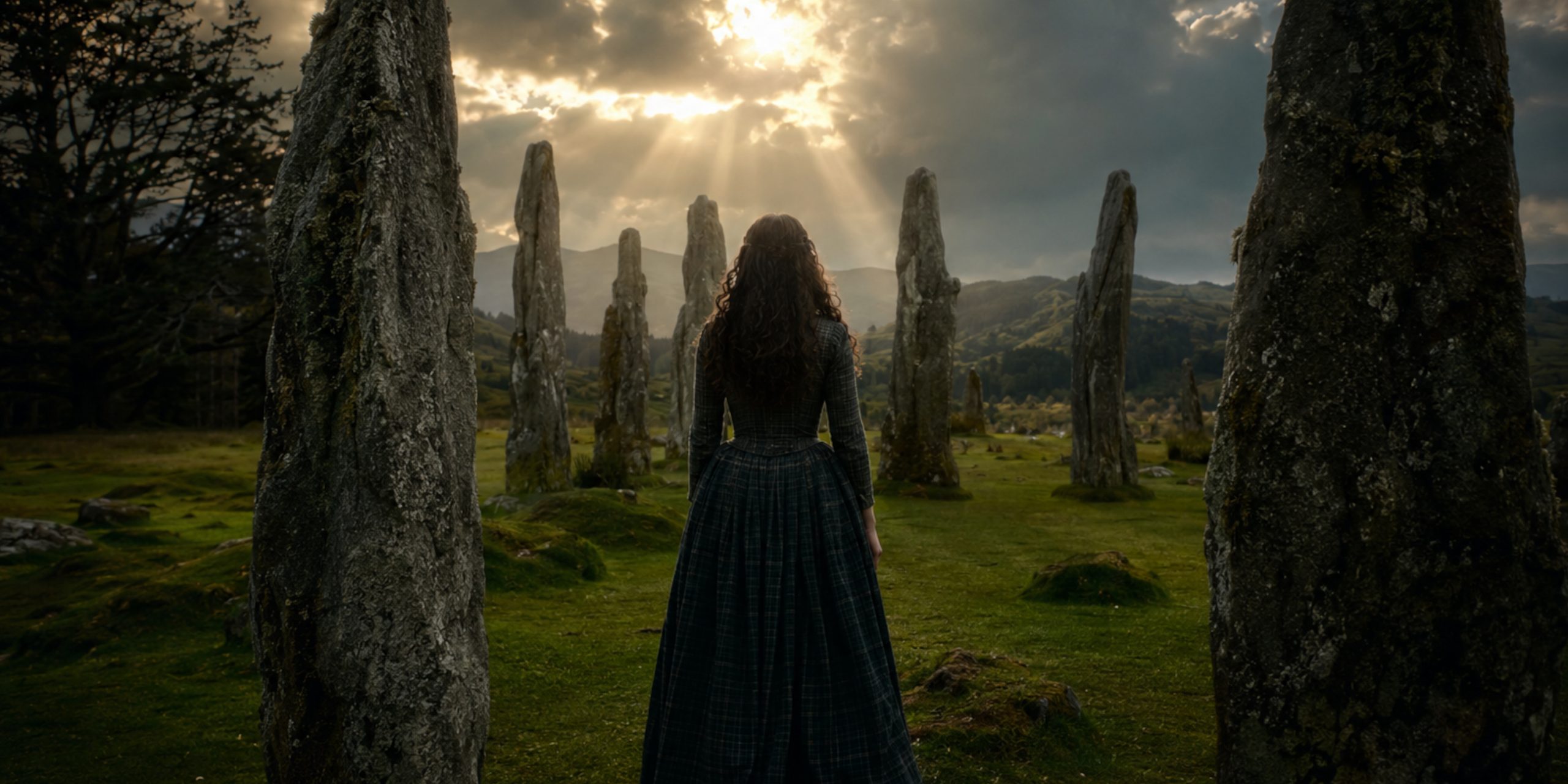
The standing stones are the spiritual centre of Outlander. They are mysterious, ancient, and slightly threatening in the way only giant prehistoric rocks can be.
Craigh na Dun is fictional, but it draws heavily from real Scottish stone circles like the Callanish Stones and the Ring of Brodgar.
In Celtic folklore, standing stones were often linked to:
- Ancient rituals
- Burial traditions
- Spirits
- Seasonal ceremonies
- Doorways between worlds
Outlander leans fully into that mythology. The stones are not explained scientifically because the story works better when they remain half-understood. Even characters who believe in them rarely claim to fully grasp how they work.
There is something quite funny about the fact that the most dangerous object in the series is essentially a haunted rock formation.
Catholicism and the Weight of Sin
Religion in Outlander is rarely gentle.
Catholicism shapes much of Jamie Fraser’s worldview, especially early on. Concepts like guilt, honour, confession, and redemption influence nearly every major decision he makes. Jamie often measures himself against impossible moral standards, which is admirable but also occasionally exhausting.
Claire approaches faith differently. She is sceptical, practical, and less interested in strict doctrine. Yet she gradually develops respect for spiritual traditions, even if she refuses to blindly accept them.
The series does a good job showing how religion could both comfort and control people in the eighteenth century.
Priests, ministers, and church authority figures carry enormous influence. Accusations of sin or witchcraft are dangerous because communities genuinely fear divine punishment. Public morality was not just social pressure. People believed eternal consequences were involved.
That makes scenes like Claire’s witch trial especially unsettling because nobody thinks they are being irrational.
Well, apart from Claire, who understandably looks ready to throw herself into the nearest river.
Witchcraft and Female Fear
One of the strongest themes in Outlander is how quickly intelligent women become targets.
Claire’s medical knowledge repeatedly places her under suspicion. Herbal remedies, surgery, and anatomy are seen by many as unnatural or dangerous. To modern viewers this seems absurd, but historically it happened constantly.
Across Scotland and Europe, women associated with healing were often viewed with suspicion, especially during periods of social instability.
The witch trial storyline pulls heavily from real historical fears:
- Women with medical knowledge
- Midwives
- Herbal healers
- Social outsiders
- Widows or unmarried women
Geillis Duncan embodies this tension perfectly. She openly embraces mysticism and manipulation, making her both fascinating and terrifying. Unlike Claire, Geillis actively weaponises superstition.
Honestly, Geillis often feels like the only person in the room fully enjoying the madness.
The Role of Second Sight
Second sight appears throughout Highland folklore and plays a huge role in Outlander.
Traditionally, second sight referred to prophetic visions or supernatural awareness. In Gaelic culture, some individuals were believed capable of seeing future events, deaths, or spiritual presences.
Characters such as Mrs Fitz and the seer Maisri treat visions as entirely normal parts of life.
Even Jamie experiences moments that suggest spiritual connection beyond ordinary explanation. Dreams, intuition, and visions blur the line between coincidence and destiny throughout the series.
Outlander wisely avoids overexplaining these moments. The ambiguity keeps them powerful.
The show constantly asks:
- Are these genuine supernatural events?
- Are they intuition shaped by belief?
- Or are people simply finding meaning in chaos?
The answer changes depending on the character.
Folk Remedies, Charms, and Everyday Superstition
One detail Outlander gets very right is how ordinary superstition feels.
People carry charms. They avoid certain places. They interpret dreams. They fear curses. They recite prayers before journeys. These habits are woven into daily life rather than treated as dramatic fantasy elements.
Common Highland beliefs included:
| Belief | Purpose |
|---|---|
| Rowan wood charms | Protection from evil |
| Iron objects | Warding off spirits or fairies |
| Protective prayers | Safety during travel or childbirth |
| Omens from animals | Predicting death or danger |
| Seasonal rituals | Ensuring good harvests or health |
Claire often dismisses these traditions initially, yet she slowly adapts to them because she understands their emotional importance.
Sometimes the remedy mattered less than the comfort it provided.
And honestly, modern people are not quite as rational as we pretend either. We just replaced charms with phone batteries at 2 percent and blind optimism.
Folk Music, Storytelling, and Oral Tradition
Folklore in Outlander is also preserved through songs and stories.
Ballads, oral histories, and legends shape Highland identity throughout the series. This is historically accurate because Gaelic culture relied heavily on oral tradition before widespread literacy.
Stories carried:
- Clan history
- Moral lessons
- Political loyalties
- Warnings
- Mythological memory
Music in particular becomes almost spiritual in Outlander. Songs connect characters to grief, homeland, and identity in ways that dialogue often cannot.
This gives the series emotional depth beyond romance and warfare. The past feels alive because people constantly retell it.
Protestantism, Conflict, and Social Division
Faith in Outlander is not unified. Religion often divides communities as much as it comforts them.
The tensions between Catholic Highlanders and Protestant authorities reflect genuine historical conflict in Britain after the Jacobite uprisings.
Religious identity was political identity.
A person’s church affiliation could affect:
- Loyalty to the Crown
- Clan alliances
- Social trust
- Marriage prospects
- Legal treatment
Outlander uses these divisions carefully, especially during the build-up to Culloden. Religion becomes another layer in a world already full of suspicion and violence.
Why the Supernatural Works in Outlander
What keeps Outlander interesting is that it never fully commits to pure fantasy.
The supernatural remains emotional rather than mechanical. There are no neat rulebooks explaining every mystical event. Characters experience visions, prophecies, and strange encounters the way real people often process unexplained experiences, through fear, memory, hope, and belief.
That uncertainty is the point.
Faith and folklore in Outlander are not there to prove magic exists. They reveal how people survive uncertainty in brutal times.
Whether someone trusted God, the stones, second sight, or an old charm hanging by a doorway, belief gave meaning to suffering and chaos.
And in fairness, eighteenth-century Scotland probably required a very strong belief system just to cope with the weather alone.
Takeaway
Outlander succeeds because it treats belief seriously without becoming preachy or ridiculous. Faith, folklore, and superstition are woven naturally into the fabric of Highland life, shaping everything from politics to personal relationships.
The series understands that history was not populated by modern cynics with smartphones and irony poisoning. People genuinely believed the world was filled with signs, spirits, blessings, and dangers beyond explanation.
That worldview makes Outlander feel immersive in a way many historical dramas struggle to achieve.
Also, it gives us haunted stones, prophetic dreams, terrifying old women who definitely know more than they admit, and at least three moments per season where Claire looks completely done with the eighteenth century.
Which, honestly, is fair.