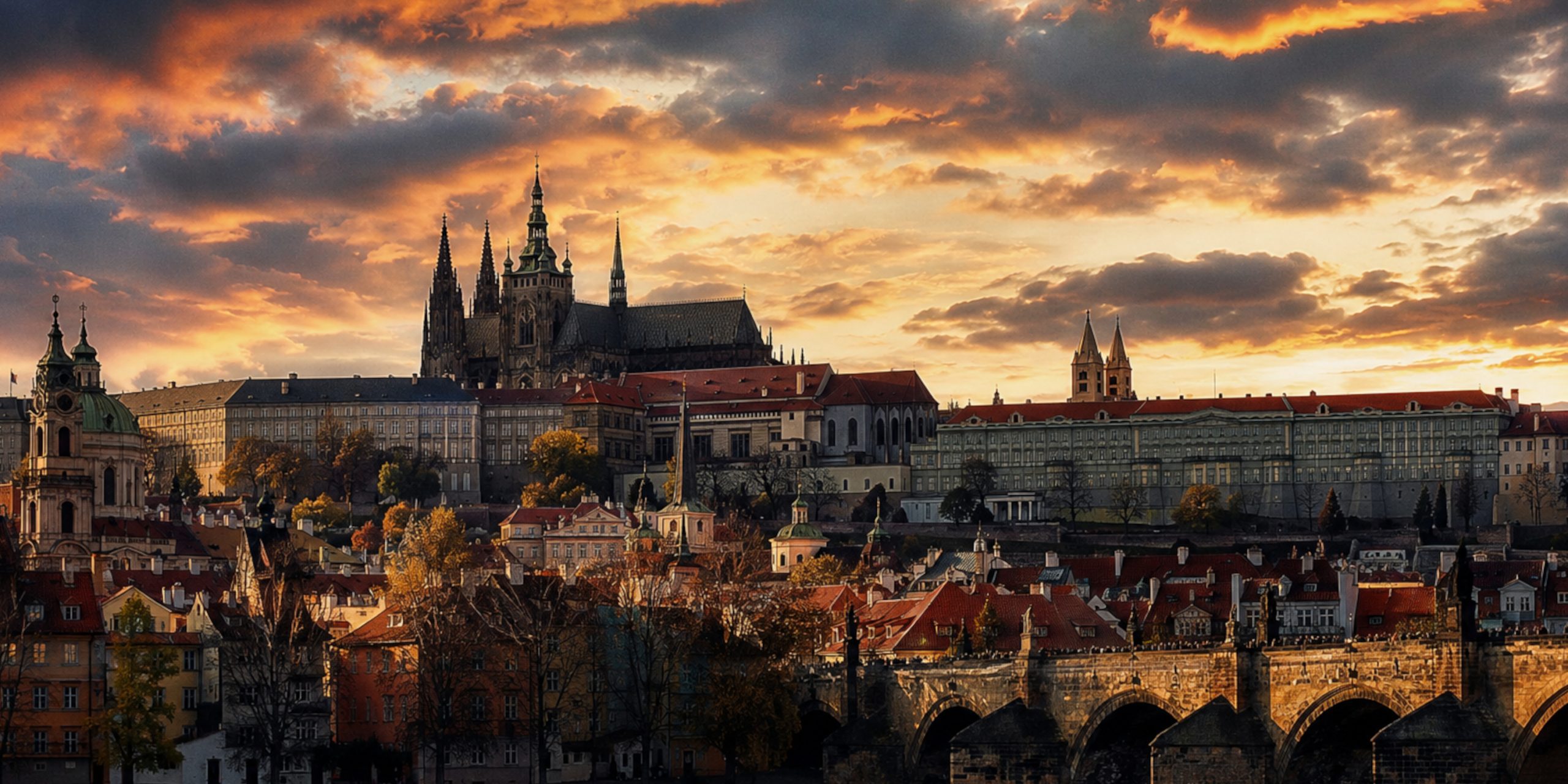
Few castles in Europe feel quite as alive as Prague Castle. Some fortresses are beautiful ruins. Others are museums with gift shops and carefully polished suits of armour that look faintly embarrassed to be indoors. Prague Castle is different. It still dominates politics, identity, religion, and the skyline itself.
It sits above the city like it knows perfectly well that emperors, kings, invaders, reformers, and tourists have all eventually had to pass beneath it.
And frankly, it has earned the attitude.
Part palace, part cathedral complex, part military fortress, Prague Castle has evolved continuously for over a thousand years. According to the Guinness World Records, it is considered the largest ancient castle complex in the world, stretching across roughly 70,000 square metres. That is less a castle and more a small fortified civilisation.
The Origins of Prague Castle
Prague Castle was founded around 880 by Prince Bořivoj of the Přemyslid dynasty, the first historically documented ruler of Bohemia to convert to Christianity.
At the time, the site was a strategic hilltop overlooking the Vltava River. Long before the Gothic towers and Renaissance palaces arrived, this was essentially a heavily defended political stronghold built from timber fortifications and earthworks.
The earliest known church within the complex was the Church of the Virgin Mary. Over time, additional basilicas, residences, defensive walls, and royal buildings transformed the hill into the political centre of Bohemia.
The castle became inseparable from Czech statehood itself.
Even today, Czech presidents operate from the same hill once occupied by medieval princes who probably settled disputes with significantly more axes.
Prague Castle Under the Holy Roman Emperors
The castle reached new prominence during the reign of Charles IV in the 14th century.
Charles IV transformed Prague into one of Europe’s great capitals. Under his rule:
- Prague became the capital of the Holy Roman Empire
- Massive Gothic rebuilding projects began
- St. Vitus Cathedral was expanded
- New defensive works strengthened the complex
- Royal palaces became more elaborate and ceremonial
Charles IV viewed Prague not as a provincial capital, but as the beating heart of Christian Europe.
The cathedral itself became a statement of power. Its towering Gothic architecture was designed to compete with the great cathedrals of France and Germany.
Construction would continue for centuries. Medieval builders had a wonderfully optimistic relationship with deadlines.
St. Vitus Cathedral
At the centre of the castle stands St. Vitus Cathedral, one of the most important Gothic structures in Europe.
It houses:
- The tomb of Charles IV
- The Bohemian Crown Jewels
- Tombs of saints and kings
- Intricate stained glass windows
- Gothic vaulting and flying buttresses
- The Chapel of St. Wenceslas
The cathedral was begun in 1344 and not fully completed until 1929.
That is nearly six centuries of construction. One suspects several generations of stonemasons quietly stopped asking when the project would finally be finished.
The Defenestration of Prague and Religious Conflict
Prague Castle stood at the centre of one of Europe’s most explosive religious crises.
In 1618, Protestant nobles stormed the castle during what became known as the Defenestration of Prague.
Imperial officials were thrown from a castle window.
Remarkably, they survived the fall.
Catholic accounts claimed angels intervened. Protestant accounts suggested they landed in a pile of manure. Historians wisely note that both explanations reveal a great deal about the period.
The event triggered the Thirty Years’ War, one of the deadliest conflicts in European history.
Prague Castle instantly became more than a royal residence. It became a symbol of confessional warfare across the continent.
Major Sieges and Attacks
The Swedish Siege of 1648
One of the most dramatic assaults came near the end of the Thirty Years’ War.
Swedish forces attacked Prague in 1648 and captured parts of the city, including sections of the Lesser Town and Castle District.
The defenders managed to hold crucial portions of Prague Castle itself, though many treasures and artworks were looted by the Swedes and transported north.
Some of those objects remain in Swedish collections today.
For Czech chroniclers, the defence became a symbol of endurance during national catastrophe.
The Hussite Wars
During the 15th century, Prague became deeply entangled in the Hussite religious wars following the execution of reformer Jan Hus.
The castle changed hands several times amid the instability. Fortifications were strengthened, while political factions battled for control over Bohemia’s future.
The period permanently altered Czech religious identity and left scars across the kingdom.
Prussian Occupation
During the 18th century wars between Austria and Prussia, Prague suffered bombardment and military occupation.
The castle complex endured artillery fire and troop presence during the War of the Austrian Succession and the Seven Years’ War.
By this stage, warfare had evolved dramatically. Medieval walls that once terrified raiders now faced organised cannon batteries and professional armies.
Stone towers tend to lose arguments with artillery eventually.
Occupants Timeline
9th Century
- Founded by Prince Bořivoj
- Early Přemyslid rulers occupy the site
10th to 13th Centuries
- Expansion under Bohemian dukes and kings
- Romanesque churches and fortifications added
14th Century
- Charles IV transforms Prague into an imperial capital
- Major Gothic reconstruction begins
15th Century
- Hussite conflicts destabilise royal authority
- Fortifications reinforced
16th Century
- Habsburg rulers expand Renaissance sections
- Emperor Rudolf II turns Prague into a centre of alchemy, science, and art
17th Century
- Thirty Years’ War devastates the region
- Swedish attacks damage and loot parts of Prague
18th Century
- Baroque modifications reshape sections of the complex
- Military occupations occur during continental wars
19th Century
- National revival movements restore Czech historical identity
- Neo-Gothic restoration efforts intensify
20th Century to Present
- Seat of Czechoslovak and later Czech presidents
- Major restoration and conservation work continues
Rudolf II and the Strange Golden Age
Few occupants shaped Prague Castle quite like Rudolf II, Holy Roman Emperor.
Rudolf moved the imperial court to Prague in the late 16th century and filled the castle with:
- Astronomers
- Alchemists
- Artists
- Occult scholars
- Collectors of rare curiosities
This was the Prague of Tycho Brahe and Johannes Kepler.
The emperor developed enormous collections of exotic objects, scientific instruments, paintings, weapons, and manuscripts. The castle became one of Europe’s great intellectual centres, though also one of its more eccentric royal courts.
Rudolf himself descended into increasing paranoia and instability, which admittedly was not uncommon among Habsburg rulers.
Still, his reign left Prague culturally transformed.
Archaeology at Prague Castle
Archaeological excavations beneath Prague Castle have revealed layers of occupation stretching back well before the medieval period.
Finds include:
- Early Slavic settlements
- Defensive earthworks
- Romanesque foundations
- Medieval roads
- Burial sites
- Ceramics and weapon fragments
- Early Christian structures
Excavations in the 20th century uncovered remnants of the earliest stone buildings from the 9th and 10th centuries.
Archaeologists have also studied the evolution of the castle’s fortifications, revealing how the complex adapted to changing military technology over centuries.
One of the more fascinating aspects is how little of the original early medieval castle remains visible above ground. Prague Castle is essentially a giant architectural layer cake built by rulers who rarely agreed with their predecessors.
Arms, Armour, and the Castle Armouries
As the seat of Bohemian kings and Holy Roman Emperors, Prague Castle housed substantial armouries.
Weapons associated with the castle across different periods included:
- Arming swords
- Longswords
- Falchions
- Poleaxes
- Crossbows
- Wheel-lock pistols
- Early arquebuses
- Ceremonial parade armour
The Habsburg period saw increasing adoption of gunpowder weapons and elaborate court armour designed as much for prestige as battle.
Several surviving collections connected to Prague Castle can still be viewed in Czech museums today.
Contemporary Quotes
The chronicler Cosmas of Prague described the city and its rulers with deep admiration during the medieval period, portraying Prague as a growing centre of Christian authority.
Charles IV reportedly declared:
“Prague is the head of the kingdom.”
Meanwhile, visitors to Rudolf II’s court often wrote with astonishment about the emperor’s collections and experiments.
English traveller Fynes Moryson described Prague in the early 17th century as:
“One of the fairest cities of Germany.”
Though Czechs today might gently remind him that Bohemia was not Germany.
Architecture and Layout
Prague Castle is not a single building. It is a sprawling collection of:
- Palaces
- Churches
- Courtyards
- Towers
- Defensive walls
- Gardens
- Administrative buildings
Architectural styles include:
| Style | Examples |
|---|---|
| Romanesque | Early basilicas and foundations |
| Gothic | St. Vitus Cathedral |
| Renaissance | Royal palace additions |
| Baroque | Later facades and chapels |
| Neo-Gothic | 19th century restorations |
The result is visually chaotic in the best possible way. Walking through the complex feels like travelling through several centuries simultaneously.
Prague Castle During the Modern Era
During the Nazi occupation of Czechoslovakia, Prague Castle became the seat of Reich Protector Reinhard Heydrich, one of the most feared figures in the Third Reich.
After the Second World War, the castle resumed its role as the political centre of the state.
Under communist rule, restoration and preservation efforts continued, though often filtered through ideological priorities.
Today, the castle serves as the official residence of the President of the Czech Republic.
Despite centuries of invasion, revolution, empire, occupation, and political collapse, Prague Castle remains active rather than frozen in time.
That continuity is part of what makes it extraordinary.
Visiting Prague Castle Today
Modern visitors can explore:
- St. Vitus Cathedral
- Old Royal Palace
- Golden Lane
- St. George’s Basilica
- The castle gardens
- Observation towers
- Historic halls and exhibitions
The complex attracts millions of visitors annually and remains one of Europe’s defining historic landmarks.
The changing of the guard ceremony draws large crowds daily, though one occasionally suspects the guards deserve hazard pay for enduring endless camera lenses at point-blank range.
Legacy
Prague Castle represents more than Czech history.
It reflects the rise of medieval kingdoms, the authority of emperors, the violence of religious conflict, the transformation of warfare, the ambitions of the Habsburgs, and the survival of national identity through occupation and upheaval.
Many castles become monuments to vanished worlds.
Prague Castle never entirely stopped being relevant.
That may be the most remarkable thing about it.