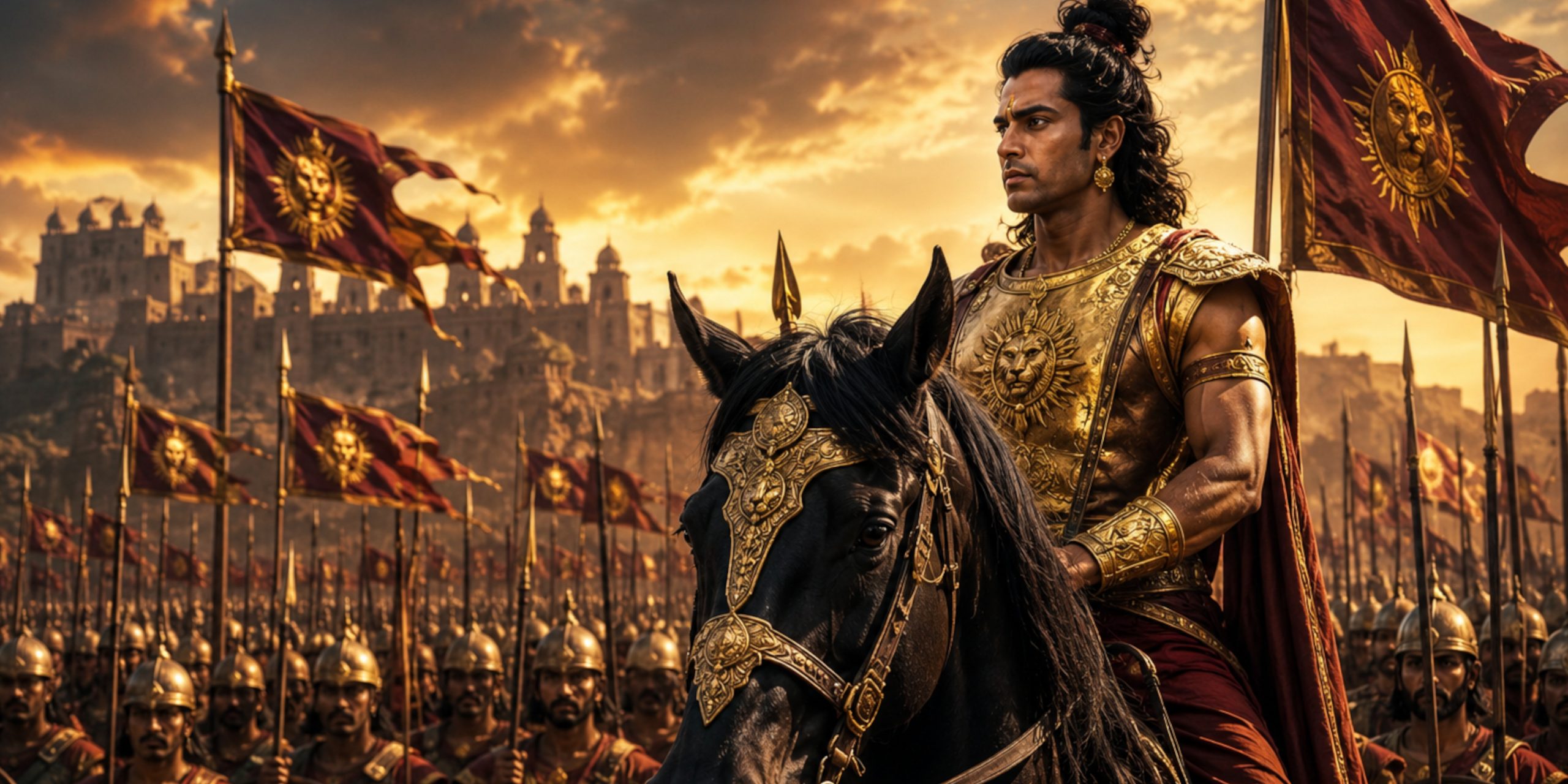
Few figures in ancient history transformed a region as completely as Chandragupta Maurya. Emerging from relative obscurity during the fourth century BCE, he overthrew powerful rulers, challenged the successors of Alexander the Great, and established what became the largest empire India had yet seen.
As a historian, I find Chandragupta particularly fascinating because he sits at the intersection of history and legend. Ancient Indian traditions portray him as a destined ruler guided by a brilliant strategist. Greek writers viewed him as a formidable monarch who rose from humble beginnings. Somewhere between these accounts stands a remarkable military leader whose achievements altered the course of South Asian history.
His empire laid the foundations for one of the most influential dynasties in world history, eventually producing his grandson Ashoka, whose name remains recognised across the globe. Yet none of that would have been possible without Chandragupta’s relentless ambition and military skill.
Who Was Chandragupta Maurya?
Chandragupta Maurya was the founder of the Mauryan Empire, ruling from approximately 321 BC until around 297 BC.
He emerged during a period of political fragmentation following Alexander the Great’s invasion of north-western India. The dominant power in northern India at the time was the Nanda Dynasty, centred on the wealthy city of Pataliputra.
According to Indian traditions, Chandragupta was mentored by Chanakya, also known as Kautilya, a scholar and political strategist. Together they organised resistance against the Nandas and ultimately seized power.
Once established on the throne, Chandragupta expanded rapidly across northern India, creating an empire stretching from Afghanistan to Bengal and deep into central India.
Quick Facts
| Detail | Information |
|---|---|
| Born | c. 340 BC |
| Died | c. 297 BC |
| Dynasty | Maurya |
| Capital | Pataliputra |
| Reign | c. 321-297 BC |
| Successor | Bindusara |
| Famous For | Founding the Mauryan Empire |
The Rise of a Conqueror
The origins of Chandragupta remain debated.
Some traditions claim noble ancestry. Others suggest he came from a relatively modest background. Ancient sources often disagree, which is hardly unusual when discussing founders of empires. Successful rulers have a habit of acquiring increasingly impressive origin stories after their victories.
What seems clear is that Chandragupta developed an alliance with Chanakya. Together they built a political and military movement capable of challenging the Nandas.
After years of conflict, they captured Pataliputra and dismantled the Nanda state.
This victory provided Chandragupta with access to enormous resources, including wealth, manpower, and strategic control of the fertile Gangetic Plain.
The Mauryan Empire
Following his victory, Chandragupta embarked on an ambitious programme of expansion.
The Mauryan Empire became one of the largest states of the ancient world.
At its height under Chandragupta, the empire included:
- Most of northern India
- Modern Pakistan
- Parts of Afghanistan
- The Indus Valley
- The Gangetic Plain
- Extensive territories in central India
Greek ambassador Megasthenes, who later visited Chandragupta’s court, described a highly organised administration and a capital city of impressive scale.
Pataliputra was surrounded by wooden fortifications, defensive towers, gates, and extensive urban infrastructure. Contemporary descriptions suggest a city comparable to the great capitals of the Hellenistic world.
Battles and Military Acumen
Chandragupta’s greatest strength was not merely battlefield courage. It was his ability to combine military force with long-term strategic planning.
The Overthrow of the Nanda Dynasty
The campaign against the Nandas was likely a prolonged struggle involving alliances, recruitment, and gradual territorial gains.
Rather than relying upon a single decisive battle, Chandragupta appears to have weakened his enemies through persistent military pressure and political manoeuvring.
The eventual capture of Pataliputra transformed him from rebel leader into emperor.
Campaigns Against the Macedonian Successor States
Following Alexander’s death in 323 BC, his empire fragmented.
Several Greek and Macedonian governors controlled territories in modern Afghanistan and Pakistan.
Chandragupta exploited this instability, conquering many of these regions and incorporating them into his growing empire.
War with Seleucus I Nicator
Perhaps Chandragupta’s most famous military achievement came during his conflict with Seleucus I Nicator, one of Alexander’s most successful successors.
Around 305 BC, Seleucus launched a campaign into the eastern territories.
The result was not a crushing victory for either side but a diplomatic settlement that strongly favoured Chandragupta.
Seleucus ceded large territories in exchange for peace and reportedly received 500 war elephants.
These elephants later played a crucial role in Seleucus’ western campaigns.
Why He Was Such an Effective Commander
Several factors explain Chandragupta’s success:
- Exceptional strategic patience
- Ability to exploit political instability
- Effective use of alliances
- Large and disciplined armies
- Strong logistical organisation
- Integration of conquered territories
- Flexible diplomacy when advantageous
Many conquerors win battles. Far fewer create stable empires. Chandragupta achieved both.
Arms and Armour of Chandragupta’s Army
The Mauryan military was among the largest standing forces of the ancient world.
Ancient sources provide varying figures, though some claim hundreds of thousands of troops served under Mauryan authority.
Infantry Weapons
Mauryan infantry likely carried:
- Iron swords
- Spears
- Javelins
- Large bamboo bows
- Arrows tipped with iron points
- Axes and maces
Long bows were particularly respected. Greek observers noted their impressive size and power.
Cavalry Equipment
Mauryan cavalry used:
- Spears
- Swords
- Shields
- Protective horse equipment in some units
The incorporation of north-western territories likely introduced additional cavalry traditions influenced by Central Asian warfare.
War Elephants
The true symbol of Mauryan military power was the war elephant.
These animals:
- Broke enemy formations
- Carried archers and javelin throwers
- Created psychological shock
- Served as mobile command platforms
Their reputation spread throughout the Hellenistic world.
Armour
Evidence suggests a variety of protective equipment:
- Quilted armour
- Leather protection
- Scale armour for elite troops
- Metal helmets
- Large shields made from hide or wood
Elite guards and officers probably possessed superior equipment compared with ordinary soldiers.
Administration and Statecraft
Military conquest alone did not sustain the Mauryan Empire.
Chandragupta established a highly organised government featuring:
- Provincial governors
- Tax administration
- Road networks
- Intelligence gathering
- Military oversight
- Urban management
The administrative ideas associated with Chanakya’s Arthashastra reveal a sophisticated understanding of governance, economics, espionage, and warfare.
Even allowing for later revisions to the text, it offers valuable insight into Mauryan political thinking.
Chandragupta and Jainism
According to Jain tradition, Chandragupta eventually abdicated the throne in favour of his son Bindusara.
He is said to have embraced Jainism and travelled south to Shravanabelagola in present-day Karnataka.
Tradition holds that he spent his final years as an ascetic before undertaking the ritual fast known as sallekhana.
Although aspects of this account remain debated, it forms an important part of his historical legacy.
Artefacts and Objects from His Reign
Direct artefacts specifically linked to Chandragupta are relatively rare.
However, several categories of Mauryan material survive.
Punch-Marked Coins
These silver coins circulated during the Mauryan period and provide insight into imperial administration and commerce.
Northern Black Polished Ware
Highly refined pottery associated with elite urban culture during the Mauryan age.
Fortification Remains
Excavations at Pataliputra have uncovered evidence of monumental wooden structures and defensive works.
Stone Architecture
While much surviving Mauryan stonework belongs to the reign of Ashoka, it emerged from foundations established under Chandragupta and Bindusara.
Where to See Mauryan Artefacts Today
Visitors interested in Chandragupta’s era should consider:
Patna Museum, Bihar
Contains important Mauryan sculptures, archaeological finds, and material from ancient Pataliputra.
Bihar Museum, Patna
One of the finest collections relating to Mauryan history and early Indian civilisation.
Indian Museum, Kolkata
Houses Mauryan sculptures, inscriptions, and archaeological discoveries.
National Museum, New Delhi
Contains major artefacts from the Mauryan period and later developments of the dynasty.
Archaeological Sites
- Kumrahar, Patna
- Pataliputra remains
- Shravanabelagola
- Taxila archaeological complex
These locations provide some of the closest physical connections to Chandragupta’s world.
Latest Archaeology and Research
Archaeological work continues to improve our understanding of the Mauryan period.
Recent research has focused on:
Urban Development at Pataliputra
Excavations and surveys continue to reveal the scale of the ancient capital, including evidence for large administrative complexes and defensive structures.
Mauryan Trade Networks
Studies of artefacts, ceramics, and coins increasingly demonstrate the remarkable economic integration achieved under Mauryan rule.
Environmental Research
Scientists have examined ancient settlement patterns and landscape changes to understand how the empire supported large populations.
New Analysis of Early Texts
Historians continue reassessing Greek, Jain, Buddhist, and Brahmanical sources to separate legend from historical reality.
The picture remains incomplete, but each discovery strengthens the image of a highly organised imperial state.
Legacy
Chandragupta Maurya transformed the political map of South Asia.
He united vast territories, defeated powerful rivals, and created institutions that survived long after his death.
His achievements provided the platform upon which Ashoka would later build one of history’s most influential empires.
As a historian, I am always struck by how often Chandragupta is overshadowed by his grandson. Ashoka left inscriptions across an empire. Chandragupta left the empire itself.
That may be the greater achievement.
Without Chandragupta Maurya, there would have been no Mauryan golden age, no imperial unification of northern India, and no dynasty remembered more than two thousand years later.
Few rulers can claim to have changed history on such a scale.