Prince Karl Philipp von Schwarzenberg remains one of the more curious figures of the Napoleonic Wars. He was not a thunderbolt commander in the mould of Napoleon, nor a charismatic battlefield gambler like Murat. He rarely dominates popular history books, and Hollywood has largely ignored him, which in fairness may be the greatest compliment a historical figure can receive.
Yet Schwarzenberg stood at the centre of one of the most important military coalitions in European history. He commanded the Allied Army of Bohemia during the campaign that finally broke Napoleon’s grip over Central Europe. At Leipzig in 1813, the largest battle in Europe before the First World War, Schwarzenberg presided over the Coalition force that defeated the French Emperor decisively.
He was aristocratic, diplomatic, cautious and often frustrating to more aggressive allies. He also happened to be exactly the kind of commander the Coalition needed. Europe in 1813 did not require another Napoleon. It required someone capable of keeping Russians, Austrians, Prussians and dozens of ambitious generals from strangling one another before the French even arrived.
That alone was an achievement worthy of a field marshal’s baton.
Early Life and Background
Karl Philipp von Schwarzenberg was born on 15 April 1771 into one of the great noble families of the Habsburg Empire. The Schwarzenbergs were immensely wealthy and politically influential, with estates spread across Bohemia and Austria.
Unlike many aristocrats who drifted through military service as a ceremonial obligation, Schwarzenberg developed a serious interest in warfare at a young age. He entered Austrian military service during an era when the Habsburg army was repeatedly tested against Revolutionary France and the Ottoman Empire.
These conflicts shaped him profoundly. Austrian warfare in the late eighteenth century valued discipline, logistics and careful planning over theatrical heroics. Schwarzenberg absorbed this culture completely. He learned patience, organisation and coalition diplomacy, skills that later became indispensable.
He first gained significant distinction during the wars against the Ottoman Empire and later against Revolutionary France, particularly during the campaigns of the 1790s and early 1800s.
The Rise of a Coalition Commander
Schwarzenberg’s rise accelerated after Austria’s repeated humiliations at Napoleon’s hands. While other Austrian generals earned reputations for catastrophic overconfidence, Schwarzenberg developed a reputation for realism.
This was not always glamorous.
Austrian military correspondence from the period often reveals commanders desperate for decisive action. Schwarzenberg was frequently the man suggesting caution, coordination and preservation of manpower. Such advice rarely inspires paintings.
Still, the Habsburg monarchy trusted him because he understood the strategic reality of Europe after Austerlitz and Wagram. Austria could not defeat Napoleon alone.
By 1813, Schwarzenberg became commander of the Allied Army of Bohemia, effectively the largest Coalition field army assembled against France. His command included Austrians, Russians and Prussians, as well as senior figures such as Tsar Alexander I and King Frederick William III. Managing their egos may have been more exhausting than fighting the French.
Battles and Military Acumen
The Battle of Leipzig (1813)
Leipzig remains Schwarzenberg’s defining moment.
The Battle of Leipzig, often called the Battle of Nations, involved over half a million soldiers across several days of brutal combat. Schwarzenberg commanded the main Allied army against Napoleon.
His approach reflected his personality:
- Coordinated pressure from multiple armies
- Avoidance of reckless frontal assaults
- Gradual attrition of French strength
- Careful management of coalition unity
Critics then and now accused him of excessive caution. Some Prussian officers believed the Coalition could have destroyed Napoleon completely with greater aggression.
Perhaps. Yet caution also prevented disaster. Napoleon excelled at smashing overextended opponents. Schwarzenberg refused to give him that opportunity.
The French defeat at Leipzig shattered Napoleon’s position in Germany and opened the road into France itself.
The 1814 Campaign in France
In 1814 Schwarzenberg invaded France alongside Blücher’s Prussian army.
This campaign exposed both his strengths and weaknesses.
Blücher wanted relentless attacks. Schwarzenberg preferred measured advances and diplomatic flexibility. The contrast drove allied staff officers nearly insane. Reading some of their memoirs feels like watching two men argue over carriage directions while Napoleon burns villages in the distance.
Still, Schwarzenberg understood the broader picture. He aimed not merely to defeat France militarily but to preserve a stable European balance after Napoleon’s fall.
When Paris fell in March 1814, Schwarzenberg had achieved the strategic goal that had eluded Europe for over a decade.
Other Notable Engagements
Battle of Wagram (1809)
Schwarzenberg commanded Austrian forces during parts of the campaign against Napoleon. Though Austria lost, Schwarzenberg performed competently in difficult circumstances.
Battle of Dresden (1813)
Here Schwarzenberg suffered a major defeat against Napoleon. Critics argued he mishandled the assault and allowed the French Emperor to exploit Coalition disorganisation.
The defeat demonstrated one of Schwarzenberg’s limitations. He was rarely brilliant in tactical combat. His real talent lay in operational coordination and strategic endurance.
Battle of Kulm (1813)
Following Dresden, Coalition forces helped destroy a French corps at Kulm. This victory stabilised the campaign and restored Allied momentum.
Arms and Armour
By Schwarzenberg’s era, warfare had evolved far beyond the fully armoured knights of earlier centuries, though aristocratic cavalry traditions still retained a flair for splendour.
Schwarzenberg’s Personal Equipment
As an Austrian field marshal and nobleman, Schwarzenberg likely possessed:
- Ornate field marshal uniforms with gold embroidery
- Ceremonial sabres and dress swords
- Fine pistols manufactured by Viennese gunsmiths
- Cavalry riding equipment of exceptional quality
- Parade armour used for courtly display rather than combat
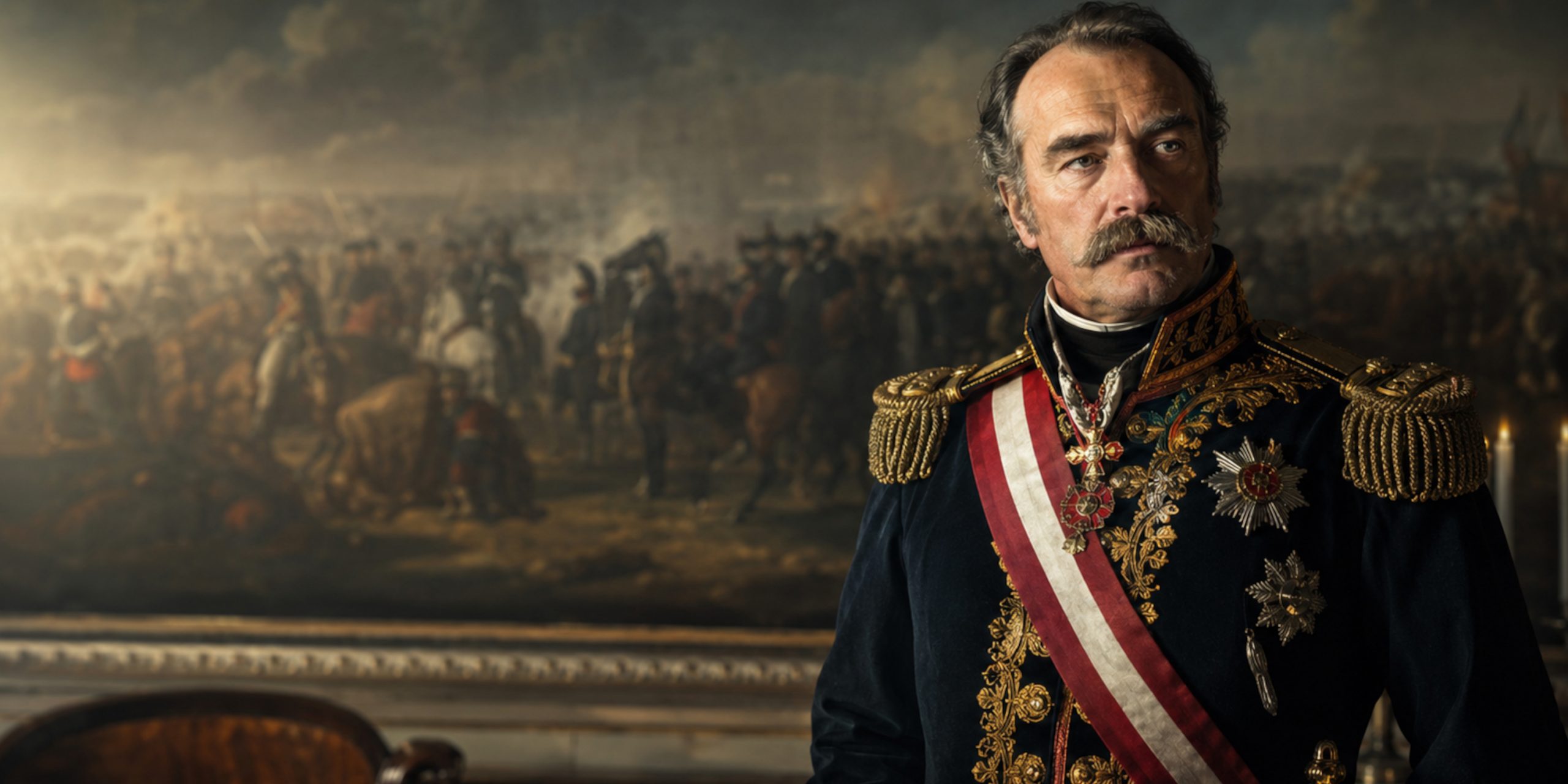
Portraits show Schwarzenberg dressed with the restrained elegance typical of Austrian high command. Austrian military fashion lacked some of the peacock extravagance seen among certain French marshals, which frankly may have improved survival rates.
Weapons Used by Schwarzenberg’s Forces
Infantry Weapons
| Weapon | Type | Notes |
|---|---|---|
| Austrian Musket M1798 | Flintlock musket | Standard infantry firearm |
| Bayonet | Infantry blade | Essential for close combat |
| Pioneers’ Axes | Engineering weapon/tool | Used in siege and camp operations |
Cavalry Weapons
| Weapon | Type | Notes |
|---|---|---|
| Austrian Cavalry Sabre | Sabre | Used by hussars and cuirassiers |
| Heavy Cavalry Broadsword | Sword | Favoured by heavy cavalry |
| Pistols | Flintlock firearms | Used at close range |
Artillery
The Austrian artillery arm under Schwarzenberg was highly respected:
- 6-pounder field guns
- 12-pounder heavy artillery
- Howitzers for explosive shell fire
Coalition artillery superiority became increasingly important during the campaigns of 1813 and 1814.
Leadership Style
Schwarzenberg was fundamentally a coalition politician in uniform.
That may sound faintly insulting, but coalition warfare is among the hardest forms of command imaginable. Different languages, rival monarchs, competing ambitions, contradictory supply systems and generals who often disliked one another intensely all had to function as a single machine.
Schwarzenberg managed this surprisingly well.
He lacked Napoleon’s genius for battlefield improvisation. He lacked Wellington’s icy precision. He lacked Blücher’s manic aggression.
What he possessed was steadiness.
Modern historians increasingly appreciate how important that steadiness became. Coalition armies before 1813 had repeatedly collapsed into rivalry and confusion. Schwarzenberg helped hold the alliance together long enough to win.
That is not romantic military history. It is, however, effective military history.
Relationship with Napoleon
Napoleon respected Schwarzenberg more than many realise.
The Austrian prince served briefly as ambassador to Paris after Austria’s defeat in 1809. During this period he navigated the dangerous politics surrounding Napoleon’s marriage to Archduchess Marie Louise.
Schwarzenberg’s diplomatic skill helped maintain Austrian survival during one of the empire’s weakest periods.
Napoleon reportedly viewed him as intelligent and dependable, though not especially dangerous tactically. In fairness, Napoleon thought this about most European generals.
Their eventual confrontation in 1813 and 1814 carried an almost tragic undertone. Schwarzenberg represented the old aristocratic Europe trying desperately to outlast the revolutionary military titan that had reshaped the continent.
Eventually, attrition defeated brilliance.
History occasionally works that way.
Artefacts and Where to See Them
Several museums across Central Europe preserve artefacts connected to Schwarzenberg and the Napoleonic Wars.
Heeresgeschichtliches Museum, Vienna
The Vienna Museum of Military History contains:
- Austrian Napoleonic uniforms
- Field marshal regalia
- Weapons from the Leipzig campaign
- Austrian cavalry sabres
- Battlefield paintings and command equipment
It remains one of the finest Napoleonic collections in Europe.
Schwarzenberg Family Collections
The Schwarzenberg family historically maintained collections at:
- Český Krumlov Castle
- Hluboká Castle
These sites preserve aristocratic interiors, military portraits and family heirlooms connected to the Habsburg era.
Leipzig Museums
Museums around Leipzig preserve:
- Battlefield artefacts
- Uniform fragments
- Cannonballs and musket shot
- Maps and campaign documents
The Leipzig battlefield itself remains one of Europe’s most significant Napoleonic heritage sites.
Latest Archaeology and Historical Discoveries
Napoleonic archaeology has expanded dramatically over the past two decades.
Leipzig Battlefield Excavations
Archaeologists around Leipzig continue uncovering:
- Musket balls and artillery fragments
- Mass burial sites
- Uniform fittings
- Cavalry equipment
These discoveries provide valuable insight into the scale and violence of the 1813 campaign.
Several excavations have revealed evidence of chaotic close-range fighting during the retreat phases of the battle. It is one thing to read casualty figures on paper. It is another to stand beside excavated remains and realise how young many of the soldiers were.
Battlefield Forensics
Modern forensic archaeology has also helped historians reassess casualty patterns and troop movements from the 1813 campaign.
Researchers increasingly use:
- Ballistic analysis
- GIS battlefield mapping
- Soil disturbance studies
- DNA examination of burial remains
This has transformed Napoleonic warfare from purely documentary history into a multidisciplinary field.
Austrian Military Archives
Digitisation projects in Vienna continue uncovering correspondence linked to Schwarzenberg’s headquarters. These documents reveal the immense strain of coalition command and the constant disagreements between allied leaders.
Frankly, some of the letters read like exhausted office managers trying to organise a deeply hostile committee meeting with cannons.
Personal Life and Character
Contemporaries described Schwarzenberg as calm, courteous and intelligent. He projected aristocratic dignity without excessive arrogance, a relatively rare trait among European high nobility.
He also endured personal tragedy. In 1810 a catastrophic fire at a Parisian embassy ball killed several members of his family and household staff. The disaster deeply affected him.
Unlike some Napoleonic commanders who cultivated flamboyant public myths, Schwarzenberg appears more human in surviving accounts. Thoughtful, burdened, occasionally weary and intensely aware of the stakes facing Europe.
That humanity gives him an oddly modern quality.
Death and Legacy
Prince Schwarzenberg died in 1820 at the age of forty-nine.
His reputation never achieved the popular fame of Wellington or Napoleon, partly because his victories emerged from collective effort rather than dramatic personal brilliance.
Yet his role was enormous.
Without Schwarzenberg, the Coalition of 1813 might well have fractured. Without the Coalition, Napoleon may have survived far longer.
He was not the sharpest sword of the Napoleonic age. He was the hand steady enough to hold several swords together at once.
In the end, that mattered more.
The Seven Swords Takeaway
Schwarzenberg fascinates me precisely because he resists the usual heroic mould. Historians often gravitate toward dazzling battlefield geniuses or reckless warriors charging into cannon smoke with cinematic confidence.
Schwarzenberg was something rarer. He was competent on a continental scale.
That sounds terribly unpoetic, but empires are often saved by competent people while louder men receive the paintings.
He understood diplomacy, logistics, coalition politics and strategic patience. None produce exciting cavalry portraits. All helped defeat Napoleon.
For that reason alone, Prince Schwarzenberg deserves far more attention than he usually receives.