The Second Battle of Newbury was one of the strangest major battles of the English Civil War. It was large, chaotic, tactically ambitious, and strategically frustrating. Both sides claimed some form of success. Neither side truly won. Historians have spent centuries staring at maps of Berkshire and muttering darkly about missed opportunities.
Fought on 27 October 1644, the battle saw Parliament attempt to trap King Charles I’s Royalist army near Newbury. Parliament possessed superior numbers and controlled multiple approaches. The Royalists were tired, under pressure, and carrying artillery and baggage. On paper, it looked ideal for a decisive Parliamentary victory.
Instead, the King escaped.
That single fact haunted Parliament afterwards and helped fuel the growing dissatisfaction that would eventually lead to the creation of the New Model Army. Second Newbury was less a glorious triumph and more a national argument conducted with cannon fire.
Background to the Battle
By autumn 1644, the English Civil War had entered a brutal middle phase. Parliament had won important victories, most notably at Marston Moor earlier that year, yet the war remained unresolved. King Charles I still possessed experienced field armies and retained support across large parts of England.
The Royalist western army under the Earl of Essex had suffered disaster at Lostwithiel, while the King manoeuvred through southern England attempting to maintain momentum. Parliament’s commanders meanwhile struggled with divided authority, political rivalry, and painfully slow decision making.
The Royalists eventually concentrated around Newbury in Berkshire, an important crossroads town already bloodied during the First Battle of Newbury in 1643. Parliament sought to intercept and destroy the King’s army before it could retreat safely westward toward Oxford.
What followed became a sprawling two-front battle across fields, hedgerows, hills, and enclosed lanes around Speen, Shaw House, Donnington Castle, and Clay Hill.
Forces
Parliamentarian Army
| Commander | Estimated Strength | Notes |
|---|---|---|
| Earl of Manchester | 14,000 infantry and cavalry | Eastern Association troops |
| Sir William Waller | 10,000 | Experienced southern army |
| Earl of Essex | 3,000 to 5,000 | Reduced after earlier setbacks |
| Total | Roughly 19,000 to 22,000 | Superior artillery and manpower |
Royalist Army
| Commander | Estimated Strength | Notes |
|---|---|---|
| King Charles I | Overall command | Present during battle |
| Prince Rupert | Cavalry commander | Aggressive battlefield leadership |
| Earl of Brentford | Senior military adviser | Veteran professional |
| Total | Roughly 8,000 to 10,000 | Outnumbered but cohesive |
Leaders and Troop Composition
Key Parliamentarian Commanders
- Edward Montagu, Earl of Manchester
- Sir William Waller
- Philip Skippon
- Oliver Cromwell
- Sir Arthur Hesilrige
Key Royalist Commanders
- King Charles I
- Prince Rupert of the Rhine
- Lord Hopton
- Sir John Byron
- Earl of Brentford
Typical Parliamentary Troops
- Pike and shot infantry regiments
- Eastern Association cavalry
- London Trained Bands
- Artillery batteries
- Dragoons deployed in hedges and enclosed ground
Typical Royalist Troops
- Cavalry under Rupert
- Veteran infantry brigades
- Welsh foot regiments
- Artillery train
- Royal bodyguard cavalry
The troop quality varied sharply. Parliament had quantity, but not always unity. The Royalists had fewer men yet often displayed greater battlefield coordination. One suspects several Parliamentary commanders spent more time glaring at each other than at the enemy.
Arms and Armour
The battle was fought during a transitional age of warfare where gunpowder increasingly dominated the battlefield, though cold steel still settled matters at terrifyingly close range.
Parliamentarian Weapons
| Weapon Type | Description |
|---|---|
| Basket-hilt broadswords | Common among cavalry officers |
| Mortuary swords | Distinctive English Civil War cavalry swords |
| Matchlock muskets | Standard infantry firearm |
| Pike | Essential anti-cavalry weapon |
| Buff coats | Thick leather protection |
| Lobster-tailed helmets | Popular cavalry head protection |
Royalist Weapons
| Weapon Type | Description |
|---|---|
| Backswords | Favoured by cavalry |
| Rapier-influenced cavalry swords | Used by officers and gentlemen |
| Flintlock and matchlock firearms | Mixed availability |
| Pistols | Cavalry shock weapons |
| Breastplates and cuirasses | Still worn by elite cavalry |
| Polearms | Used by sergeants and guards |
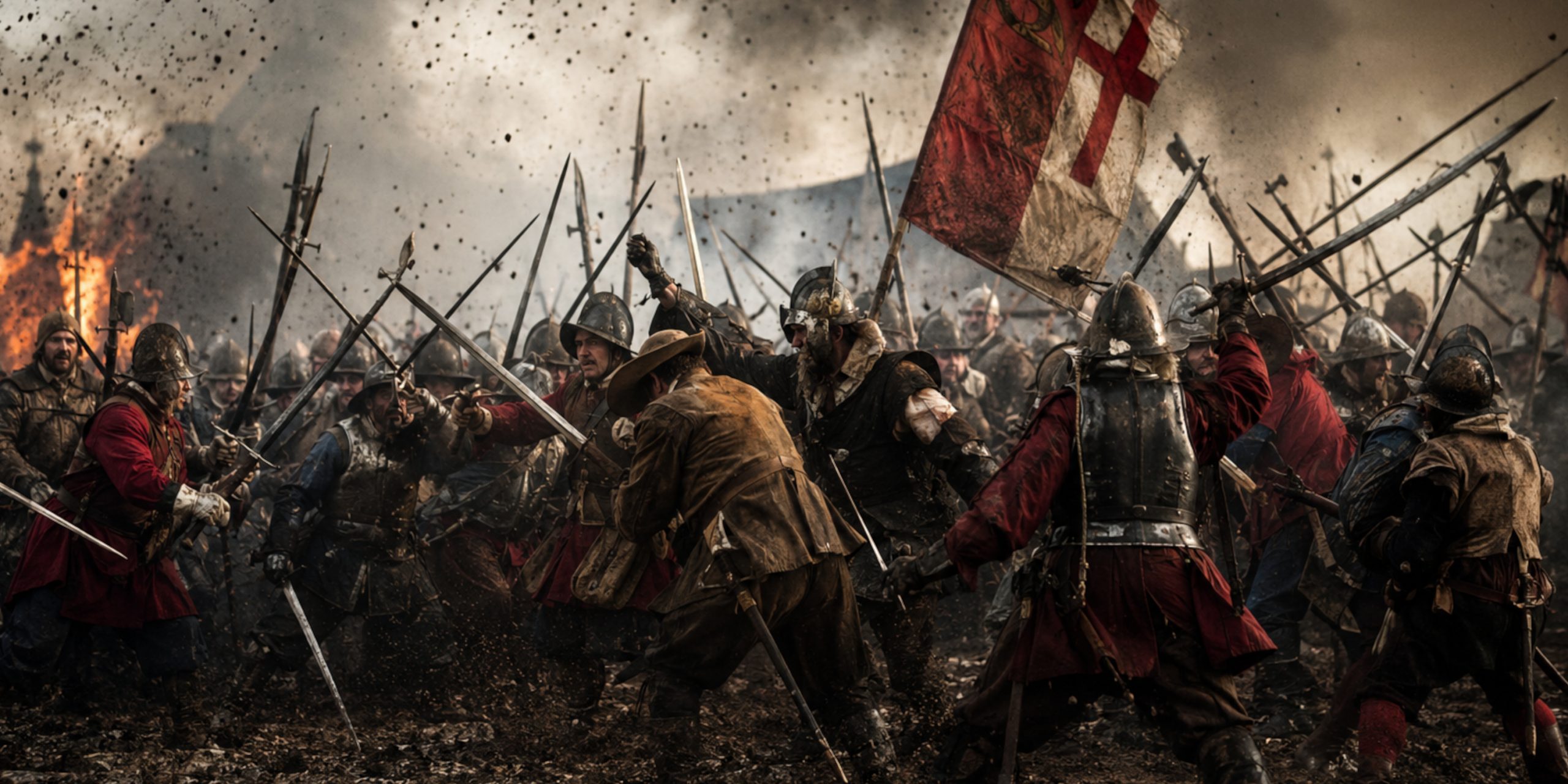
Sword fighting still mattered greatly during cavalry engagements. Rupert’s horsemen preferred aggressive charges with sword in hand rather than relying solely on pistols. The result was often terrifying momentum followed by utter confusion.
One contemporary observer noted cavalry collisions resembled “smiths hammering upon anvils”. That sounds poetic until one remembers the anvils were human beings.
The Battlefield and Archaeology
The battlefield around Newbury remains one of the best studied Civil War landscapes in England. Key sites include:
- Shaw House
- Speen
- Donnington Castle
- Clay Hill
- Wash Common
Archaeological work has uncovered:
- Musket balls
- Pistol shot
- Cannon shot
- Buckles and horse equipment
- Fragments of military gear
The distribution of musket balls has helped historians reconstruct infantry firing lines and cavalry movements. Some areas show intense close-range fighting around hedges and enclosed fields.
Donnington Castle still stands today, heavily damaged but deeply atmospheric. It remains one of the most tangible surviving links to the campaign.
Battle Timeline
| Time | Event |
|---|---|
| Early morning | Parliament begins coordinated assault |
| Morning | Waller attacks Royalist positions near Speen |
| Midday | Heavy fighting develops around Shaw House |
| Afternoon | Parliament gains ground on both flanks |
| Late afternoon | Royalists conduct disciplined withdrawal |
| Evening | Charles begins retreat toward Donnington |
| Following days | Royalists successfully escape westward |
The fighting around Shaw House became particularly savage. The manor changed hands multiple times amid musket volleys and close combat. Thick smoke, collapsing formations, and exhausted soldiers turned sections of the battlefield into utter chaos.
Shaw House and the Fight for the Centre
Shaw House became the focal point of the battle. Royalist infantry defended the mansion stubbornly against repeated assaults.
Parliamentary troops attacked through enclosed ground under heavy fire. Windows became firing points. Walls became improvised fortifications. Civil War battles often carried an ugly intimacy that popular imagination sometimes forgets. This was not elegant manoeuvre warfare. It was mud, smoke, panic, and exhausted men trying not to die in gardens and orchards.
Despite fierce attacks, the Royalists held long enough for the army to disengage in good order.
Contemporary Quotes
Sir Edward Walker, Royalist observer:
“The enemy pressed hard upon us from several quarters.”
Richard Baxter, Parliamentary chaplain:
“The noise of the cannon and muskets, and the smoke, was very dreadful.”
Oliver Cromwell reportedly criticised the conduct of certain Parliamentary commanders after the battle, arguing they had allowed the King to escape unnecessarily. His frustration became politically explosive.
Why Parliament Failed to Win Decisively
Second Newbury exposed severe problems within Parliament’s command structure.
Key Problems
- Divided leadership
- Poor battlefield coordination
- Rivalries between commanders
- Delays in exploitation
- Lack of unified strategic control
Cromwell in particular became deeply frustrated with the cautious Earl of Manchester. Their disagreements contributed directly to the Self-Denying Ordinance and eventually the formation of the New Model Army in 1645.
In that sense, Second Newbury mattered enormously. It demonstrated that Parliament could no longer afford half-measures or competing egos.
Wars are expensive enough without senior commanders treating strategy meetings like passive-aggressive dinner parties.
Casualties
| Side | Estimated Losses |
|---|---|
| Parliament | 1,000 to 1,500 |
| Royalists | 900 to 1,300 |
Precise figures remain uncertain, which is hardly unusual for Civil War battles. Contemporary reporting was often partisan, confused, or optimistic in the way only defeated commanders can manage.
Legacy of the Battle
Second Newbury was strategically inconclusive but politically transformative.
Its Lasting Importance
- Highlighted failures in Parliamentary leadership
- Accelerated military reform
- Helped pave way for New Model Army
- Preserved Royalist resistance temporarily
- Demonstrated increasing scale of Civil War warfare
Within months, Parliament reorganised its military system entirely. By 1645, the New Model Army would emerge as a far more disciplined and centralised fighting force.
The Royalists escaped Newbury, but the balance of the war was slowly shifting against them.
Visiting the Battlefield Today
Visitors can still explore much of the battlefield landscape around modern Newbury.
Key Sites
- Shaw House
- Donnington Castle
- Speen
- Wash Common
Interpretive boards and preserved terrain provide valuable insight into troop movements and fighting positions. Walking the ground remains the best way to understand how fragmented and confusing the battle truly was.
Civil War battlefields often appear deceptively peaceful today. Birds sing. Dog walkers pass by. Then one notices the ridgelines, the narrow lanes, the killing grounds between hedges, and suddenly the entire field begins to make grim military sense.
Takeaway
The Second Battle of Newbury was not a glorious triumph for either side. It was a grinding, exhausting confrontation shaped by confusion, missed chances, and stubborn resistance.
Yet its consequences reached far beyond Berkshire. The battle exposed weaknesses within Parliament that could no longer be ignored. Out of the frustration of Newbury came reform, and out of reform came the army that would eventually defeat the King.
Sometimes history turns not on clear victories, but on arguments nobody can stop having afterwards.