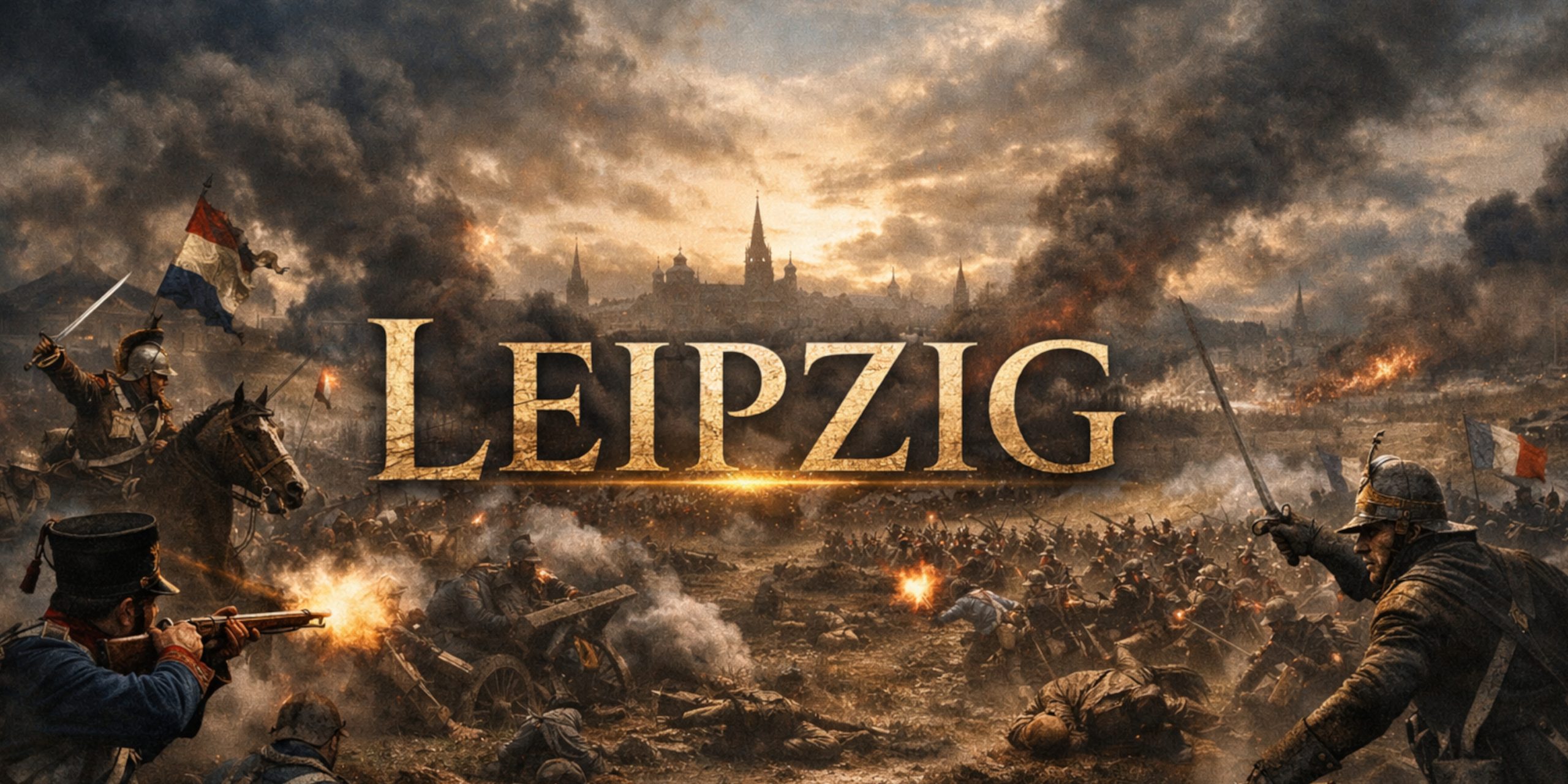
The Battle of Leipzig was not simply another clash in the long Napoleonic Wars. It was the moment when the tide finally turned against Napoleon Bonaparte in Europe. Fought between 16 and 19 October 1813 near the Saxon city of Leipzig, the battle brought together armies from across the continent. Russians, Prussians, Austrians, and Swedes combined against Napoleon’s forces in what became the largest battle in Europe before the First World War.
Nearly half a million soldiers fought across fields, villages, and marshland surrounding the city. Smoke hung over the plain for days. Cannon thunder rolled across Saxony from dawn to dusk. When it ended, Napoleon’s aura of invincibility had cracked beyond repair.
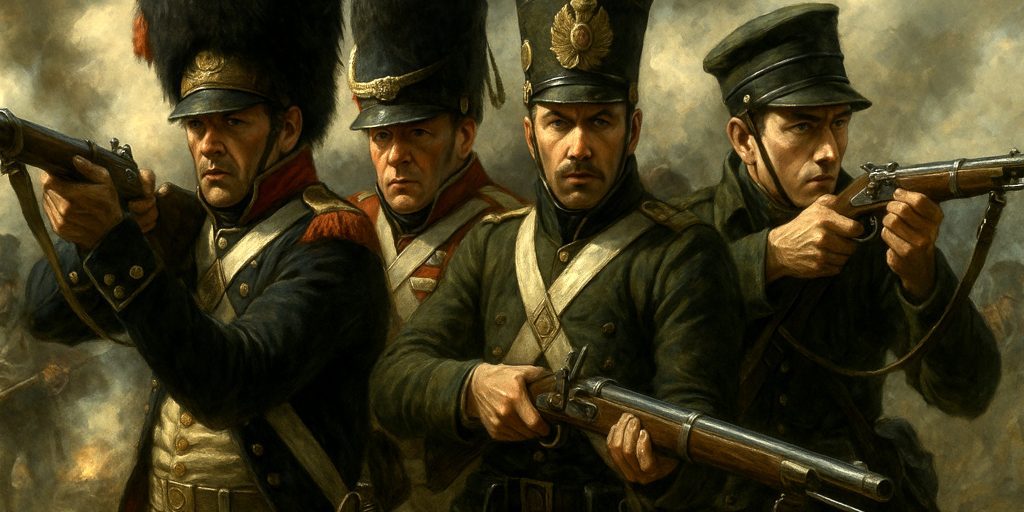
Historians tend to call it the “Battle of Nations,” which is accurate enough. Armies from nearly every major European power were present. If you stood on a hill overlooking the battlefield you would have seen uniforms of every colour imaginable, from French blue to Russian green and Austrian white. It was a continental war condensed into four violent days.
Background to the Battle
Napoleon’s catastrophic invasion of Russia in 1812 reshaped the balance of power in Europe. The Grande Armée staggered back west shattered by cold, hunger, and relentless Russian pursuit. The myth of Napoleon’s invincibility died somewhere in the snows outside Moscow.
Sensing weakness, the Sixth Coalition formed. Russia and Prussia were joined by Austria, Sweden, and several German states. Their aim was simple enough: defeat Napoleon on German soil and push France back behind the Rhine.
During 1813 Napoleon fought several sharp campaigns in Germany, winning at Lützen and Bautzen earlier in the year. Yet these victories could not compensate for his dwindling manpower and overstretched resources. The coalition armies adopted a strategy known as the Trachenberg Plan, which essentially meant avoiding Napoleon himself while defeating his marshals whenever possible.
By autumn the coalition armies converged on Saxony. Napoleon concentrated his forces around Leipzig, intending to defeat each enemy army separately. Instead he found himself surrounded by three converging coalition forces.
Forces
The scale of the armies involved is difficult to exaggerate. Combined troop numbers approached 600,000 men by the end of the fighting.
| Side | Estimated Strength |
|---|---|
| French Empire and Allies | 190,000 to 200,000 troops |
| Sixth Coalition | 350,000 to 380,000 troops |
Coalition numbers increased as reinforcements arrived during the battle. Napoleon’s army, by contrast, gradually shrank under constant pressure.
French Empire and Allies
Commander-in-Chief
• Napoleon Bonaparte
Senior Commanders
• Marshal Michel Ney
• Marshal Joachim Murat
• Marshal Auguste Marmont
• Marshal Nicolas Oudinot
• Marshal Jacques Macdonald
• General Bertrand
• General Lauriston
Allied Contingents Fighting with France
• Kingdom of Saxony
• Duchy of Warsaw (Polish troops)
• Various German Confederation units
Napoleon still commanded an experienced army, though it included many young conscripts. His cavalry arm had never fully recovered from the Russian disaster.
Sixth Coalition
The coalition armies were technically separate forces but coordinated closely.
Army of Bohemia
• Commander: Karl von Schwarzenberg
• Austrian, Russian, and Prussian troops
Army of Silesia
• Commander: Gebhard Leberecht von Blücher
• Mainly Prussian and Russian forces
Army of the North
• Commander: Jean-Baptiste Bernadotte, Crown Prince of Sweden
• Swedish, Russian, and Prussian troops
Notably, Bernadotte had once been one of Napoleon’s marshals. European politics can be wonderfully awkward like that.
Arms and Armour
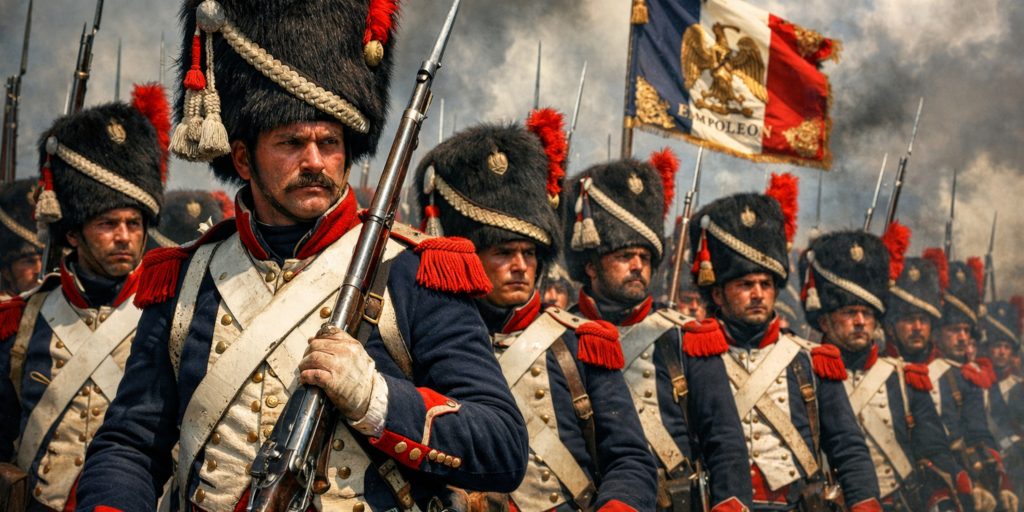
Napoleonic warfare had reached a refined and brutally efficient form by 1813. The battlefield around Leipzig became a vast demonstration of early industrial age warfare.
Infantry Weapons
• Flintlock muskets such as the French Charleville Model 1777
• Prussian Potsdam muskets
• Russian Model 1808 muskets
• Socket bayonets used for close combat
Musket volleys dominated the battlefield. Engagement distances were typically under one hundred metres.
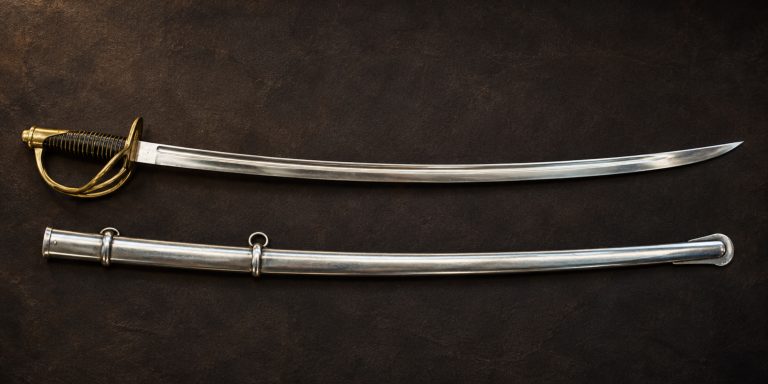
Cavalry Weapons
Cavalry remained a decisive arm when used properly.
Common sword types included
• French AN XI Light Cavalry Sabre
• Heavy cavalry straight swords carried by cuirassiers
• Prussian Pallasch heavy cavalry swords
• Russian dragoon sabres
Heavy cuirassiers wore steel breastplates and helmets, giving them an intimidating appearance. Light cavalry such as hussars and chasseurs relied more on speed than armour.
Artillery
Artillery played a major role.
• French 6 pounder and 12 pounder field guns
• Austrian and Russian artillery batteries
• Congreve rockets used by some coalition units
The open plains around Leipzig allowed massed artillery fire. Some sectors of the battlefield saw hundreds of guns firing simultaneously.
Armour and Uniforms
Full armour had largely disappeared except for cuirassier breastplates. Uniforms, however, remained striking.
• French infantry wore dark blue coats
• Austrian troops appeared in distinctive white uniforms
• Russian infantry wore dark green
• Prussians wore dark blue with black equipment
For historians the battle is a gift. For the soldiers who marched into that smoke and mud it must have felt like the end of the world.
The Battlefield

Leipzig itself sat in a patchwork of rivers, marshes, and villages. Streams such as the Pleisse and the Elster created natural obstacles. Numerous small villages around the city became fortified strongpoints.
Key locations included:
• Wachau
• Liebertwolkwitz
• Markkleeberg
• Möckern
• Lindenau
These villages changed hands repeatedly during the battle. A churchyard wall or farm building could become the centre of a desperate fight.
Battle Timeline

16 October 1813
The first major clashes erupted south of Leipzig.
Napoleon launched attacks against Schwarzenberg’s Army of Bohemia near Wachau and Liebertwolkwitz. The fighting was savage and indecisive. Massive cavalry engagements unfolded on the plains, including one of the largest cavalry battles of the Napoleonic Wars.
Meanwhile to the north, Blücher’s army attacked Marshal Marmont near Möckern. After brutal fighting the Prussians captured the village, forcing Marmont to retreat.
17 October 1813
Both sides paused briefly. Reinforcements continued to arrive for the coalition armies. Napoleon realised the numerical balance was shifting rapidly against him.
Skirmishing and artillery duels continued throughout the day. Leipzig itself filled with wounded soldiers.
18 October 1813
The coalition launched a massive coordinated assault from multiple directions.
Over 300,000 coalition troops pressed against Napoleon’s lines. Villages around Leipzig became killing grounds. One dramatic moment occurred when Saxon troops fighting for Napoleon switched sides mid battle and joined the coalition artillery.
By evening the French army began withdrawing into Leipzig.
19 October 1813
Napoleon ordered a retreat westward across the River Elster.
Disaster struck when the main bridge was blown too early by French engineers, trapping thousands of soldiers inside the city. Chaos followed as troops tried to escape.
Large numbers were captured. Others drowned attempting to swim the river.
Napoleon himself managed to escape, but his army had suffered a catastrophic defeat.
Archaeology and Battlefield Discoveries
Leipzig’s battlefield has produced significant archaeological finds over the years.
Modern excavations and metal detecting surveys have uncovered:
• Musket balls and artillery fragments
• Uniform buttons from several national armies
• Cavalry sabres and bayonets
• Personal items such as pipes and coins
Some discoveries have helped confirm the exact positions of certain engagements described in written accounts.
Human remains have also been uncovered during construction projects around Leipzig. These grim reminders underline just how many men died during the battle.
The region now hosts museums and memorials dedicated to the conflict. The massive Völkerschlachtdenkmal, completed in 1913, towers above the landscape and commemorates the battle’s centenary.
Contemporary Quotes
Several observers left vivid descriptions of the battle.
The Prussian officer Heinrich von Brandt wrote:
“The noise of the artillery was uninterrupted and terrible. One could scarcely hear commands even when shouted directly into the ear.”
Marshal Marmont later reflected on the chaos of the final retreat:
“The army withdrew fighting, but the disaster of the bridge rendered the confusion complete.”
A Russian officer recorded the scale of the battle with simple understatement:
“The plain was covered with troops beyond counting.”
When soldiers describe something as beyond counting, historians generally take the hint.
Casualties
The losses were enormous.
| Side | Estimated Casualties |
|---|---|
| French Empire and Allies | 70,000 to 80,000 |
| Sixth Coalition | 50,000 to 55,000 |
Tens of thousands more were captured during the retreat.
Many wounded soldiers later died from infection. Napoleonic medicine had improved somewhat since earlier wars, but the conditions were still grim.
Legacy
The defeat at Leipzig shattered Napoleon’s control over Germany. Many of his German allies abandoned him soon after the battle.
Within months coalition armies crossed the Rhine and invaded France itself. The following year Napoleon would abdicate and be exiled to Elba.
Leipzig therefore stands as one of the decisive turning points of the Napoleonic Wars. Without it, the map of nineteenth century Europe might have looked very different.
It also demonstrated something important about coalition warfare. For years Napoleon had defeated enemies one at a time. At Leipzig they finally managed to coordinate their efforts effectively.
That simple change proved decisive.
Takeaway
Standing on the fields around Leipzig today it is difficult to imagine the scale of what happened there. The countryside is quiet. Villages have grown into suburbs. Traffic hums along modern roads.
Yet beneath that calm landscape lies the memory of one of the largest battles in European history.
The Battle of Leipzig was not elegant warfare. It was enormous, chaotic, and brutally exhausting for everyone involved. But it marked the beginning of the end for Napoleon’s empire.
And for historians, it remains one of those rare moments when the entire fate of a continent seemed to hang in the balance.
Watch the documentary: