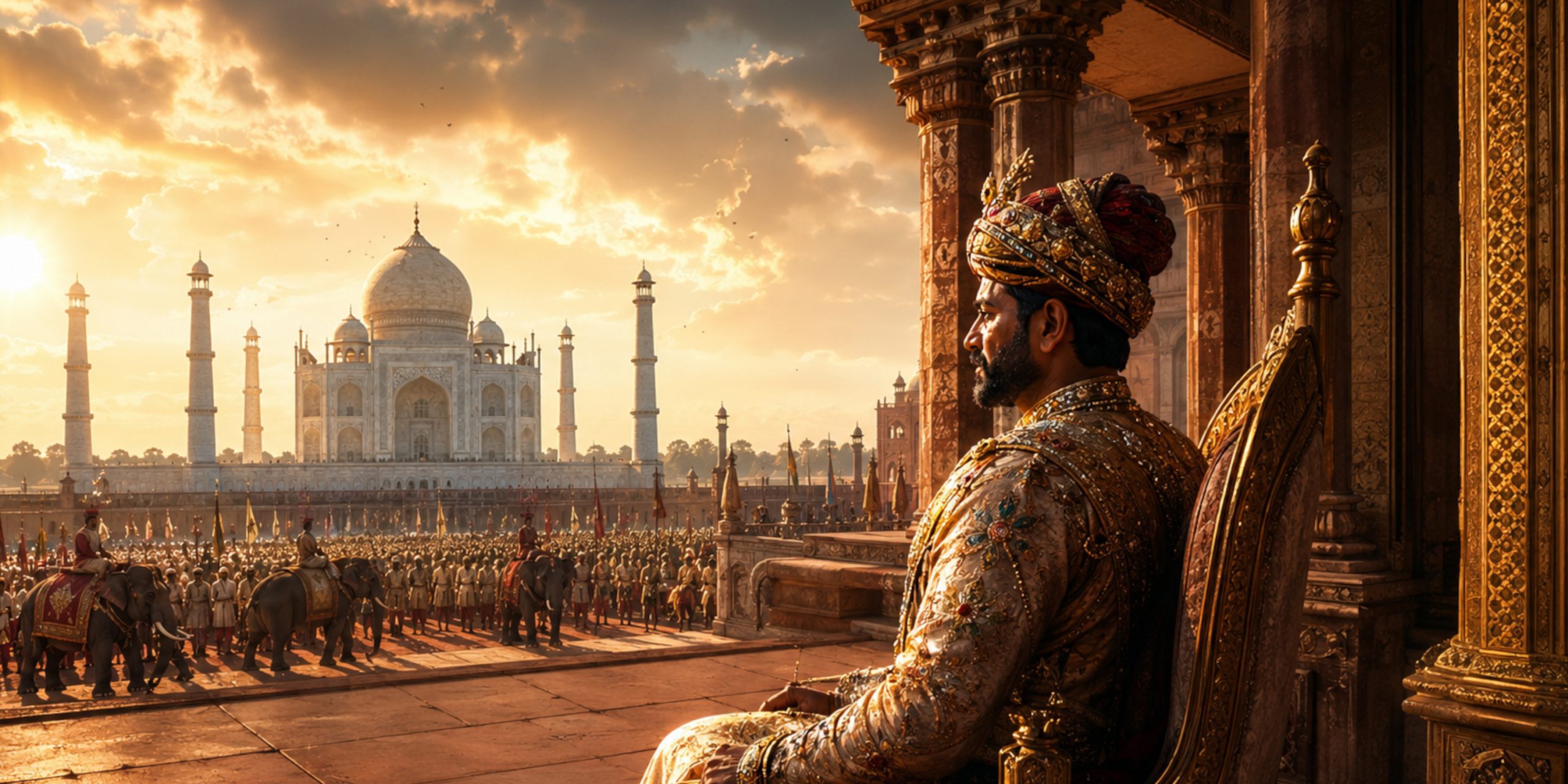
Few rulers have left such a contradictory legacy as Shah Jahan. Mention his name and almost everyone immediately thinks of the Taj Mahal, that shimmering monument of white marble that has become one of humanity’s defining architectural achievements. Yet reducing Shah Jahan to the grieving husband who built the world’s most famous tomb misses the far larger story.
He inherited one of the richest empires on Earth, commanded vast armies, fought determined campaigns across the Indian subcontinent, presided over a court of extraordinary wealth, and transformed Mughal architecture into something approaching perfection. His reign represented the high watermark of imperial splendour before the long and costly decline that would eventually consume the dynasty.
As a historian, I find Shah Jahan fascinating precisely because of this contrast. He was capable of immense artistic vision while remaining every bit the hard-headed imperial ruler expected of a seventeenth century monarch. Marble palaces and bloody sieges were simply different tools of kingship.
Contents
- Early Life
- Rise to the Throne
- The Mughal Empire Under Shah Jahan
- Battles and Military Acumen
- Arms and Armour
- Administration and Government
- The Golden Age of Mughal Architecture
- The Taj Mahal
- Family and Succession
- Imprisonment by Aurangzeb
- Character and Personality
- Artefacts From His Reign
- Archaeology and Recent Discoveries
- Legacy
Early Life
Shah Jahan was born Prince Khurram on 5 January 1592 in Lahore.
He was the third son of Emperor Jahangir and grandson of Akbar the Great. Growing up within the Mughal court meant receiving an education that combined military training, Persian literature, Islamic scholarship, diplomacy and administration.
From an early age he demonstrated qualities expected of an imperial successor.
He became proficient in:
- Horse riding
- Archery
- Swordsmanship
- Elephant warfare
- Court etiquette
- Military command
- Persian poetry
His grandfather Akbar reportedly regarded him as especially gifted, a judgement that would later influence court politics.
Rise to the Throne
Succession in the Mughal Empire rarely happened peacefully.
Prince Khurram established himself through military victories before eventually rebelling against his father Jahangir after political tensions within the court.
Following Jahangir’s death in 1627, Khurram defeated rival claimants in another succession struggle.
He ascended the throne in 1628 under the regnal name Shah Jahan, meaning “King of the World.”
Like many Mughal successions, his accession involved the elimination of potential rivals. It was ruthless but entirely consistent with imperial tradition.
The Mughal Empire Under Shah Jahan
At its greatest extent, the Mughal Empire stretched across much of modern India, Pakistan, Bangladesh and Afghanistan.
Its wealth astonished foreign visitors.
Revenue came from:
- Agricultural taxation
- International trade
- Textile production
- Precious stones
- Metalworking
- Luxury goods
European merchants regularly described the Mughal court as richer than almost any monarchy they had encountered.
The imperial treasury funded:
- Massive standing armies
- Grand building programmes
- Extensive road networks
- Fortifications
- Gardens
- Religious institutions
The empire became one of the largest economies in the world during Shah Jahan’s reign.
Battles and Military Acumen
Although remembered primarily as a patron of architecture, Shah Jahan spent much of his career commanding armies.
The Deccan Campaigns
The Deccan Sultanates remained one of the empire’s greatest challenges.
Shah Jahan directed repeated campaigns against Ahmadnagar, Bijapur and Golconda.
These wars combined diplomacy with military pressure.
Rather than seeking outright conquest every time, he often forced rulers into tributary relationships that strengthened Mughal influence while avoiding endless occupation.
Bundelkhand Campaign
The Bundela rebellion tested imperial authority.
Imperial forces eventually crushed resistance through overwhelming manpower, careful logistics and prolonged pressure rather than spectacular battlefield victories.
Kandahar Campaigns
Perhaps Shah Jahan’s greatest military disappointment involved Kandahar.
The fortress city controlled an important gateway between Persia and India.
Although initially recovered by the Mughals, the city was captured by the Safavid Persians in 1649.
Several expensive Mughal attempts to retake Kandahar failed.
These defeats exposed limitations in Mughal siege warfare, particularly against well-defended fortresses supplied with modern artillery.
Military Leadership
Shah Jahan excelled more as a strategic organiser than as a battlefield commander in the mould of Babur.
His strengths included:
- Careful planning
- Administrative organisation
- Effective logistics
- Use of experienced generals
- Strong financial backing for campaigns
- Maintaining imperial authority
His weaknesses included:
- Overconfidence during the Kandahar campaigns
- Heavy logistical costs
- Slow siege operations
- Increasing military expenditure
Arms and Armour
The Mughal military under Shah Jahan fielded some of the finest weapons of the seventeenth century.
Swords
Common sword types included:
Many elite swords featured:
- Jade hilts
- Gold koftgari decoration
- Gemstone inlays
- Damascus steel blades
- Qur’anic inscriptions
Imperial workshops produced weapons that were both functional and magnificent works of art.
Armour
Elite warriors commonly wore:
- Steel helmets
- Mail shirts
- Plate-and-mail armour
- Arm guards
- Shielded gauntlets
- Quilted cotton armour beneath steel protection
Shields
Shields were often made from:
- Rhinoceros hide
- Steel
- Buffalo hide
Decorative examples carried elaborate gold ornamentation.
Firearms
By Shah Jahan’s reign firearms had become central to Mughal warfare.
Weapons included:
- Matchlock muskets
- Large siege cannon
- Bronze artillery
- Swivel guns mounted on elephants
- Rocket-like incendiary weapons
Artillery remained one of the empire’s defining military strengths.
War Elephants
Elephants continued serving:
- Command platforms
- Siege operations
- Battlefield shock forces
- Ceremonial roles
Many carried protective armour made from iron plates and heavy textiles.
Administration and Government
The Mughal bureaucracy reached remarkable sophistication during Shah Jahan’s reign.
Officials maintained detailed records covering:
- Taxation
- Agriculture
- Military obligations
- Provincial administration
- Trade
The mansabdari system allocated military responsibilities and salaries according to rank.
While corruption certainly existed, the administrative machinery remained among the most advanced anywhere in the early modern world.
The Golden Age of Mughal Architecture
If Akbar built an empire, Shah Jahan dressed it in marble.
His architectural style emphasised:
- White marble
- Symmetry
- Refined geometric planning
- Floral decoration
- Pietra dura stone inlay
- Elegant domes
- Slender minarets
Major surviving works include:
- Taj Mahal
- Red Fort in Delhi
- Jama Masjid
- Sections of Agra Fort
- Shalimar Gardens in Lahore
This period is widely regarded as the pinnacle of Mughal architecture.
The Taj Mahal
Construction began in 1632 following the death of Mumtaz Mahal.
It employed thousands of craftsmen drawn from across Asia.
Materials arrived from throughout the empire and beyond.
Highlights include:
- Makrana marble
- Carnelian
- Jasper
- Lapis lazuli
- Turquoise
- Onyx
- Jade
Despite its immense beauty, the Taj Mahal also functioned as a political statement.
Only a ruler commanding extraordinary wealth and stability could commission such a project.
Family and Succession
Shah Jahan and Mumtaz Mahal had fourteen children.
Following Mumtaz’s death, succession tensions intensified.
His sons included:
- Dara Shikoh
- Aurangzeb
- Shah Shuja
- Murad Baksh
The resulting civil war ultimately destroyed the stability Shah Jahan had spent decades building.
Imprisonment by Aurangzeb
In 1658 Aurangzeb seized power.
Shah Jahan spent the final eight years of his life imprisoned within Agra Fort.
Tradition holds that he could see the Taj Mahal from his apartments.
Whether every romantic detail of that story is true remains uncertain, but contemporary accounts confirm his confinement.
He died in 1666.
He was buried beside Mumtaz Mahal inside the Taj Mahal.
Character and Personality
Contemporary writers described Shah Jahan as dignified, disciplined and deeply conscious of imperial ceremony.
He appreciated luxury without descending into extravagance for its own sake.
His court valued precision.
Protocol mattered.
Appearance mattered.
Architecture mattered.
Power had to be seen as much as exercised.
Modern historians sometimes criticise the immense cost of his building projects. Others argue that they represented investments employing thousands of craftsmen while projecting stability throughout the empire.
Both interpretations carry weight.
Artefacts From His Reign
Visitors can still see remarkable objects connected with Shah Jahan.
India
Agra Fort
Contains palaces, audience halls and apartments associated with the emperor.
Taj Mahal
His tomb alongside Mumtaz Mahal remains the most famous surviving monument of his reign.
Red Fort, Delhi
Includes imperial halls, audience chambers and palace complexes built under Shah Jahan.
National Museum, New Delhi
Displays Mughal arms, armour, jewellery, manuscripts and decorative arts from the seventeenth century.
United Kingdom
The Royal Collection contains Mughal weapons, jade objects, paintings and diplomatic gifts dating from Shah Jahan’s era.
The British Museum also preserves manuscripts, coins, metalwork and luxury goods from the period.
Pakistan
The Lahore Fort and Shalimar Gardens preserve some of the emperor’s most significant architectural commissions outside modern India.
Archaeology and Recent Discoveries
Archaeological work continues to improve our understanding of Shah Jahan’s empire.
Recent investigations have focused on:
Taj Mahal Conservation
Modern laser scanning has documented subtle movement within marble surfaces and helped conservation teams identify weathering caused by pollution and environmental change.
Red Fort Excavations
Archaeologists have uncovered drainage systems, service buildings, workshops and structural details revealing how the vast palace complex functioned behind its ceremonial façade.
Agra Fort
Ground penetrating surveys continue revealing earlier construction phases beneath Shah Jahan’s modifications.
These findings help distinguish between buildings inherited from Akbar and those commissioned during Shah Jahan’s own reign.
Mughal Gardens
Restoration projects have reconstructed original water channels using archaeological evidence, revealing the remarkable engineering behind Mughal landscape design.
Material Analysis
Scientific examination of marble, pigments and decorative stones continues identifying trade routes stretching from Central Asia to Europe, demonstrating the global reach of Mughal commerce.
Legacy
Shah Jahan inherited an already formidable empire and elevated its artistic achievements to extraordinary heights.
Yet his reign also exposed structural weaknesses.
The immense costs of warfare and monumental construction placed increasing demands upon imperial finances. The bitter succession struggle among his sons shattered political stability. Aurangzeb inherited a vast empire but one that required almost constant military effort to sustain.
Even so, Shah Jahan’s cultural legacy has endured where many military victories have faded.
Millions visit the Taj Mahal each year.
Architects continue studying Mughal design principles.
Collectors prize weapons from his reign for their exceptional craftsmanship.
Historians still debate whether he should be remembered primarily as a conqueror, administrator or patron of the arts. For me, the answer lies somewhere in the middle. Shah Jahan embodied the Mughal ideal of kingship, where military authority, artistic refinement and political theatre formed a single vision of empire. His greatest monument may be the Taj Mahal, but his true achievement was shaping the Mughal Empire into one of the most sophisticated courts the early modern world had ever seen.