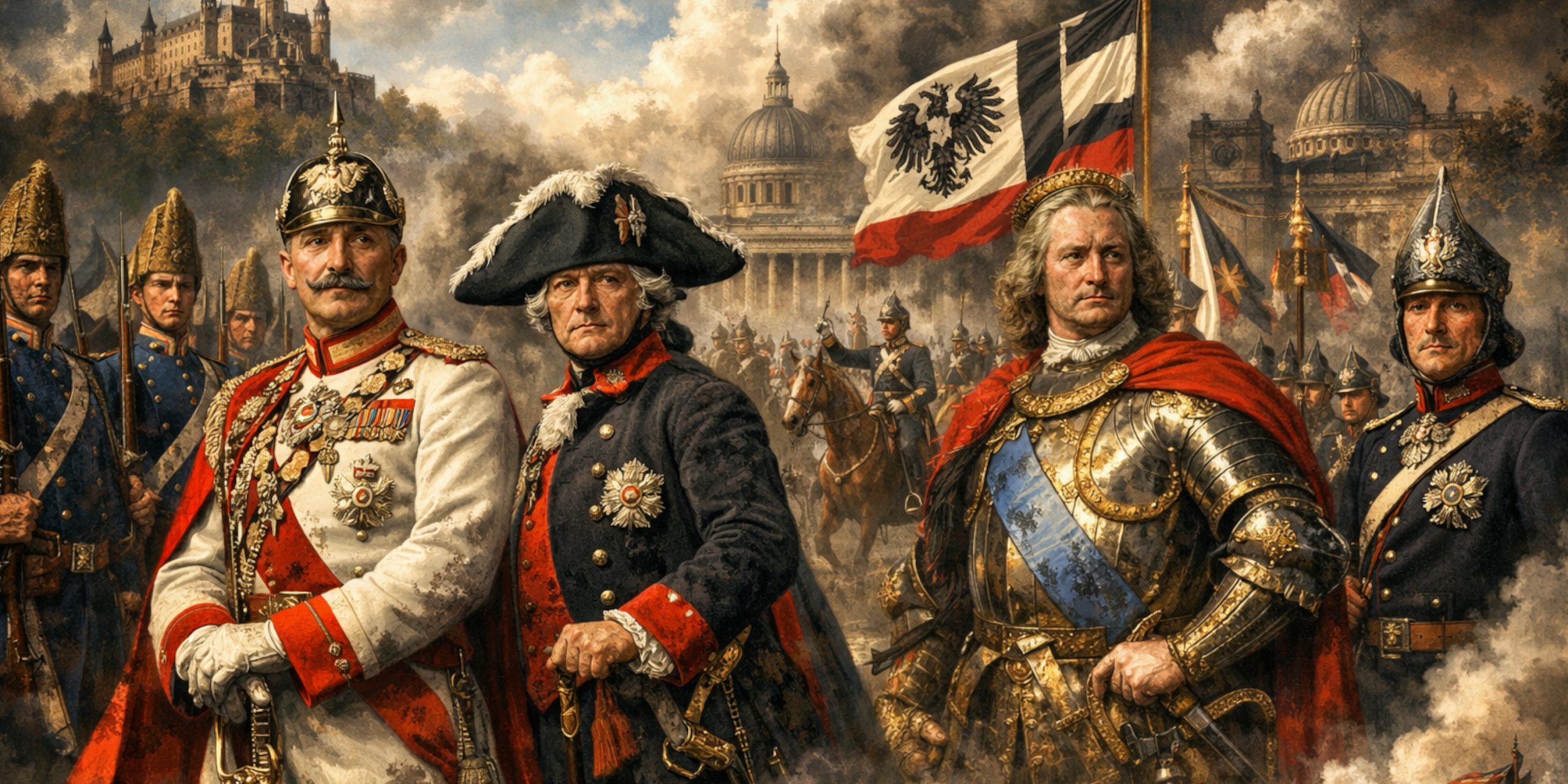
The Hohenzollerns ruled for just over five centuries, beginning as rather ambitious Franconian nobles and ending with an emperor quietly slipping across the Dutch border in November 1918. It is difficult to think of another dynasty that shaped Germany so thoroughly, and with such determination, thrift, stubbornness and, at times, a frankly alarming enthusiasm for uniforms.
From their acquisition of Brandenburg in 1415 to the collapse of the German Empire in 1918, the Hohenzollerns built one of Europe’s most formidable states. They turned a scattered and rather unpromising collection of territories into Prussia, then into the German Empire itself. Yet the same habits that made them successful, militarism, rigid discipline and a belief that the ruler always knew best, eventually helped bring the whole structure crashing down.
Origins of the Hohenzollerns
The dynasty began in southern Germany, near the castle of Hohenzollern in Swabia. By the thirteenth century the family had divided into two branches. The southern line remained in Swabia, while the northern Franconian line became increasingly important.
The crucial turning point came in 1415, when the Holy Roman Emperor Sigismund granted Frederick VI of Nuremberg the Electorate of Brandenburg. He became Frederick I, Elector of Brandenburg.
Brandenburg was not especially wealthy or glamorous. It was marshy, fragmented and politically troublesome. One suspects that many medieval princes would rather have inherited a good vineyard and a quiet life. Frederick, however, saw an opportunity.
Brandenburg and the Foundations of Power
Frederick I to Joachim II
The early Hohenzollern electors spent the fifteenth and sixteenth centuries consolidating Brandenburg. They subdued unruly nobles, strengthened administration and increased their control over taxation.
Frederick I and his successors understood a simple truth. If a ruler wanted to survive in the Holy Roman Empire, with its hundreds of quarrelsome princes and bishops, he needed money, soldiers and a bureaucracy that obeyed.
Joachim II, who ruled from 1535 to 1571, introduced Lutheranism into Brandenburg during the Reformation. He did so cautiously. The Hohenzollerns had a gift for changing sides at exactly the moment when it became useful.
The conversion to Protestantism had lasting consequences. Brandenburg became firmly associated with the Protestant cause, placing it in growing rivalry with Catholic powers such as Austria.
The Thirty Years’ War and Near Disaster
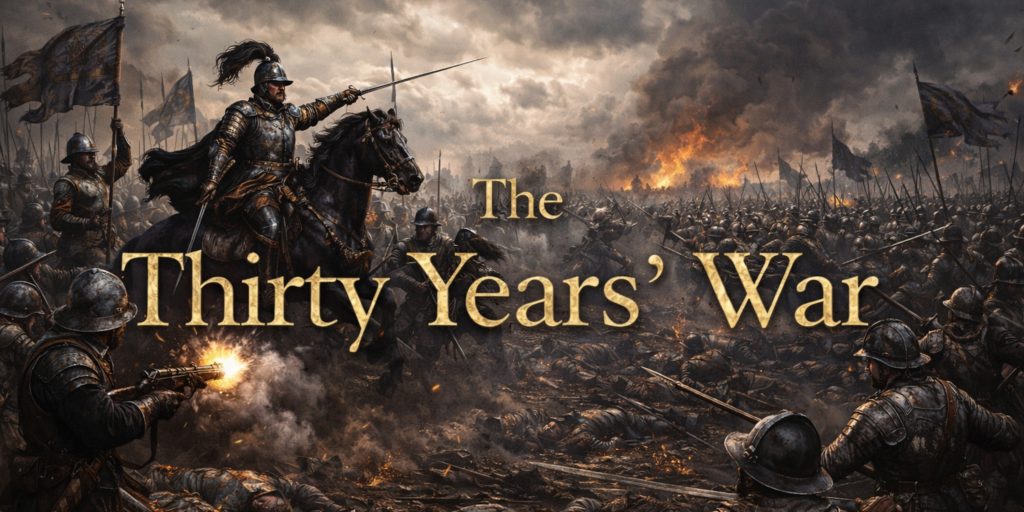
The Thirty Years’ War devastated Brandenburg. When George William inherited in 1619, he ruled over territories that included Brandenburg and the Duchy of Prussia. Unfortunately, he was indecisive at precisely the moment when Europe had decided to become violently unreasonable.
Between 1618 and 1648 Brandenburg was invaded repeatedly. Towns were destroyed, trade collapsed and the population fell sharply. By the end of the war, parts of Brandenburg resembled the aftermath of an argument between several armies and a plague.
Yet the dynasty survived.
The man who rescued it was Frederick William, known as the Great Elector.
Frederick William, the Great Elector
Frederick William ruled from 1640 to 1688 and laid the foundations of the Prussian state.
He created a standing army, centralised administration and reduced the power of the regional estates. He also encouraged immigration, welcoming Protestant refugees such as the Huguenots expelled from France.
The Great Elector understood that Brandenburg-Prussia could not rely on geography. His lands were scattered and vulnerable. Since he could not move his territories closer together, he built an army large enough to make his neighbours think twice.
By the end of his reign Brandenburg-Prussia had become a significant European power. The army numbered around 30,000 men, impressive for a state of its size.
I have always found Frederick William oddly modern. He cared little for romance or ceremony. He wanted efficient officials, obedient soldiers and tax revenues. He would probably have adored a spreadsheet.
The Birth of the Kingdom of Prussia
In 1701 Frederick III crowned himself King in Prussia, becoming Frederick I.
He could not call himself King of Brandenburg because Brandenburg was still legally part of the Holy Roman Empire. Instead, he used the Duchy of Prussia, which lay outside the empire, as the basis for his royal title.
The ceremony in Königsberg was magnificent. Frederick I adored pomp, ceremony and expensive palaces. After generations of careful, rather stern rulers, the dynasty briefly acquired a man who behaved as though he had wandered out of an opera.
His son, Frederick William I, was quite different.
Frederick William I and the Military State
Frederick William I ruled from 1713 to 1740. He transformed Prussia into a disciplined military state.
He reduced court spending, expanded the army and created a highly efficient bureaucracy. By the end of his reign, Prussia had one of the largest armies in Europe relative to its population.
The king became famous for his obsession with tall soldiers, particularly the Potsdam Giants. He spent absurd sums recruiting unusually tall men from across Europe. There are moments in history when one is forced to admit that even great rulers have very peculiar hobbies.
Yet beneath this eccentricity lay a formidable system. Frederick William I built the machinery that later allowed Prussia to dominate Germany.
Frederick the Great and the Rise of Prussia
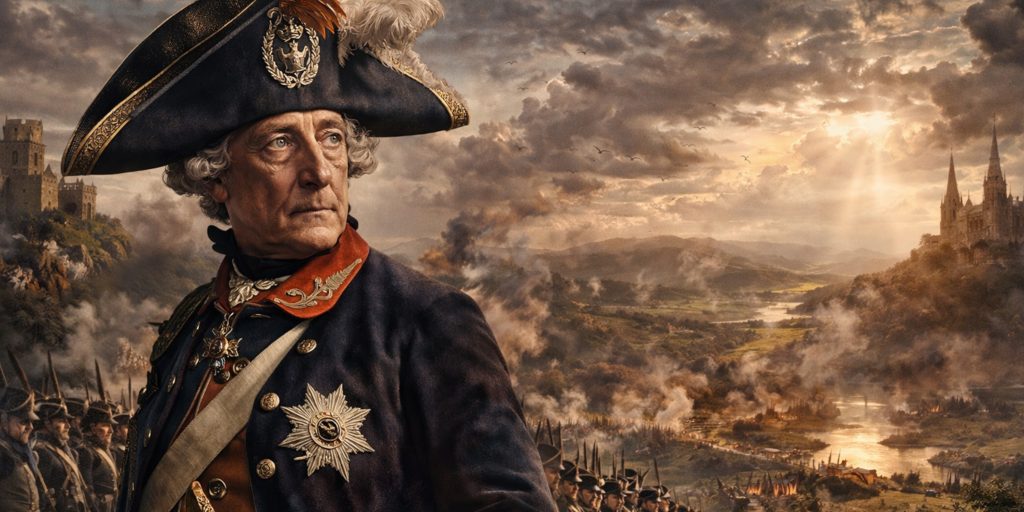
Frederick II, better known as Frederick the Great, ruled from 1740 to 1786.
He is the most famous Hohenzollern ruler and perhaps the most brilliant. Cultured, ruthless, intelligent and often deeply unpleasant, Frederick embodied both the strengths and weaknesses of Prussia.
He seized Silesia from Austria in 1740, beginning the War of the Austrian Succession. The conquest transformed Prussia into a major European power.
Later, during the Seven Years’ War, Frederick fought Austria, Russia, France and Saxony. Against extraordinary odds, he survived and retained Silesia.
Prussia emerged from these wars with immense prestige. Frederick also reformed the legal system, encouraged religious toleration and supported agriculture and industry.
Yet Frederick’s success reinforced the belief that Prussia’s destiny lay in military strength. The state increasingly revolved around the army. One could hardly buy a loaf of bread in eighteenth-century Prussia without eventually encountering a uniform.
The Napoleonic Wars and Reform
Prussia suffered a humiliating defeat at the hands of Napoleon in 1806 at Jena and Auerstedt. The Prussian army, so proud and self-confident, collapsed with remarkable speed.
The disaster forced reform.
Ministers such as Stein and Hardenberg modernised the state. Serfdom was reduced, administration improved and the army was reorganised by men such as Scharnhorst and Gneisenau.
These reforms gave Prussia new strength. In 1813 Prussia joined the struggle against Napoleon and helped defeat him.
The Congress of Vienna in 1815 greatly expanded Prussian territory. The kingdom now stretched across northern Germany and included the Rhineland, one of the most industrial regions in Europe.
The Road to German Unification
Throughout the nineteenth century, the Hohenzollerns sought to increase Prussian influence within Germany.
The revolutions of 1848 briefly threatened the dynasty. King Frederick William IV refused a crown offered by the Frankfurt Parliament, dismissing it as a crown from the gutter.
It was a revealing moment. The Hohenzollerns were willing to lead Germany, but only on their own terms.
Those terms arrived under Otto von Bismarck and King Wilhelm I.
Wilhelm I, Bismarck and the German Empire
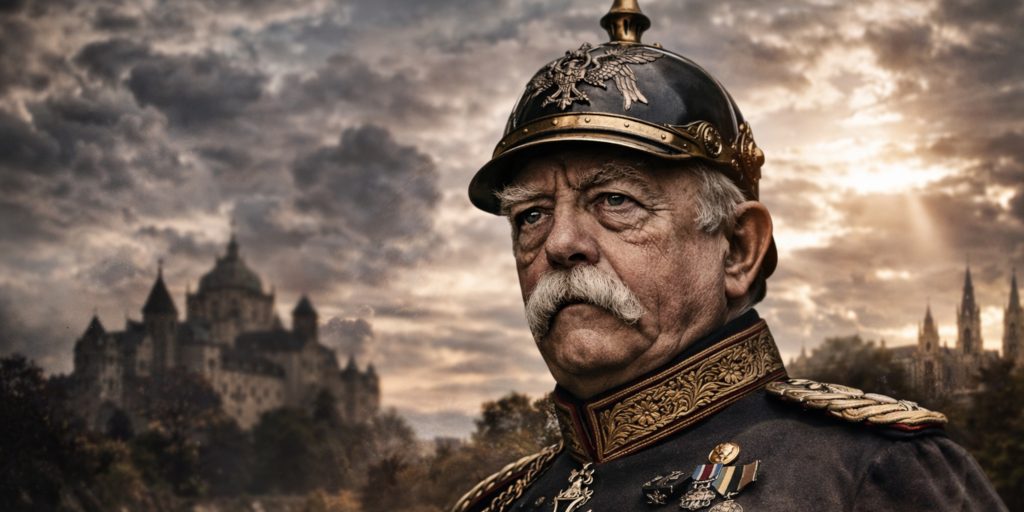
Wilhelm I became King of Prussia in 1861. With Bismarck as his minister-president, he oversaw the creation of the German Empire.
Bismarck fought three carefully chosen wars:
- Against Denmark in 1864
- Against Austria in 1866
- Against France in 1870 to 1871
Each victory increased Prussian influence.
In January 1871 Wilhelm I was proclaimed German Emperor in the Hall of Mirrors at Versailles. It was a scene of astonishing triumph and perhaps a touch of unnecessary provocation. Declaring a German Empire inside the most famous palace in France was unlikely to encourage lasting friendship.
The new empire was dominated by Prussia. The Hohenzollerns now ruled not merely Brandenburg or Prussia, but most of Germany.
The German Empire Under the Hohenzollerns
The German Empire from 1871 to 1918 was prosperous, industrial and powerful.
Germany became a leader in steel production, chemicals, science and industry. Berlin grew into one of Europe’s great capitals.
Yet the empire remained politically conservative. Real power rested with the emperor, the army and the aristocracy.
Wilhelm I ruled cautiously. Frederick III reigned for only ninety-nine days in 1888 before dying of cancer.
Then came Wilhelm II.
Wilhelm II and the Road to Disaster
Wilhelm II ruled from 1888 to 1918.
He was energetic, intelligent and utterly convinced of his own brilliance. Unfortunately, he was also impulsive, thin-skinned and rather too fond of dramatic speeches.
Wilhelm dismissed Bismarck in 1890 and pursued a more aggressive foreign policy. He expanded the navy, antagonised Britain and encouraged Germany to seek what he called a “place in the sun”.
The emperor loved uniforms so much that he seemed determined to collect every one in Europe.
Under Wilhelm II, Germany became increasingly isolated. The rigid military planning of the empire contributed to the outbreak of the First World War in 1914.
When the war began, many Germans rallied behind the emperor. By 1918 they were exhausted, hungry and disillusioned.
The war destroyed the prestige of the dynasty. Military defeat, revolution and economic collapse brought the empire to an end.
The Fall of the Hohenzollerns
On 9 November 1918 Wilhelm II abdicated.
Two days later he crossed into the Netherlands, where he lived in exile.
The German monarchy ended, and with it the rule of the Hohenzollerns.
It is a curious ending for such a dynasty. After centuries of war, ceremony, uniforms and imperial ambition, the final act was surprisingly quiet. No great last battle, no dramatic stand in Berlin. Merely a tired emperor boarding a train and leaving.
Legacy of the Hohenzollern Dynasty
The Hohenzollerns left a profound mark on Germany and Europe.
They created Prussia, unified Germany and transformed a fragmented region into one of the world’s great powers.
They also fostered a political culture that valued obedience, militarism and authority. These traditions shaped Germany long after 1918.
As a historian, I find the dynasty both fascinating and frustrating. The Hohenzollerns were extraordinarily capable. They built a state from almost nothing and sustained it for centuries. Yet they rarely understood that power needs restraint.
Again and again they mistook discipline for wisdom and military success for political insight. For a time it worked brilliantly. Then, in 1918, the whole grand edifice simply folded in upon itself.
The castle at Hohenzollern still stands above the Swabian hills. It is beautiful, theatrical and slightly overconfident, which, when one thinks about it, is rather fitting.