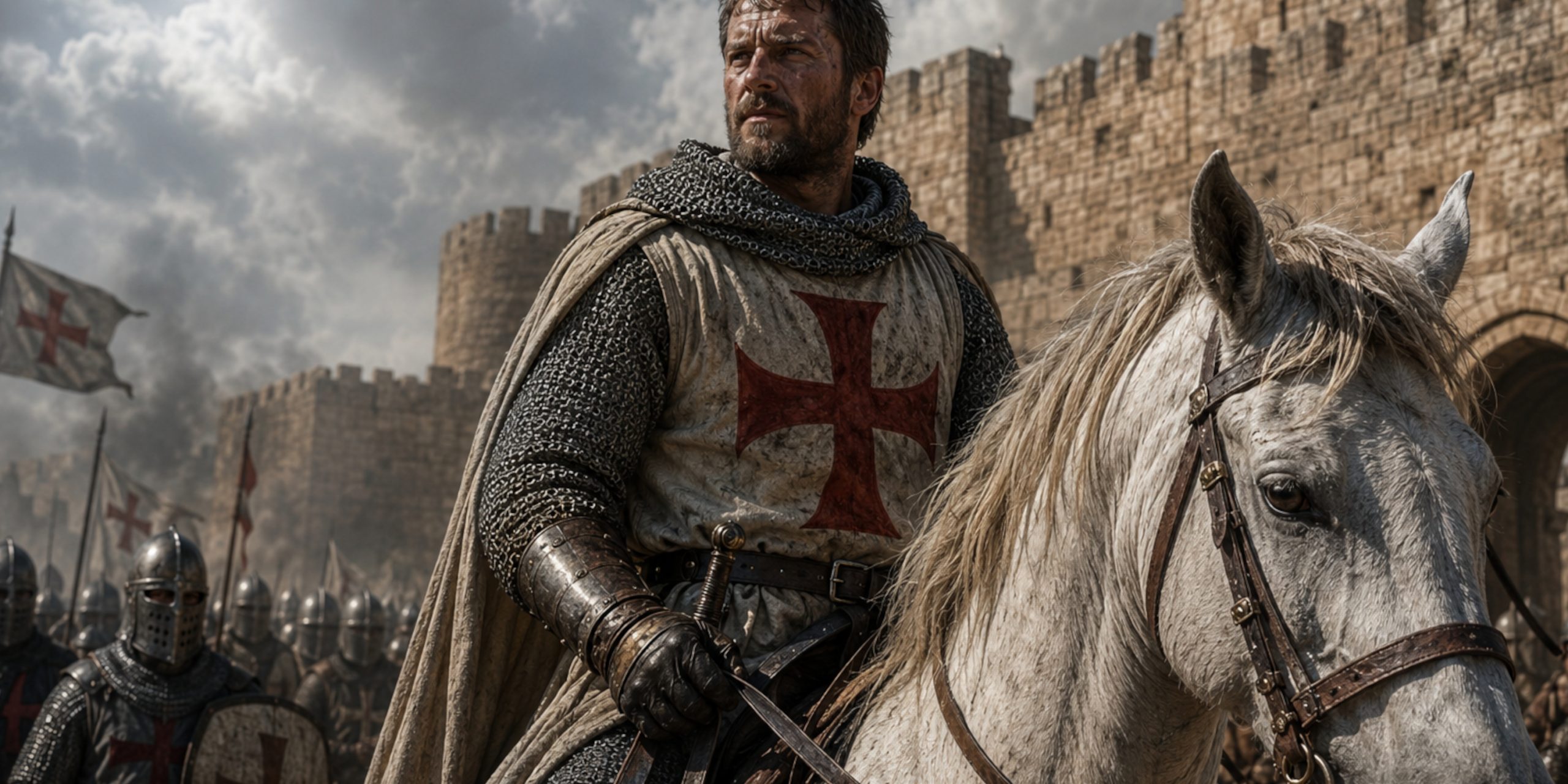
From Anjou To The Throne Of Jerusalem
Fulk of Jerusalem (c.1089 to 1143), also known as Fulk V of Anjou or Fulk the Younger, lived one of the more remarkable medieval careers. He began as a powerful French nobleman, became an experienced crusader, and eventually ruled one of the most politically fragile kingdoms of the 12th century.
He was not the romanticised knight of later stories, charging into every problem with a shining sword and questionable confidence. Fulk was something more useful: a patient organiser, experienced commander and political survivor. In the medieval world, where a poorly timed argument could end with a rebellion or a dagger, that was no small achievement.
His journey from western France to the Kingdom of Jerusalem also linked him to one of the most influential dynasties of the Middle Ages. Through his first marriage he was the father of Geoffrey Plantagenet, making him grandfather of Henry II of England and an ancestor of later English kings.
Early Life And Rise As Count Of Anjou
Fulk was born around 1089, the son of Fulk IV of Anjou and Bertrade de Montfort. The County of Anjou occupied a strategically important region of western France, constantly balancing relations with Normandy, France and neighbouring nobles.
When Fulk inherited Anjou in 1109, he inherited a difficult political landscape. His early rule was focused on:
- Strengthening Angevin authority
- Managing disputes with rival nobles
- Expanding influence through marriage and alliances
- Maintaining relations with the French crown
His first marriage to Ermengarde of Maine brought valuable territories and helped secure Angevin power.
Fulk gained a reputation as a practical ruler. Medieval chroniclers often praised warriors who performed spectacular feats, but the less glamorous skill of keeping a territory stable usually mattered more. Fulk understood that castles, marriages and diplomacy could achieve what swords sometimes could not.
First Crusading Experience
Fulk travelled to the Holy Land in 1120, joining the tradition of European nobles making armed pilgrimages after the First Crusade.
Unlike many crusaders who arrived briefly, fought, donated money and returned home with impressive stories, Fulk became seriously involved in defending the Crusader States.
He supported the military orders, particularly the Knights Templar during their early development. His wealth and influence helped strengthen Christian military organisation in the region.
This experience proved crucial. When he later returned as king, he was not arriving as a complete outsider.
Becoming King Of Jerusalem
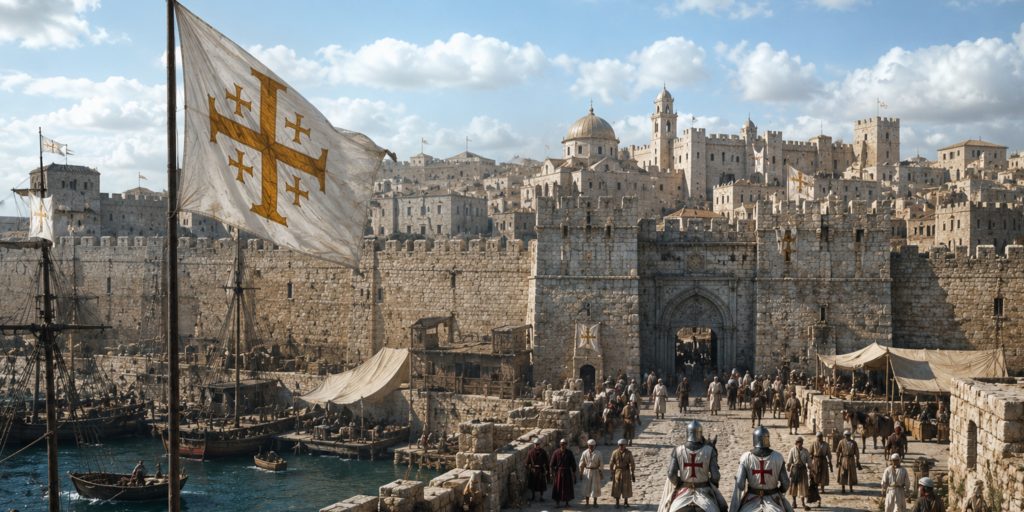
King Baldwin II of Jerusalem faced a succession problem. He had daughters but no male heir, and the kingdom needed a ruler capable of military command.
Fulk was selected as a suitable husband for Baldwin’s eldest daughter, Melisende. He was:
- Experienced in warfare
- Wealthy
- Politically connected
- Familiar with the Holy Land
Fulk married Melisende in 1129. When Baldwin II died in 1131, Fulk and Melisende became joint rulers of Jerusalem.
The arrangement was not immediately smooth. Fulk initially attempted to dominate royal authority, favouring his own Angevin supporters. The native nobility of the Crusader States resisted this, and Melisende proved herself a highly capable political figure.
After internal disputes, Fulk accepted a more balanced partnership. It remains one of the more interesting royal relationships of the Crusader period: two ambitious rulers discovering that neither was easy to push aside.
Battles And Military Acumen
Fulk’s military career was shaped less by dramatic battlefield victories and more by defensive strategy, castle construction and political warfare.
Key Conflicts And Campaigns
| Conflict | Date | Fulk’s Role | Outcome |
|---|---|---|---|
| Angevin conflicts in France | Early 1100s | Count and military leader | Strengthened Angevin position |
| Crusader campaigns in the Levant | From 1120 | Noble crusader and supporter | Built experience in eastern warfare |
| Defence against Zengi | 1130s to 1140s | King and commander | Maintained Jerusalem’s security |
| Campaigns around Antioch and northern Syria | 1130s | Political and military intervention | Protected Crusader influence |
Fulk Against Zengi
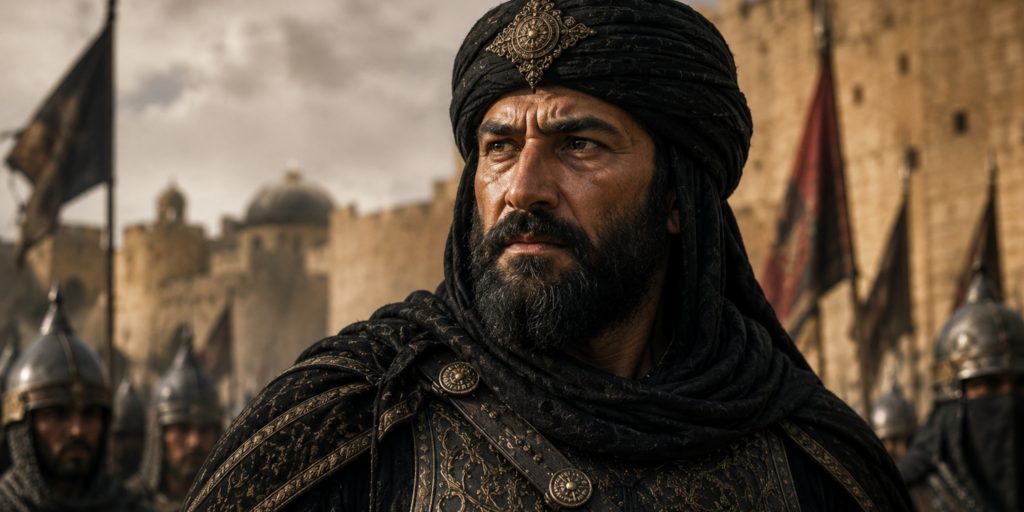
The greatest external threat during Fulk’s reign was Imad al-Din Zengi, ruler of Mosul and Aleppo.
Zengi was a dangerous opponent:
- Politically ambitious
- Militarily skilled
- Capable of uniting Muslim territories
- Experienced in siege warfare
Fulk recognised that Jerusalem could not rely purely on open battle. Instead, he focused on defensive depth.
His policies included:
- Strengthening castles
- Supporting frontier fortifications
- Maintaining alliances
- Responding quickly to threats
It was not the most glamorous medieval strategy. Nobody writes many heroic songs about good logistics, although perhaps they should. A reliable supply route often achieved more than a reckless cavalry charge.
Arms And Armour Of Fulk Of Jerusalem
Fulk lived during a transitional period of medieval warfare when knights were becoming increasingly professionalised.
As a wealthy noble and king, his equipment would have represented the highest standard of early 12th-century knightly arms.
Armour
Likely equipment included:
Mail Hauberk
- Knee-length interlinked iron mail armour
- Long sleeves
- Often included an integrated mail coif protecting the head and neck
- Flexible and effective against cuts
Helmet
Fulk likely used helmets such as:
- Nasal helmet
- Early enclosed helmet styles emerging among elite knights
Shield
Typical shields included:
- Long kite shield
- Wooden construction covered with leather
- Painted heraldic designs
The kite shield was particularly suited for mounted warfare, protecting the rider’s left side while allowing use of a lance.
Swords And Weapons Used
Fulk’s battlefield equipment would have followed the knightly traditions of France and the Crusader States.
Knightly Sword
The classic 12th-century knightly sword was his primary sidearm.
Features:
- Straight double-edged blade
- Cruciform guard
- Single-handed grip
- Optimised for cutting but capable of thrusting
Comparable sword classifications include:
- Oakeshott Type X
- Early Type XI swords
These were descendants of earlier Viking Age designs but adapted for the mounted knight.
Other Weapons
Fulk would also have used or commanded troops equipped with:
Lance
- Main weapon of heavy cavalry
- Used in mounted charges
Mace
- Effective against armoured opponents
Dagger
- Secondary battlefield weapon
Crossbow
- Increasingly important in Crusader warfare, especially for sieges and castle defence
Fulk’s Army In Jerusalem
The Kingdom of Jerusalem relied on a mixture of European and local military traditions.
| Unit Type | Equipment | Battlefield Role |
|---|---|---|
| Knights | Mail, sword, lance, shield | Heavy cavalry shock attacks |
| Sergeants | Spears, swords, lighter armour | Supporting cavalry and infantry |
| Crossbowmen | Crossbows, helmets, padded armour | Missile support |
| Turcopoles | Light armour, bows, spears | Mobile warfare and scouting |
| Castle garrisons | Mixed equipment | Defence and patrol duties |
The Crusader armies were often smaller than imagined. Their survival depended heavily on mobility, fortifications and careful leadership.
Relationship With The Knights Templar
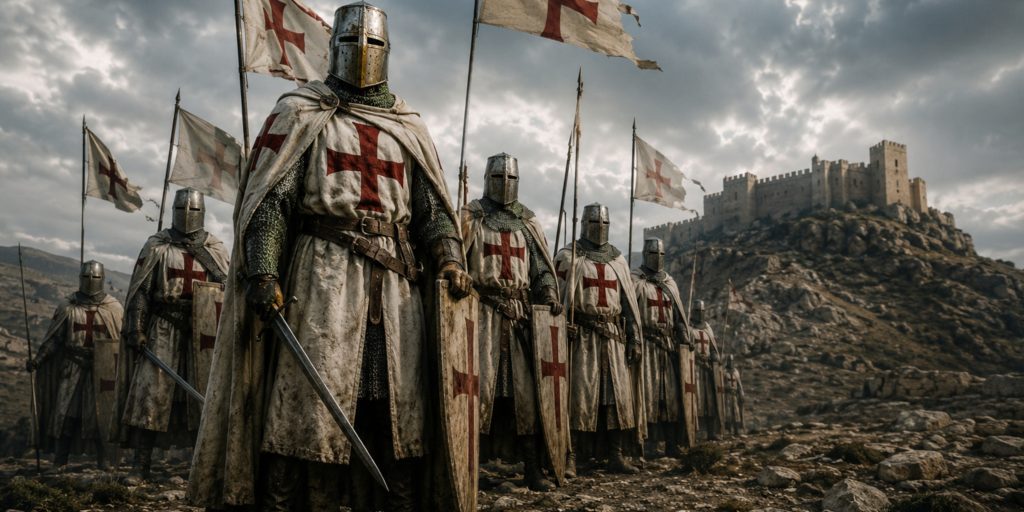
Fulk was closely associated with the rise of the Knights Templar.
The order had only recently been founded, and powerful supporters were essential. Fulk provided financial support and helped strengthen their position.
During his reign, military orders became increasingly important because they offered something medieval kingdoms desperately needed: permanent professional soldiers.
A king could call nobles to war, but convincing everyone to stay after the glory faded was rather harder.
Death Of Fulk
Fulk died in 1143 after a hunting accident near Acre.
According to William of Tyre, his horse stumbled while chasing a hare, throwing him violently. His saddle struck his head, causing fatal injuries.
For a ruler who survived wars, political rivalries and the dangers of crusading, being defeated by a small animal and an unlucky fall feels almost unfairly medieval.
His son Baldwin III eventually succeeded him, while Melisende remained a major political force.
Contemporary Quotes
The most important source for Fulk’s reign is William of Tyre, writing later in the 12th century.
On Fulk’s character, William described him as:
“A man of experience in warfare, patient and wise.”
William also noted his physical presence:
“He was ruddy like David, faithful and gentle, affable and kind.”
As with many medieval writers, William mixed history with moral judgement, so his descriptions should be read carefully rather than accepted as a perfect portrait.
Artefacts Connected To Fulk’s Reign And Where To See Them
No confirmed personal sword, armour or royal equipment belonging directly to Fulk survives.
However, several museums preserve objects that represent the world he ruled.
Tower Of David Museum, Jerusalem
Holds material connected to:
- Medieval Jerusalem
- Crusader fortifications
- The political landscape of the Crusader Kingdom
Israel Museum, Jerusalem
Collections include:
- Medieval archaeological finds
- Crusader-period objects
- Weapons and architectural remains
Metropolitan Museum Of Art, New York
Important for comparative examples:
- 12th-century European swords
- Mail armour
- Medieval knightly equipment
Musée de Cluny, Paris
Contains:
- Medieval French artefacts
- Religious objects
- Material culture from the world of Angevin nobility
Latest Archaeology And Research
Modern archaeology has transformed understanding of Fulk’s Jerusalem.
Important areas include:
Crusader Castles
Research into castles such as Kerak, Belvoir and other fortifications has revealed:
- Sophisticated defensive planning
- Adaptation to Middle Eastern conditions
- Blending of European and local construction techniques
Although not all were built directly by Fulk, they represent the military system developing during and around his reign.
Jerusalem Excavations
Archaeological work has revealed:
- Crusader-period streets
- Churches and religious buildings
- Imported European objects
- Evidence of trade networks
These discoveries show the kingdom was not simply a military colony. It was a complex society where Latin Christians, Eastern Christians, Muslims and Jewish communities interacted in complicated ways.
Legacy: How Good Was Fulk Of Jerusalem?
Fulk rarely receives the attention given to figures such as Richard the Lionheart or Saladin, partly because his achievements were quieter.
His strengths were:
- Defensive strategy
- Political negotiation
- Administrative experience
- Understanding the importance of castles and alliances
His weaknesses included:
- Early tensions with local nobles
- Underestimating Melisende’s authority
- Limited ability to stop the long-term rise of Zengi’s power
Looking at him as a historian, Fulk feels less like a legendary crusading hero and more like a working medieval ruler. He inherited dangerous problems, solved some, managed others and left a kingdom still standing.
In the 12th century, that alone was a fairly impressive achievement. History tends to remember the kings who won spectacular battles, but sometimes the most valuable rulers were the ones who simply stopped everything from falling apart.