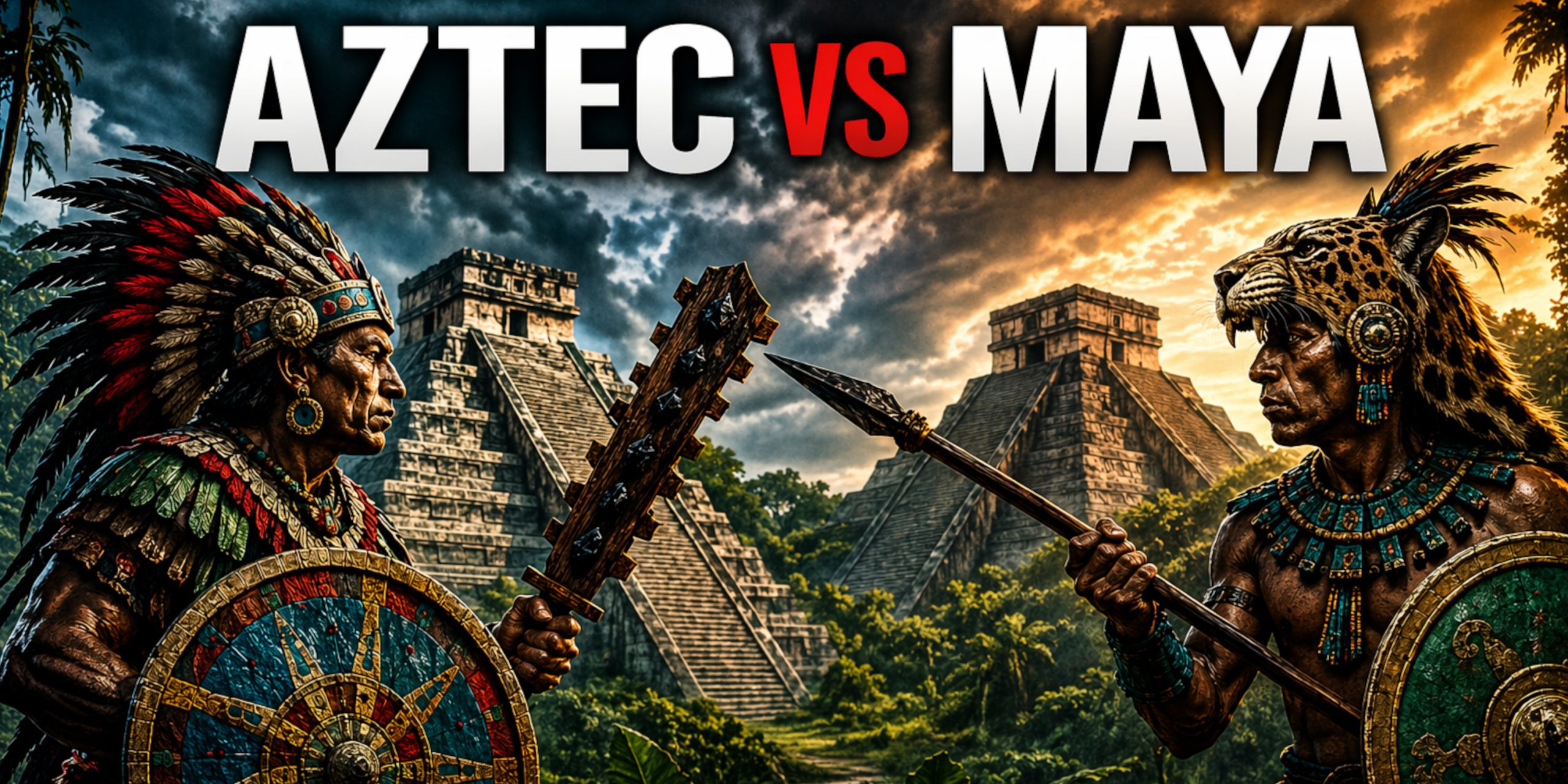
The Aztecs and the Maya are often bundled together in popular culture, usually somewhere between a feathered headdress and a man in a pith helmet confidently getting everything wrong. In reality, they were very different societies, separated by centuries of development, geography and military priorities.
Their weapons reflected that difference.
Aztec armies were built for expansion, intimidation and the taking of prisoners. Maya warfare was often more fragmented and regional, with city-states fighting one another in conflicts that could simmer for generations. Both used fearsome obsidian blades, spears and missile weapons, but the way they used them could be dramatically different.
What survives today comes from archaeology, Spanish accounts, carved monuments, murals and the rather inconvenient fact that wood, cloth and leather tend not to survive five hundred years in tropical conditions. Even so, enough remains to build a surprisingly vivid picture.
Aztec and Maya Warfare at a Glance
| Feature | Aztec Warfare | Maya Warfare |
|---|---|---|
| Main Period | c. 1325–1521 | c. 250–900 for the Classic Maya, with warfare continuing later |
| Political Structure | Large empire dominated by Tenochtitlan | Independent city-states and kingdoms |
| Main Goal of War | Expansion, tribute and taking captives | Territory, dynastic rivalry and prestige |
| Preferred Weapons | Macuahuitl, atlatl, spears | Spears, bows, obsidian blades, atlatls |
| Armour | Quilted cotton armour, shields, helmets | Cotton armour, shields and some animal-hide protection |
| Tactical Style | Large organised armies with elite warrior societies | Smaller forces, ambushes, raids and siege warfare |
The Aztecs fielded larger, more structured armies. Maya warfare could be every bit as brutal, but was often more localised. A Maya ruler might spend years fighting a rival city only a few miles away. Aztec emperors, by contrast, tended to think in terms of conquering entire regions.
The Aztec Macuahuitl Versus Maya Bladed Weapons
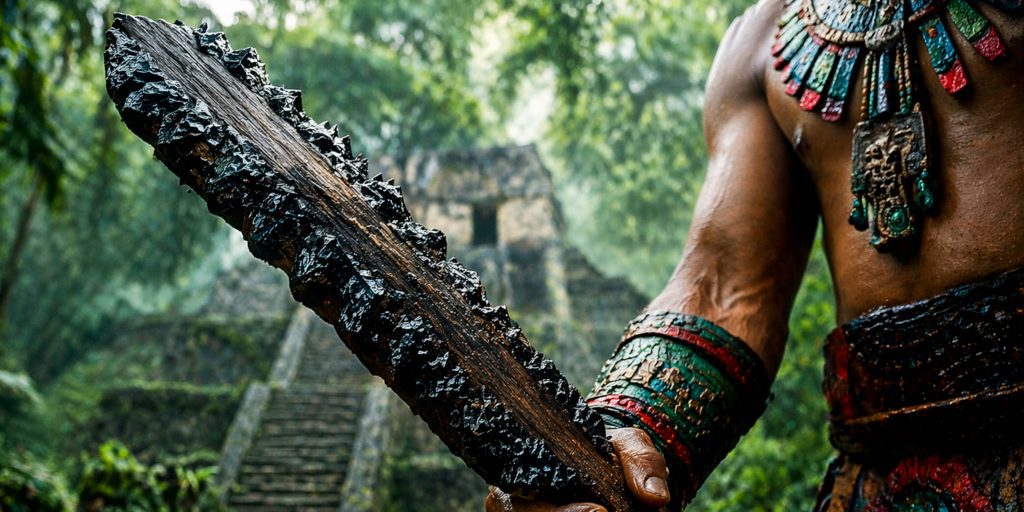
The most famous Aztec weapon was the macuahuitl, a flat wooden club edged with razor-sharp obsidian blades.
It looked vaguely like a cricket bat designed by someone with a profound grudge.
Spanish chroniclers claimed it could decapitate a horse. That may have been a little theatrical, although Spanish writers were not generally known for understatement when trying to explain why they were losing men to what they had assumed would be an easy campaign.
The macuahuitl was devastating in close combat. Obsidian is sharper than steel, though far more brittle. A strike could tear flesh horribly, but repeated blows could snap the obsidian inserts.
The Maya also used obsidian-edged clubs and knives, though their weapons were often shorter and less standardised. Maya warriors tended to rely more heavily on spears and missile weapons, with bladed clubs serving as secondary arms.
| Weapon | Aztec Version | Maya Version |
| Obsidian Club | Large two-handed or one-handed macuahuitl | Smaller obsidian-edged clubs |
| Knife | Flint or obsidian sacrificial and combat knives | Similar obsidian and flint knives |
| Use | Main battlefield weapon | Often secondary to spear and bow |
Archaeological finds from central Mexico and Maya sites in Guatemala and Yucatán show remarkably similar obsidian technology. The difference lies less in the material and more in how it was used.
The Aztecs built an entire military culture around the macuahuitl. The Maya did not.
Spears and Polearms
Both civilisations used spears extensively.
The Maya probably relied on them more.
Maya warriors commonly carried long thrusting spears and lighter throwing spears. Murals from Bonampak show warriors with long spears tipped with obsidian or flint. These weapons suited the more fluid, often smaller-scale fighting of Maya warfare.
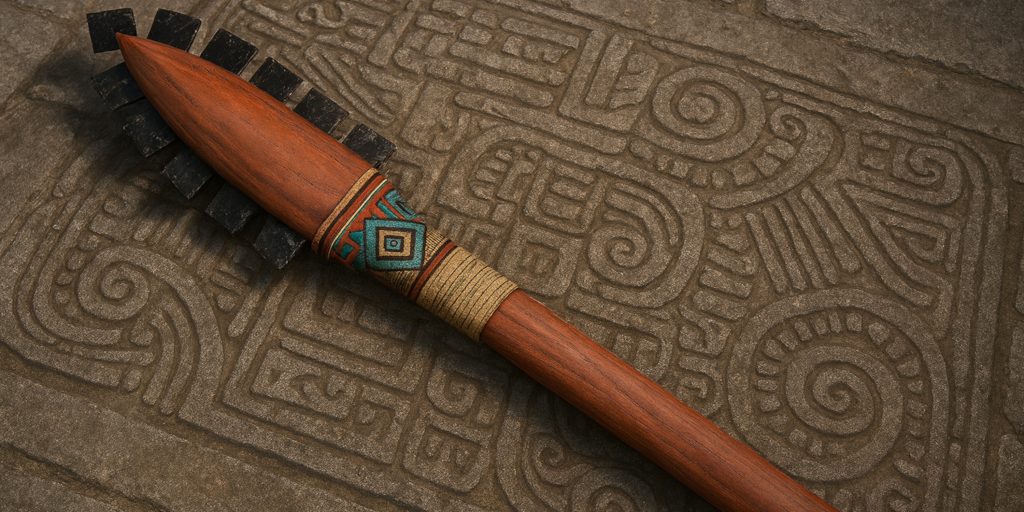
The Aztecs also used spears, known as tepoztopilli when fitted with a broad obsidian blade. The tepoztopilli was somewhere between a spear and a halberd. It could thrust, slash and hook.
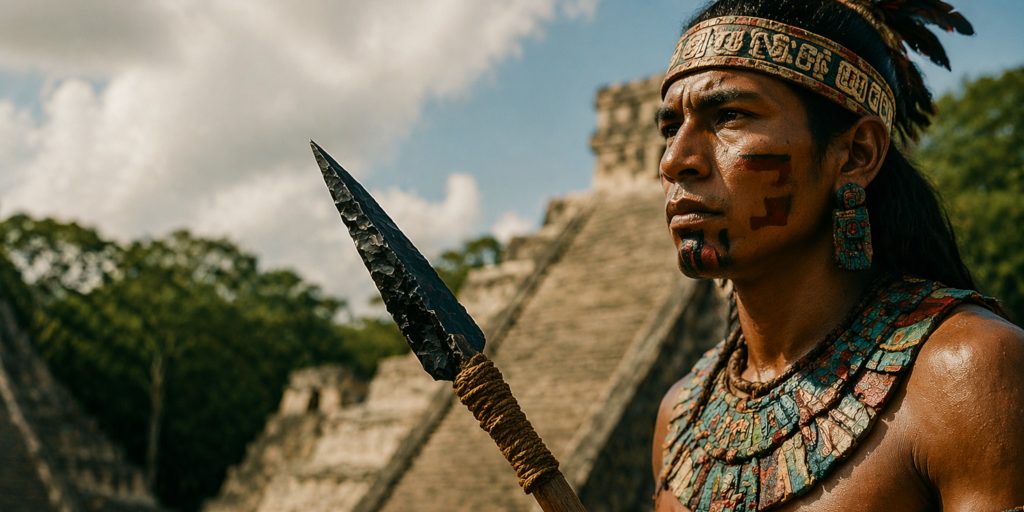
| Weapon | Aztec Tepoztopilli | Maya Spear |
| Length | Up to 2 metres | Often 1.5 to 2.5 metres |
| Head | Broad obsidian-edged blade | Flint or obsidian point |
| Best Use | Formations and close combat | Thrusting, skirmishing and throwing |
The Aztec version was generally heavier and designed for use in massed formations. Maya spears were often lighter and more flexible.
Atlatls and Missile Weapons
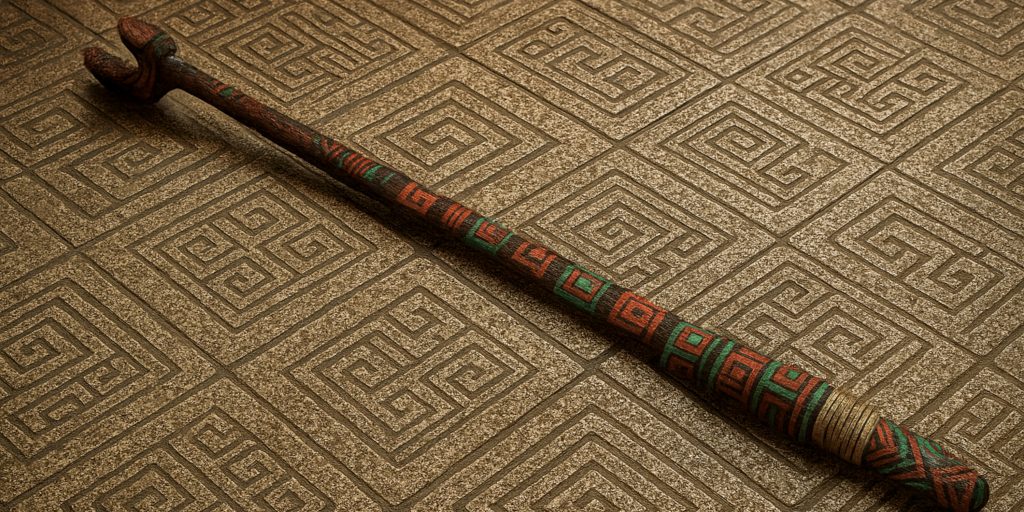
One of the deadliest weapons used by both peoples was the atlatl, a spear-thrower that increased the power and range of a dart.
An atlatl could send a dart through armour at surprising distance. Spanish soldiers described them with a mixture of fascination and alarm, which is usually the tone one adopts when something just lodged itself in one’s shoulder.
The Aztecs used the atlatl widely, especially among elite warriors. It often appears in codices and carvings.
The Maya also used atlatls, though there is evidence that bows became increasingly important during the later Maya period.
| Weapon | Aztecs | Maya |
| Atlatl | Common, prestigious, used by elites | Used, especially in earlier periods |
| Bow and Arrow | Less important than spear and atlatl | More common, especially later |
| Sling | Used by some troops | Also widely used |
This may be the clearest military difference between the two.
The Maya increasingly embraced the bow and arrow. The Aztecs never made it the centrepiece of their armies. Aztec warfare still favoured the dramatic rush into close combat, preferably with enough shouting to terrify everyone within earshot.
Armour and Shields
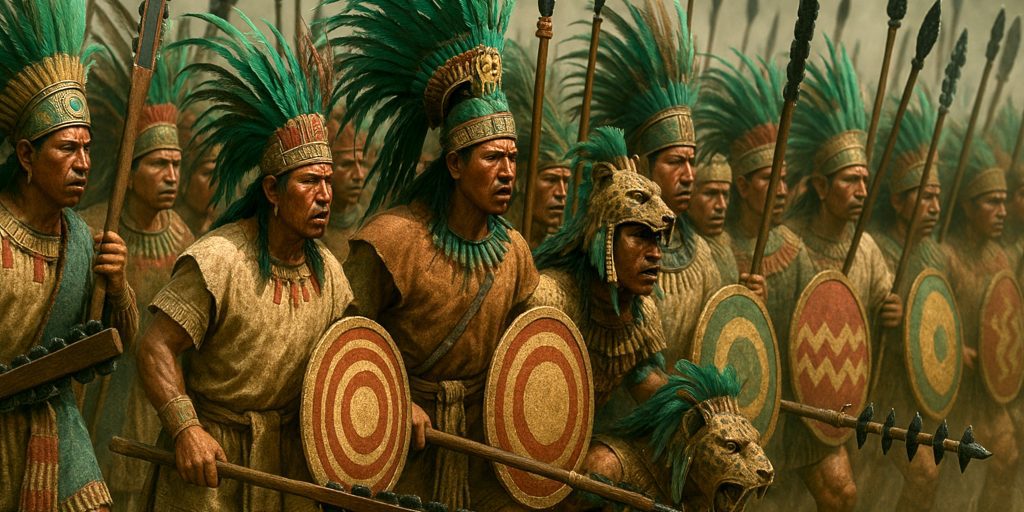
Neither the Aztecs nor the Maya used metal armour. Instead they relied on quilted cotton armour, shields and impressive confidence.
Aztec ichcahuipilli, a padded cotton cuirass, was surprisingly effective. Spanish soldiers occasionally adopted it because it was lighter and cooler than steel armour in the Mexican climate. There is something faintly humiliating about travelling across an ocean in polished plate armour only to decide that the local cotton jacket is actually the better idea.
Maya armour was broadly similar but often lighter. Some Maya warriors also used jaguar skins, animal hides or heavy cloth.
| Armour Type | Aztec | Maya |
| Quilted Cotton Armour | Common | Common |
| Wooden Shields | Yes, often richly decorated | Yes |
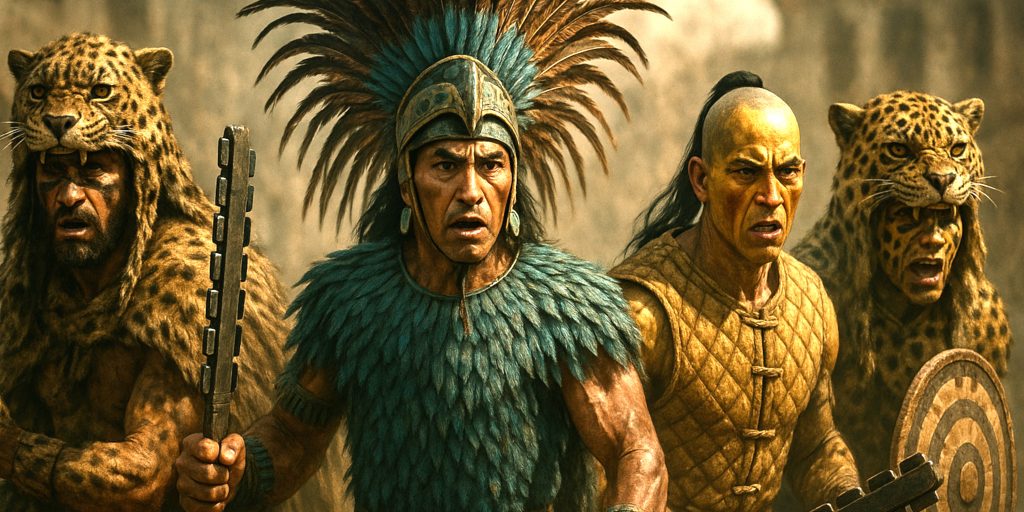
| Helmets | Animal-themed elite helmets | Less elaborate, though some elite headgear existed |
Aztec shields, or chimalli, were highly decorative and often marked rank or military society. Maya shields appear in murals and carvings but were generally smaller and simpler.
Battles and Battlefield Tactics
Aztec Battle Tactics
Aztec armies fought in large formations with a clear chain of command. Elite warrior societies such as the Jaguar and Eagle warriors formed the core of the assault.
The goal was not always to kill the enemy outright. Capturing prisoners for sacrifice and prestige was often more valuable.
This shaped Aztec weapons.
The macuahuitl and other obsidian-edged weapons could wound and disable as effectively as they could kill. An Aztec warrior who captured an enemy gained status. One who simply hit everyone in sight and lost track of the prisoners was missing the point somewhat.
One of the best-known examples is the so-called Flower Wars between the Aztecs and neighbouring states such as Tlaxcala. These conflicts were partly ritualised and partly deadly. It was warfare with rules, although not rules one would especially wish to experience.
Maya Battle Tactics
Maya warfare was often less formal and more flexible.
City-states launched raids, ambushes and sieges. Kings personally led armies, and monuments proudly recorded victories, captives and dynastic humiliation.
Classic Maya warfare often focused on capturing rival rulers rather than annihilating armies. The capture of a king could collapse an entire kingdom.
The murals at Bonampak show scenes of chaotic close combat, prisoners being stripped and nobles paraded in defeat. It is difficult to look at them without realising that Maya warfare could be every bit as savage as anything seen in Aztec Mexico.
One famous Maya conflict was the long struggle between the kingdoms of Calakmul and Tikal. These two powers fought for dominance across centuries, using alliances, raids and repeated campaigns.
Archaeology: What Has Actually Been Found?
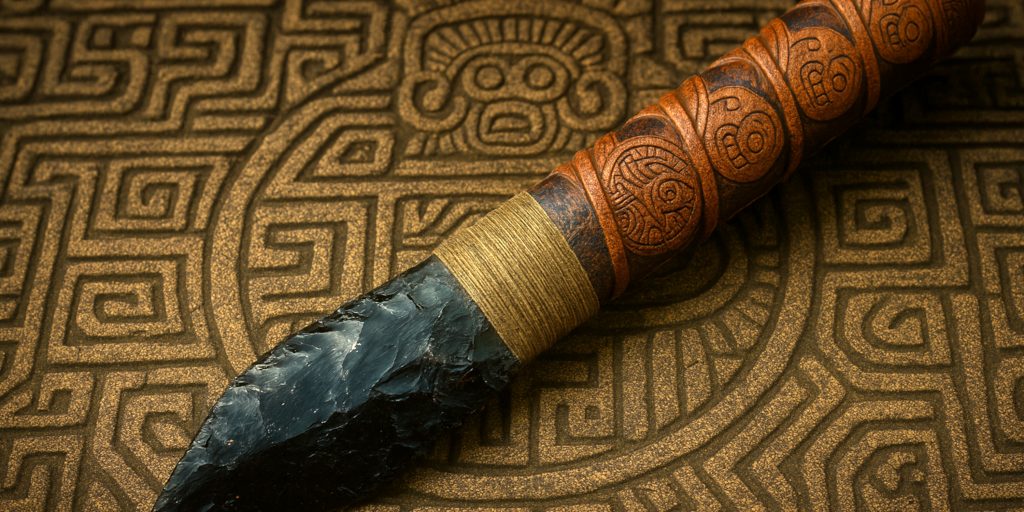
The archaeology of Aztec and Maya weapons is frustrating because so many weapons were made partly from wood.
Wood rots. Obsidian survives.
As a result, archaeologists often find the blade fragments without the weapon that once held them.
At Aztec sites such as Tenochtitlan, excavations have uncovered:
- Obsidian blades from macuahuitl and tepoztopilli
- Flint and obsidian knives
- Decorative shield elements
- Armour fragments and military costume pieces
- Sculptures showing armed warriors
Maya sites such as Bonampak, Tikal and Copán have revealed:
- Spear points and obsidian blades
- Murals showing warriors in action
- Stone carvings of kings carrying weapons
- Burials containing knives and ceremonial arms
- Fortifications, walls and defensive earthworks
The murals at Bonampak are particularly valuable because they show Maya warfare in vivid detail. Warriors carry spears, shields and feathered costumes. Prisoners kneel before victorious rulers. Nobody appears to be having a particularly pleasant afternoon.
Contemporary Quotes
Spanish observers left some of the most vivid descriptions of Aztec weapons.
Bernal Díaz del Castillo wrote of the macuahuitl:
“They wielded swords which cut like razors.”
Hernán Cortés described Aztec missile weapons and armour as effective and surprisingly dangerous.
“They carry shields and wear quilted armour, which is so strong that a crossbow cannot pierce it easily.”
For the Maya, later Spanish sources and indigenous accounts describe fierce fighting and raids between rival kingdoms.
The Maya text known as the Popol Vuh contains a striking description of conflict and warrior identity:
“They were all warriors and they went to battle.”
Like most ancient military boasts, it is wonderfully confident and perhaps a little selective about what happened next.
Which Weapons Were Better?
The answer depends entirely on the kind of war being fought.
Aztec weapons were better suited to large organised armies and close-quarter fighting. The macuahuitl and tepoztopilli were ideal for brutal clashes in formation.
Maya weapons were often more versatile. Greater use of bows, lighter spears and mobile tactics gave Maya armies flexibility in raids and skirmishes.
If one were standing in an open field facing an advancing Aztec line, the Maya bow might suddenly seem very appealing.
If, on the other hand, an Aztec warrior with a macuahuitl had already closed the distance, it would probably feel a little late for such thoughts.
Seven Swords Takeaway
Aztec and Maya weapons shared the same materials and some of the same ideas, particularly the use of obsidian, wood and cotton armour. Yet they belonged to different worlds.
Aztec warfare was imperial, disciplined and theatrical. Its weapons were designed for conquest and the taking of captives.
Maya warfare was local, political and deeply tied to the rivalry of city-states. Maya weapons reflected that reality, favouring flexibility and missile fire.
Both civilisations created weapons that were remarkably effective despite the lack of metal. They remind us that military technology is not simply about the hardest material. It is about adapting to the battlefield, the enemy and the society behind the weapon.
The Aztecs and the Maya did exactly that, though perhaps with rather more obsidian than most people would consider reasonable.