The Elder Scrolls V: Skyrim was released on 11 November 2011. Fifteen years later, we are somehow still talking about it, playing it, modding it and occasionally waking up in a cart next to Ralof.
At this point, Skyrim has lasted longer than entire console generations. Bethesda has released it across multiple generations of hardware, expanded it with official DLC, bundled hundreds of Creation Club additions into the Anniversary Edition and opened the game further through its Creations platform.
More importantly, Skyrim has become the yardstick against which The Elder Scrolls VI will eventually be measured.
That sequel is no longer a logo attached to a distant promise. Bethesda confirmed in July 2026 that The Elder Scrolls VI is its primary development focus, with the majority of its development team working on the game and playable builds being used internally.
So this feels like a good moment to return to Skyrim and ask a slightly ridiculous question.
Why are we still here?
Skyrim at a Glance
Detail
Information
Developer
Bethesda Game Studios
Publisher
Bethesda Softworks
Original release
11 November 2011
Series
The Elder Scrolls
Setting
Skyrim, Tamriel
Genre
Open-world action RPG
Engine
Creation Engine
Major expansions
Dawnguard, Hearthfire, Dragonborn
Current major edition
Skyrim Anniversary Edition
Latest major platform expansion
Nintendo Switch 2
Sequel
The Elder Scrolls VI
TES VI release date
Not announced
The basic structure remains wonderfully simple. You arrive in Skyrim as a prisoner, discover you are Dragonborn and are presented with an urgent existential threat.
You can then completely ignore it for 80 hours because somebody mentioned a suspicious cave.
That freedom remains Skyrim’s greatest strength.
Why Skyrim Still Works
Plenty of games have bigger maps, better combat and prettier mountains now. Few have reproduced Skyrim’s particular mixture of exploration, atmosphere and distraction.
The world constantly nudges you away from whatever you intended to do.
You head towards Whiterun.
You see a ruin.
The ruin contains bandits.
The bandits have a note.
The note mentions a cave.
The cave contains something Dwemer.
Three hours later you are underground, carrying seventeen cheese wheels and have absolutely no memory of why you originally left Riverwood.
That sounds silly, but it is also very clever world design.
Skyrim does not depend entirely upon scripted quest chains to create momentum. Geography itself generates curiosity. Mountains, towers, forts, tomb entrances and distant settlements continually give the player something else to investigate.
Its open world feels less like a checklist and more like a place you are allowed to get lost in.
The Freedom to Build Almost Any Character
Skyrim abandoned the rigid traditional class selection of earlier RPGs. Instead, characters develop largely through the skills they actually use.
Want to become a heavily armoured warrior?
Wear heavy armour and hit things.
Want to become a mage?
Use magic.
Want to become a stealth archer?
You probably already have.
The skill system encourages experimentation because the game rarely demands that you commit permanently to a particular archetype at the beginning.
Playstyle
Core Skills
Typical Weapons
Warrior
One-Handed, Two-Handed, Block, Heavy Armour
Sword, axe, mace, greatsword
Stealth Archer
Archery, Sneak, Light Armour
Bow, dagger
Assassin
Sneak, One-Handed, Illusion
Dagger, sword
Battlemage
Destruction, Conjuration, Heavy Armour
Magic, sword
Spellsword
One-Handed, Destruction, Restoration
Sword and spell
Pure Mage
Destruction, Alteration, Conjuration
Magic
Paladin-style build
Heavy Armour, Block, Restoration
Sword and shield
The system is not perfectly balanced. Smithing, Enchanting and Alchemy can turn an apparently normal adventurer into Tamriel’s answer to an industrial weapons programme.
But breaking Skyrim is arguably part of playing Skyrim.
For Seven Swords readers, this is where things get particularly interesting.
Skyrim has an enormous arsenal of swords, axes, bows, daggers, maces and fantasy weapons. Its weapon design borrows freely from historical material while pushing almost everything towards heroic fantasy.
Iron and Steel Swords
These are among the game’s more restrained designs. Their straight double-edged blades, guards and pommels loosely recall European medieval swords, although proportions and construction are exaggerated.
Nordic Weapons
Nordic designs lean heavily into the popular fantasy interpretation of Viking material culture. They are considerably more elaborate than most historical Scandinavian weapons.
Actual Viking Age swords tended to be comparatively clean in silhouette, with decoration concentrated around the hilt rather than covering every available surface with spikes.
Fantasy has standards to maintain, apparently.
Imperial Swords
Imperial weapons incorporate visual cues associated with Roman equipment, particularly the gladius, although they remain unmistakably fantasy designs rather than historical reconstructions.
Elven Weapons
Long, curved profiles and ornate detailing separate Elven equipment from human weaponry. Practicality has politely left the room by this stage.
Daedric Weapons
Daedric swords are deliberately aggressive, asymmetrical and intimidating.
Nobody has ever looked at a Daedric sword and thought, “that seems sensible.”
That is rather the point.
Unique Swords
Some of Skyrim’s most memorable blades include:
Dawnbreaker
Dragonbane
Chillrend
Nightingale Blade
Harkon’s Sword
Miraak’s Sword
Bloodskal Blade
Windshear
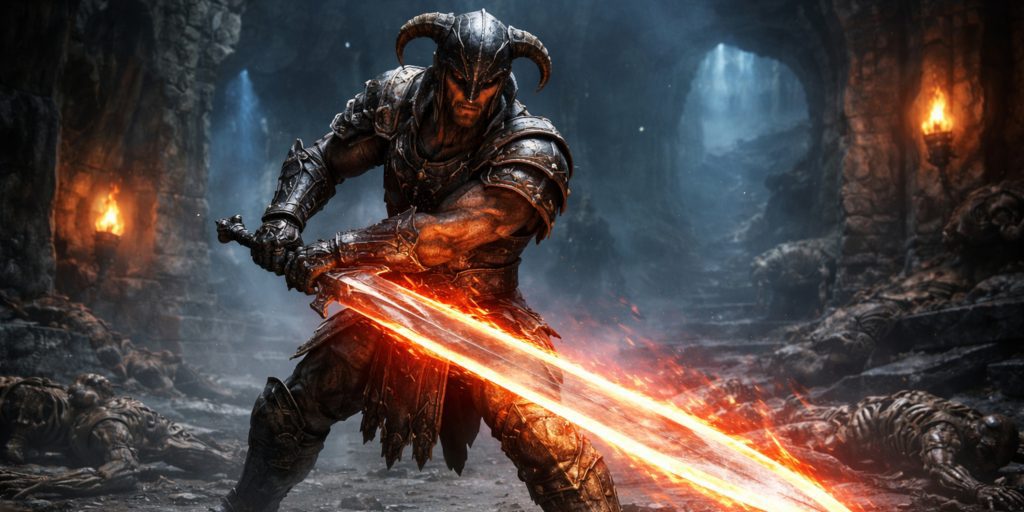
Many have become almost as recognisable as the Dragonborn’s horned helmet.
The Expansions Changed Skyrim More Than People Remember
Skyrim’s three official expansions substantially broadened the original game.
Dawnguard
Dawnguard introduced a conflict between vampire hunters and the Volkihar vampire clan.
It added new locations, weapons, armour, enemies and the ability to become a Vampire Lord.
It also introduced Serana, who promptly became one of the most popular companions Bethesda has ever created.
Hearthfire
Hearthfire was considerably quieter.
Players could purchase land, construct houses, furnish them and adopt children.
In a game about dragons consuming the world, Bethesda correctly realised that what players really wanted was property development.
Dragonborn
Dragonborn was the most substantial expansion.
It took players to Solstheim, an island previously explored in The Elder Scrolls III: Morrowind’s Bloodmoon expansion.
The expansion introduced Miraak, the first Dragonborn, alongside new equipment, enemies, locations and Dragon Shouts.
It remains some of Skyrim’s strongest official content.
What Is Skyrim Anniversary Edition?
Bethesda released Skyrim Anniversary Edition in November 2021 to mark the game’s tenth anniversary.
It combines Skyrim Special Edition with the three official expansions and a large collection of Creation Club material.
Bethesda lists 74 included Creations containing more than 500 individual elements, including quests, weapons, armour, houses and other additions.
Some additions are surprisingly substantial.
They include new questlines, survival mechanics, fishing, armour sets, weapons, spells, enemies and locations.
This makes Anniversary Edition the closest thing Skyrim currently has to a definitive official package.
Skyrim Creations and the Modern Modding Scene
Mods are arguably the single biggest reason Skyrim has survived for so long.
Bethesda formalised its modern approach in December 2023 by introducing Bethesda Game Studios Creations.
The system combined the previous Mods and Creation Club menus into a unified Creations interface while allowing approved creators to sell certain content.
The accompanying update also added PC improvements including ultrawide monitor support and Steam Deck support.
Traditional free modding remains enormously important, particularly on PC.
Players have created:
New regions
Quest campaigns
Combat systems
Survival mechanics
Graphical overhauls
New weapons and armour
Followers
Cities
Magic systems
UI replacements
Complete gameplay overhauls
At its most extreme, modded Skyrim barely resembles the game Bethesda released in 2011.
Skyrim on Nintendo Switch 2
Skyrim found another home in December 2025 when Bethesda released Skyrim Anniversary Edition for Nintendo Switch 2.
Yes, Todd did it again.
The Switch 2 version includes the base game, Dawnguard, Dragonborn, Hearthfire and hundreds of Creation Club items, alongside technical improvements for Nintendo’s newer hardware.
There is a running joke that Bethesda will port Skyrim to anything capable of producing an image.
Bethesda continues to provide supporting evidence for this theory.
How Big Is Skyrim in 2026?
Skyrim’s longevity is now backed by some rather absurd sales figures.
In July 2026, Bethesda stated that the game had sold more than 65 million copies.
That puts Skyrim among the bestselling video games ever released.
More revealing than the raw number is the fact that Bethesda is still commercially supporting it nearly fifteen years after launch.
The original game has effectively become a platform of its own.
The Elder Scrolls VI: The Latest Official Update
Now we arrive at the dragon in the room.
The Elder Scrolls VI was announced at E3 in June 2018 with a short teaser showing a mountainous landscape.
And then Bethesda asked everyone to become extremely patient.
For years, concrete information was almost nonexistent.
That situation has finally changed.
In July 2026, Bethesda Game Studios confirmed that The Elder Scrolls VI is now its primary development focus.
The studio stated that the majority of its team is currently working on the game.
More significantly, Bethesda said the game is being developed using Creation Engine 3, a new shared technology platform created following Starfield.
According to Bethesda, the developers are happy with how The Elder Scrolls VI currently looks and are playing it every day.
That does not mean release is imminent.
It does mean TES VI is now a functioning game under substantial production rather than the distant pre-production project it was for much of the period following its announcement.
Xbox Executives Have Seen The Elder Scrolls VI Running
There are further signs of progress.
Xbox executive Matt Booty confirmed in 2026 that he had visited Bethesda, sat with Todd Howard and seen The Elder Scrolls VI running. He described development as progressing well while stressing that Bethesda wants to wait for the appropriate moment before conducting a full reveal.
Then, in August 2026, Xbox executive Asha Sharma publicly discussed seeing a live playthrough of the game.
That is quite a leap from the lonely mountain teaser of 2018.
It also suggests Bethesda is deliberately keeping the game private rather than having nothing substantial to show.
Considering what happened when the company announced TES VI approximately one geological age before release, that restraint is understandable.
When Will The Elder Scrolls VI Be Released?
There is still no confirmed release date.
This is worth emphasising because speculative release windows have been circulating online for years.
Bethesda itself has not announced a year.
Todd Howard has repeatedly indicated that he prefers shorter marketing cycles, and Bethesda demonstrated just how far it is willing to take that philosophy with the surprise 2025 release of The Elder Scrolls IV: Oblivion Remastered.
So a lengthy TES VI marketing campaign is not guaranteed.
What we can reasonably say in August 2026 is:
The game is in active development
It is Bethesda Game Studios’ main development priority
The majority of the team is working on it
Playable builds exist
Senior Xbox executives have seen it running
It uses Creation Engine 3
Bethesda has not announced a release date
Bethesda has not officially confirmed the setting
Anything much more specific belongs in the speculation pile.
Where Will The Elder Scrolls VI Be Set?
This may be the most analysed coastline in gaming history.
Fans have spent years examining the landscape shown in the 2018 teaser, with Hammerfell frequently proposed as the most likely setting. High Rock has also appeared repeatedly in fan theories.
Neither should currently be treated as confirmed.
Bethesda has revealed remarkably little about the game’s geography, story, factions or historical period.
Until Bethesda names the province, Hammerfell remains an attractive theory rather than established fact.
For a series built around exploring mysterious worlds, perhaps that is appropriate.
It is also driving Elder Scrolls lore fans slightly mad.
What Elder Scrolls VI Needs to Learn From Skyrim
Skyrim’s success creates a peculiar problem for Bethesda.
Simply producing Skyrim with better graphics probably will not be enough.
The next game needs to preserve what made Skyrim special while addressing areas where the 2011 design now shows its age.
Exploration
This should remain the priority.
Skyrim succeeds because players constantly discover places and stories they were never explicitly told to find.
More Reactive NPCs
Modern RPGs have raised expectations considerably. Characters, settlements and factions need to react more convincingly to player decisions.
Becoming leader of every organisation in the province while nobody particularly notices would feel rather strange now.
Better Melee Combat
Sword fighting has never been Bethesda’s strongest system.
For a fantasy RPG containing hundreds of weapons, Skyrim’s melee combat is surprisingly basic.
TES VI has an opportunity to introduce better blocking, weapon weight, reach, enemy reactions and animation without turning the game into a hardcore combat simulator.
Meaningful Factions
Joining competing organisations should involve actual consequences.
Skyrim sometimes allows the Dragonborn to accumulate important titles like someone collecting supermarket loyalty cards.
Keep the Weirdness
This matters.
The Elder Scrolls universe contains vanished races, living gods, unreliable history, metaphysical arguments, Daedric princes and an enormous brass god capable of breaking reality.
Bethesda should resist sanding all that down into generic fantasy.
Tamriel is interesting because Tamriel is weird.
Is Skyrim Still Worth Playing in 2026?
Yes, although the answer depends on what you expect from it.
The combat can feel dated. Character animation shows its age. NPC behaviour occasionally resembles an elaborate experiment involving confused mannequins.
Yet the fundamental experience remains remarkably strong.
Few RPGs are as comfortable allowing the player simply to exist within their world.
You can hunt.
You can explore.
You can collect books.
You can become an assassin.
You can hunt vampires.
You can build a house.
You can study magic.
You can spend three hours organising ingredients into different cupboards.
Nobody said being Dragonborn had to involve dragons.
For newcomers, Anniversary Edition provides the broadest official package. PC players also have access to an enormous modding ecosystem capable of modernising almost every aspect of the experience.
Skyrim’s Legacy
Skyrim changed expectations around open-world RPGs.
Its influence can be seen in the emphasis modern games place on exploration, emergent discovery and worlds that allow players to wander away from their objectives.
Not every part of Skyrim has aged gracefully. Some systems were already simplistic in 2011. The combat lacks depth, faction progression can feel rushed and Bethesda’s familiar collection of bugs has become part criticism, part folklore.
But Skyrim’s greatest achievement was never technical perfection.
It created somewhere people wanted to return to.
Fifteen years later, that distinction matters.
The Elder Scrolls VI will eventually replace Skyrim as Bethesda’s current vision of Tamriel. Based on the company’s 2026 updates, that transition is finally beginning to look real.
Until then, there is another character build to start.
This one definitely won’t become a stealth archer.
Probably.
Sources
Bethesda Game Studios, July 2026 Official studio update confirming The Elder Scrolls VI as Bethesda’s primary development focus, the use of Creation Engine 3, majority-team development and regular internal play.
Bethesda Game Studios Official Skyrim Anniversary Edition information covering the base game, Dawnguard, Hearthfire, Dragonborn and Creation Club content.
Bethesda Support Anniversary Edition content documentation confirming 74 Creations and more than 500 individual pieces of additional content.
Bethesda Game Studios, December 2023 Official Skyrim Special Edition Creations update and patch notes covering the unified Creations menu, Steam Deck support, ultrawide support and Creation Kit changes.
Bethesda Game Studios, December 2025 Official announcement of Skyrim Anniversary Edition for Nintendo Switch 2.
PC Gamer, June and August 2026 Reporting on the development status of The Elder Scrolls VI and Xbox executives seeing playable builds.
“Skyrim belongs to the Nords, and to anyone with a thirst for adventure.”