Baldur’s Gate 3 has a refreshingly dangerous attitude towards player freedom. It lets you negotiate with monsters, betray apparently important allies, throw enemies from rooftops and accidentally ruin your romantic prospects by choosing the wrong sentence at a party. Sometimes all four happen before lunch.
Developed by Larian Studios and based on the fifth edition rules of Dungeons & Dragons, this is a turn-based role-playing game built around choice. Its most impressive achievement is not the enormous map, lavish cinematics or exhausting number of spells. It is the way the game reacts when the player does something unexpected.
Plenty of RPGs promise that your decisions matter. Baldur’s Gate 3 appears genuinely curious about what terrible decision you will make next.
After substantial post-release support, including official mod integration, expanded endings, Honour Mode, cross-play, photo mode and twelve additional subclasses, this is also a more complete game than it was at launch. A few rough edges remain, particularly during the crowded final act, but they do little to diminish what Larian achieved.
Verdict: Baldur’s Gate 3 is one of the finest modern role-playing games. It is intelligent, funny, emotionally generous and almost irresponsibly replayable.
| Category | Score |
|---|---|
| Story and writing | 9.5/10 |
| Companions | 10/10 |
| Combat | 9/10 |
| Exploration | 9.5/10 |
| Presentation | 9/10 |
| Technical performance | 8/10 |
| Overall | 9.5/10 |
What Is Baldur’s Gate 3 About?

The opening is not gentle. Your character wakes aboard a mind flayer ship after having a parasitic tadpole inserted behind one eye. The parasite should transform its host into another mind flayer, which is medically inconvenient and rather poor for the complexion.
After the ship crashes, you discover other survivors carrying the same parasite. The group begins searching for a cure, but the tadpoles are behaving strangely. Transformation does not occur, mysterious powers begin to emerge, and an expanding religious cult appears to be connected to the infection.
The story develops across three large acts:
| Act | Setting and focus |
|---|---|
| Act One | The wilderness, Emerald Grove, goblin territories and the Underdark |
| Act Two | The Shadow-Cursed Lands, Moonrise Towers and the history of the Absolute |
| Act Three | Rivington and the city of Baldur’s Gate |
This begins as a desperate hunt for treatment and gradually develops into a conflict involving gods, devils, ancient powers and several people who should never have been trusted with political authority.
It is possible to understand the main plot without knowing previous Baldur’s Gate games or Dungeons & Dragons. Returning players will recognise characters, factions and pieces of Forgotten Realms history, but the game does not require three decades of homework before allowing anyone through the door.
A Story That Actually Responds to You
The strongest part of Baldur’s Gate 3 is its willingness to accommodate different approaches.
A guarded settlement might be entered through persuasion, disguise, stealth, violence or accidental involvement in somebody else’s crime. A hostile character may become an ally. A potential companion may be killed before joining the party. Major quests can disappear because an important person met the sharp end of a sword twenty hours earlier.
The system is not infinitely flexible, of course. Every branching story eventually meets the boundaries of recorded dialogue, scripted scenes and developer sanity. Yet those boundaries are remarkably distant.
Dialogue checks use visible dice rolls modified by skills, attributes, spells and situational bonuses. Failure does not always mean reloading. It can produce a different conversation, a new fight or a consequence that follows the party much later.
This makes failure interesting, which is an unusually confident design choice. I am still emotionally opposed to rolling a natural one during an important conversation, but at least the resulting catastrophe usually makes a good story.
The narrator, performed by Amelia Tyler, deserves particular praise. Her delivery can be ominous, amused, intimate or quietly judgmental. The last of those feels entirely deserved when the player has just licked something that clearly should not be licked.
Character Creation and Role-Playing
Players can create a custom protagonist, select a pre-written Origin character or play as the Dark Urge, an Origin with a customisable appearance and a considerably less reassuring personal history.
Character creation includes:
- Twelve main classes
- Numerous subclasses
- Multiclassing
- Playable races and subraces
- Backgrounds that influence proficiencies and inspiration
- Extensive appearance and identity options
- Several voices and body types
A fully custom character offers the cleanest space for personal role-playing. Choosing an Origin character provides greater access to that companion’s private motivations, but it removes much of their usual voiced presence.
The Dark Urge sits somewhere between the two. It allows visual customisation while adding a personal storyline built around violent impulses and missing memories. It can support either a heroic struggle against those instincts or a spectacular descent into villainy.
Class choice affects far more than combat. Bards can talk their way through absurd situations. Barbarians receive wonderfully direct dialogue options. Druids can speak to animals while transformed into animals, which feels like showing professional credentials. Paladins must also live with an oath system that can punish behaviour inconsistent with their chosen principles.
Not every class receives the same volume of special dialogue, but there are enough tailored responses to make a character’s background feel relevant.
The Companions Are the Real Heart of the Game

The central plot may involve an existential threat, but the companions give it emotional weight.
The main party includes:
- Shadowheart, a secretive cleric devoted to Shar
- Lae’zel, a fiercely disciplined githyanki warrior
- Astarion, a charming rogue carrying two centuries of trauma
- Gale, a gifted wizard with a catastrophic magical condition
- Wyll, a celebrated hero bound to a devil
- Karlach, a tiefling barbarian with an infernal engine in place of a heart
Additional characters can join later, depending on the player’s choices.
These companions are not merely sets of combat abilities waiting at camp. They disagree with decisions, develop relationships with each other and pursue personal goals that can collide with the main story. Their approval can open new conversations, friendships, romances and confrontations.
The writing is strongest when it allows a character to be contradictory. Astarion can be manipulative and deeply vulnerable. Lae’zel is abrasive but shaped by a culture built upon obedience and conquest. Shadowheart’s guarded sarcasm conceals a crisis of identity. Gale can explain terrifying magical concepts with the slightly wounded expression of a man whose dinner invitation has been declined.
Some romances can develop rather quickly, although later patches corrected several overenthusiastic approval triggers. Camp still occasionally has the energy of a theatre group stranded together after the last train home. Everyone is intense, attractive and one conversation away from making the evening complicated.
Turn-Based Combat That Rewards Improvisation

Combat adapts the structure of fifth edition Dungeons & Dragons. Characters use actions, bonus actions, movement, reactions, spell slots and class resources during turn-based encounters.
The rules can appear intimidating at first, particularly for players unfamiliar with tabletop role-playing. Terms such as Armour Class, concentration, advantage and saving throws arrive in quick succession. The interface provides explanations, but the opening hours still involve a certain amount of staring at tooltips and pretending everything is under control.
Once understood, the system is wonderfully flexible.
Positioning matters. High ground can improve ranged attacks, narrow passages can be blocked and vulnerable characters can be protected behind tougher party members. Environmental surfaces allow fire, water, ice, acid and electricity to interact. Objects can be moved, stacked, broken or thrown.
A typical encounter might involve:
- Coating the ground in grease and setting it alight
- Shoving an enemy from a ledge
- Dropping a suspended object onto a group below
- Silencing a spellcaster
- Using darkness to disrupt ranged attackers
- Throwing an improvised weapon
- Transforming an enemy into a sheep
- Discovering that the sheep remains a surprisingly serious problem
The game encourages experimentation, although it occasionally rewards preparation so strongly that entering combat through dialogue feels like a tactical mistake. Characters who begin a fight in conversation may lose the opportunity to spread out or claim high ground. Apparently polite introductions are not always optimal military doctrine.
Enemy turns can also become slow during larger battles, particularly when numerous summoned creatures or allied NPCs are involved. The combat remains excellent, but its enthusiasm for complexity sometimes exceeds its sense of pace.
Exploration and Environmental Storytelling

The world is divided into large, densely constructed regions rather than one continuous open map. This proves to be a sensible choice. Very little space feels like decorative padding.
Paths curl above and beneath one another. Caves connect to cellars, hidden doors reveal forgotten chambers and apparently minor buildings can contain substantial quests. The Underdark is especially effective, combining bioluminescent beauty with the persistent suspicion that every mushroom is planning something.
Exploration is supported by jumping, climbing, teleportation, transformation and spells such as Misty Step, Fly and Feather Fall. Parties can reach areas through routes that initially seem unintended, although Larian often has a reward waiting there. The developers apparently anticipated players stacking crates to reach suspicious windows. This is either remarkable foresight or evidence of long-term exposure to their own audience.
Speak with Animals and Speak with Dead deserve special mention. Animals have their own arguments, ambitions and minor criminal enterprises. Corpses may reveal clues, identify murderers or refuse to speak to the person who killed them. Disguise spells can sometimes resolve that final issue, because death has rules but not especially sophisticated identity checks.
Weapons, Swords and Magical Equipment
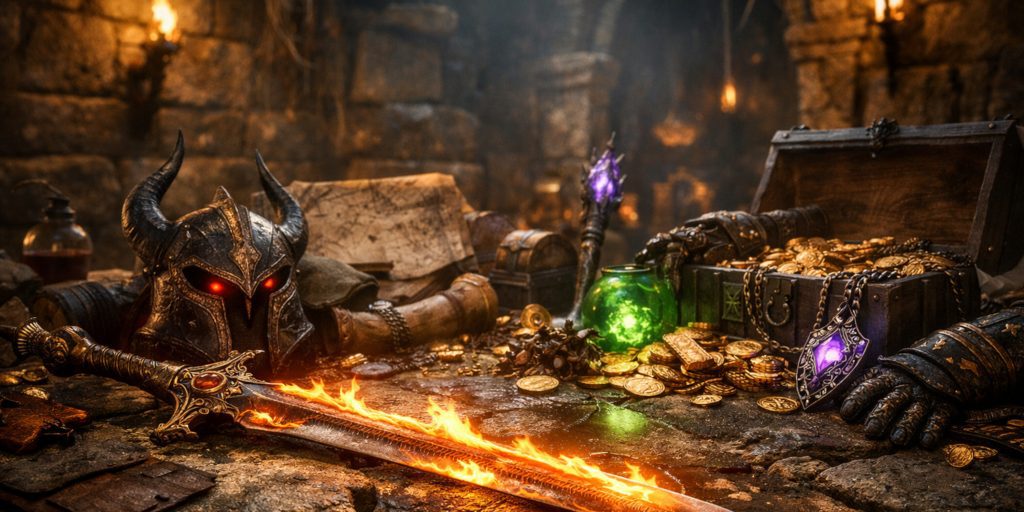
Equipment in Baldur’s Gate 3 is more interesting than a simple climb through higher damage numbers. Many weapons support particular builds, spells or tactical combinations.
| Weapon | Type | Why it stands out |
|---|---|---|
| Phalar Aluve | Finesse longsword | Uses its melody to strengthen allies or weaken nearby enemies |
| Sword of Screams | Rapier | Adds psychic damage to weapon attacks |
| Blood of Lathander | Mace | Provides powerful radiant abilities and can prevent its wielder from falling in battle |
| Everburn Blade | Greatsword | Deals additional fire damage and can be acquired unusually early |
| Soulbreaker Greatsword | Greatsword | A githyanki weapon with psychic abilities and an initiative bonus |
| Duellist’s Prerogative | Rapier | Supports one-handed duelling with additional reactions and attacks |
| Balduran’s Giantslayer | Greatsword | A formidable late-game weapon designed for fighting large opponents |
| Sorrow | Glaive | Grants the Sorrowful Lash bonus action and suits control-focused builds |
Some equipment remains useful across several acts because its special effect complements a build. A modest-looking ring may be more valuable than an ornate suit of armour if it applies the right condition at the right moment.
The fantasy designs are lavish, but the weapon categories retain recognisable differences. Rapiers favour precise finesse builds, greatswords support heavy two-handed damage, glaives offer reach and longswords provide versatility. Historical realism sensibly leaves the room once blades begin singing and maces start producing sunlight.
Visual Design and Performance
The facial animation and cinematic direction are crucial to the game’s appeal. Conversations are framed like scenes rather than static exchanges between character models. Small expressions add meaning to performances that might otherwise be lost in a game with such a large script.
The environments range from sunlit forests and ancient ruins to corrupted battlefields, subterranean cities and the crowded streets of Baldur’s Gate. The final city is especially rich in detail, although its density contributes to some of the game’s technical strain.
Act Three was the least polished section at launch. Updates have improved performance and corrected many quest problems, but it can still feel more cumbersome than the earlier acts. Crowded streets, overlapping objectives and background NPC behaviour create visual and mechanical noise.
Other persistent irritations include:
- Party members choosing awkward routes
- Characters failing to jump after the rest of the group
- Camera problems across multiple elevations
- Inventory management becoming tedious
- Important scenes occasionally triggering in an odd order
- Controller radial menus becoming crowded at higher levels
None of these ruins the game. They do occasionally remind you that an astonishingly complex machine is being held together behind the scenery, possibly by one exhausted wizard and several emergency patches.
How Good Is the Writing?
The writing balances horror, tragedy, romance and comedy without treating the world as a continuous joke. Its humour usually emerges from personality or circumstance rather than constant self-aware dialogue.
More importantly, Baldur’s Gate 3 allows sincere moments to remain sincere. Characters discuss faith, abuse, autonomy, mortality and the fear of becoming something unrecognisable. Several companion stories concern people reclaiming control from gods, masters, families or institutions that have defined their lives.
The game can occasionally overstate the scale of everything. By its final act, the player is managing personal crises, political conspiracies and multiple threats to reality while apparently being the only person available to investigate local murders. Baldur’s Gate may have guards, but their delegation policy is extraordinary.
The sheer number of branching paths also means some scenes receive more development than others. Minor characters may vanish from the story, while certain late-game choices feel compressed compared with the careful build-up that precedes them.
Even so, the quality remains unusually high for a game carrying this many narrative possibilities.
Multiplayer and Co-op
Up to four players can explore together, each controlling a custom or Origin character. This changes the tone considerably.
A solo campaign allows one player to shape conversations, companion relationships and party composition. Multiplayer introduces the possibility that somebody else will start a fight while you are shopping, steal an important object or advance a quest while half the party is examining hats.
This can be extremely funny, but it also weakens some of the more intimate storytelling. Companion slots may be occupied by player characters, leaving less space for the cast. Important conversations can also occur while another player is elsewhere.
Cross-play now allows players on PC, Mac, PlayStation 5 and Xbox Series consoles to share multiplayer campaigns through the Larian Network. Groups using mods need compatible versions installed, so a heavily modified campaign requires more coordination.
For a first playthrough, I prefer solo play or a two-player campaign. Four-player co-op is brilliant chaos, but chaos is not known for carefully reading dialogue.
Difficulty Settings and Honour Mode
The game provides several difficulty options:
| Mode | Best suited to |
|---|---|
| Explorer | Players mainly interested in story and exploration |
| Balanced | A mixture of narrative and tactical challenge |
| Tactician | Experienced players seeking tougher encounters |
| Honour Mode | Players willing to accept a single save and deadlier bosses |
| Custom | Players who want to adjust individual difficulty settings |
Honour Mode adds legendary actions to major enemies and limits the campaign to a single save file. A failed party can end the run or be continued without the Honour Mode completion reward.
It is tense, occasionally unfair and capable of turning a minor mistake into a funeral. It also exposes how deep the combat system can be when saving and reloading are no longer available as informal magical powers.
Custom Mode is arguably the most useful addition for ordinary players. It allows the challenge to be adjusted without forcing everyone into the same definition of difficulty.
Patch 8 and the Current Version
Larian released Patch 8 in April 2025 as the game’s final major content update. It added:
- Cross-play between PC, Mac, PlayStation 5 and Xbox
- Photo mode
- Split-screen support on Xbox Series S
- Twelve new subclasses
- Further bug fixes and interface improvements
- Expanded tools for supported mods
The new subclasses are:
- Path of the Giant Barbarian
- College of Glamour Bard
- Death Domain Cleric
- Circle of Stars Druid
- Arcane Archer Fighter
- Way of the Drunken Master Monk
- Oath of the Crown Paladin
- Swarmkeeper Ranger
- Swashbuckler Rogue
- Shadow Magic Sorcerer
- Hexblade Warlock
- Bladesinging Wizard
Patch 8 did not add a new campaign, expansion or major companion storyline. Larian has said that no further substantial narrative content is planned, although smaller hotfixes have continued.
The current version is therefore the best point at which to judge the game. Its systems have been expanded, many launch problems have been corrected and official mod support gives returning players more reasons to experiment.
What Baldur’s Gate 3 Does Best
Its greatest strengths are closely connected.
- Choices produce visible and sometimes delayed consequences
- Companions have strong personal stories and excellent performances
- Combat allows creative solutions beyond straightforward attacks
- Exploration consistently rewards curiosity
- Classes provide distinct mechanical and conversational identities
- Side quests are often as carefully written as the main plot
- Failure can produce new stories rather than simple dead ends
- The world respects both heroic and villainous role-playing
The game is especially good at remembering small actions. A rescued character can reappear much later. A decision made during an apparently local dispute may alter the population of an entire area. Even when the final outcome is similar, the route towards it can feel personal.
Where It Falls Short
For all its brilliance, Baldur’s Gate 3 is not a perfectly controlled experience.
The third act is overcrowded. Once the party reaches the city, major quests compete for attention and urgency becomes difficult to read. The story insists that several disasters are imminent while still inviting the player to investigate missing pigeons.
Inventory management is functional but tiresome. Four characters accumulate weapons, scrolls, potions, keys, camp supplies and pieces of armour at alarming speed. Sorting them feels less like heroic preparation and more like clearing a shared student kitchen.
The level cap of twelve also means progression slows during the final act. This prevents high-level Dungeons & Dragons spells from destroying the campaign’s balance, but it can make late-game experience rewards feel less meaningful.
The game’s freedom can produce tonal oddities too. A companion may react intensely to one decision while ignoring another that seems far more serious. This is the unavoidable price of branching narrative, but some seams are visible.
Is Baldur’s Gate 3 Good for Newcomers?
Yes, although the opening hours require patience.
You do not need experience with earlier Baldur’s Gate games. You also do not need to understand tabletop Dungeons & Dragons. The game explains its rules, and Explorer difficulty provides room to learn them.
New players should remember a few things:
- Save regularly
- Long rest more often than you think
- Speak to companions at camp
- Examine enemies before attacking
- Use the environment
- Accept that failed rolls can be interesting
- Do not worry about constructing a perfect build immediately
- Keep several different damage types available
Respeccing becomes available early and is inexpensive. Experimentation is expected. The game would much rather let you rebuild a character than punish you for selecting the wrong feat while still learning what a feat is.
Is Baldur’s Gate 3 Still Worth Playing?
Absolutely.
Players who enjoy story-rich RPGs, tactical combat and character-driven adventures will find an enormous amount here. A first campaign can easily exceed 80 hours, while players exploring side quests thoroughly may pass 100. Alternative classes, romances, alliances and moral choices make subsequent campaigns meaningfully different.
It may be less suitable for anyone who dislikes turn-based combat, dense interfaces or lengthy conversations. This is not an action RPG disguised with a few dialogue wheels. Battles require thought, characters enjoy talking and books exist mainly to tempt people who already have too much to read.
The game also asks players to tolerate a certain amount of disorder. Quests overlap, inventories swell and plans collapse because somebody missed a dice roll. That disorder is part of its character.
Final Verdict
Baldur’s Gate 3 succeeds because it treats player curiosity as something to reward rather than manage. It builds an elaborate fantasy world, fills it with characters worth caring about and then allows the player to interfere with almost everything.
Its combat is imaginative, its performances are exceptional and its best decisions can feel genuinely uncomfortable. Act Three remains less elegant than the opening sections, while inventory management appears to have been designed by a minor god of administrative punishment. Those flaws are real, but they sit inside one of the richest RPGs ever made.
I expected the game’s scale to impress me. What stayed with me was its attentiveness. It notices who you helped, what you said and which principles you abandoned when a more interesting reward appeared.
Final score: 9.5/10
Baldur’s Gate 3 is ambitious enough to let players wreck its plans and clever enough to make the wreckage feel like a story.
Baldur’s Gate 3 Review FAQ
How long does Baldur’s Gate 3 take to complete?
A focused campaign generally takes around 60 to 80 hours. Exploring companion stories and side quests can push a playthrough beyond 100 hours.
Do I need to play Baldur’s Gate 1 and 2 first?
No. Knowledge of the earlier games adds context to returning characters and factions, but the central story stands on its own.
Is Baldur’s Gate 3 an open-world game?
Not in the conventional sense. It uses several large, open-ended regions filled with branching routes, quests and hidden areas.
Can Baldur’s Gate 3 be played solo?
Yes. Solo play provides the fullest access to companions and gives one player control over the party. Multiplayer is optional.
Does Baldur’s Gate 3 have cross-play?
Yes. Cross-play supports multiplayer between PC, Mac, PlayStation 5 and Xbox Series consoles.
Does Baldur’s Gate 3 support mods?
Yes. Official mod support is available, including an in-game mod manager. The range of supported mods varies by platform.
Is Baldur’s Gate 3 difficult?
Balanced difficulty can be challenging until its rules become familiar. Explorer Mode reduces the pressure, while Custom Mode allows individual settings to be adjusted.
Can you continue playing after the ending?
There is no full post-game world after the final sequence. The expanded epilogue shows the consequences of major decisions, but unfinished quests cannot then be resumed.
Will Baldur’s Gate 3 receive DLC?
Larian has stated that it is not developing a major expansion or new narrative campaign for the game. Patch 8 was its final major content update.
Official update details were checked against Larian’s Patch 8 announcement and its two-year community update.