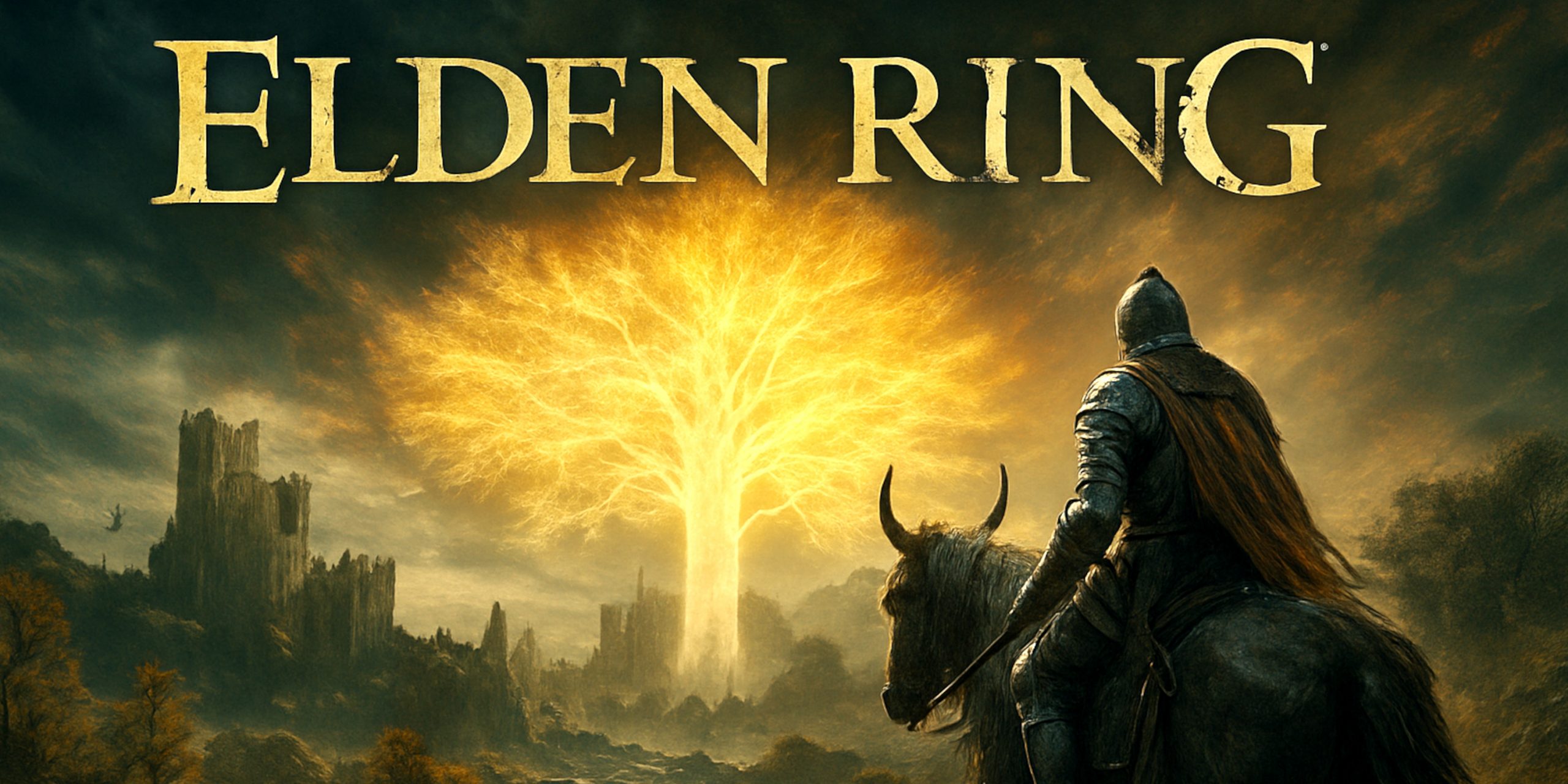
Few games have made me feel quite as clever and quite as stupid within the same five-minute period as Elden Ring.
One moment I am piecing together an obscure quest from three lines of dialogue and congratulating myself on apparently having the deductive abilities of Sherlock Holmes. The next, I am being repeatedly murdered by something that looks suspiciously like an angry bird.
That contrast is a large part of why Elden Ring works.
Released in 2022, FromSoftware’s open-world action RPG took the combat and deliberately obscure storytelling of Dark Souls and placed them inside a world enormous enough to disappear into. George R.R. Martin contributed to the underlying mythology, Hidetaka Miyazaki directed the game, and somehow the collaboration produced something that feels unmistakably like FromSoftware rather than Dark Souls: Westeros Edition.
Years later, after Shadow of the Erdtree expanded the game and Elden Ring Nightreign took the series in a different direction, the original deserves another look.
Is Elden Ring still worth playing?
Absolutely. I would also argue that time has made its weaknesses easier to see.
| Review | Verdict |
|---|---|
| Developer | FromSoftware |
| Publisher | Bandai Namco Entertainment |
| Director | Hidetaka Miyazaki |
| Original release | 25 February 2022 |
| Genre | Open-world action RPG |
| Platforms | PC, PS4, PS5, Xbox One, Xbox Series X/S |
| Expansion | Shadow of the Erdtree |
| Best for | Exploration, challenging combat, character builds, dark fantasy |
| Main weaknesses | Repetition, obscure quests, uneven late game, performance issues |
| Seven Swords score | 9.5/10 |
Elden Ring Understands Why Exploration Is Fun
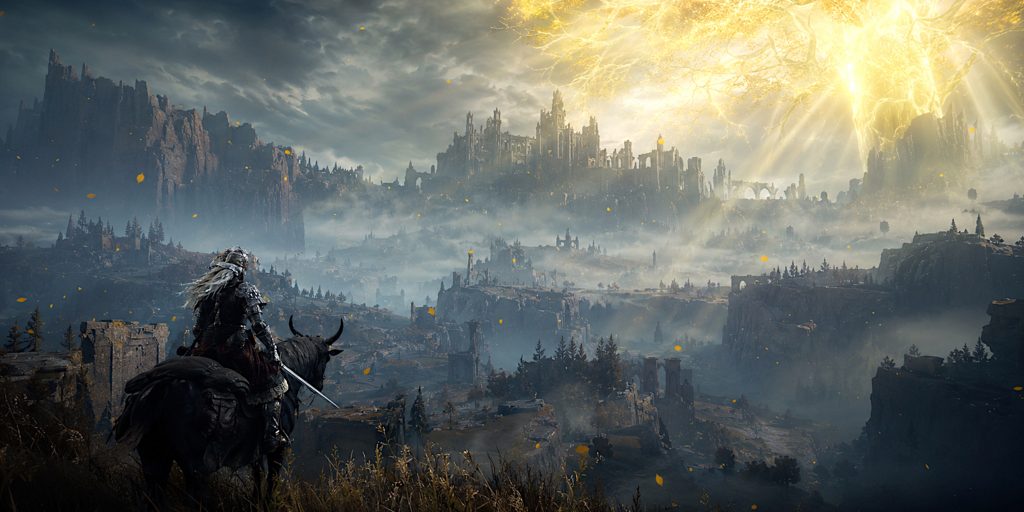
The smartest thing Elden Ring does is surprisingly simple.
It lets you get lost.
The Lands Between are not completely directionless. Sites of Grace gently indicate possible routes and the geography constantly pulls your attention towards enormous castles, towers, trees and other suspicious-looking structures.
But the game rarely treats exploration like administrative work.
There is no endless sequence of icons demanding that you clear Bandit Camp 17 before climbing Ancient Tower 23 to reveal another portion of the map.
Instead, you see something.
You wonder what it is.
You go there.
Occasionally you discover treasure. Occasionally you find an entire underground civilisation. Occasionally a dragon lands on your head.
Fair enough.
That sense of uncertainty makes exploration feel genuinely personal. Two people can spend ten hours playing Elden Ring and have surprisingly different stories about what happened.
Limgrave remains one of my favourite opening areas in any RPG because it quietly teaches this philosophy. Stormveil Castle dominates the landscape, clearly signalling where the main path lies, but practically everything around it whispers, “Go on, have a look.”
Naturally, having a look is usually dangerous.
The Lands Between Still Feel Extraordinary
There are larger open worlds and probably more technically sophisticated ones, but few have geography as memorable as Elden Ring.
Limgrave feels almost inviting until you discover what actually lives there. Liurnia is eerie and melancholy. Caelid looks as though someone asked Hieronymus Bosch to design a fungal infection. Leyndell has the scale and grandeur of a civilisation that genuinely believed itself eternal.
Then there are the underground areas.
The first descent into Siofra River remains one of those gaming moments I wish I could erase from my memory purely so I could experience it again. You think you are entering another dungeon. Then the lift keeps descending.
And descending.
And descending.
Eventually an artificial night sky appears beneath the earth and the scale of the game suddenly changes.
That is Elden Ring at its best. It repeatedly convinces you that you understand the boundaries of its world before quietly revealing that you do not.
Combat Is Difficult, But More Flexible Than Dark Souls
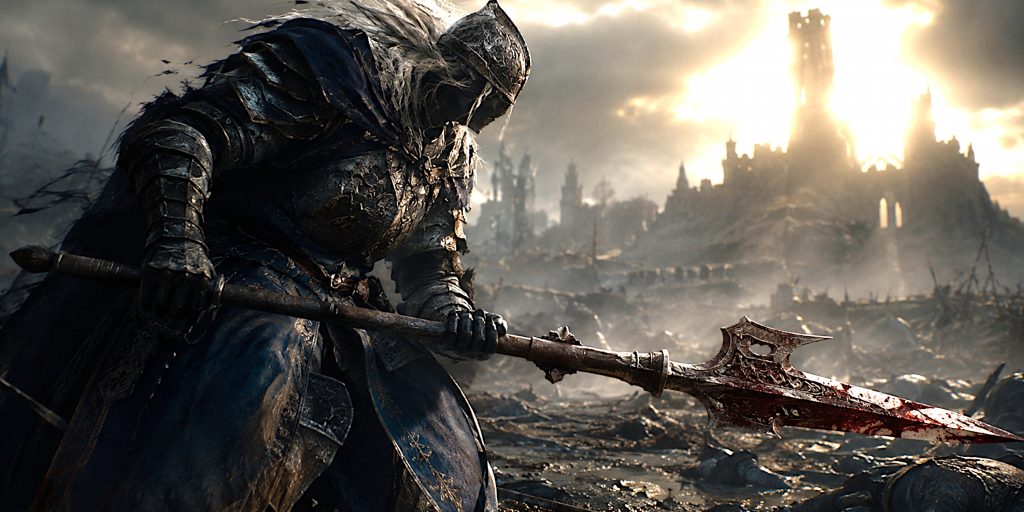
Calling Elden Ring simply “really hard” misses something important.
It can be difficult, certainly. Malenia has probably contributed more swear words to the English language than several minor wars.
But Elden Ring gives players an extraordinary number of ways to deal with difficulty.
You can use:
- Spirit Ash summons
- NPC and player summons
- Sorcery
- Incantations
- Status effects such as bleed and frost
- Shields and guard counters
- Ashes of War
- Heavy Strength weapons
- Fast Dexterity builds
- Ranged attacks
- Mounted combat
- Consumables and crafting
- The ancient tactical technique known as “leave and come back later”
That last one matters.
In previous Souls games, being stuck against a boss could mean repeatedly throwing yourself against the same wall. Elden Ring usually gives you another option.
Ride somewhere else.
Explore a cave. Find a weapon. Gain some levels. Upgrade your Spirit Ashes. Accidentally become involved in a witch’s elaborate plan to overthrow the established cosmic order.
Then return.
The difficulty remains fundamental to the experience, but the open world gives players much greater control over how they respond to it.
The Bosses Range From Brilliant to Mildly Infuriating
FromSoftware knows how to make a boss entrance.
Starscourge Radahn is absurd in exactly the right way. Godrick the Grafted establishes the grotesque nature of the demigods beautifully. Morgott feels tragic rather than simply monstrous. Malenia became an instant gaming icon.
The best fights combine mechanics, music, visual design and narrative until the encounter feels like the climax of a story you only half understand.
That last part is very FromSoftware.
There are problems, though.
Some enemies and bosses are reused too frequently. Fighting a terrifying creature once can be memorable. Fighting its slightly different cousin several regions later inevitably reduces the effect.
Late-game bosses can also become extremely aggressive, with long combinations and narrow opportunities to retaliate. Depending on your build, the experience can shift from exhilarating to slightly exhausting.
Elden Ring occasionally confuses giving the player a challenge with giving an enemy another seven-hit combo.
Character Builds Are Where Elden Ring Becomes Dangerous
Not dangerous for your character.
Dangerous for your free time.
The sheer variety of viable builds is one of the main reasons Elden Ring remains so replayable.
You can build a heavily armoured knight, katana-wielding bleed specialist, sorcerer, pyromancer, dragon cult lunatic, holy warrior, dual-wielding assassin or a mostly naked person carrying an object roughly the size of a Vauxhall Corsa.
The game does not merely provide lots of weapons. Many substantially alter how combat feels.
Ashes of War add another layer by allowing weapon skills and affinities to be changed. That makes experimentation surprisingly addictive.
You start wondering whether a different sword might work better.
Three hours later you are reading about Dexterity scaling and arguing with strangers about poise.
There is no coming back.
Swords Are One of Elden Ring’s Greatest Strengths
For a site called Seven Swords, we should probably address the important matter.
There are a lot of swords.
More importantly, FromSoftware understands that fantasy weapons should have personality.
| Weapon class | Examples | Historical inspiration |
| Straight swords | Longsword, Lordsworn’s Straight Sword | Medieval European arming swords and related one-handed swords |
| Greatswords | Claymore, Banished Knight’s Greatsword | European two-handed and hand-and-a-half sword traditions |
| Colossal swords | Greatsword, Zweihander | Exaggerated fantasy interpretations of large European swords |
| Katanas | Uchigatana, Nagakiba, Moonveil | Japanese uchigatana and later katana traditions |
| Curved swords | Scimitar, Shamshir | Middle Eastern and Asian curved sword traditions |
| Thrusting swords | Estoc, Rapier | European late-medieval and Renaissance thrusting swords |
| Heavy thrusting swords | Great Épée, Bloody Helice | Largely fantasy designs drawing on European thrusting weapons |
Historical accuracy is not really the point. Elden Ring happily takes recognisable weapon traditions and exaggerates them until they fit its world.
Read: Best Weapons in Elden Ring
The Greatsword is essentially an enormous slab of iron inspired by Berserk. Moonveil is a magical katana capable of firing waves of light. The Sword of Night and Flame allows its owner to produce magical devastation that would have surprised even the most optimistic medieval swordsmith.
Yet ordinary weapons remain viable.
There is something pleasing about walking into a world filled with demigods, dragons and cosmic horrors while carrying what is basically a good longsword.
The Story Is Brilliant, Provided You Can Find It
Here is where Elden Ring becomes divisive.
The storytelling can be infuriating.
You play a Tarnished called back to the Lands Between following the Shattering of the Elden Ring. Queen Marika’s demigod children possess fragments of the Ring, and your apparent objective is to defeat them, claim their Great Runes and become Elden Lord.
Simple enough.
Except it really isn’t.
The Golden Order, Greater Will, Two Fingers, Erdtree, Empyreans, Outer Gods, Destined Death and competing ambitions of characters such as Ranni, Miquella and Marika gradually turn the apparent hero’s journey into something far stranger.
George R.R. Martin’s contribution to the underlying mythology helps give the setting the feeling of an ancient dynastic catastrophe. FromSoftware then does what FromSoftware does and scatters the remains across architecture, dialogue and item descriptions.
I love this approach when it works.
I am less enthusiastic when an interesting NPC disappears because I failed to speak to them three times while standing beside a specific rock during a full moon.
The lack of a traditional quest log encourages attention, but some questlines cross the line from mysterious into unnecessarily awkward.
There is mystery, and then there is needing a wiki.
George R.R. Martin’s Influence Is More Subtle Than Expected
Anyone expecting lengthy Game of Thrones conversations will be disappointed.
Martin’s influence appears primarily in the mythology underpinning the world. The complicated divine family, shattered alliances, demigods, succession struggles and corrupted bloodlines certainly feel compatible with his interests.
Miyazaki and FromSoftware transformed that material through their own visual and narrative style.
The result feels cohesive.
Godrick grafting the limbs of other warriors onto himself is grotesque even by Souls standards, but it also says something about his desperation to inherit the strength and legitimacy of a more impressive bloodline.
Radahn, Ranni, Malenia, Miquella, Morgott and Mohg are not simply bosses waiting patiently in rooms for someone to kill them. They are remnants of a ruined family whose ambitions helped destroy the world around them.
Suddenly Christmas with your relatives seems quite manageable.
Where Elden Ring Gets Things Wrong
A 9.5/10 game can still annoy me.
In fact, Elden Ring sometimes annoys me spectacularly.
The open world becomes less surprising once its patterns are familiar. Catacombs, caves and certain bosses repeat. Some late-game regions feel less richly developed than Limgrave, Liurnia or Leyndell.
The camera remains capable of becoming your greatest enemy when fighting very large creatures.
Platforming is better than in previous Souls games but occasionally feels as though the controls and the level designer are having a private disagreement about what game you are playing.
NPC quests can be unnecessarily obscure.
PC performance has also been one of the less impressive parts of the experience, particularly compared with the quality of the art direction.
None of these problems ruins the game. They matter because Elden Ring is otherwise so consistently good that its weaker elements become unusually noticeable.
Shadow of the Erdtree Makes the Complete Package Even Better
The 2024 expansion Shadow of the Erdtree is substantial enough to feel closer to a smaller sequel than a conventional piece of DLC.
It introduces the Land of Shadow, new weapon categories, armour, spells, enemies and major bosses while expanding the stories surrounding Miquella, Marika and the history concealed beneath the Golden Order.
Its world design is particularly impressive.
The map appears relatively compact from above but folds areas over and beneath one another. Paths snake between cliffs, ruins and underground spaces in ways that make exploration feel less predictable than parts of the base game.
The expansion is also difficult.
Very difficult.
The Scadutree Fragment system creates a separate progression structure, encouraging players to explore rather than simply relying on an over-levelled character imported from the base game.
Some bosses push FromSoftware’s taste for aggression to extremes, but the expansion ultimately strengthens Elden Ring as a complete experience.
Graphics and Art Direction
Technically, Elden Ring has never been the most advanced game of its generation.
Artistically, I would put it among the best.
That distinction matters.
The Lands Between are memorable because of composition, architecture, lighting, colour and scale rather than sheer polygon counts. The Erdtree hanging over the landscape gives the entire world a visual anchor.
Enemy design is equally strong.
FromSoftware can apparently look at a perfectly normal human body and immediately think of six deeply upsetting ways to rearrange it.
There is beauty everywhere, but it is usually accompanied by decay.
That combination gives Elden Ring its identity.
Music and Sound
The soundtrack knows when to be enormous and when to disappear.
Boss themes carry much of the drama, particularly during encounters designed as major narrative events. Ambient sound is used more cautiously during exploration, allowing wind, wildlife and distant enemies to give areas their atmosphere.
The opening menu theme deserves special mention because it has absolutely no interest in allowing you to begin the game calmly.
You have not even pressed Continue and the orchestra already thinks civilisation is ending.
Which, to be fair, is thematically accurate.
Is Elden Ring Too Difficult for New Players?
It depends what you mean by difficult.
The combat demands patience. You will die. Bosses will punish panic rolls and greedy attacks. The game explains surprisingly little.
But Elden Ring is arguably the most approachable traditional Souls-style game FromSoftware has made because it provides so many ways around obstacles.
New players should use Spirit Ashes, upgrade weapons, explore thoroughly and summon help if they want it.
Ignore anyone insisting there is only one legitimate way to play.
The game gives you these systems because FromSoftware expects you to use them.
If a giant spectral jellyfish helps you kill a demigod, the demigod is still dead.
Is Elden Ring Still Worth Playing?
Very much so.
The initial shock of discovering its enormous world cannot be recreated once you know its secrets, and some of its flaws have become clearer with time.
Yet few open-world games give exploration this much meaning.
You are constantly being rewarded for curiosity, whether through a weapon, dungeon, boss, NPC, fragment of lore or an entire region you somehow failed to notice.
More importantly, Elden Ring respects experimentation.
It allows players to make strange builds, wander in the wrong direction, discover areas out of sequence and occasionally defeat supposedly terrifying enemies using tactics that feel faintly embarrassing.
That freedom gives the game its longevity.
Elden Ring Review Verdict
Elden Ring is not flawless.
Its open world contains repetition. Its quest design occasionally mistakes obscurity for depth. Some late-game encounters push difficulty into irritation, and the technical presentation has never been quite as accomplished as the art direction.
I still think it is one of the defining games of its generation.
FromSoftware took a formula built around carefully controlled environments and somehow expanded it into an open world without losing the tension, mystery or satisfaction that made the Souls games distinctive.
The best moments are rarely the ones the game explicitly tells you to experience. They are the moments when you notice a tower on the horizon, find a suspicious hole in the ground or decide that the enormous creature ahead probably cannot be that dangerous.
It can.
You go over there anyway.
Seven Swords score: 9.5/10
Best for: Players who enjoy exploration, difficult combat, character building and environmental storytelling.
Think twice if: You want a heavily guided RPG, straightforward quests or a story that explains itself without requiring detective work.
Verdict: Still essential.