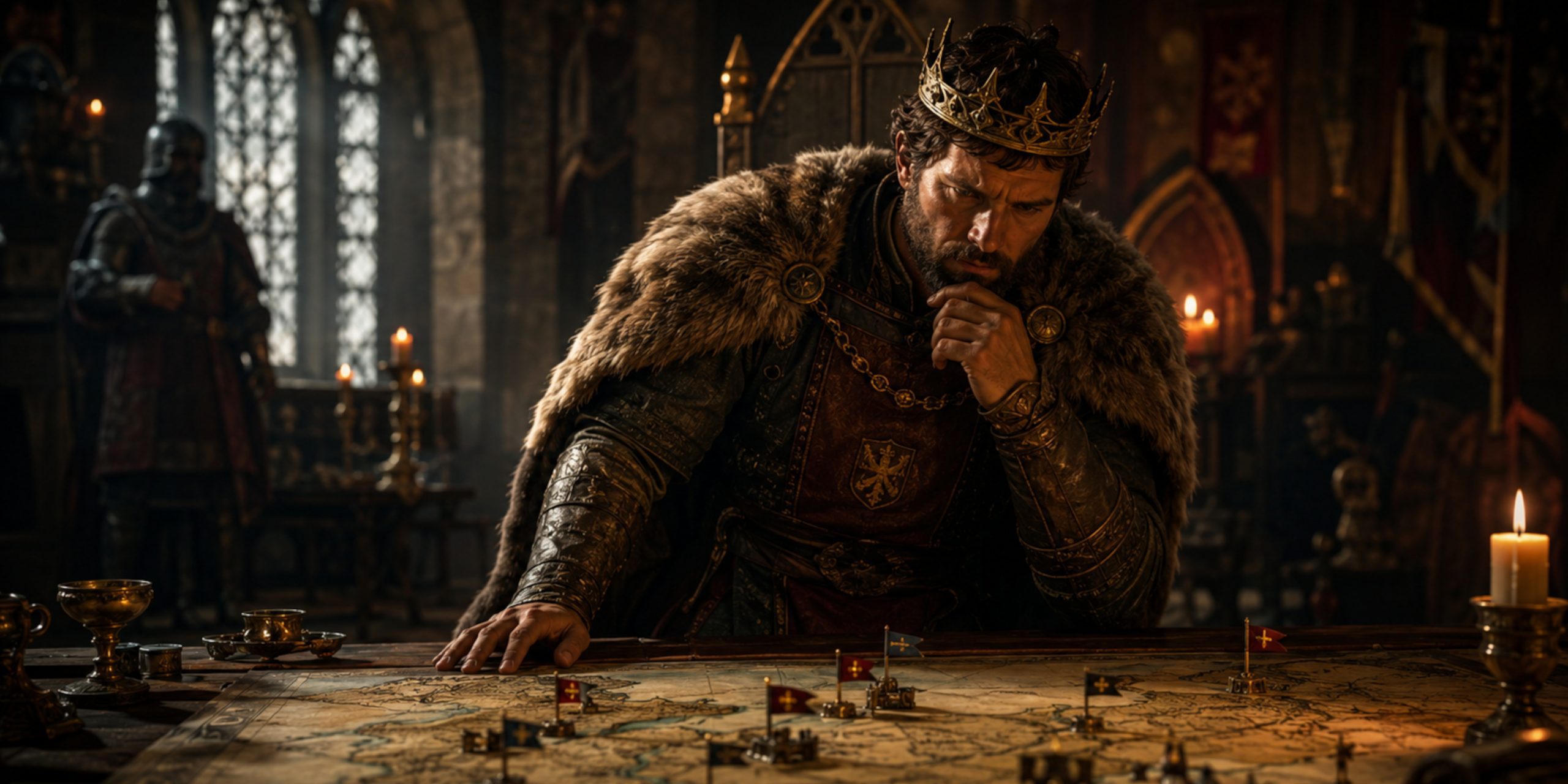
There is something deeply funny about trying to build a medieval superpower from one muddy little county while the Holy Roman Empire casually strolls around with 400 levies and a tax income larger than your annual GDP.
That is the magic of the One County Challenge in Crusader Kings III.
It turns CK3 from a sprawling conquest simulator into a paranoid survival RPG where every marriage matters, every knight matters, and one badly timed hunting accident can end your entire bloodline faster than you can say “disputed heritage”.
The challenge sounds simple. You are only allowed to personally hold one county for the entire campaign.
No expanding your domain.
No stacking duchy capitals.
No gobbling up farmland across Europe like a medieval landlord with a spreadsheet addiction.
Just one county.
The surprising part is how absurdly powerful you can still become.
What Is the One County Challenge?
The rules vary depending on how cruel you want to be to yourself.
The basic version is straightforward:
- You may only personally hold one county
- You can still have vassals
- You can become a king or emperor
- Your realm may expand, but your personal holdings cannot
The truly painful version goes further:
- No additional baronies
- No moving capital
- No temporary holdings
- No cheesy inheritance grabs
- Ironman enabled
At that point you are basically roleplaying a highly stressed accountant trying to survive the Middle Ages.
Still, it is one of the most rewarding ways to play CK3 because it forces you to actually understand the systems instead of simply outnumbering everyone.
Why the Challenge Is So Addictive
Normally in CK3, mistakes are recoverable.
Lose a war? Fine, raise another army.
Go bankrupt? Sell a spare duchy.
Terrible heir? Just disinherit half the family tree like an emotionally detached lizard monarch.
With one county, every weakness becomes visible immediately.
Your economy matters.
Your council matters.
Your genetics matter.
Your succession planning matters.
You stop playing like a conqueror and start playing like a survivor.
Weirdly, it also makes the roleplaying stronger. Tiny realms feel personal. You remember rulers more clearly. You care about buildings because you only have one place to improve.
That random hill farm upgrade suddenly feels like a national achievement.
Best Starts for a One County Challenge
Some starts are designed for suffering. Others are secretly overpowered.
Bohemia
Bohemia is arguably the easiest strong start because of its development potential, cultural advantages, and excellent terrain.
Starting as a count inside a larger kingdom gives you protection while you build upward politically.
Prague can become an economic monster if managed correctly.
You basically become the medieval equivalent of a hedge fund manager hiding behind imperial borders.
Sardinia
The mines are the big attraction here.
A single wealthy county with strong development potential can finance mercenaries, schemes, and infrastructure far beyond what most one-county rulers should realistically afford.
Money fixes many problems in CK3.
Not all of them.
Your inbred cousin still cannot command an army just because you built a tax office.
Iceland
This is the “leave me alone” strategy.
Isolation protects you from early aggression, and tribal mechanics allow some surprisingly aggressive expansion through vassals later on.
The downside is development speed.
You are effectively building an empire from a windy rock in the North Atlantic.
Tall Italian Counties
Northern Italy is packed with excellent development, farmland bonuses, and cultural innovation potential.
Places like Genoa, Florence, and Verona can become absurdly rich.
Playing tall in Italy almost feels unfair once the money starts rolling in.
You become less of a feudal ruler and more of a medieval property developer.
The Most Important Thing: Development
Development is your lifeline.
In a normal campaign, players often compensate for weak counties by conquering more land. In a One County Challenge, your capital must become an economic and technological powerhouse.
High development gives:
- More taxes
- More levies
- Faster innovations
- Better long-term scaling
This means steward-focused rulers become incredibly valuable.
A mediocre martial ruler with 20 counties is fine.
A mediocre steward with one county is basically digging your grave personally.
Buildings Matter More Than Ever
Every building slot becomes precious.
Prioritise:
- Economic buildings first
- Fortifications second
- Military specialisation later
Military buildings are tempting, but bankrupt rulers tend to die quickly in CK3. Usually dramatically.
A stable economy lets you:
- Hire mercenaries
- Bribe vassals
- Fund schemes
- Recover from disasters
- Manipulate elections
- Survive succession crises
Gold is not just money in CK3.
It is emotional stability.
Diplomacy Becomes Your Main Weapon
A one-county ruler cannot survive through brute force alone.
You need alliances constantly.
Marriage management becomes essential. A well-placed alliance with France or Byzantium can completely deter aggression.
You also start viewing diplomacy differently.
Strong neighbours stop being targets.
They become emotional support kingdoms.
Swearing fealty is often smart too. Being a powerful vassal inside a stable empire can give you centuries of protection while you quietly build influence.
Then eventually you control the empire from the shadows anyway.
Classic CK3 behaviour.
Intrigue Is Completely Broken in This Challenge
Honestly, intrigue might be the strongest route for a One County Challenge.
Why?
Because murder does not care how many counties you own.
A tiny ruler with good intrigue can:
- Collapse dynasties
- Manipulate succession
- Install puppet rulers
- Destroy alliances
- Trigger claimant wars
- Inherit entire realms indirectly
You stop thinking like a battlefield commander and start thinking like a deeply unethical spider.
It is glorious.
Men-at-Arms Become Your Real Army
Levies matter less in this challenge because your county simply cannot produce huge numbers.
Elite Men-at-Arms become everything.
A small professional army with strong counters can outperform far larger forces.
Stationing bonuses become incredibly important too. If your county specialises correctly, your elite troops become terrifyingly efficient.
This is especially true with:
- Varangian Veterans
- Cataphracts
- Longbowmen
- Armoured Horsemen
Watching 3,000 elite troops erase a much larger army never stops being funny.
Succession Can Destroy Everything
This is where many One County runs die.
Partition succession is already annoying in normal CK3.
With one county it becomes catastrophic.
You must prepare early through:
- Dynasty perks
- Crown authority
- Strategic marriages
- Heir management
- Disinheritance
- Religious reform
Nothing hurts more than building a perfect capital over 200 years only for your heir to immediately ruin everything because he inherited the personality traits of an angry goose.
Religion and Culture Choices Matter More
Normally you can absorb weaknesses through expansion.
Not here.
Your religion and culture heavily define your survival.
Useful cultural traits include:
- Development bonuses
- Military efficiency
- Economic boosts
- Faster innovations
Useful religious traits include:
- Stability
- Communion income
- Easier succession
- Strong doctrines for diplomacy
Hybrid cultures can become absurdly powerful in long campaigns.
Some players basically engineer custom super-cultures designed entirely around making one county function like a mini superpower.
It feels ridiculous.
It also works.
Can You Actually Become an Emperor?
Yes. Surprisingly often.
The funniest part of the One County Challenge is eventually ruling gigantic realms while personally owning less land than some random bishop in Germany.
Through vassals, intrigue, dynastic manipulation, and diplomacy, you can absolutely become:
- King of England
- Byzantine Emperor
- Holy Roman Emperor
- Caliph
- Even a world-spanning empire
All while technically remaining a one-county ruler.
CK3’s systems allow absurd political outcomes if you understand leverage.
Military conquest is only one path to power.
Late Game Problems
The late game becomes less about survival and more about control.
Huge vassal networks become dangerous because your personal military strength remains relatively small.
Factions can become terrifying.
You often need:
- Dread
- Strong alliances
- Massive gold reserves
- Elite Men-at-Arms
- Good succession
- Careful vassal management
One weak ruler can trigger a collapse.
The challenge never fully disappears, which is part of why the format stays interesting far longer than normal blob campaigns.
The Seven Swords Takeaway
The One County Challenge quietly reveals what makes CK3 brilliant.
It strips away easy expansion and forces you to engage with the actual systems beneath the map painting.
You become more invested in characters.
More invested in politics.
More invested in survival.
And honestly, surviving 400 years with one county feels far more satisfying than steamrolling Europe with 80 holdings and a doomstack the size of modern Birmingham.
It is stressful, ridiculous, occasionally unfair, and completely addictive.
Which is basically Crusader Kings 3 at its best.