Few fantasy weapons inspire quite as much fascination, or outright dread, as Dragnipur. Plenty of legendary blades are said to steal souls, curse their owners, or cut through enchanted armour. Dragnipur looks at those ideas and quietly raises the stakes until they become cosmic horror.
This is not simply a magical sword. It is a prison. A burden. A moving apocalypse balanced on a blade.
Steven Erikson filled the Malazan universe with extraordinary weapons, yet Dragnipur occupies a category of its own. Every time it appears, the atmosphere changes. Characters who have faced dragons, gods and immortal armies suddenly become very cautious, and for good reason.
If there is one fantasy sword that truly earns its terrifying reputation, Dragnipur is near the very top of the list.
What Is Dragnipur?
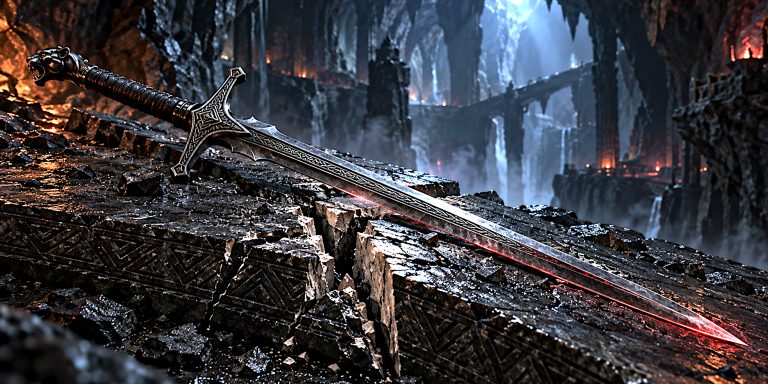
Dragnipur is one of the most powerful and feared swords in the Malazan Book of the Fallen series. Forged by the Elder God Draconus, it later became the signature weapon of Anomander Rake, the Son of Darkness and ruler of Moon’s Spawn.
Unlike ordinary enchanted weapons, Dragnipur does not merely kill.
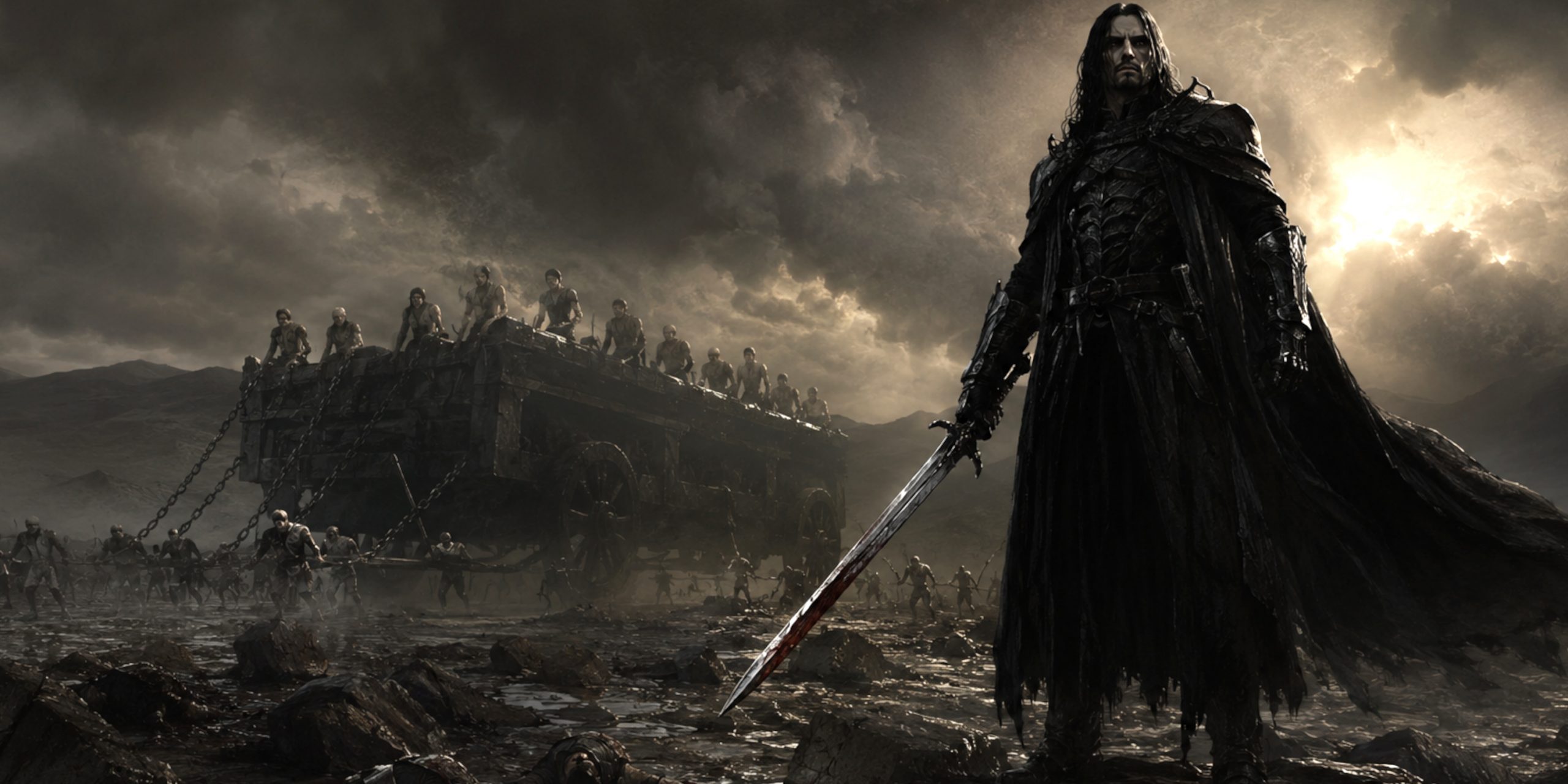
Anyone slain by the sword has their soul drawn inside the blade itself. Once imprisoned, they are chained to an immense wagon that must be pulled forever through a bleak, endless landscape.
Failure is not an option.
If the wagon stops moving, catastrophe follows.
That simple concept transforms every death by Dragnipur into something far worse than execution. It becomes eternal labour under impossible conditions.
The Origins of Dragnipur
The sword was forged by Draconus long before the events of the novels. Its creation was linked to the protection of the Gate of Darkness, one of the oldest and most fundamental forces within the Malazan universe.
Instead of allowing Chaos to consume the Gate, Draconus created an extraordinary prison dimension within the sword itself.
The wagon endlessly carries the Gate away from the pursuing forces of Chaos.
Every new victim added to Dragnipur becomes another unwilling labourer helping keep existence itself intact.
It is a wonderfully grim idea. Save reality by condemning countless souls to endless suffering. Erikson rarely offers clean moral choices, and Dragnipur might be the clearest example of that philosophy.
How Dragnipur Works
The mechanics of the sword are surprisingly straightforward, although the implications are horrifying.
When Dragnipur kills someone:
- Their soul is trapped instantly.
- Heavy chains bind them.
- They are attached to an enormous wagon.
- They must help pull the wagon forever.
- Behind the wagon, Chaos slowly advances.
Every prisoner contributes strength to the effort. Strong warriors remain valuable even after death because they become stronger haulers.
Ironically, some of history’s greatest heroes eventually become prisoners alongside villains, assassins and kings.
Death becomes recruitment.
Why Everyone Fears Dragnipur
Fantasy is filled with cursed weapons, but Dragnipur creates a very specific kind of terror.
Normal death offers uncertainty.
Dragnipur removes uncertainty entirely.
Victims know exactly what awaits them, endless toil with no hope of escape.
This certainty makes even incredibly powerful characters reluctant to face Anomander Rake in combat. Losing means far more than dying.
Several immortal beings openly fear the sword despite possessing powers capable of reshaping continents.
That says everything.
The Symbolism Behind the Sword
One reason Dragnipur remains so memorable is that it works on multiple levels.
On the surface, it is an immensely powerful magical weapon.
Beneath that, it explores ideas about:
- Responsibility
- Sacrifice
- Justice
- Eternal punishment
- The burden of leadership
- The cost of preserving order
The chained souls literally carry the weight of existence.
Meanwhile, those outside the sword often benefit without fully understanding the terrible price being paid.
That feels remarkably human.
Anomander Rake and Dragnipur
It is impossible to separate Dragnipur from Anomander Rake.
Rake carries the weapon for thousands of years, fully aware of its terrible purpose. He understands every death adds another soul to its impossible burden, yet he also recognises that abandoning the sword could unleash something even worse.
This creates one of fantasy’s most compelling relationships between warrior and weapon.
Rake never treats Dragnipur as a trophy.
He treats it as a responsibility.
That distinction makes him a far more interesting character than many fantasy heroes who happily swing legendary weapons without ever questioning them.
The Wagon Inside the Sword
One of Erikson’s greatest creative decisions was actually showing readers what exists inside Dragnipur.
The interior landscape feels almost mythological.
An endless plain stretches beneath a dark sky.
An enormous wagon creaks forward.
Countless chained souls struggle against impossible weight.
Chaos follows behind like an approaching storm that never stops advancing.
It feels less like conventional fantasy and more like an ancient nightmare.
Many readers remember these scenes years after finishing the series because they possess such striking visual power.
The Fate of Dragnipur
Without venturing into major spoilers, Dragnipur eventually reaches the centre of one of the most important storylines in the entire Malazan saga.
Its history, purpose and future all become deeply intertwined with the fate of gods, mortals and the balance of existence itself.
Rather than remaining a cool magical weapon sitting on the sidelines, Dragnipur becomes one of the series’ central narrative engines.
That is remarkably rare.
Many fantasy swords become iconic because they look impressive.
Dragnipur becomes iconic because the entire world changes around it.
How Dragnipur Compares to Other Legendary Fantasy Swords
| Sword | Universe | Greatest Strength | Greatest Danger |
|---|---|---|---|
| Dragnipur | Malazan Book of the Fallen | Traps souls while protecting the Gate of Darkness | Eternal imprisonment inside the sword |
| Stormbringer | Elric Saga | Devours souls to empower its wielder | Corrupts and manipulates its owner |
| Frostmourne | Warcraft | Steals souls and grants immense power | Serves darker cosmic forces |
| The One Ring’s sword equivalents | Tolkien | Symbolic rather than destructive | None match Dragnipur’s imprisonment |
| Nightblood | Cosmere | Consumes evil and immense magical energy | Can destroy nearly anyone who draws it |
Dragnipur arguably combines the most unsettling qualities of every legendary cursed weapon while adding a uniquely philosophical twist.
Why Dragnipur Still Stands Out
Fantasy readers have seen countless enchanted blades over the years.
Many promise unlimited power.
Many glow.
Many choose worthy owners.
Dragnipur does something far more interesting.
It forces readers to question whether absolute responsibility can become its own form of imprisonment.
Its terrifying reputation comes from consequence rather than spectacle. Every swing carries moral weight. Every victory creates another victim. Every death strengthens the prison while making its existence even more tragic.
That balance between mythology, horror and philosophy is why Dragnipur continues to rank among the greatest fictional swords ever created.
You do not remember it because it cuts through armour.
You remember it because, once you understand what happens inside the blade, every duel suddenly feels much darker.