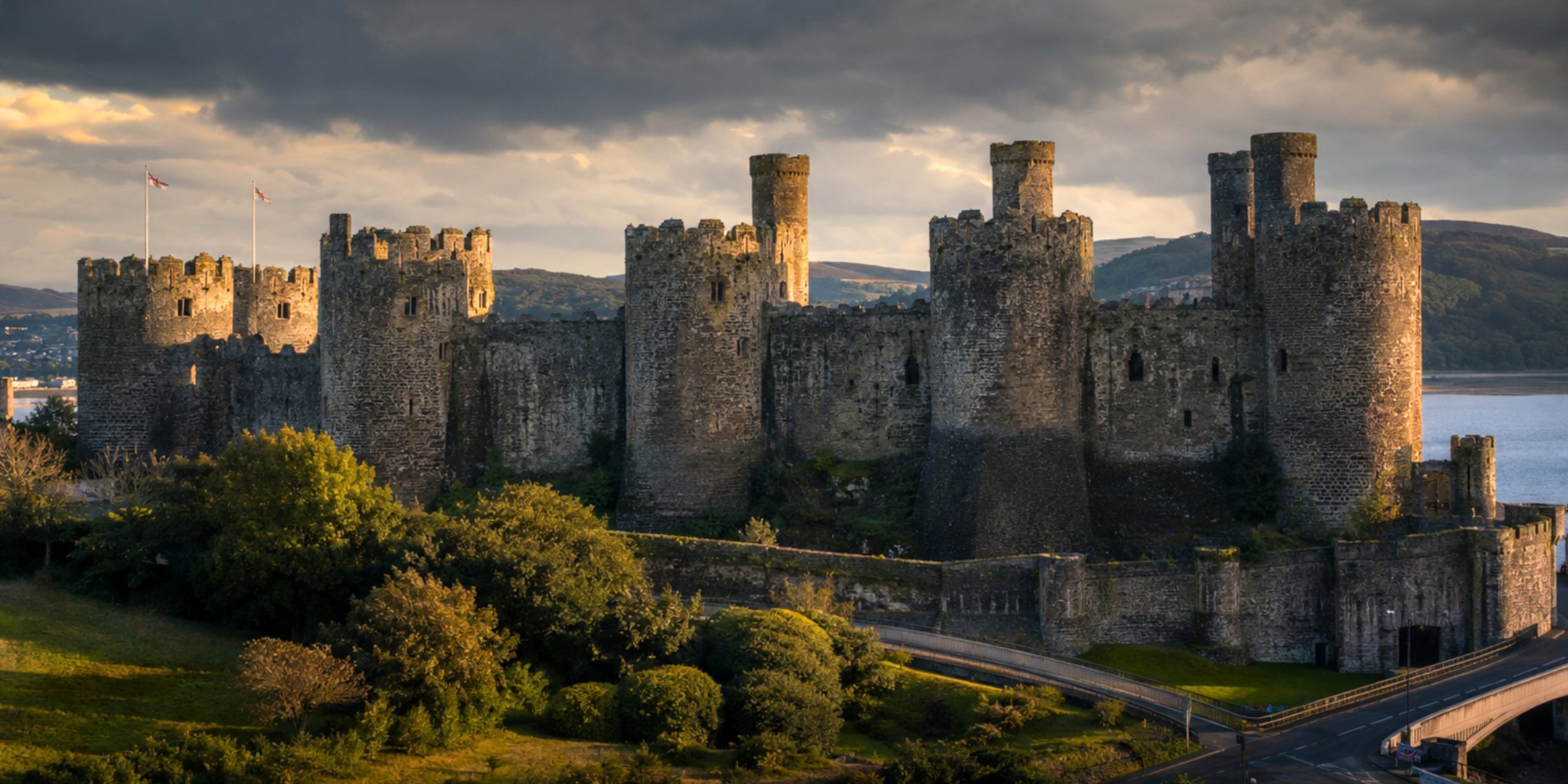
Perched above the broad estuary of the River Conwy, Conwy Castle is one of the finest surviving medieval fortresses in Europe. It dominates the skyline with eight towering drum towers, immense curtain walls and commanding views across North Wales. More than seven centuries after its construction, it remains remarkably complete, allowing visitors to walk the same battlements once patrolled by soldiers serving the English crown.
As a historian, Conwy always feels like the castle that quietly gets on with being extraordinary. It lacks the theatrical fame of some fortresses, yet few castles reveal the military ambitions of a medieval king quite so clearly. If Edward I wanted to convince Wales that resistance was a poor career choice, Conwy was one of his strongest arguments.
Overview
| Feature | Details |
|---|---|
| Location | Conwy, North Wales |
| Built | 1283 to 1287 |
| Builder | King Edward I of England |
| Master Architect | James of St George |
| Purpose | Royal fortress and administrative centre |
| Style | Late 13th century concentric military architecture |
| Towers | Eight large drum towers |
| UNESCO Status | Part of the Castles and Town Walls of King Edward in Gwynedd |
| Current Owner | Cadw |
Why Was Conwy Castle Built?
Conwy Castle was constructed immediately after Edward I’s conquest of North Wales. Following the defeat of the Welsh prince Llywelyn ap Gruffudd in 1282, Edward launched an ambitious programme of castle building that permanently altered the political landscape.
Conwy formed part of the famous Iron Ring of castles alongside Caernarfon Castle, Harlech Castle and Beaumaris Castle.
These castles were more than military bases. They became centres of English government, taxation and settlement. New walled towns grew beside them, occupied largely by English settlers, creating islands of royal authority within recently conquered territory.
Construction began in 1283 and progressed at remarkable speed. Within four years, the fortress was substantially complete.
James of St George and the Design
The mastermind behind Conwy was the Savoyard military engineer James of St George, one of medieval Europe’s greatest castle architects.
His design blended formidable military strength with comfortable royal accommodation. Unlike many earlier Norman keeps, Conwy separated living quarters between the east and west ends while maintaining exceptional defensive strength.
Some notable architectural features include:
- Eight massive drum towers
- Two heavily defended gatehouses
- Multiple portcullises
- Murder holes above entrances
- A complete circuit of curtain walls
- Royal apartments with private chambers
- Great Hall
- Chapel
- Kitchens
- Well over 28 metres deep
The castle could operate as both palace and fortress without compromising either function.
Construction
Construction required an astonishing logistical effort.
Thousands of labourers, masons, carpenters, blacksmiths and quarrymen worked simultaneously. Timber arrived from nearby forests while stone was quarried locally.
Historical financial records survive in remarkable detail.
| Resource | Estimated Requirement |
|---|---|
| Construction period | About 4 years |
| Cost | Around £15,000 |
| Workforce | Up to 1,500 labourers during peak activity |
| Stone | Local limestone and sandstone |
| Timber | North Welsh forests |
The project consumed a substantial proportion of Edward I’s annual income.
Architecture and Defences
Conwy demonstrates military engineering at its height during the late thirteenth century.
Curtain Walls
The outer walls average around 4.5 metres thick and connect all eight towers into one integrated defensive system.
Attackers would face overlapping fields of fire from archers positioned throughout the walls and towers.
Gatehouses
Both main entrances created deadly bottlenecks.
An enemy forcing one gate still had to overcome additional portcullises, heavy doors and defenders attacking from above.
Towers
Each drum tower provided accommodation, storage and fighting platforms.
The circular design reduced weak points that square towers often suffered during siege warfare.
Water Access
One particularly clever feature was the postern gate leading towards the river.
This allowed supplies to arrive by boat even when land routes were threatened.
The Royal Apartments
Although famous for its military role, Conwy also functioned as a royal residence.
The apartments included:
- Great Hall
- King’s Chamber
- Queen’s Chamber
- Private chapel
- Kitchens
- Service rooms
- Heated living spaces
The apartments overlooked both mountains and sea, making Conwy one of Edward’s more comfortable Welsh residences.
Comfort, of course, remained relative. Medieval luxury still involved a considerable amount of draughts.
The Town Walls
Conwy Castle was inseparable from the surrounding medieval town.
Nearly 1.3 kilometres of town walls enclosed the new English settlement, with twenty one surviving towers and several gatehouses.
Together, castle and town formed one enormous defensive complex unlike almost anything previously built in Britain.
Occupants Timeline
| Period | Occupants |
|---|---|
| 1283 to 1287 | Builders and royal workforce |
| Late 13th century | Edward I’s royal garrison |
| 1290s | English administrators and soldiers |
| Early 14th century | Royal officials and governors |
| 1401 | Captured by supporters of Owain Glyndŵr |
| 15th century | Crown garrison |
| 16th century | Declining military importance |
| English Civil War | Royalist forces |
| After 1660 | Gradual abandonment |
| 19th century onwards | Historic monument and tourist attraction |
Major Sieges
The Madog ap Llywelyn Revolt (1294 to 1295)
Perhaps the most famous episode occurred during the Welsh uprising led by Madog ap Llywelyn.
Edward I himself became trapped inside Conwy Castle after Welsh forces isolated the fortress.
Supplies arrived by sea, allowing the king to survive until relief forces broke the siege.
The episode proved exactly why the castle had been built where it was.
Owain Glyndŵr’s Revolt (1401)
During the rebellion of Owain Glyndŵr, a small group posing as carpenters successfully seized Conwy Castle through deception.
The garrison was caught completely off guard.
Although English forces later recovered the castle through negotiation, the capture demonstrated that clever planning could occasionally achieve what armies could not.
English Civil War
Conwy supported the Royalist cause during the seventeenth century.
Parliamentarian forces eventually compelled its surrender in 1646.
Unlike many castles, Conwy escaped deliberate destruction after the war, although parts of its fittings and timber were removed.
Life Inside the Castle
The permanent population varied considerably.
Typical residents included:
- Constable
- Soldiers
- Archers
- Priests
- Cooks
- Servants
- Royal officials
- Craftsmen
During royal visits, the population increased dramatically with nobles, attendants and additional guards.
Food stores included salted meat, ale, grain, fish and imported wine.
Archaeology
Conwy has benefited from centuries of archaeological investigation.
Important discoveries include:
- Original medieval drainage systems
- Foundations of service buildings
- Domestic pottery
- Arrowheads
- Crossbow bolts
- Iron tools
- Coins
- Animal bones revealing medieval diets
- Architectural fragments from windows and fireplaces
Excavations have helped historians reconstruct daily life rather than simply military activity.
Scientific surveys continue to improve understanding of building techniques, repair phases and environmental changes surrounding the castle.
Contemporary Quotes
The royal records reveal Edward’s determination during construction.
“The work is to be pressed on with all speed.”
This instruction reflected the urgency with which Edward viewed his conquest.
The chronicler Walter of Guisborough described Edward’s campaign as one that secured Wales through castles and settlements rather than temporary victories in battle.
The medieval chronicler John of Trokelowe also recorded the difficulties faced during the Welsh revolts, highlighting the importance of fortified positions such as Conwy.
Arms and Armour of the Garrison
The castle’s defenders would typically have carried:
| Weapon | Purpose |
|---|---|
| Longbow | Long-range defence |
| Crossbow | Accurate defensive shooting |
| Spear | Gate and wall defence |
| Arming sword | Standard sidearm |
| Falchion | Close combat |
| Poleaxe | Fighting during assaults |
Armour included:
- Mail hauberks
- Early plate armour
- Great helms
- Bascinets
- Shields bearing royal insignia
- Gambesons
Preservation and UNESCO Status
Today Conwy Castle forms part of the UNESCO World Heritage Site known as the Castles and Town Walls of Edward I in Gwynedd.
Its remarkable preservation allows visitors to explore nearly every section of the fortress, including towers, walls and royal apartments.
The survival of both castle and town walls together makes Conwy one of the most complete medieval military landscapes anywhere in Europe.
Visiting Today
Visitors can explore:
- Battlements
- Eight towers
- Great Hall
- Royal apartments
- Chapel
- Kitchens
- Town walls
- River viewpoints
- Interpretation displays
The panoramic views across Snowdonia and the Conwy Estuary remain every bit as strategic as they were in Edward I’s day, although today’s visitors are usually carrying cameras rather than crossbows.
Legacy
Conwy Castle represents the peak of Edward I’s military architecture and remains one of Britain’s greatest medieval monuments. It tells the story of conquest, resistance, royal ambition and remarkable engineering with unusual clarity.
Its walls witnessed kings under siege, daring infiltrations, civil war and centuries of political change. Yet despite all that history, the castle itself still stands with astonishing confidence above the estuary, almost daring time to have another go.
For historians, Conwy is more than an impressive ruin. It is one of the closest experiences we have to walking through a functioning thirteenth century fortress. Few castles allow the medieval world to feel quite so tangible.