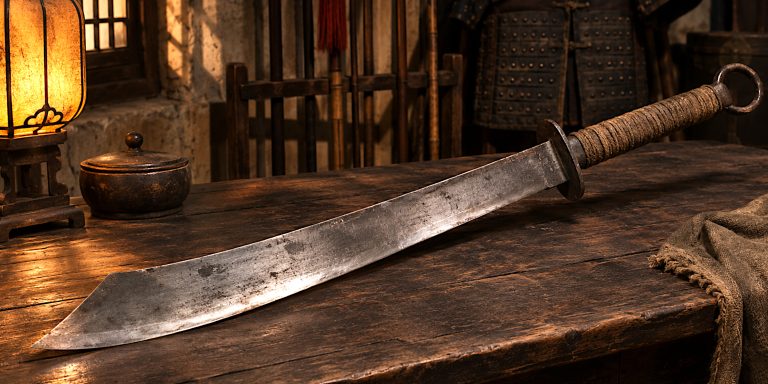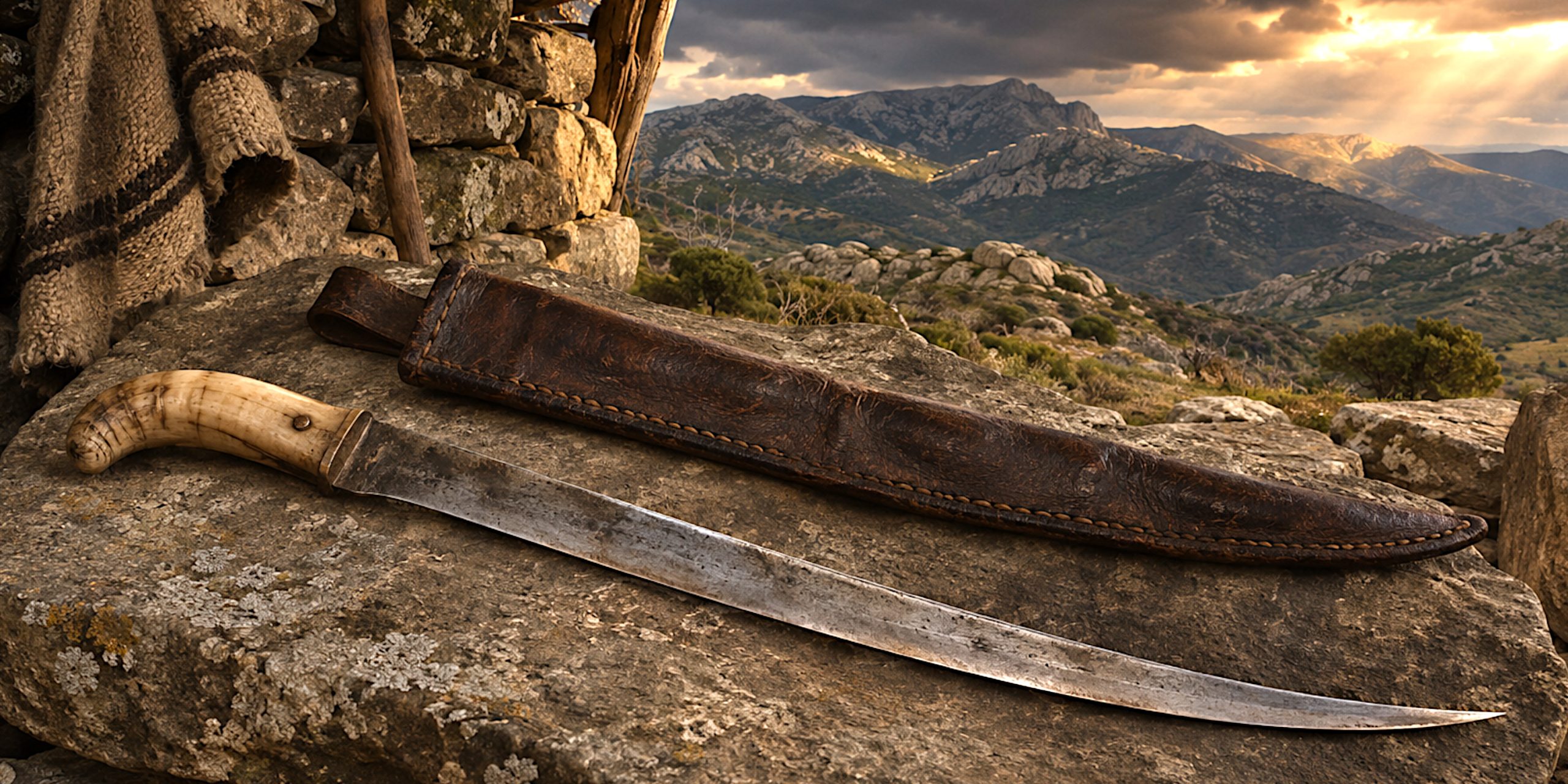
The Sardinian leppa looks like a knife that has grown into a short sabre. Its single cutting edge, curved blade and compact hilt made it a distinctive part of the island’s rural material culture. Shepherds, farmers and hunters could use a leppa as a cutting tool, while its size also made it a weapon.
There is a naming complication. Leppa originally referred to a long fixed blade carried at the belt, often called leppa de chintu. The word is now sometimes used more broadly for Sardinian knives, including folding patterns. A resolza or pattadesa is worth knowing about, but it is not the same object as the long belt blade discussed here.
Specification
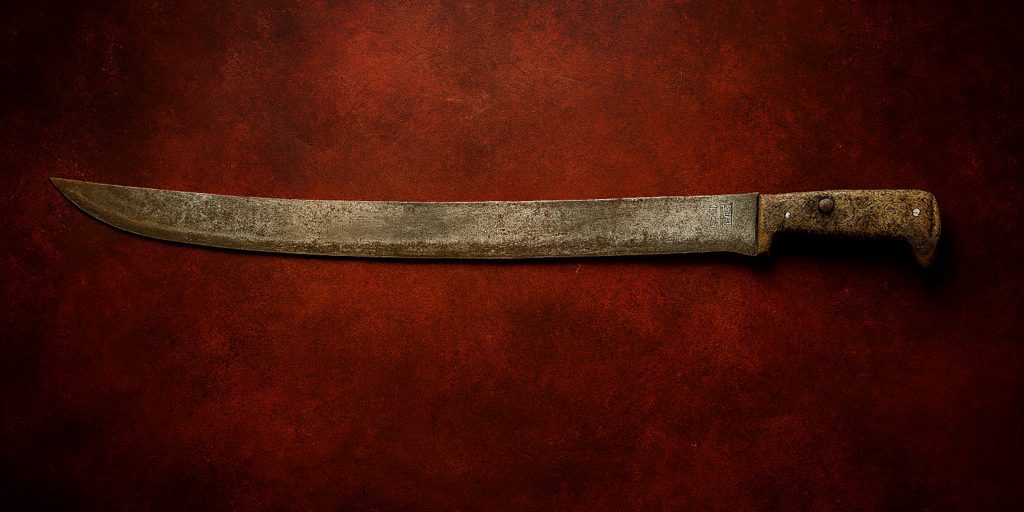
Surviving examples vary considerably by workshop and region. The dimensions below describe the historic long fixed blade, rather than every knife sold under the leppa name.
| Feature | Typical form |
|---|---|
| Origin | Sardinia, Italy |
| Form | Long fixed blade, often described as a knife or short sabre |
| Edge | Single edged, usually sharpened on the convex side |
| Blade | Curved, with a substantial spine near the hilt |
| Length | Variable; one catalogued 19th-century example measures 56.3 cm overall |
| Hilt | Often wood or horn, sometimes with decorative metal fittings |
| Guard | Commonly absent |
| Carry | At the belt, with a sheath or scabbard |
The 56.3 cm measurement belongs to a specific leppa di Ollolai in Italy’s national cultural heritage catalogue. It should not be treated as a standard length for the type.
History and Evolution
The leppa belongs to Sardinia’s long tradition of blades made for local needs. Its familiar historic form is especially well represented by 19th-century examples. A leppa could serve practical cutting work, but its long blade and belt carry also gave it a clear defensive role. Calling it merely a farm knife rather understates the amount of steel involved.
Regional craftsmen did not produce one rigid pattern. A plain working blade and an elaborately furnished example could both be leppas. At S’Abba Frisca museum in Dorgali, a leppa de chittu has a curved blade engraved with crescents and stars, plus a hilt shaped like a feline head and covered in chased brass. The hilt bears the date 1871. Its decoration shows how a practical blade could also carry personal and local meaning.
As folding knives became more prominent in Sardinian daily life, names and traditions overlapped. Today, an artisan piece called a leppa may be shorter than a historic belt blade. That change in usage is one reason to check an object’s construction and measurements before accepting a seller’s description.
Advantages and Disadvantages
Advantages
- Effective cutting reach: The long, curved edge offered more reach than a small working knife.
- Simple construction: A fixed blade avoided the moving parts of a folder.
- Adaptable use: Historic accounts connect the leppa with both rural work and personal defence.
- Strong regional identity: Hilt shapes, fittings and decoration can reveal something about local craft traditions.
Disadvantages
- Awkward for fine tasks: A long blade is poorly suited to the careful work of a small pocket knife.
- Limited hand protection: Many examples have little or no guard.
- Bulky to carry: Its length is an advantage only until it gets in the way.
- Maintenance: Carbon steel needs careful cleaning and storage, particularly on an antique with existing corrosion.
Comparison with Similar Blades
| Blade | Main distinction |
|---|---|
| Sardinian leppa de chintu | A long, fixed, curved, single-edged belt blade |
| Sardinian resolza or pattadesa | A smaller folding knife associated with everyday carry and craft traditions |
| Sardinian daga or stillu | Other historic fixed-blade forms; their names should not be used as blanket synonyms for leppa |
| Short sabre | Similar in reach and cutting role, although the leppa belongs to a particular Sardinian tradition |
The most useful comparison is with Sardinia’s own folding knives. Modern use of the word leppa can blur that distinction, while a historic fixed example makes it obvious as soon as you try to fold it.
Legacy
The leppa remains a recognisable expression of Sardinian metalworking and rural dress. Museum collections preserve historic examples, while contemporary makers continue to interpret the form. Those modern pieces keep the craft visible, though they should be identified as contemporary work rather than presented as old pastoral blades.
Where to See a Leppa
- S’Abba Frisca, Dorgali: Its published collection includes a decorated leppa de chittu dated 1871 and a catalogued 19th-century leppa di Ollolai. Check the museum’s current display before travelling to see a particular object.
- Italy’s General Catalogue of Cultural Heritage: The online record for the leppa di Ollolai provides a useful documented example for studying form and dimensions.
- Sardinian artisan showcases: Contemporary work shows how makers interpret the leppa today, although dimensions and construction may differ from historic examples.
Collector’s Guide and Auction Prices
Begin by establishing what is being offered. A 19th-century fixed blade, a modern handmade interpretation and a Sardinian folding knife may all appear in searches for “leppa”. Their prices are not directly comparable.
Before bidding, check:
- The overall and blade lengths, edge profile, hilt construction and any maker’s marks.
- Whether the sheath belongs to the blade and whether fittings have been replaced.
- Close photographs of the tang area, blade tip, corrosion and repairs.
- Provenance and any claim that an example comes from a particular town or maker.
- The auction house’s buyer’s premium, taxes and shipping charges.
A useful price reference comes from Finarte’s September 2023 arms and armour sale. Its catalogue lists 19th-century leppa de chintu lots sold for €875, €938 and €3,000. These are individual results, not a dependable market-wide price band. Finarte states that its published results include buyer’s premium and exclude applicable taxes and other costs. Condition, decoration, attribution and provenance can make a substantial difference.
| Recorded sale | Description | Published result |
|---|---|---|
| Finarte, September 2023 | Rare 19th-century leppa de chintu | €875 |
| Finarte, September 2023 | Rare 19th-century leppa de chintu | €938 |
| Finarte, September 2023 | Fine 19th-century leppa de chintu | €3,000 |
For an antique, an honest description and clear photographs matter more than a polished blade. Heavy cleaning may remove evidence of age along with the rust. A good leppa should be judged as a historical object first and an impressive wall display second.