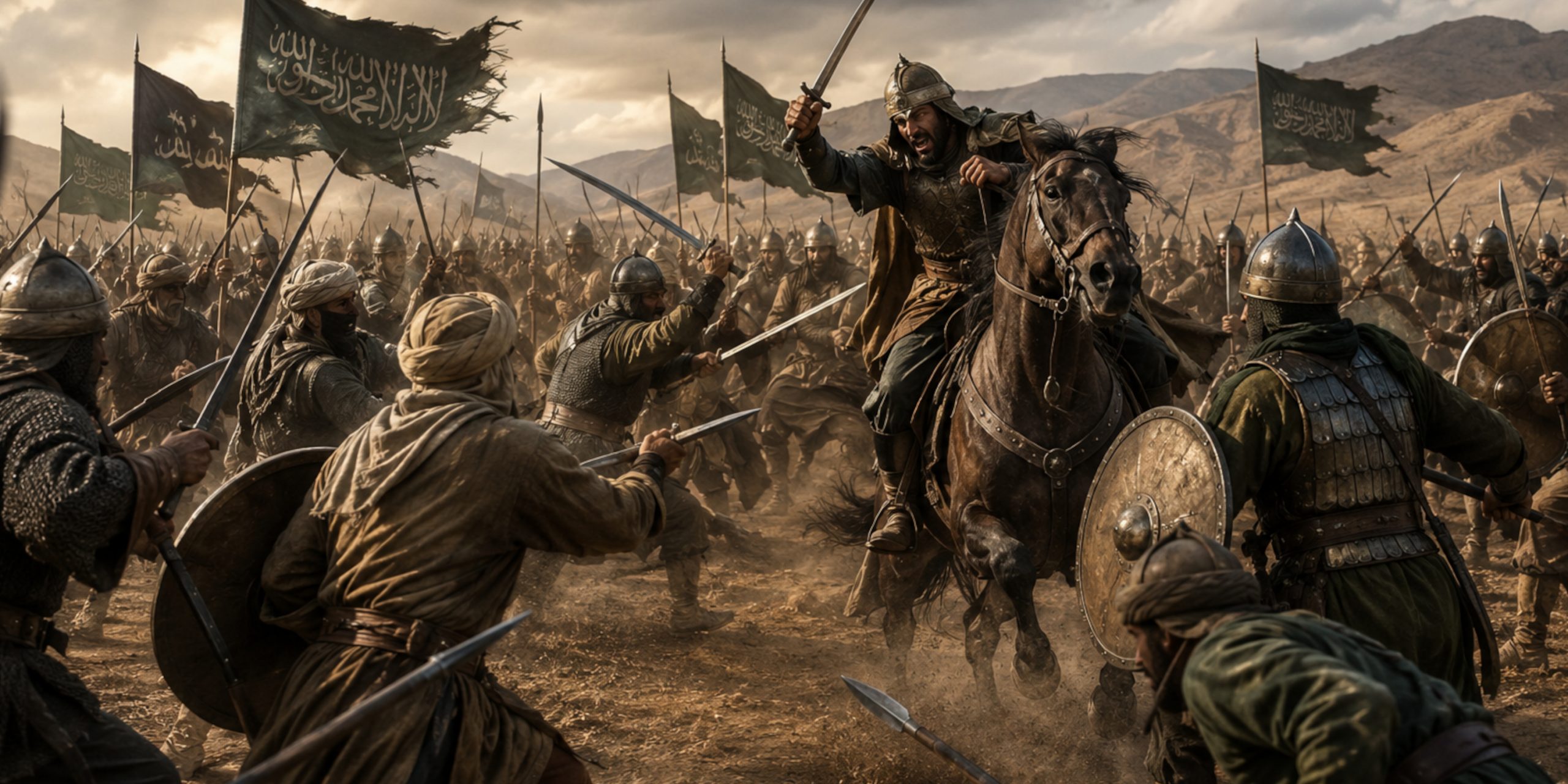
The Battle of al-Buḥayra in 1130 was one of the defining early clashes between the rising Almohad movement and the established Almoravid Empire of Morocco and al-Andalus. Fought near Marrakesh, the battle ended in a severe Almohad defeat, yet strangely became a stepping stone towards their eventual domination of North Africa.
History enjoys these little contradictions. A movement could lose thousands of warriors, fail to capture its greatest target, and somehow still emerge as the future. The Almoravids won the battlefield, but the Almohads survived the war of ideas.
The battle centred on the ambitions of the religious reformer Ibn Tumart and his followers, who sought to overthrow Almoravid authority. His successor, Abd al-Mu’min, would later transform this battered movement into one of the medieval Islamic world’s greatest powers.
Background: Almoravid Power Meets Almohad Ambition
By the early 12th century, the Almoravid Empire controlled a vast region stretching across Morocco, parts of the Sahara and Muslim Spain. Their strength came from:
- Berber tribal alliances
- Desert cavalry traditions
- Control of trade routes
- Religious authority based on Maliki Sunni Islam
The Almohads emerged among the Masmuda Berbers of the High Atlas Mountains under Ibn Tumart. They criticised Almoravid religious practices and presented themselves as a purifying movement.
After consolidating support in the mountains, Ibn Tumart’s followers moved towards Marrakesh, the Almoravid capital. Capturing the city would have been a political earthquake.
The Almoravids had other ideas.
Forces
Reliable medieval numbers are difficult to establish. Chroniclers often inflated army sizes to make victories appear miraculous or defeats suitably tragic. The reality was likely smaller but still significant.
| Army | Commander | Estimated Strength | Composition |
|---|---|---|---|
| Almohads | Ibn Tumart’s commanders, including Abu Muhammad al-Bashir | Possibly 10,000 to 30,000 | Masmuda Berber infantry, tribal warriors, cavalry |
| Almoravids | Ali ibn Yusuf’s forces | Possibly 20,000 or more | Professional troops, cavalry, infantry, guards, tribal contingents |
The Almoravids had the advantage of defending their political heartland. The Almohads brought enthusiasm and religious conviction, but enthusiasm alone rarely stops a cavalry charge. Medieval battlefields were rather unforgiving places to test theories.
Leaders And Troop Composition
Almohad Forces
| Leader | Role | Notes |
| Ibn Tumart | Spiritual leader | Founder of the Almohad movement, although his direct battlefield role is debated |
| Abu Muhammad al-Bashir | Military commander | Led major operations during the campaign against Marrakesh |
| Abd al-Mu’min | Senior follower | Survived the crisis and later built the Almohad Empire |
Troops
- Masmuda Berber infantry from the Atlas Mountains
- Tribal spearmen
- Light cavalry
- Religious volunteers
- Archers and skirmishers
The Almohad army was motivated but lacked the experience and organisation of the Almoravid military system.
Almoravid Forces
| Leader | Role | Notes |
| Ali ibn Yusuf | Almoravid ruler | Controlled the empire from Marrakesh |
| Almoravid commanders | Field leadership | Directed the defence and counterattack |
Troops
- Elite cavalry
- Berber tribal warriors
- Professional soldiers
- Infantry formations
- Archers
- Possible Andalusian contingents
The Almoravid army combined desert mobility with experience gained from decades of warfare in North Africa and Iberia.
Arms And Armour
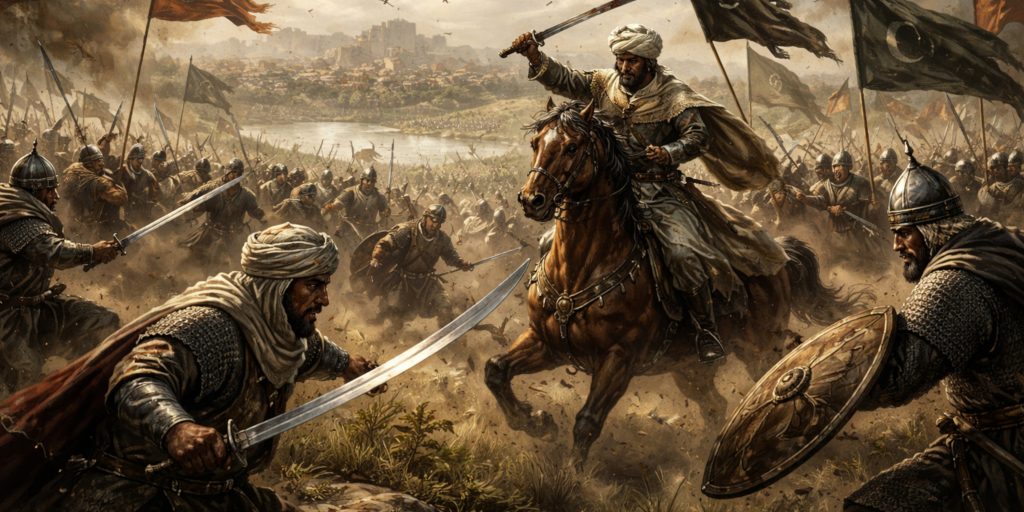
The battle took place during a period when North African warfare mixed Berber traditions, Islamic military influences and equipment from al-Andalus.
Almohad Weapons
Swords
Specific surviving examples from al-Buḥayra are unknown, but warriors likely carried:
- Saif: The common Arabic sword, usually a straight double-edged blade during this period rather than the strongly curved sabres of later centuries.
- Berber straight swords: Locally produced blades influenced by wider Islamic and Mediterranean designs.
- Early forms associated with later Maghrebi sword traditions: The famous nimcha developed much later, but North African sword culture had older roots in these medieval weapons.
Other Weapons
- Long spears
- Javelins
- Bows
- Round shields
- Daggers
Armour
- Quilted textile armour
- Leather protection
- Mail shirts among wealthier fighters
- Conical helmets
Almoravid Weapons
Swords
The better equipped Almoravid troops likely used:
- Straight saif swords: Favoured by cavalry and infantry.
- Andalusian influenced blades: Produced through the advanced metalworking traditions of Islamic Spain.
- High quality cavalry swords: Designed for cutting from horseback.
Other Weapons
- Cavalry lances
- Composite bows
- Spears
- Axes
- Daggers
Armour
Elite Almoravid troops could possess:
- Mail hauberks
- Lamellar armour
- Iron helmets
- Reinforced shields
The Almoravids were not simply desert raiders. By 1130 they were rulers of a sophisticated empire with access to some of the finest craftsmen in the western Islamic world.
The Battle
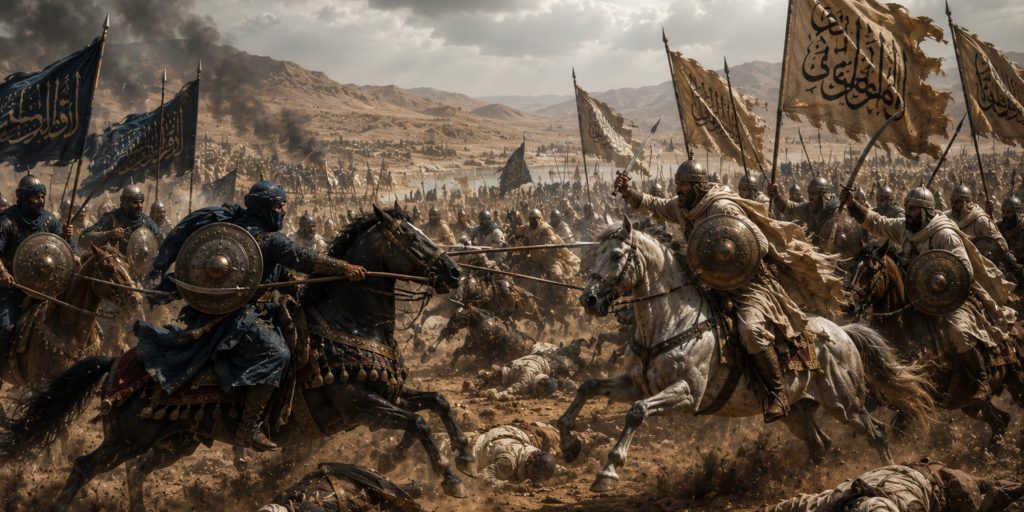
The Almohad army advanced from the Atlas region and surrounded Marrakesh. Their goal was clear, remove the Almoravid centre of power in a single decisive campaign.
The fighting reached its climax near al-Buḥayra, outside the city.
The Almoravids allowed the Almohads to commit themselves before launching a devastating response. Their cavalry advantage proved decisive. The Almohad army suffered heavy casualties and many senior figures were killed.
The defeat was so serious that Ibn Tumart’s death shortly afterwards was concealed for a period while Abd al-Mu’min stabilised the movement.
It was a disaster, but not a collapse.
Battle Timeline
| Date | Event |
| Before 1130 | Ibn Tumart builds the Almohad movement among the Masmuda Berbers |
| Early 1130 | Almohad forces move against Marrakesh |
| 1130 | Siege operations begin around the Almoravid capital |
| Battle of al-Buḥayra | Almoravid forces defeat the Almohads outside Marrakesh |
| After battle | Almohads retreat into the mountains |
| c.1130 | Ibn Tumart dies, though his death is temporarily hidden |
| 1130s to 1140s | Abd al-Mu’min rebuilds Almohad strength |
| 1147 | Almohads capture Marrakesh and replace the Almoravids |
Archaeology
The precise battlefield location has not produced a large collection of securely identified artefacts linked specifically to the Battle of al-Buḥayra.
Archaeology connected to the wider period provides important evidence:
- Excavations around medieval Marrakesh reveal Almoravid urban planning and fortification methods.
- Surviving Almoravid structures show the wealth and organisational ability of the dynasty.
- Weapon finds from medieval Morocco and al-Andalus confirm the use of straight swords, spearheads, arrowheads and mail armour.
- Ceramics and architectural remains demonstrate the close cultural connections between Morocco and Islamic Spain.
The lack of a clearly excavated battlefield is frustrating, although medieval historians become quite used to frustration. A single rusty spearhead with a convenient label saying “used here in 1130” would make life much easier, but archaeology rarely offers such generosity.
Contemporary Quotes And Sources
Much of what we know comes from later medieval Islamic historians who preserved accounts of the Almoravid and Almohad struggle.
Ibn Khaldun, writing later, described the rise of the Almohads and the power of their tribal organisation:
“Group feeling produces the ability to defend oneself, to offer opposition, to protect oneself, and to press one’s claims.”
While not a direct battlefield statement, his analysis captures the tribal and political forces that shaped the conflict.
Almohad traditions portrayed Ibn Tumart as a divinely guided reformer, while opponents saw his movement as rebellion against established authority. As often happens in medieval history, the answer depended heavily on who paid the chronicler.
Aftermath And Legacy
The immediate result was a clear Almoravid victory.
The Almohads lost:
- Thousands of warriors
- Important commanders
- Their attempt to seize Marrakesh
- Momentum in the short term
Yet the battle failed to destroy them.
Abd al-Mu’min reorganised the movement, expanded recruitment and built a far more professional military force. Less than two decades later, the Almohads captured Marrakesh in 1147 and replaced the dynasty that had defeated them.
The Battle of al-Buḥayra is therefore remembered as a strange kind of turning point. The Almoravids won brilliantly on the day, but the Almohads learned, adapted and returned stronger.
For historians, it is a reminder that a battlefield victory and a strategic victory are not always the same thing.