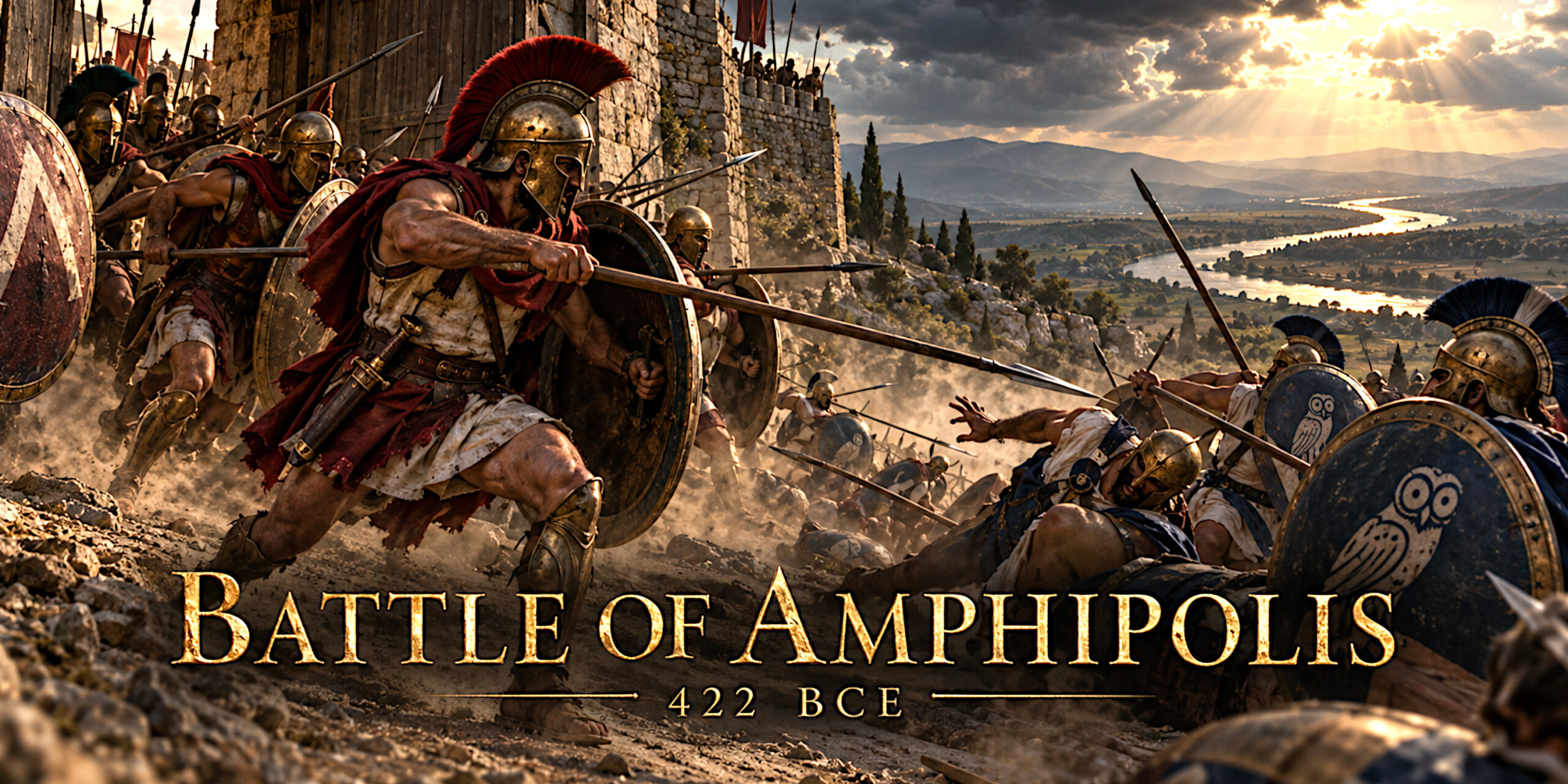
The Battle of Amphipolis in 422 BCE was decided by a badly handled withdrawal and a commander who recognised precisely when to attack. Outside a strategically important city in northern Greece, Brasidas caught an Athenian army off balance and turned its retreat into a rout.
Both principal commanders died. Athens lost its opportunity to recover Amphipolis, while Sparta lost the officer who had done so much to undermine Athenian power in the north.
What interests me most about this battle is how little it resembles the tidy collision of spear walls often presented as typical Greek warfare. Observation, concealment, light infantry and panic mattered enormously. The hoplites were formidable, but only while their formation remained something more organised than several hundred men trying to leave at once.
Battle of Amphipolis at a Glance
| Detail | Summary |
|---|---|
| Date | 422 BCE, towards the end of the summer campaigning season |
| War | Peloponnesian War |
| Location | Outside Amphipolis, near the River Strymon in northern Greece |
| Athenian commander | Cleon |
| Opposing commanders | Brasidas and Clearidas |
| Result | Victory for the Spartan-led coalition |
| Athenian losses | Approximately 600 killed, according to Thucydides |
| Coalition losses | Seven killed, according to Thucydides, including Brasidas |
| Immediate consequence | Athens failed to recover Amphipolis |
| Wider significance | The defeat and the deaths of both commanders helped create conditions for the Peace of Nicias in 421 BCE |
The casualty figures are ancient reported totals, rather than independently verified counts. The exceptionally low figure for the victorious army deserves particular caution.
Why Amphipolis Mattered
Amphipolis occupied a valuable position beside the Strymon, linking the northern Aegean with inland routes through Thrace and Macedonia. The surrounding region offered timber, agricultural resources and access to mineral wealth.
For Athens, this was a substantial strategic investment. A maritime empire required shipbuilding materials, revenue and dependable connections. Losing an important northern centre threatened all three.
Founded under Athenian leadership in 437 BCE, Amphipolis nevertheless had a mixed population whose interests did not always coincide with those of Athens. Its location made it desirable; its politics made possession less secure than Athenian officials might have wished.
Brasidas secured its surrender in 424 BCE. The battle two years later was therefore an Athenian attempt to reverse an existing loss, rather than the occasion on which Sparta first captured the city.
Leaders and Command Decisions
| Leader | Position | Role at Amphipolis |
|---|---|---|
| Brasidas | Spartan commander directing the northern campaign | Concealed his intentions and led the first assault against the withdrawing Athenians |
| Clearidas | Spartan officer commanding troops within Amphipolis | Led the supporting sortie and continued the fighting after Brasidas was wounded |
| Cleon | Athenian politician and general | Advanced from Eion, inspected the city and ordered the withdrawal that exposed his army |
Brasidas understood that his opportunity depended on timing. Thucydides presents him as reluctant to risk a conventional engagement against the quality of the opposing infantry. His solution was to attack while the Athenians were changing position.
Clearidas deserves more attention than he usually receives. Brasidas devised the attack, but Clearidas helped turn the initial shock into a completed victory.
Cleon requires a fairer hearing than a simple label of incompetent politician allows. His campaign had already achieved successes, including the capture of Torone. At Amphipolis, however, his reconnaissance placed the army in danger before its expected reinforcements arrived.
Our principal narrator, Thucydides, is openly hostile towards Cleon. His account remains indispensable, but its character judgements should not be mistaken for neutral personnel assessments.
Forces and Troop Composition
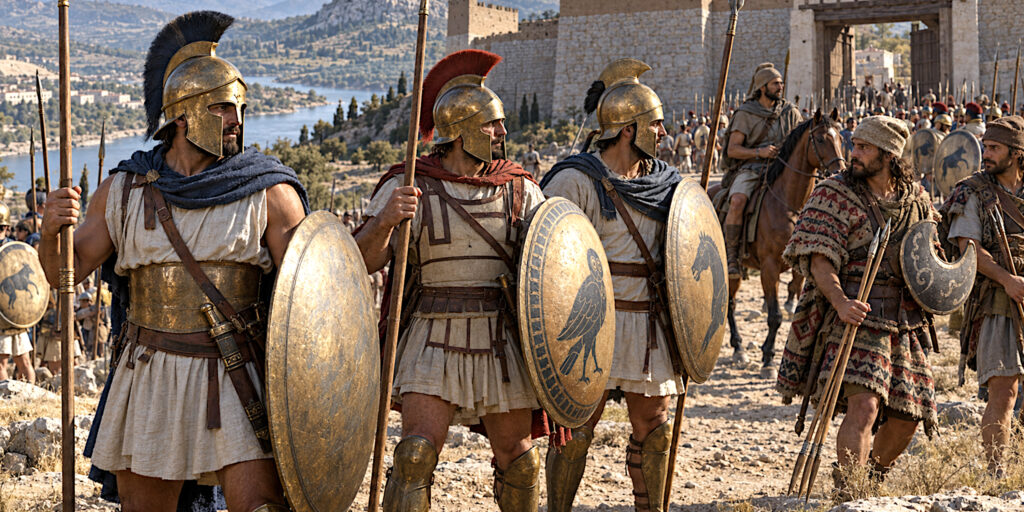
The armies were more complicated than “Athens against Sparta” suggests. Brasidas commanded a coalition containing Greek heavy infantry, local troops, Thracian mercenaries, cavalry and peltasts.
Thucydides also distinguishes between forces assembled for the campaign and those committed to particular movements. Those figures should not be combined into a deceptively precise battlefield total.
| Contingent | Reported strength | Composition and qualification |
|---|---|---|
| Athenian citizen hoplites | 1,200 at the expedition’s departure | Heavy infantry forming the core of Cleon’s force |
| Athenian cavalry | 300 at departure | Their precise deployment during the battle is unclear |
| Athenian allies | Not fully numbered | Included high-quality Lemnian and Imbrian infantry |
| Athenian fleet | 30 ships at departure | Supported transport and coastal operations |
| Brasidas’ heavy infantry | Approximately 2,000 available | A mixed force, not 2,000 Spartan citizens |
| Thracian mercenaries | 1,500 called up | Part of the wider forces described before the battle |
| Myrcinian and Chalcidian peltasts | Approximately 1,000 | Additional light troops were also present |
| Greek cavalry with Brasidas | Approximately 300 | Supplemented by local mounted forces |
| Edonian troops | Unspecified | Cavalry and peltasts |
| Brasidas’ initial assault party | 150 picked hoplites | The opening strike, not his entire army |
The distinction matters. Brasidas did not defeat the Athenians with only 150 men. He used 150 men to begin an attack supported by Clearidas and a substantially larger coalition.
The principal troop types served different purposes:
- Hoplites supplied the close-order infantry capable of holding ground and delivering a concentrated attack.
- Peltasts used mobility and missiles to harass opponents without accepting a prolonged spear fight.
- Cavalry threatened exposed troops and made a disordered retreat considerably more dangerous.
- Local contingents brought manpower and knowledge of the surrounding country.
Arms and Armour
There is no surviving equipment inventory for the men who fought at Amphipolis. The following reconstruction draws on fifth-century BCE Greek military equipment. Specific weapons should therefore be understood as appropriate to the period, rather than securely identified finds from this battle.
| Equipment | Description | Battlefield purpose |
|---|---|---|
| Dory | One-handed thrusting spear | Principal weapon of Greek hoplites |
| Aspis | Large round shield, principally wooden with fittings and sometimes a bronze facing | Protected the bearer and contributed to collective defence |
| Xiphos | Straight, double-edged iron sword, often with a leaf-shaped blade | Sidearm for close fighting when the spear became unusable |
| Kopis | Single-edged cutting sword with a forward-curving blade | A period-appropriate alternative sidearm, although its use here is unconfirmed |
| Bronze helmet | Various forms offering different balances of protection, hearing and visibility | Head protection |
| Body armour | Bronze or textile-based protection, depending on resources and preference | Torso protection |
| Greaves | Usually bronze shin defences | Protection for the lower legs |
| Javelins and lighter shields | Equipment associated with peltasts | Mobile missile fighting |
Surviving Greek armour supports the broad combination of helmet, cuirass, greaves, round shield, spear and short sword. It does not support dressing every participant in an identical outfit.
For all the understandable interest in swords, the spear was the hoplite’s primary weapon. A xiphos was useful insurance. Ideally, its owner would finish the day without needing to discover quite how useful.
The battle also illustrates the limits of heavy equipment. Armour could protect a man from a blow. It could not restore a broken formation or prevent mounted pursuers from reaching him.
How the Battle Unfolded
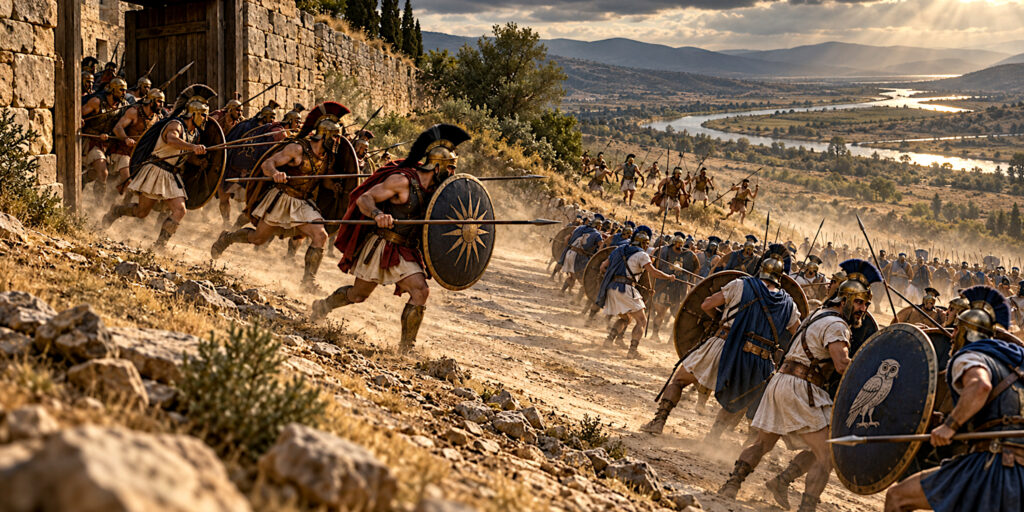
Cleon used Eion, near the Strymon’s mouth, as his base while awaiting Macedonian and Thracian reinforcements. Brasidas initially observed the Athenians from Cerdylium before moving into Amphipolis.
When Cleon advanced to inspect the city, Brasidas avoided displaying his army in a conventional battle line. Instead, he prepared a sudden sortie.
Reports of troops gathering inside the gates persuaded Cleon to withdraw. The danger emerged during the movement itself. Part of the army was already heading towards Eion while another section wheeled around, exposing its unshielded side.
Brasidas attacked the centre with his selected hoplites. Clearidas followed with the supporting force. The Athenian left broke, but the right resisted repeated assaults before cavalry and light troops helped overwhelm it.
Cleon was killed during the retreat. Brasidas received a mortal wound and was carried into Amphipolis, where he survived long enough to hear of the victory. classics.mit.edu
Battle Timeline
The sequence follows Thucydides. Exact timings and every movement across the terrain cannot be recovered.
| Stage | Event |
|---|---|
| 424 BCE | Brasidas secures Amphipolis for the Spartan side |
| 422 BCE: northern expedition | Cleon campaigns along the coast before establishing himself at Eion |
| Before the battle | Cleon requests reinforcements; Brasidas watches from Cerdylium |
| Athenian advance | Cleon takes his army towards Amphipolis to examine its position |
| Preparations inside the city | Brasidas selects 150 hoplites and assigns the supporting force to Clearidas |
| Withdrawal begins | Cleon orders a retreat towards Eion |
| Opening assault | Brasidas strikes the Athenian centre during the movement |
| Supporting attack | Clearidas emerges and increases the pressure |
| Athenian resistance collapses | The right wing holds temporarily before being overcome |
| Commanders lost | Cleon is killed; Brasidas dies after being carried into the city |
| Aftermath | Survivors reach Eion and the Athenians recover their dead |
Contemporary Accounts and Quotes
Thucydides provides the principal contemporary account, although he does not claim to have witnessed the battle personally. His reconstructed speeches should be read as historical interpretation, rather than verbatim transcripts.
In the speech he assigns to Brasidas, good soldiers are marked by:
“zeal, honour, and obedience”
Thucydides, History of the Peloponnesian War, Book V, section 9, translated by Richard Crawley.
As the Athenians withdraw, Brasidas reportedly observes:
“Troops which do as they do seldom stand a charge.”
Thucydides, Book V, section 10, translated by Richard Crawley. classics.mit.edu
Both passages capture the central concern of the narrative: cohesion. Brasidas watches how the enemy moves and recognises an opportunity before their withdrawal is complete.
I find that more revealing than any general declaration about Spartan courage. Courage was available on both sides. At this particular moment, control of events was not.
Archaeology and the Evidence on the Ground
Amphipolis offers substantial archaeological evidence for its urban setting, fortifications and river connections. That evidence helps explain the campaign’s geography, although it cannot supply a complete reconstruction of the fighting.
The ancient bridge and fortifications
Surviving wooden piles associated with the Strymon bridge are among the site’s most remarkable remains. The bridge underwent repeated rebuilding, so the surviving structure must be understood as evidence for a long-lived crossing rather than an untouched battlefield feature from 422 BCE.
Its relationship with the city’s gates and defences demonstrates why movement across the river mattered so much.
The burial attributed to Brasidas
A tomb discovered in 1976 contained a silver ossuary and a gold olive wreath, now displayed in the Archaeological Museum of Amphipolis. The burial has been identified with Brasidas.
That association is historically compelling, particularly alongside Thucydides’ account of his public burial, but it should still be presented as an archaeological identification rather than unquestionable proof of identity.
What remains uncertain
- The precise position of every contingent.
- The exact routes taken during the pursuit.
- A securely identified collection of weapons belonging specifically to the battle.
- Independent confirmation of the reported casualty totals.
Archaeology gives the account a physical setting. It does not conveniently leave a labelled spear at every important turning point.
Outcome and Legacy
Amphipolis remained beyond Athenian control. Brasidas received exceptional honours from its inhabitants, who commemorated him as a heroic founder and displaced the public memory of the Athenian founder Hagnon.
The deaths of Brasidas and Cleon also removed two prominent advocates of continuing the war. Alongside military exhaustion and wider strategic pressures, this helped negotiations towards the Peace of Nicias in 421 BCE. The settlement did not produce a lasting resolution, and its provisions concerning Amphipolis were not successfully implemented.
For me, Amphipolis remains a particularly useful corrective to simplified accounts of Greek warfare. Heavy infantry mattered, but so did the men throwing javelins, the cavalry pursuing fugitives and the commander watching an opponent turn the wrong way.
Brasidas won through judgement and coordination. His death made the victory costly in a way the casualty totals alone cannot express.